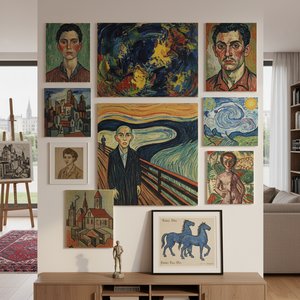
The Essence of Munch’s Vision
Edvard Munch's
untitled (6386) stands as a cornerstone of Expressionism, encapsulating the movement’s core preoccupation with subjective experience and conveying profound psychological turmoil. More than just a depiction of a woman walking down the street—though that serves as an anchor to reality—the painting delves into the anxieties inherent in modern life, mirroring Munch's own turbulent inner world. As evidenced by his seminal work
The Scream, Munch possessed an unparalleled ability to translate raw emotion into visual form, utilizing bold colors and distorted shapes as instruments of artistic expression. This singular approach distinguishes him from many of his contemporaries and cements his place among the most influential artists of the late nineteenth century.
Scene Depiction and Expressionist Style
The canvas portrays a woman traversing a cityscape—a seemingly mundane setting elevated by Munch’s masterful stylistic choices. The muted palette—dominated by blues, greens, and browns—creates an atmosphere of melancholy and introspection, mirroring the emotional landscape of the subject. Unlike Impressionists who sought to capture fleeting moments of light and color, Munch deliberately employed distortion and exaggeration to communicate inner feelings rather than external appearances. This technique is characteristic of Expressionist artists like Ernst Ludwig Kirchner and Emil Nolde, whose works similarly prioritized psychological resonance over photographic realism. The deliberate blurring of boundaries between observation and imagination underscores the artist’s commitment to portraying not what he *saw*, but what he *felt*.
Key Elements of the Painting
Several crucial elements contribute to
untitled (6386)’s emotive power. The prominent woman figure is positioned centrally against a backdrop of swirling colors and undulating lines—a visual representation of psychological instability. Her gaze directs upwards, seemingly confronting an unseen force—perhaps representing fear or despair. Surrounding her are indistinct figures, rendered in similar stylistic conventions, symbolizing the pervasive isolation and anxiety experienced by individuals within urban environments. The inclusion of umbrellas adds to the scene’s sense of unease; they represent protection from external threats but also serve as barriers against connection with others. Munch's meticulous brushstrokes—loose and expressive—further amplify the painting’s emotional impact, inviting viewers into a visceral experience of psychological distress.
Historical Context and Symbolism
Created in 1893,
untitled (6386) emerged during a period of significant social and intellectual upheaval—the dawn of the twentieth century. The anxieties surrounding industrialization, urbanization, and scientific advancements fueled a growing sense of disillusionment and uncertainty. Munch’s painting reflects these concerns, articulating the pervasive fear of mortality and the psychological burden of confronting existential questions. The woman's posture embodies resilience amidst vulnerability, mirroring Munch's own struggles with illness and loss. Ultimately,
untitled (6386) transcends its formal elements to become a timeless meditation on the human condition—a poignant reminder of our capacity for both profound joy and unbearable sorrow.
Conclusion
Edvard Munch’s
untitled (6386) remains a testament to Munch's artistic genius and the enduring power of Expressionism. Like his celebrated masterpiece
The Scream, it exemplifies Munch’s ability to distill complex emotions into striking visual imagery—a feat that continues to captivate audiences worldwide. For a deeper understanding of Munch's life and artistic legacy, explore the extensive collection housed at
Wikipedia and delve into the captivating exhibitions presented by
The National Gallery of Norway—where you can witness
untitled (6386) in person and immerse yourself in the world of Munch’s extraordinary oeuvre.



 Preview
 Bestil maleri
 Del
Del Del
Del
 Detaljer

 Download
 Lignende værker
 Røntgenundersøgelse
 Diasshow

 Se mere






































 Glasmulighed er kun tilgængelig i størrelser under 110 cm