

Shown: · With its frame:
 Se i rummet
 Del som kort
 Del
Del
 Detaljer
 Guide
Guide

 Download
 Lignende værker
 Røntgenundersøgelse
 Diasshow
 Q&A
Q&A Statistikker

Dkr 1936
Håndlavet oliereproduktion
Håndmalet olie på lærred i din valgte størrelse og ramme, udført efter bestilling af vores kunstnere. ( Skift til printsalg Skift til digitalt billede)
Size
·Standardstørrelse
speciallavet
CM
INCH
Vælg mellem vores forudindstillede størrelser, der matcher kunstværkets originale proportioner.
Loading sizes...

bredde
højde
Indtast den bredde og højde, du har brug for, så det passer til din ramme eller din væg. Da dette er håndmalet, kan kunstneren ved en anden form på størrelsen male lidt mere rundt om billedet eller skære lidt væk — det er op til dig. Vi sender dig et digitalt mockup til godkendelse, før maleriet påbegyndes. Billedet, der vises på denne side, viser ikke det endelige resultat — det er kun mockuppet, der gør.
 Læs mere
Finish
·
White Dkr1

Blurside Dkr1

Extended Dkr1

P118B Dkr10

P118H Dkr10

P118W Dkr10

P438Z Dkr10

P508JH Dkr12

P508YH Dkr12

P805H Dkr10

P805Z Dkr10

P919BZ Dkr10

P919G Dkr10

P919XJ Dkr10

P959ZH Dkr10

P968JZ Dkr12

W106C Dkr8

W218G Dkr10

W218JH Dkr8

W218Y Dkr10

W307PJ Dkr10

W316G Dkr10

W316PJ Dkr8

W316Y Dkr10

W398PJ Dkr8

W4111J Dkr10

W500HY Dkr15

W500JH Dkr15

W692G Dkr12

W849H Dkr8

W940BG Dkr15

W953PJ Dkr8

H24-GOLD Dkr30

H24-SILVER Dkr30

H36-GOLD Dkr45

H36-SILVER Dkr45
Shipped in a protective tube, ready for your own framer.
Above 105 cm the frame is shipped as a kit for a professional framer — read the details.
Extras
optionalWhat do the extras include?
Examples of what can be changed: Replace face with customer photo; Add pet (e.g., replace cat with dog); Include hidden message in background; Change background landscape or elements.
After order, TopImpressionists.com team will email client for instructions and provide a mockup preview
After order, TopImpressionists.com team will email client for instructions and provide a mockup preview
Verdensomspændende levering () på 3-4 uger i stedet for de standard 5 uger. (30 oktober). Ingen kompromiser med kvaliteten.
Beskyttende fernis
Navneskilt
Detaljer om indgraveret bronzeskilt
This elegant plaque features the artist's name and the title of the artwork, finely engraved for a timeless presentation.
It is made from bronze with a refined, elegant finish. The text is precisely laser-engraved for a sharp and permanent result. Measuring 9x2 cm, the plaque is compact yet easy to read. It's built to be durable and scratch-resistant, offering a professional, museum-quality look. Mounting is simple thanks to the included adhesive backing.
Detaljer om gennemsigtig akrylplade
The plaque includes essential engraved details such as the artist's name, the title of the artwork, the date it was created, the type of media used-like oil on canvas or watercolor-a brief description of the piece, and a QR code that links to the complete artwork information.
It is crafted from clear acrylic, offering a sleek, modern appearance. The text is UV-engraved in black to ensure strong visual contrast. With a size of 10x15 cm, it ensures optimal readability. It comes equipped with two metal hooks for secure wall mounting. The plaque is designed to be weather-resistant, making it suitable for various environments, and it includes interactive features that work seamlessly with smartphone scanning.
Detaljer om sort akrylplade
This elegant plaque includes engraved information such as the artist's name, the title of the artwork, the date it was created, the type of media used (like oil on canvas or watercolor), a short description of the artwork, and a QR code for quick access to more information.
The plaque itself is made from refined black acrylic with a premium finish. The text is laser-engraved in white for high contrast and readability. Its size is 10x15 cm, designed to be easy to read. It comes with two metal hooks for professional mounting. The design is sleek and fits any interior style. It is also weather-resistant and durable, with built-in digital integration for mobile compatibility.
Glasmulighed er kun tilgængelig i størrelser under 110 cm
 Glasmulighed er kun tilgængelig i størrelser under 110 cm
- Gratis ekspresforsendelse til hele verden
- Lærred af linned i høj kvalitet
- Fuld transportforsikring
- Garanti for refusion af told og importafgifter
- Garanti for præcis farvegengivelse
- 100 dages returret ved fabrikationsfejl
- 100% fuld returret
- Mængderabat ved flere køb


Beskrivelse af samlerobjektet
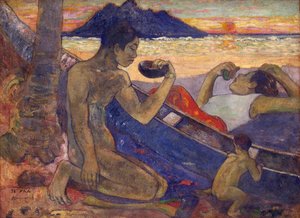
Explore 'arearea' by Paul Gauguin – a vibrant Tahitian masterpiece! Discover Post-Impressionism, bold colors & symbolic depth in this iconic work.
Kunstnerbiografi
Paul Gauguin: En revolutionerende maler med stærke farver og eksotiske motiver. Oplev hans rejse fra finans til kunstlegende – et symbolistisk geni!
About the painting
A Window into Tahitian Life: Exploring Gauguin’s *arearea*
This captivating painting, *arearea*, transports viewers to the lush and enigmatic world of Tahiti as envisioned by Post-Impressionist master Paul Gauguin. A large-scale work brimming with vibrant color and symbolic depth, it offers a compelling glimpse into Polynesian life and spirituality – themes that profoundly influenced the artist during his self-imposed exile from Europe.Subject & Composition: A Moment of Intimacy and Ritual
The composition centers around two figures—a man and a woman—engaged in what appears to be an intimate moment, their connection underscored by the presence of a dog nestled at their feet. This central grouping is framed by a backdrop of activity; partially visible women seem to be engaged in a dance or ritualistic performance. Gauguin deliberately flattens the perspective, eschewing traditional realism for a more emotionally resonant and symbolic representation. The stylized landscape, complete with volcanic rock formations and dense vegetation, further enhances this sense of otherworldliness.Style & Technique: Synthetism and Bold Expression
*arearea* is quintessentially Gauguinesque. It exemplifies his signature style – a move away from the Impressionists’ focus on capturing fleeting moments of light towards Synthetism, where forms are simplified, colors are intensified, and compositions are deliberately constructed to convey emotion rather than objective reality. The application of paint is thick and impastoed, particularly in the foreground, creating a tactile quality that invites close inspection. Lines are bold and expressive, defining shapes with deliberate force. Gauguin’s limited color palette—a masterful interplay of contrasting hues—contributes to the painting's dreamlike atmosphere.Historical Context: Escapism & Primitivism
Born in Paris in 1848, Paul Gauguin initially pursued a career in finance before dedicating himself to art. Disillusioned with European society and seeking inspiration away from its constraints, he traveled to Tahiti in 1891. This journey marked a turning point in his artistic development. He was captivated by what he perceived as the “primitive” beauty of Polynesian culture – a concept that, while problematic through a modern lens, profoundly shaped his art. Gauguin sought to capture not just *what* he saw, but *how* it felt—the essence of Tahitian life and spirituality. His work became a powerful expression of escapism and a rejection of Western materialism.Symbolism & Emotional Impact: Fertility, Love & Connection
The symbolism within *arearea* is rich and layered. The figures are often interpreted as representing fertility, love, and the harmonious connection between humanity and nature. The ritualistic dance in the background hints at ancient beliefs and spiritual practices. Gauguin’s deliberate distortion of perspective and use of non-naturalistic colors contribute to a sense of mystery and enchantment. The painting evokes a feeling of longing, exoticism, and a deep reverence for the natural world. It's not merely a depiction of Tahiti; it is an emotional response—a subjective interpretation filtered through Gauguin’s unique artistic vision.For Collectors & Designers
*arearea*, or high-quality reproductions thereof, offers a striking focal point for any space. Its bold colors and dynamic composition make it suitable for both modern and traditional interiors. The painting's themes of connection to nature and spiritual awakening resonate deeply, adding depth and meaning to the surrounding environment.- Its vibrant palette complements neutral color schemes.
- The large scale makes a statement in expansive rooms.
- The symbolic imagery sparks conversation and contemplation.
Spørgsmål og svar
Er "arearea" af Paul Gauguin et lyst eller et mørkt kunstværk?
"arearea" har en overordnet lysstyrke på balanced, og dens luminans er Soft Shadow.
Hvilke farver dominerer i "arearea" af Paul Gauguin?
Farveidentiteten i "arearea" af Paul Gauguin: en Dark palet, domineret af Driftwood (#bb8a56).
Hvor kan jeg finde en guide til "arearea"?
Guiden til "arearea" findes på værkets Elevguide-side – et printbart faktablad, der præsenterer værket sammen med dets billedtekst, kreditering og identifikationstabel (kunstner, datoer, medie, original størrelse, samling).
Quick facts and art quiz
About Paul Gauguin

Paul Gauguin
1848 - 1903, Frankrig
Kunstnerbiografi
Eugène Henri Paul Gauguin: En Revolutionær Kunstner i Farvernes Verden
Eugène Henri Paul Gauguin, et navn der runger af levende farver og rebelsk ånd, står som en central figur i overgangen fra Impressionismen til moderne kunst. Han blev født i Paris i 1848, og hans liv var langt fra konventionelt. Hans tidlige år var formet af en usædvanlig opvækst; hans far var journalist, og hans mor nedstammet fra peruviansk aristokrati – hendes bedrømmelse Flora Tristan, en banebrydende feminist og socialistisk forfatter hvis idealer utvivlsomt resonerede i familien. Dette arv ville dybtgående forme Gauguins kunstneriske vision, og give ham en fascination med kulturer uden for Europa. En vigtig periode tilbragt i Peru som barn, efterfulgt af familiens flytning i 1850, fordypede ham i en verden langt fra parisamfundet – en oplevelse der hang ved og ultimativt brændte hans søgen efter autenticitet i kunsten. Tilbage til Frankrig efter sin fars død modtog Gauguin en formel uddannelse, men fandt sig selv tiltrukket af finansverdenen snarere end akademiet, og begav sig ud på en karriere som aktiehandler – en vej der tilsyneladende var i modstrid med den kunstneriske skæbne, der ventede ham.Fra Finans til Kunstnerisk Kald
I mange år førte Gauguin et dobbelt liv, hvor han omhyggeligt forfulgte sine forretningsinteresser, mens han hemmeligt plejede en passion for maleri. I første omgang blev han påvirket af Impressionisterne og eksperimenterede med farve og lys i sin fritid, men følte hurtigt sig begrænset af deres dedikation til at fange flygtige øjeblikke af virkeligheden. Den finansielle krise i 1882 viste sig at være en vendepunkt, der tvang ham til at forlade sin lukrative karriere og fuldt ud omfavne sin kunstneriske kaldelse. Dette var ikke blot et skifte i erhverv – det var en fundamental ændring i verdenssynet. Han søgte vejledning fra Camille Pissarro, der opmuntrede ham til at udvikle sig og introducerede ham til de avantgarde kredse i Paris. Alligevel begyndte Gauguin hurtigt at afvige fra impressionistiske principper, længende efter noget mere udtryksfuldt, mere symbolsk – en måde at kommunikere ikke kun hvad han *så*, men hvad han *følte*. Denne længsel førte ham på en rejse for kunstnerisk udforskning, der ville føre ham langt ud over de parisensiske saloner og ind i hjertet af “primitiv” kulturer. Han var ikke blot interesseret i at forestille sig disse kulturer; han søgte at absorbere deres essens, idet han mente, at de indeholdt en renhed tabt i vestlig civilisation.Opdagelsen af Bretagne og Tahiti
Gauguins kunstneriske udvikling var uadskillelig fra hans rejser. Han tilbragte tid i Bretagne, fortryllet af landskabets robuste landskaber og de dybt rodfæstede traditioner i dets folk. Denne periode så ham eksperimentere med flade former, dristige konturer og en forenkling af komposition – teknikker, der flyttede ham længere væk fra naturalismen og tættere på et mere symbolsk sprog. Men hans rejse til Tahiti i 1891 udløste virkelig hans kreative potentiale. Søgende efter tilflugt fra det, han betragtede som de kvælende begrænsninger af europæisk civilisation, håbede Gauguin at finde inspiration i polynesisk kultur, idet han mente, at den tilbød en renere, mere autentisk måde at leve på. Dette var ikke blot en kunstnerisk søgen – det var en åndelig mission. Han fordybede sig i lokale skikke og overbevisninger, forestillede polynesiske kvinder, landskaber og religiøse praksisser gennem sit unikke perspektiv. Påvirket af japanske tryk – *Japonisme* – og middelalderkunst udviklede han en distinkt æstetik karakteriseret ved levende farver, eksotisk emnevalg og et præg af mystik. Ikoniske malerier som “Vahine no te miti” (Kvinde med mango), “Manao Tupapau” (Overvåget af den døde ånds ånd) og “Dagen for guderne” opstod i denne periode, hvilket cementerede hans ry som en visionær kunstner. Hans brug af farver blev stadig mere dristig og ikke-naturlig, tjent til at udtrykke følelser og åndelig mening snarere end blot at gengive virkeligheden.Arv og Kontrovers
Trods sin kunstneriske gennembrud var Gauguins liv ofte præget af vanskeligheder. Han kæmpede med økonomiske problemer og forværret helbred under sit ophold i Tahiti og senere på Marquesasøerne, hvor han endelig etablerede sig. Alligevel fortsatte han at male produktivt, utrætteligt udforskende temaer om liv, død og åndelighed. Han døde i 1903 på Hiva Oa, en afsidesliggende ø i Marquesasøerne, stort set ukendt for sin genialitet. Kun efter hans død begyndte Gauguins værk at modtage den anerkendelse, det fortjente. I dag fejres han som en central figur i udviklingen af moderne kunst, der forbinder Impressionismen med Symbolismen og baner vejen for bevægelser som Fauvisme. Hans brug af farver, flade former og symbolsk billedsprog har haft en dybtgående indflydelse på kunstnere som Pablo Picasso, Henri Matisse og mange andre. Alligevel er Gauguin fortsat en kontroversiel figur på grund af aspekter af hans personlige liv – især hans forhold til unge polynesiske kvinder – som fortsat debatteres og fortolkes i lyset af nutidige etiske overvejelser. Alligevel er hans kunstneriske bidrag uomtvisteligt, og hans arv inspirerer kunstnere og kunstelskere verden over. Han var en sand innovator, en rebelsk sjæl, der modigt udfordrede konventioner og skabte sin egen vej – efterlod et værk, der er lige så fængslende og gådefuld som manden selv.Nøglepåvirkninger & Kunstneriske Karakteristika
- Impressionisme: Tidlig indflydelse på farve og lys, senere afvist for dets fokus på flygtige øjeblikke.
- Japonisme: Inspireret til flade perspektiver, dristige konturer og dekorative mønstre.
- Middelalderkunst: Påvirket symbolsk billedsprog og en afvisning af streng realisme.
- Syntetisme: En stil udviklet af Gauguin, der understregede skabelsen af kunst baseret på subjektiv oplevelse snarere end objektiv observation.
- Primitivism: Fascination med ikke-vestlige kulturer, idet man mente, at de tilbød en renere og mere åndelig måde at leve på. Dette afspejles i hans emnevalg og stilistiske valg.
Quick facts about Paul Gauguin
- Artistic Movement Or Style: Postimpressionisme
- Artists Or Movements Influenced By This Artist:
- Picasso
- Matisse
- Artists Who Influenced This Artist: ['Camille Pissarro']
- Date Of Birth: 7. juni 1848
- Date Of Death: 9. maj 1903
- Full Name: Eugène Henri Paul Gauguin
- Nationality: Fransk
- Notable Artworks:
- Nafea faa ipoipo?
- To kvinder på stranden
- Place Of Birth: Paris, Frankrig
Lignende kunstværker



Udforsk kunstværker organiseret efter temaer, stilarter og karakteristika.


Paul Gauguin
arearea
() ·
With its frame: · Hand-painted in oil on linen
Total