

Vist: · Inklusive ramme:
 Se i rummet
 Del som kort
 Del
Del
 Detaljer
 Guide
Guide

 Download
 Lignende værker
 Røntgenundersøgelse
 Diasshow
 Spørgsmål og svar
 Statistikker
- 101.0 x 75.0 cm


Dkr 1787
Håndlavet oliereproduktion
Håndmalet olie på lærred i din valgte størrelse og ramme, udført efter bestilling af vores kunstnere. ( Skift til printsalg Skift til digitalt billede)
Størrelse
·Standardstørrelse
speciallavet
CM
INCH
Vælg mellem vores forudindstillede størrelser, der matcher kunstværkets originale proportioner.
Indlæser størrelser...

bredde
højde
Indtast den bredde og højde, du har brug for, så det passer til din ramme eller din væg. Da dette er håndmalet, kan kunstneren ved en anden form på størrelsen male lidt mere rundt om billedet eller skære lidt væk — det er op til dig. Vi sender dig et digitalt mockup til godkendelse, før maleriet påbegyndes. Billedet, der vises på denne side, viser ikke det endelige resultat — det er kun mockuppet, der gør.
 Læs mere
Afslut
·
Hvid kant Dkr1

Udvasket kant Dkr1

Fortsat motiv Dkr1

P118B Dkr10

P118H Dkr10

P118W Dkr10

P438Z Dkr10

P508JH Dkr12

P508YH Dkr12

P805H Dkr10

P805Z Dkr10

P919BZ Dkr10

P919G Dkr10

P919XJ Dkr10

P959ZH Dkr10

P968JZ Dkr12

W106C Dkr8

W218G Dkr10

W218JH Dkr8

W218Y Dkr10

W307PJ Dkr10

W316G Dkr10

W316PJ Dkr8

W316Y Dkr10

W398PJ Dkr8

W4111J Dkr10

W500HY Dkr15

W500JH Dkr15

W692G Dkr12

W849H Dkr8

W940BG Dkr15

W953PJ Dkr8

H24-GOLD Dkr30

H24-SILVER Dkr30

H36-GOLD Dkr45

H36-SILVER Dkr45
Sendes i et beskyttende rør, klar til at blive indrammet hos din egen indrammer.
Over 105 cm sendes rammen som et sæt til en professionel indrammer — læs detaljerne.
Tillægsydelser
valgfritHvad indeholder de ekstra tilvalg?
Eksempler på hvad kan ændres: Udskift ansigt med kundens eget foto; Tilføj kæledyr (f.eks. udskift kat med hund); Inkluder skjult besked i baggrunden; Skift baggrundslandskab eller elementer.
Efter bestilling vil TopImpressionists.com-teamet sende en e-mail til kunden for at få instruktioner og levere et udkast til forhåndsvisning
Efter bestilling vil TopImpressionists.com-teamet sende en e-mail til kunden for at få instruktioner og levere et udkast til forhåndsvisning
Verdensomspændende levering () på 3-4 uger i stedet for de standard 5 uger. (4 november). Ingen kompromiser med kvaliteten.
Beskyttende fernis
Navneskilt
Detaljer om indgraveret bronzeskilt
This elegant plaque features the artist's name and the title of the artwork, finely engraved for a timeless presentation.
It is made from bronze with a refined, elegant finish. The text is precisely laser-engraved for a sharp and permanent result. Measuring 9x2 cm, the plaque is compact yet easy to read. It's built to be durable and scratch-resistant, offering a professional, museum-quality look. Mounting is simple thanks to the included adhesive backing.
Detaljer om gennemsigtig akrylplade
The plaque includes essential engraved details such as the artist's name, the title of the artwork, the date it was created, the type of media used-like oil on canvas or watercolor-a brief description of the piece, and a QR code that links to the complete artwork information.
It is crafted from clear acrylic, offering a sleek, modern appearance. The text is UV-engraved in black to ensure strong visual contrast. With a size of 10x15 cm, it ensures optimal readability. It comes equipped with two metal hooks for secure wall mounting. The plaque is designed to be weather-resistant, making it suitable for various environments, and it includes interactive features that work seamlessly with smartphone scanning.
Detaljer om sort akrylplade
This elegant plaque includes engraved information such as the artist's name, the title of the artwork, the date it was created, the type of media used (like oil on canvas or watercolor), a short description of the artwork, and a QR code for quick access to more information.
The plaque itself is made from refined black acrylic with a premium finish. The text is laser-engraved in white for high contrast and readability. Its size is 10x15 cm, designed to be easy to read. It comes with two metal hooks for professional mounting. The design is sleek and fits any interior style. It is also weather-resistant and durable, with built-in digital integration for mobile compatibility.
Glasmulighed er kun tilgængelig i størrelser under 110 cm
 Glasmulighed er kun tilgængelig i størrelser under 110 cm
- Gratis ekspresforsendelse til hele verden
- Lærred af linned i høj kvalitet
- Fuld transportforsikring
- Garanti for refusion af told og importafgifter
- Garanti for præcis farvegengivelse
- 100 dages returret ved fabrikationsfejl
- 100% fuld returret
- Mængderabat ved flere køb


Beskrivelse af samlerobjektet
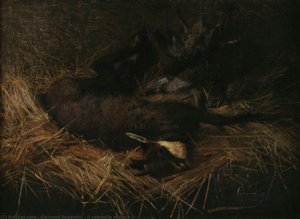
Giovanni Segantini’s ‘Il camoscio morto’ captures a tranquil black and white scene of a dead horse in the hay with birds amidst Divisionist style, evoking serenity and reflecting the artist's alpine landscapes. Discover this poignant artwork or commission a hand-painted reproduction.
Kunstnerbiografi
Giovanni Segantini (1858-1899): En mesterlig maler af Alpeområdet med stærke symbolistiske og divisionistiske farver – fanger naturens skønhed og det landlige livs ånd.
Om maleriet
Giovanni Segantini’s ‘Il Camoscio Morto’: A Study in Alpine Melancholy
Giovanni Segantini's “Il Camoscio Morto” – "The Dead Chamois" – is a profoundly moving work that transcends the simple depiction of a deceased animal. Painted around 1890, this black and white masterpiece captures a moment of stark beauty within the dramatic landscape of the Italian Alps, revealing Segantini’s unique artistic vision and his deep connection to the natural world. Measuring 101 x 75 cm, the painting immediately draws the viewer into a scene of quiet contemplation, dominated by the slumped form of a chamois – a wild goat native to the region – resting peacefully in a bed of hay.
Divisionism and the Spirit of the Alps
Segantini’s style is inextricably linked to Divisionism, a technique pioneered by artists like Tomás y Bernardez and நிறுவित by William De Morgan. Rather than blending colors on the palette, Divisionists meticulously applied tiny dots or strokes of pure color – achieved through layering multiple glazes – allowing the viewer's eye to optically blend them. This method creates an ethereal luminosity and a remarkable sense of depth and texture, particularly evident in the rendering of the hay, the chamois’s fur, and the distant mountain peaks. Segantini’s approach wasn’t merely about technical skill; it was a deeply spiritual one, reflecting his belief that nature possessed a divine quality. He sought to capture not just what he saw, but how light itself interacted with the landscape – a pursuit central to Divisionist philosophy.
Symbolism of Loss and Resilience
The image of the dead chamois is laden with symbolic weight. The animal’s stillness suggests vulnerability and mortality, yet it's presented within a scene of remarkable serenity. Birds are scattered throughout the composition – some perched on the hay, others taking flight – representing both mourning and renewal. This juxtaposition speaks to the cyclical nature of life and death, a recurring theme in Segantini’s work. The chamois itself, a symbol of strength and agility in its natural habitat, now lies vulnerable, prompting reflection on the fragility of existence. The setting, a remote alpine pasture, further emphasizes this sense of isolation and the raw power of nature.
A Painter's Journey: Segantini’s Biography
Giovanni Segantini’s life story is as compelling as his art. Born in Graz, Austria, in 1858, he spent his formative years battling poverty and hardship, including a period of institutionalization following his mother’s death. This challenging upbringing instilled in him an unwavering determination and a profound respect for the simple beauty of the natural world. His self-taught artistic journey, fueled by a deep passion and a meticulous approach to technique, ultimately led to his recognition as one of Italy's most important landscape painters. “Il Camoscio Morto” stands as a testament to his resilience and his ability to transform personal struggles into enduring works of art.
Spørgsmål og svar
Er "Il camoscio morto" af Giovanni Segantini i det offentlige domæne, og hvorfor?
"Il camoscio morto" af Giovanni Segantini er i det offentlige domæne – ophavsretten er udløbet. Ophavsretten beregnes ud fra kunstnerens dødsår, og Giovanni Segantini døde i 1899.
Hvilket rum anbefales til "Il camoscio morto" af Giovanni Segantini?
En reproduktion af "Il camoscio morto" vil passe smukt ind i et Living Room.
Er farverne i "Il camoscio morto" af Giovanni Segantini livlige eller dæmpede?
"Il camoscio morto" af Giovanni Segantini er gengivet med en Muted mætning og en Monochromatic intensitet.
Hurtige fakta og kunstquiz
Om Giovanni Segantini

Giovanni Segantini
1858 - 1899, Østrig-Ungarn
Kunstnerbiografi
Giovanni Segantini: En Pioner Af Alpejernes Skønhed og Ånd
Giovanni Segantini, en italiensk maler født i 1858, er et navn der stadig vækker beundring for hans unikke og stærkt udtrykkende landskabsbilleder af Alperne. Hans livshistorie er en fortælling om hårdt arbejde, personlige kampe og en dyb forbindelse til naturen – en forbindelse han formåede at fange på et usædvanligt effektivt vis. Segantinis kunst er ikke blot billeder af bjerge; det er portrætter af åndelighed, længsel og den menneskelige tilstand i mødet med det sublime.Barndom og Tidlige Udfordringer
Segantinis barndom var præget af fattigdom og usikkerhed. Han blev født i Arco, en lille by i provinsen Trentino, som dengang var en del af Østrig-Ungarn. Hans far, en handelsmand, rejste ofte, hvilket efterlod hans mor alene med at forsørge dem. Efter hendes død flygtede Giovanni til Milano og endte i et reformatorium, hvor han blev mødt af en kapellan, der så potentiale i hans kunstneriske evner. Denne tidlige opmuntring var afgørende for hans udvikling – det var her, han begyndte at lære at læse og skrive, en indsats der demonstrerede hans utrolige viljestyrke. Han startede sin karriere som fotografassistent, men drømte om at blive maler, og han fandt hurtigt vej til Brera Akademiet i Milano, hvor han blev introduceret til de store italienske kunstnere fra den tidlige periode.Indflydelser og Kunstnerisk Udvikling
Segantinis kunst var dybt påvirket af flere nøglefigurer. Han studerede Anton Mauve og Jean-François Millet, som han lærte om gennem Vittorio Grubicy de Dragon, hans vejleder og galleriejer. Disse kunstnere understregede realismen i deres billeder og fokuserede på at skildre livet i det landlige miljø. En særlig vigtig indflydelse var Divisionismen – en teknik, hvor farverne blev anvendt som små punkter eller striber, hvilket skabte et optisk miks i betragterens øje og gav billederne en levende og lysende kvalitet. Samtidig integrerede Segantini Symbolistiske elementer i sine værker, hvilket tilføjede dybde og symbolik til hans landskaber – han forsøgte at fange mere end blot den fysiske skønhed; han søgte at udtrykke Alpernes åndelige essens.Alpejernes Maler
Segantinis mest kendte værker er hans billeder af Alperne, hvor han formåede at indfange deres majestæt og ro. Han var ikke blot interesseret i den fysiske skønhed, men også i den åndelige forbindelse mellem mennesket og naturen. Hans farvepaletter var ofte mørke og dæmpede, hvilket bidrog til en følelse af mystik og ærefrygt. I 1886 flyttede familien til Savognin, hvor Segantini begyndte at eksperimentere med Divisionismen og skabte nogle af sine mest berømte værker, herunder "Lavandaia" (vaskeren) og "Il castigo delle lussuriose" (Straffen for luksus). Senere flyttede han til Maloja i Engadin, hvor han fortsatte med at udvikle sin stil og skabte nogle af sine mest kraftfulde og symbolsk ladede værker.Vigtige Billeder og Temaer
Segantinis kunst er kendetegnet ved en række bemærkelsesværdige billeder, der repræsenterer forskellige aspekter af hans liv og kunstneriske vision: * "The Two Mothers (Le due Madri)" – Et rørende billede, der skildrer moderlig kærlighed og livet i det landlige miljø. * “Life (La Vita)” - En hyldest til Alpernes skønhed og den menneskelige forbindelse til naturen. * "Donna alla fonte (Alpenlandschaft mit Frau am Brunnen)" – Et fredfyldt billede af en kvinde ved en kilde i Alperne, der fanger essensen af ro og harmoni. * “Ragazza che fa la calza” - En smuk Symbolistisk skildring af en kvinde, der laver strømpe, der udtrykker et øjebliks af hverdagslykke. * "Capriolo morto (Dead Roe Deer)" – Et dybt og bevægende billede, der symboliserer dødeligheden og den flygtige natur af livet.Et Arv af Åndelighed og Skønhed
Giovanni Segantinis kunst er mere end blot landskaber; det er et udtryk for hans personlige oplevelser, hans åndelige søgen og hans dybe respekt for naturen. Hans unikke kombination af Divisionisme og Symbolisme gjorde ham til en pioner inden for sin tid, og hans billeder fortsætter med at inspirere kunstnere og betragtere over hele verden. Han efterlod sig et betydeligt kunstnerisk arv, der er vidnesbyrd om Alpernes skønhed og den menneskelige ånds evige længsel efter mening og forbindelse.Hurtige fakta om Giovanni Segantini
- Artistic Movement Or Style: Symbolisme, Divisionisme
- Artists Or Movements Influenced By This Artist: ['Divisionisme']
- Artists Who Influenced This Artist:
- Mauve
- Millet
- Date Of Birth: 15. januar 1858
- Date Of Death: 10. august 1899
- Full Name: Giovanni Segantini
- Nationality: Italiensk
- Notable Artworks:
- To Mødre
- Livet
- Kvinde ved kilde
- Place Of Birth: Arco, Italien
Udforsk kunstværker organiseret efter temaer, stilarter og karakteristika.


Giovanni Segantini
Il camoscio morto
() ·
Inklusive ramme: · Håndmalet med olie på lærred
Totalbeløb