


 Se i rummet
 Send
Send Del
Del
 Detaljer
 Guide
Guide

 Download
 Lignende værker
 Røntgenundersøgelse
 Se diasshow
 Statistik
The Floor Scrapers aka The Floor Strippers


Witness Parisian life's grit & elegance in Gustave Caillebotte’s ‘The Floor Scrapers.’ This realist masterpiece captures three laborers, blending Impressionism with meticulous detail. Own a stunning reproduction today!
 Læs mere
"DanskMetaDescription": "Gustave Caillebotte var en fransk maler kendt for sine realistiske og impressionistiske portrætter af det moderne Paris, herunder 'Paris Street; Rainy Day'. Han var en pioner indenfor kunstens komposition og støttede Impressionismen."
Køb et højopløst, optimeret digitalt billede i en kvalitet, der er langt overlegen i forhold til online-forhåndsvisningen.
Hver fil er omhyggeligt forberedt af vores interne specialister ved hjælp af avancerede værktøjer og ekspertmæssig manuel retuschering. Vi sikrer, at hvert billede har enestående klarhed, præcis farvegengivelse og fine detaljer.
Den endelige fil leveres via e-mail inden for 72 timer og er optimeret til øjeblikkelig brug i professionelle, redaktionelle og trykte miljøer. Det er den samme kvalitet, som førende designstudier, forlag og gallerier har tillid til.
Digitalt billede
Download en højopløselig fil til personlig fremvisning, print og kreative projekter. ( Skift til printversion Bestil håndmalet reproduktion)
Inkluderet i alle ordrer på digitale billeder
Professionel digital levering, garanteret
Når du vælger TopImpressionists.com, får du ikke blot et billede – du modtager et professionelt optimeret digitalt kunstværk, skabt med præcision og sikret med en tilfredshedsgaranti. Her er alt, hvad din ordre automatisk indeholder:

Hurtig levering via e-mail
Din højtopløselige digitale billedfil sendes til din e-mail inden for 72 timer efter bestilling – klar til øjeblikkelig brug.

AI-forbedret digital fil
Dit kunstværk optimeres professionelt ved hjælp af avancerede AI-værktøjer og manuel redigering, hvilket sikrer maksimal detaljegrad, klarhed og farvenøjagtighed.

Gratis livslang genlevering
Har du ved en fejl slettet eller mistet din fil? Ingen bekymring – vi sender den igen til enhver tid, helt gratis.

Ingen importgebyrer – nogensinde
Nyd dit kunstværk med det samme uden told, afgifter eller leveringsgebyrer – digitale downloads er altid skattefrie.

Garanteret farvenøjagtighed
Vi sikrer, at dit digitale billede gengiver de originale farver så præcist som muligt ved hjælp af professionelle værktøjer og farvestyring.

100 dages tilfredshedsgaranti
Hvis du ikke er tilfreds med dit digitale billede, vil vi revidere det eller refundere 100% inden for 100 dage – uden spørgsmål.

100% Pengene tilbage-garanti
Ik tilfreds? Få fuld refusion inden for 100 dage efter modtagelse af din digitale fil – uden spørgsmål.

Mængderabat ved storkøb
Køb 3 billeder, spar 10% - Køb 5, spar 15% - Køb 10+, spar 20%. Ideelt til kreative projekter, gallerier og bureauer.
A Snapshot of Urban Life: The Story Behind “The Floor Scrapers”
Gustave Caillebotte’s “The Floor Scrapers,” also known as “The Floor Strippers,” isn't merely a depiction of three men diligently working; it’s a remarkably astute and quietly revolutionary observation of Parisian urban life in the late 19th century. Painted in 1875, this work stands as one of the earliest representations of the burgeoning working class within the city – a subject largely absent from the art world at the time. Unlike the romanticized portrayals of peasants found in works by Millet or Courbet, Caillebotte offers a starkly realistic and unidealized view of those toiling beneath the glittering façade of modern Paris. The painting’s significance lies not in grand narratives or moralizing judgments, but rather in its meticulous documentation of everyday labor – a testament to the burgeoning industrialization reshaping the city's social fabric.

Impressionistic Realism: A Unique Artistic Blend
Caillebotte’s style in “The Floor Scrapers” is a fascinating synthesis of Impressionist techniques and a commitment to realism. He was deeply influenced by his early exposure to photography, adopting its precise framing, careful perspective, and ability to capture fleeting moments – elements that informed his approach to painting. However, unlike the purely optical focus of many Impressionists, Caillebotte retains a strong sense of solidity and detail. The figures are rendered with a remarkable level of accuracy, their postures and movements conveying a palpable sense of fatigue and concentration. Notice how he uses broken brushstrokes and subtle shifts in light and shadow to create an atmosphere of quiet intensity, avoiding the overly bright or vibrant palette often associated with Impressionism.
The composition itself is carefully constructed. The room, seemingly a dining area, provides a contained space for this intimate scene. The partially covered rug suggests a sense of order amidst the work, while the scattered bottles hint at the men’s brief respite. Caillebotte masterfully uses light to draw our attention – it falls primarily on the workers themselves, highlighting their efforts and emphasizing their presence within the room.
Historical Context: A New Vision of Labor
“The Floor Scrapers” emerged during a period of profound social change in Paris. The city was experiencing rapid industrialization, leading to an influx of workers from rural areas seeking employment. This shift created a new urban proletariat – individuals who were largely invisible in the art world’s traditional subjects. Caillebotte's decision to depict these laborers was groundbreaking, challenging the prevailing artistic conventions that favored idealized representations of peasant life. As research indicates, this painting is considered one of the first depictions of urban labor, marking a significant departure from previous artistic portrayals of working-class individuals.
The work’s creation coincided with Caillebotte's own evolving perspective as an observer of modern Paris. His father’s textile business and his own legal training provided him with a unique vantage point to witness the transformations occurring within the city, fueling his desire to document these changes through his art.
Symbolism and Emotional Resonance
While Caillebotte deliberately avoided injecting moralizing or political commentary into “The Floor Scrapers,” the painting nevertheless carries a powerful emotional resonance. The men’s focused expressions and tireless efforts evoke a sense of dignity and resilience in the face of arduous labor. There's an inherent quiet strength conveyed by their posture, suggesting a stoic acceptance of their circumstances. The scene isn’t romanticized; it simply presents a truthful depiction of honest work. It invites us to contemplate the unseen realities of urban life and the individuals who contribute to its functioning – often overlooked but undeniably essential.
Lignende kunstværker




Kunstnerbiografi
Gustave Caillebotte: Et Billede af den Nye Paris
Gustave Caillebotte, født i Paris i 1848, var en kunstner, der på en usædvanlig måde befandt sig i position til at fange de dramatiske forandringer, der omformede hans by. Hans far, Martial Caillebotte, arvede en succesfuld tekstilvirksomhed og tjente som dommer, hvilket gav Gustave både økonomisk sikkerhed og et perspektiv på den spirende moderne verden. Selvom han i første omgang studerede jura – og opnåede kandidater i lov i 1868 og 1870 – lå hans sande kald inden for kunsten. Han begyndte alvorlig træning under Léon Bonnat, hvor han dykkede ned i maleri, samtidig med at han udviklede en skarp interesse for fotografi, et nyopkommende medie, der ville have en dybtgående indflydelse på hans kunstneriske vision. Denne tidlige eksponering for fotografiske principper – dets ramme, perspektiv og evne til at fange flygtige øjeblikke – blev kendetegnende for hans distinkte stil. Caillebotte dokumenterede ikke blot forandring; han engagerede sig aktivt i de æstetiske muligheder, der var forbundet med den. Han var en observatør af sin tids moderne Paris, og malede det med et øje for detaljer og en forståelse for den nye verden omkring ham.Realistisk Lys med Impressionistisk Flair
Caillebottes kunstneriske vej divergerede fra streng akademisk tradition, men han omfavnede aldrig fuldt ud de rene optiske udforskninger af mange af hans impressionistiske samtidige. Han fandt fællesskab med kunstnere som Edgar Degas og Giuseppe de Nittis, der delte en fascination for moderne liv, men til nærmere undersøgelse gennem et realistisk filter. Hans tidlige mesterværk, *Les Raboteurs de Parquet (The Floor Scrapers)*, udstillet på Salonen i 1875, etablerede straks hans ry som en dristig og ukonventionel maler. Arbejdet skildrede tre arbejdere, der omhyggeligt fjerner trægulve, gengivet med ærlig ubekymrethed, hvilket chokerede nogle seere, men fascinerede andre. Det var ikke kun emnet – arbejderklassen var sjældent et fokus i høj kunst – men også kompositionen: afkappet, næsten skærende direkte og uden sentimental idealisering. Denne forpligtelse til at portrættere nutidig liv uden pynt blev demonstreret i værker som *View of Rooftops (Snow)*, hvor han masterfuldt fangede den industrielle landskab af et hurtigt foranderligt Paris med en høj vinkel og atmosfæriske effekter. Han var ikke blind for de æstetiske tendenser, der dukkede op i tiden, men han valgte at holde fast i sin egen realistiske tilgang.En Patron og en Pioner: Navigerende Kunstverdenen
Udover sine egne kunstneriske bestræbelser spillede Caillebotte en afgørende rolle i at støtte Impressionistbevægelsen. Hans økonomiske uafhængighed gjorde det muligt for ham at blive en betydelig kunsthandler, hvor han købte værker af Monet, Renoir, Pissarro, Cézanne, Degas og andre på et tidspunkt, hvor deres kunst blev stort set afvist af den officielle Salon. Han var ikke blot en samler; han aktivt fremmede disse kunstnere, organiserede og finansierede flere af Impressionistudstillingerne, der udfordrede konventionelle kunstneriske normer. Denne dedikation til at fremme innovation udvidede sig også til hans egen samling, som han testamenterede til det franske stat efter sin død i 1894 – en testamentering, der indledningsvis blev mødt med modstand, men som i sidste ende blev grundstenen i Musée d’Orsay's berømte Impressionist-samlinger. Caillebottes unikke perspektiv manifesterede sig også i hans kompositioner; værker som *Boulevard vu d’en haut (Boulevard Seen from Above)* fra 1880 demonstrerer en markant moderne synsvinkel med et dynamisk perspektiv, der forudser fotografiske perspektiver i det 20. århundrede. Denne innovative tilgang til komposition, muligvis påvirket af japanske tryk og hans egne fotoudsættelser, satte ham uden tvivl som en sand pioner.Et Billede af den Nye Paris
Caillebottes mest berømte værk, *Paris Street; Rainy Day* (1877), er et eksempel på hans evne til at fange essensen af moderne liv i Paris. Maleriet skildrer en regnfuld gade med travle fodgængere, hestevogne og en følelse af pulserende energi. Caillebotte var ikke blot en observatør; han var en aktiv deltager i det nye Paris, der fulgte med de hurtige forandringer, der fandt sted i byen. Hans malerier er ikke kun billeder af moderne liv; de er dybe meditationer over de komplekse aspekter af bylivet, den skiftende sociale landskab og forholdet mellem kunst og virkelighed. Han var en mester i at kombinere realisme med impressionistiske teknikker, hans innovative kompositioner og hans urokkelige engagement i at portrættere verden omkring ham har sikret ham en plads som en afgørende figur i det 19. århundredes kunst. Hans værker er fejret for deres unikke perspektiv, deres mesterlige udførelse og deres vedvarende relevans – et vidnesbyrd om en kunstner, der turde fange ånden i en ny æra.Vigtige Værker
- Les Raboteurs de Parquet (The Floor Scrapers) (1875): Et banebrydende værk, der viser Caillebottes realisme og ukonventionelle kompositioner.
- View of Rooftops (Snow) (1878): Demonstrerer hans brug af høje vinkler og atmosfæriske effekter, påvirket af fotografi og japanske tryk.
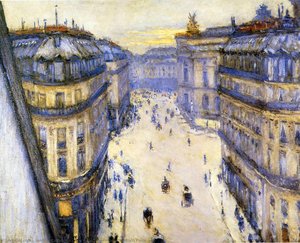
- Boulevard vu d’en haut (Boulevard Seen from Above) (1880): En markant moderne komposition med et dynamisk perspektiv.
- Paris Street; Rainy Day (1877): Hans mest berømte værk, der fanger essensen af det travle parisanske liv i en unik og fængende måde.
- The Bezique Game(1881) : Et fascinerende impressionistisk maleri af parisisk fritid.

Gustave Caillebotte
1848 - 1894 , Frankrig
Hurtige fakta
- Artistic Movement Or Style: Impressionisme og Realisme
- Artists Or Movements Influenced By This Artist: ['Impressionisterne']
- Artists Who Influenced This Artist:
- Léon Bonnat
- Degas, Monet, Renoir
- Date Of Birth: 19. august 1848
- Date Of Death: 21. februar 1894
- Full Name: Gustave Caillebotte
- Nationality: Fransk
- Notable Artworks:
- Les Raboteurs de Parquet
- Rooftop Udsigt
- Boulevard fra oven
- Place Of Birth: Paris, Frankrig