

Vist: · Inklusive ramme:
 Se i rummet
 Del som kort
 Del
Del
 Detaljer
 Guide
Guide

 Download
 Lignende værker
 Røntgenundersøgelse
 Diasshow
 Spørgsmål og svar
 Statistikker
- 125.0 x 85.0 cm


Dkr 1961
Håndlavet oliereproduktion
Håndmalet olie på lærred i din valgte størrelse og ramme, udført efter bestilling af vores kunstnere. ( Skift til printsalg Skift til digitalt billede)
Størrelse
·Standardstørrelse
speciallavet
CM
INCH
Vælg mellem vores forudindstillede størrelser, der matcher kunstværkets originale proportioner.
Indlæser størrelser...

bredde
højde
Indtast den bredde og højde, du har brug for, så det passer til din ramme eller din væg. Da dette er håndmalet, kan kunstneren ved en anden form på størrelsen male lidt mere rundt om billedet eller skære lidt væk — det er op til dig. Vi sender dig et digitalt mockup til godkendelse, før maleriet påbegyndes. Billedet, der vises på denne side, viser ikke det endelige resultat — det er kun mockuppet, der gør.
 Læs mere
Afslut
·
Hvid kant Dkr1

Udvasket kant Dkr1

Fortsat motiv Dkr1

P118B Dkr10

P118H Dkr10

P118W Dkr10

P438Z Dkr10

P508JH Dkr12

P508YH Dkr12

P805H Dkr10

P805Z Dkr10

P919BZ Dkr10

P919G Dkr10

P919XJ Dkr10

P959ZH Dkr10

P968JZ Dkr12

W106C Dkr8

W218G Dkr10

W218JH Dkr8

W218Y Dkr10

W307PJ Dkr10

W316G Dkr10

W316PJ Dkr8

W316Y Dkr10

W398PJ Dkr8

W4111J Dkr10

W500HY Dkr15

W500JH Dkr15

W692G Dkr12

W849H Dkr8

W940BG Dkr15

W953PJ Dkr8

H24-GOLD Dkr30

H24-SILVER Dkr30

H36-GOLD Dkr45

H36-SILVER Dkr45
Sendes i et beskyttende rør, klar til at blive indrammet hos din egen indrammer.
Over 105 cm sendes rammen som et sæt til en professionel indrammer — læs detaljerne.
Tillægsydelser
valgfritHvad indeholder de ekstra tilvalg?
Eksempler på hvad kan ændres: Udskift ansigt med kundens eget foto; Tilføj kæledyr (f.eks. udskift kat med hund); Inkluder skjult besked i baggrunden; Skift baggrundslandskab eller elementer.
Efter bestilling vil TopImpressionists.com-teamet sende en e-mail til kunden for at få instruktioner og levere et udkast til forhåndsvisning
Efter bestilling vil TopImpressionists.com-teamet sende en e-mail til kunden for at få instruktioner og levere et udkast til forhåndsvisning
Verdensomspændende levering () på 3-4 uger i stedet for de standard 5 uger. (7 november). Ingen kompromiser med kvaliteten.
Beskyttende fernis
Navneskilt
Detaljer om indgraveret bronzeskilt
This elegant plaque features the artist's name and the title of the artwork, finely engraved for a timeless presentation.
It is made from bronze with a refined, elegant finish. The text is precisely laser-engraved for a sharp and permanent result. Measuring 9x2 cm, the plaque is compact yet easy to read. It's built to be durable and scratch-resistant, offering a professional, museum-quality look. Mounting is simple thanks to the included adhesive backing.
Detaljer om gennemsigtig akrylplade
The plaque includes essential engraved details such as the artist's name, the title of the artwork, the date it was created, the type of media used-like oil on canvas or watercolor-a brief description of the piece, and a QR code that links to the complete artwork information.
It is crafted from clear acrylic, offering a sleek, modern appearance. The text is UV-engraved in black to ensure strong visual contrast. With a size of 10x15 cm, it ensures optimal readability. It comes equipped with two metal hooks for secure wall mounting. The plaque is designed to be weather-resistant, making it suitable for various environments, and it includes interactive features that work seamlessly with smartphone scanning.
Detaljer om sort akrylplade
This elegant plaque includes engraved information such as the artist's name, the title of the artwork, the date it was created, the type of media used (like oil on canvas or watercolor), a short description of the artwork, and a QR code for quick access to more information.
The plaque itself is made from refined black acrylic with a premium finish. The text is laser-engraved in white for high contrast and readability. Its size is 10x15 cm, designed to be easy to read. It comes with two metal hooks for professional mounting. The design is sleek and fits any interior style. It is also weather-resistant and durable, with built-in digital integration for mobile compatibility.
Glasmulighed er kun tilgængelig i størrelser under 110 cm
 Glasmulighed er kun tilgængelig i størrelser under 110 cm
- Gratis ekspresforsendelse til hele verden
- Lærred af linned i høj kvalitet
- Fuld transportforsikring
- Garanti for refusion af told og importafgifter
- Garanti for præcis farvegengivelse
- 100 dages returret ved fabrikationsfejl
- 100% fuld returret
- Mængderabat ved flere køb


Beskrivelse af samlerobjektet
Hieronymus Bosch's "Two Witches" depicts two enigmatic figures amidst a dark, symbolic scene—a haunting exploration of morality and the supernatural from the Renaissance master.
Kunstnerbiografi
Hieronymus Bosch (1450-1516): En mystisk holstensk maler kendt for surrealistiske og symbolske billeder, der udforsker moral, religion og menneskets natur. Et vartegn i kunsthistorien.
Om maleriet
A Glimpse into a Twisted World: The Enigmatic "Two Witches"
Hieronymus Bosch's “Two Witches,” painted circa 1480-1490, isn’t merely a depiction of two figures; it’s an immersion into a meticulously crafted nightmare. Born in ’s-Hertogenbosch, Netherlands, during a period rife with religious anxieties and burgeoning folklore, Bosch developed a singular artistic vision—one that fused the unsettling realities of his time with fantastical imagery and profound psychological depth. This particular work, often considered a preparatory study for a larger altarpiece, offers a concentrated dose of his signature style: a world brimming with symbolic excess, moral warnings, and a pervasive sense of impending doom. The painting’s power lies not in its narrative clarity—it deliberately avoids straightforward storytelling—but rather in the unsettling atmosphere it generates through carefully orchestrated details and an almost unbearable tension between the two central figures.
The composition itself is deceptively simple. Two women, draped in long, flowing robes of indeterminate color, occupy a starkly minimalist background. Their faces are obscured by elaborate head coverings—a deliberate choice that heightens their anonymity and emphasizes their role as archetypal figures rather than individuals. One holds a book or manuscript, its contents tantalizingly out of view, while the other carries a staff topped with what appears to be an animal skull – a potent symbol of death and decay. The positioning of the figures, slightly off-center, creates a dynamic imbalance, drawing the viewer’s eye into the heart of this unsettling tableau. Bosch masterfully uses negative space to amplify the sense of isolation and foreboding, suggesting that these women exist within a larger, unseen drama.
The Language of Line and Shadow: Technique and Style
Bosch's technique is instantly recognizable—a testament to his painstaking attention to detail. The work is executed entirely in pen and ink on paper, utilizing a remarkably precise hand that renders the figures’ forms with astonishing accuracy. He employs hatching and cross-hatching to create subtle gradations of tone, suggesting depth and volume without resorting to traditional shading techniques. This meticulous approach lends a remarkable sense of realism to the fantastical elements within the scene—the intricate folds of the robes, the unsettling details of the skull, even the suggestion of texture in the women’s garments. The monochromatic palette – shades of gray – further enhances the painting's somber mood and focuses attention on the interplay of line and shadow.
The influence of Bosch’s artistic training is evident in his mastery of perspective, though it’s deliberately flattened, creating a sense of claustrophobia. He doesn’t attempt to create an illusion of depth; instead, he uses overlapping lines and carefully positioned elements to suggest spatial relationships within the scene. The figures are presented as if trapped within a confined space—a visual metaphor for the psychological constraints imposed by sin and temptation. Bosch's style is deeply rooted in the Northern Renaissance tradition, yet it transcends conventional artistic boundaries, forging a uniquely personal and profoundly unsettling vision.
Decoding the Symbols: A Journey into Morality and Madness
“Two Witches” is saturated with symbolism, inviting endless interpretation. The book held by one figure likely represents knowledge—but perhaps also dangerous or forbidden knowledge. The skull atop the staff is a clear reference to mortality and the transience of earthly pleasures. The women themselves can be seen as allegorical figures representing temptation, sin, and the perils of indulging in worldly desires. Bosch’s work frequently served as moralistic warnings, depicting the consequences of straying from religious piety. The overall atmosphere evokes a sense of impending judgment—a reminder that even seemingly innocuous actions can lead to devastating outcomes.
Furthermore, the painting resonates with themes of madness and delusion. Bosch's art often explores the boundaries between reality and fantasy, sanity and insanity. The unsettling expressions on the women’s faces, combined with the bizarre setting, suggest a descent into psychological turmoil—a reflection of the anxieties and uncertainties that plagued Renaissance society. The scene feels like a carefully constructed dreamscape, populated by figures caught in a perpetual state of unease.
A Timeless Masterpiece: Reproduction and Legacy
“Two Witches” remains one of Hieronymus Bosch’s most compelling works, captivating viewers with its unsettling beauty and profound psychological depth. Reproductions offer an accessible way to experience the power of this extraordinary painting, allowing us to contemplate its complex symbolism and appreciate Bosch's unparalleled artistic vision. Whether displayed in a grand salon or a smaller study, a high-quality reproduction of “Two Witches” serves as a constant reminder of the enduring fascination with darkness, morality, and the mysteries of the human psyche.
Spørgsmål og svar
Er "Two Witches" af Hieronymus Bosch et maleri, en tegning eller et tryk?
"Two Witches" af Hieronymus Bosch er klassificeret som WallArt. Kategorien beskriver den type kunstværk, som originalen er.
Hvilke farver dominerer "Two Witches" af Hieronymus Bosch?
"Two Witches" af Hieronymus Bosch benytter en Neutrals farvepalet, hvor Putty (#dedede) er den dominerende farve.
Hvilken national oprindelse ligger bag Northern Renaissance i "Two Witches"?
Det Northern Renaissance værk "Two Witches" blev skabt af en kunstner født i Holland.
Hurtige fakta og kunstquiz
Om Hieronymus Bosch

Hieronymus Bosch
1450 - 1516, Holland
Kunstnerbiografi
Hieronymus Bosch: En Mystisk Maler fra Den Bosch
Hieronymus Bosch, ofte kaldet Jheronimus van Aken, er en af kunsthistoriens mest gådefulde og fascinerende figurer. Han blev født omkring 1450 i den pulserende by ’s-Hertogenbosch i Holland – dengang en del af Brabant – og hans kunstværker er præget af en unik blanding af detaljerigdom, fantasifulde billeder og en dyb, ofte ubehagelig stemning. Bosch var søn af en maler, Jan van Aken, og hans far, Anthonius van Aken, fortsatte også med at male, hvilket sandsynligvis gav ham de tidlige færdigheder, der lå til grund for hans karriere. Men selv i sine formative år begyndte han at adskille sig fra de etablerede normer, hvilket antydede den ekstraordinære fantasi, der skulle definere hans kunstneriske vision. Information om Boschs liv er sparsom og fragmenteret; optegnelserne er ufuldstændige, hvilket bidrager til mystikken omkring både manden og hans arbejde. Han giftede sig med Aleyt Goyaerts van den Meerveen før 1481, en union der gav ham økonomisk sikkerhed gennem hendes families ejendomme, men ellers var hans personlige liv relativt uselvisk.Fantastiske Visioner og Symbolsk Dybde
Boschs kunststil er umiddelbart genkendelig – en forbløffende blanding af minutiøs detalje og vildt fantasifulde billeder. Han arbejdede primært med olie på egetræsplader, hvilket demonstrerer hans mesterlige beherskelse af mediet og evnen til at skabe lystfulde farver og intrikate teksturer. Selvom hans tidlige værker viser indflydelse fra traditionel hollandsk maleri – især deres realisme og opmærksomhed på detaljer – bevægede han sig hurtigt ud over blot imitation, og udviklede en dybt original vision. Hans malerier er ikke blot repræsentationer af virkeligheden; de er allegoriske landskaber befolket af bizarre væsner, hybride skabninger og foruroligende scener, der synes stjålet fra drømme – eller mareridt. Bosch var en mester i at kombinere det hellige og det profane, den smukke og det groteske, hvilket skaber en unik og fortsat fascinerende effekt. Hans væsner – monstrøse dæmoner, fantastiske dyr og underligt menneskelige figurer – er ikke blot dekorative elementer; de er udtryk for synd, fristelse og åndelig korruption. Han udforskede komplekse moralske og teologiske koncepter gennem symbolik, ofte med fokus på farene ved synd, den skrøbelighed af jordiske fornøjelser og den uundgåelige guddommelige dom.Vigtigste Værker og Symbolisme
Boschs mest kendte værker er et bevis på hans evne til at skabe komplekse allegorier. *Haven af Jordiske Fornøjelser* (ca. 1490-1510) er et triptych, der anses for at være hans mesterværk og fortsat er en af kunsthistoriens mest gådefulde og debatterede værker. Når det åbnes, præsenteres der en panoramaudsigt over paradis, jordisk liv og helvede – en kompleks allegorisk repræsentation af menneskehedens fald fra nåden. Venstre panel viser Edens Have med fantastiske væsner og frodig vegetation; det centrale panel skildrer en verden opslugt af sanselig lyst og ukontrolleret begær, mens højre panel giver et rædselsvækkende glimt ind i helvedes torturer. Andre bemærkelsesværdige værker inkluderer *Det Sidste Dom* Triptych (ca. 1480-1490), der viser både himmelsk lykke og infernalsk pine, samt *Stigningen af De Hellige* (ca. 1480-1490), som demonstrerer hans evne til at skabe etæriske og drømmende scener. Selv mindre værker som *Epifani* (ca. 1495) viser hans innovative brug af olie på træ og kompleks symbolik, hvilket afslører en tankeproces, der konstant gravede i dybe spørgsmål om tro, moral og den menneskelige tilstand.Indflydelser og Arv
Det er vanskeligt at fastslå Boschs direkte indflydelsesfaktorer, da hans vision var så original. Kunsthistorikere peger på mulige forbindelser til middelalderlig folklore, religiøse tekster – især dem, der understreger apokalyptiske temaer – og den voksende sociale uro i tiden. Men det er klart, at han syntetiserede disse elementer til noget helt nyt og unikt for sig selv. Hans indflydelse på efterfølgende kunstnere er uomtvistelig. *Pieter Bruegel den Ældre* fulgte hans spor, adopterede lignende temaer og kompositionsmetoder, mens senere bevægelser, såsom Surrealismen, også trak inspiration fra Boschs drømmelignende billeder og udforskning af det ubevidste. Kunstnere som Salvador Dalí og Max Ernst anerkendte åbent hans skyldige visioner. Selv i dag fortsætter Boschs arbejde med at fascinere og provokere debat, hvilket sikrer hans plads som en mester blandt hollandske malere og en kunstnerisk stemme, hvis indflydelse strækker sig langt ud over sin egen tid. Hans malerier giver værdifulde indsigter i den religiøse, sociale og psykologiske atmosfære i det sene 15. og tidlige 16. århundrede, udfordrer konventionelle normer og baner vejen for nye former for kunstnerisk udtryk.Bosch's liv
Boschs liv er omgivet af mystik og mangel på sikre oplysninger. Han blev født omkring 1450 i den pulserende by ’s-Hertogenbosch, der senere inspirerede hans kunstners navn “Hieronymus Bosch”. Hans far var en maler, Jan van Aken, og hans farfar, Anthonius van Aken, var også kunstner. Det er sandsynligt, at han modtog sin tidlige uddannelse inden for familiens værksted, hvor han absorberede teknikkerne og konventionerne i hollandsk maleri. Men selv i sine formative år begyndte han at afvige fra de etablerede normer, hvilket antydede den ekstraordinære fantasi, der skulle definere hans karriere. Han giftede sig med Aleyt Goyaerts van den Meerveen omkring 1481, en union der gav ham økonomisk sikkerhed gennem hendes families ejendomme, men ellers var hans personlige liv relativt uselvisk.Hurtige fakta om Hieronymus Bosch
- Artistic Movement Or Style: Surrealisme, Symbolisme
- Artists Or Movements Influenced By This Artist: ['Pieter Bruegel']
- Date Of Birth: c. 1450
- Date Of Death: 1516
- Full Name: Hieronymus Bosch
- Nationality: Nederlandsk
- Notable Artworks:
- Havejearden
- Sidste Dommedag
- Himmel og jord
- Place Of Birth: Den Bosch, Holland
Udforsk kunstværker organiseret efter temaer, stilarter og karakteristika.


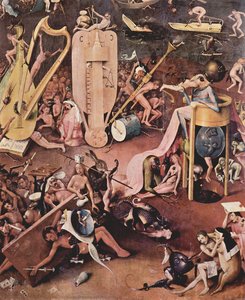


Hieronymus Bosch
Two Witches
() ·
Inklusive ramme: · Håndmalet med olie på lærred
Totalbeløb