


 Se i rummet
 Send
Send Del
Del
 Detaljer
 Studieguide til kunstværker

 Download
 Lignende værker
 Røntgenundersøgelse
 Se diasshow
 Statistik
Old Sailor
 Surrealism
 Modern
 45.0 x 56.0 cm
 Barjeel Art Foundation
A poignant portrait of an aged man capturing a sense of weathered character, this evocative painting by Inji Efflatoun invites you to explore the profound depth of modern Egyptian art through this timeless masterpiece.
A pioneer of modern Egyptian art and a leading feminist activist, Inji Efflatoun captured the resilience of rural life and political struggle in works like The Worker, inviting you to discover her profound visual legacy.
 Læs mere
Kunstværket vist på denne side er beskyttet af ophavsretsloven, hvilket betyder, at vi ikke lovligt kan skabe eller sælge en identisk reproduktion. Denne beskyttelse håndhæves i henhold til internationale aftaler som f.eks. den Bernerkonventionen og af nationale love, herunder de bestemmelser, der er fastlagt i Amerikansk ophavsretslov - Titel 17.
Som et respektfuldt og lovligt alternativ tilbyder vi skræddersyede, håndmalede kunstværker inspireret af originalen. Vores dygtige og professionelle kunstnere studerer omhyggeligt originalens stil, stemning og kunstneriske essens for at skabe et nyt, unikt værk, der fremkalder den samme følelse – samtidig med at det forbliver en original skabelse i egen ret.
Denne metode overholder fuldt ud ophavsretsreglerne, da den ikke indebærer kopiering eller duplikering af det beskyttede kunstværk. I stedet er der tale om en kreativ nytolkning – et nyt maleri, som er inspireret af det oprindelige, men ikke identisk med det.
Håndlavet oliereproduktion
Håndmalet olie på lærred i din valgte størrelse og ramme, udført efter bestilling af vores kunstnere. ( Skift til printversion Skift til digitalt billede)




P118B Dkr10

P118H Dkr10

P118W Dkr10

P438Z Dkr10

P508JH Dkr12

P508YH Dkr12

P805H Dkr10

P805Z Dkr10

P919BZ Dkr10

P919G Dkr10

P919XJ Dkr10

P959ZH Dkr10

P968JZ Dkr12

W106C Dkr8

W218G Dkr10

W218JH Dkr8

W218Y Dkr10

W307PJ Dkr10

W316G Dkr10

W316PJ Dkr8

W316Y Dkr10

W398PJ Dkr8

W4111J Dkr10

W500HY Dkr15

W500JH Dkr15

W692G Dkr12

W849H Dkr8

W940BG Dkr15

W953PJ Dkr8




Standardstørrelse
speciallavet
CM
INCH
Vælg mellem vores forudindstillede størrelser, der matcher kunstværkets originale proportioner.
Loading sizes...

bredde
højde
Indtast den bredde og højde, du har brug for, så det passer til din ramme eller din væg. Da dette er håndmalet, kan kunstneren ved en anden form på størrelsen male lidt mere rundt om billedet eller skære lidt væk — det er op til dig. Vi sender dig et digitalt mockup til godkendelse, før maleriet påbegyndes. Billedet, der vises på denne side, viser ikke det endelige resultat — det er kun mockuppet, der gør.
Eksempler på tilpasningsmuligheder: Udskift ansigt med kundens eget foto; Tilføj kæledyr (f.eks. udskift kat med hund); Inkluder en skjult besked i baggrunden; Ændr baggrundslandskab eller elementer.
Efter bestilling vil TopImpressionists.com team sende en e-mail til kunden for at indhente instruktioner og fremsende et udkast til gennemgang.
Efter bestilling vil TopImpressionists.com team sende en e-mail til kunden for at indhente instruktioner og fremsende et udkast til gennemgang.
Levering i hele verden () på 3-4 uger i stedet for de standard 5 uger. (24 oktober). Ingen kompromiser med kvaliteten.

Gratis ekspresforsendelse til hele verden

Lærred af linned i høj kvalitet

Komplet transportforsikring

Garanti for refusion af told og importafgifter

Garanti for autentisk farvegengivelse

100 dages returret ved fabrikationsfejl

100% fuld returret

Mængderabat ved flere køb
 Glasmulighed er kun tilgængelig i størrelser under 110 cm

Old Sailor
Reproduktionsmateriale
Reproduktionsstørrelse
-


Samlet pris
Dkr 1768
Lignende kunstværker


Om kunstneren
A Vision of Resilience: The Life and Art of Inji Efflatoun
In the vibrant and often turbulent landscape of twentieth-century Egyptian art, few figures command as much respect and profound emotional resonance as Inji Efflatoun. A pioneer of modern Egyptian art, her life was a seamless tapestry woven from the threads of creative brilliance and fierce political activism. Born in Cairo, Egypt, into a family with deep intellectual roots, Efflatoun emerged not merely as a painter, but as a leading spokeswoman for the Marxist-progressive-nationalist-feminist movement during the transformative decades of the 1940s and 1950s. Her work serves as a visceral testament to the struggles of her era, capturing the very soul of a nation in flux.
Her artistic journey was deeply informed by her early exposure to diverse social realities. Growing up in Cairo, she navigated environments ranging from the traditional and bourgeois to the radical intellectual circles of the Art and Freedom Group. Under the mentorship of figures like Kamel El Telmissany, she developed a foundation that allowed her to bridge the gap between aesthetic innovation and social commentary. Her canvases often act as windows into everyday Egyptian life, utilizing earthy tones and intricate patterns to evoke a sense of heritage and connection to the land.
The Canvas as Witness: Themes and Technique
Efflatoun’s oeuvre is characterized by its ability to transcend mere depiction, moving into the realm of the symbolic and the haunting. Her technique often merged the raw, energetic spirit of expressionism with a stark, skeletal minimalism. This approach is perhaps most powerfully realized in her later works, where she stripped away the unnecessary to focus on the essential agony of human existence. In masterpieces such as Workers, one encounters a harrowing scene of figures suspended against bare trees—a tableau that captures the heavy cost of political and social upheaval with a rhythmic yet unsettling movement.
Her subject matter frequently turned toward the dignity of labor and the resilience of the common person. In works like The Worker, she employed an impressionistic style and warm tones to capture the essence of rural labor. Yet, this warmth was often juxtaposed against the darker realities of her lived experience. The following elements define much of her visual language:
- Social Realism: A profound commitment to depicting the struggles of the working class and the impact of political shifts on the populace.
- Symbolic Landscapes: The use of skeletal trees, desolate landscapes, and stark silhouettes to mirror internal and national desolation.
- Textural Depth: An exploration of historical textures and the use of negative space to create a sense of profound depth and emotional gravity.
Artistry Amidst Adversity
The most defining period of Efflatoun’s life, and perhaps the most poignant for her artistic development, was her time in prison. Imprisoned by the Nasserite regime between 1959 and 1963 due to her communist ties, she found herself in a position where her art became a tool for documenting the unrenewable. This period of incarceration produced works that are often considered the highlight of her oeuvre, serving as both a documentary record of the oppression faced by political opponents and a secret window into the reality of women’s prisons.
These paintings from her imprisonment possess an extraordinary intensity, shedding light on a hidden reality through a lens of raw honesty. Her ability to transform the trauma of confinement into profound visual testimony solidified her historical significance. She did not merely paint the world she saw; she painted the weight of existence itself, ensuring that the sacrifices and the resilience of the Egyptian people would be etched into the annals of modern art history.

Inji Efflatoun
1924 - 1989 , Egypt
Hurtige fakta
- Artistic Movement Or Style: Modern Egyptian art; Expressionism
- Artists Who Influenced This Artist: ['Kamel El Telmissany']
- Full Name: Inji Efflatoun
- Nationality: Egyptian
- Notable Artworks:
- The Worker
- Workers
- Installation View
- Place Of Birth: Cairo, Egypt
- Date Of Birth: 1924
- Date Of Death: 1989
Relaterede artikler
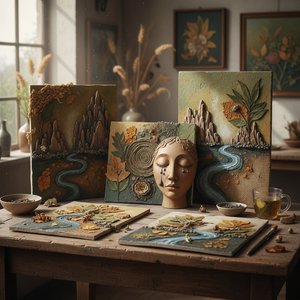
Earthy Tones & Emotional Resonance: Exploring the Vibe of Grounded Artworks
Explore the emotional power of earthy tones in art history! Discover how artists use color to evoke feelings & create grounded spaces. Expert advice on selecting artwork for your home – plus custom reproductions at TopImpressionists.

Top 10 Berømte Malerier i Sandfarver: Kunst, Historie & Indretning
Oplev top 10 berømte malerier i smukke sandfarver! Fra Monet til Rembrandt – udforsk kunsthistorien, teknikker og inspiration. Find museumskvalitets reproduktioner & dekorer dit hjem med tidløs elegance på TopImpressionists.com.

Top 10 Berømte Malerier i Lerfarver: Kunst, Historie & Indretning
Oplev top 10 berømte malerier domineret af smukke lerfarver! Lær historierne bag Picasso, Van Gogh og Monet. Find inspiration til dit hjem med museumskvalitets kunsttryk på TopImpressionists.com – køb reproduktioner online i dag!

De 10 mest ikoniske malerier i svampefarver – Kunst til dit hjem | TopImpressionists.dk
Oplev de 10 mest ikoniske malerier i smukke svampefarver! Fra Monet til Van Gogh – lær historierne bag disse tidløse kunstværker og find inspiration til dit hjem. Køb museumskvalitets reproduktioner på TopImpressionists.com.

Top 10 Berømte Malerier Domineret af Rå Umber: Kunst, Historie & Indretning
Oplev 10 berømte malerier domineret af rå umber – fra Rembrandts dybde til Caravaggios drama. Lær om kunsthistorien og find inspiration til din indretning med museumskvalitets reproduktioner på TopImpressionists.com
Udforsk kunstværker organiseret efter temaer, stilarter og karakteristika.
