Se i rummet
 Send
Send Del
Del
 Detaljer
 Guide
Guide

 Download
 Lignende værker
 Røntgenundersøgelse
 Se diasshow
 Statistik
The Studio (also known as Young Woman with a Mandolin)


Jean-Baptiste-Camille Corot
A Life Immersed in Light and LandscapeJean-Baptiste-Camille Corot, a name that resonates with the tranquil beauty of 19th-century French landscape painting, was born into a comfortable Parisian bourgeois family on July 16, 1796. Though initially steered towards a commercial path, destiny – and perhaps an innate artistic sensibility – intervened. His early years were ma
 Læs mere
Jean-Baptiste Corot (1796-1875) var en dansk landskabsmaler, kendt for sine fredfyldte billeder og indflydelse på impressionismen. Oplev hans poetiske landskaber og evne til at fange lysets skønhed.
Håndlavet oliereproduktion
Håndmalet olie på lærred i din valgte størrelse og ramme, udført efter bestilling af vores kunstnere. ( Skift til printversion Skift til digitalt billede)




P118B $10

P118H $10

P118W $10

P438Z $10

P508JH $12

P508YH $12

P805H $10

P805Z $10

P919BZ $10

P919G $10

P919XJ $10

P959ZH $10

P968JZ $12

W106C $8

W218G $10

W218JH $8

W218Y $10

W307PJ $10

W316G $10

W316PJ $8

W316Y $10

W398PJ $8

W4111J $10

W500HY $15

W500JH $15

W692G $12

W849H $8

W940BG $15

W953PJ $8




Standardstørrelse
speciallavet
CM
INCH
Vælg mellem vores forudindstillede størrelser, der matcher kunstværkets originale proportioner.
Loading sizes...

bredde
højde
Du kan indtaste dine egne mål for at passe til en bestemt ramme eller plads. Hvis den valgte størrelse ikke stemmer overens med det originale billedes proportioner, vil vi enten beskære kunstværket eller udvide maleriet med yderligere håndmalede elementer. En digital skitse sendes til din godkendelse, før produktionen påbegyndes.
Bemærk venligst, at forhåndsvisningen på skærmen ikke afspejler den faktiske beskæring eller udvidelse. Kun skitsen vil nøjagtigt vise den endelige komposition.
Selvom specialmål er mulige, anbefaler vi at vælge en dimension fra den foruddefinerede liste for at bevare de originale proportioner.
Eksempler på tilpasningsmuligheder: Udskift ansigt med kundens eget foto; Tilføj kæledyr (f.eks. udskift kat med hund); Inkluder en skjult besked i baggrunden; Ændr baggrundslandskab eller elementer.
Efter bestilling vil TopImpressionists.com team sende en e-mail til kunden for at indhente instruktioner og fremsende et udkast til gennemgang.
Efter bestilling vil TopImpressionists.com team sende en e-mail til kunden for at indhente instruktioner og fremsende et udkast til gennemgang.
Levering i hele verden () på 3-4 uger i stedet for de standard 5 uger. (23 september). Ingen kompromiser med kvaliteten.

Gratis ekspresforsendelse til hele verden

Lærred af linned i høj kvalitet

Komplet transportforsikring

Garanti for refusion af told og importafgifter

Garanti for autentisk farvegengivelse

100 dages returret ved fabrikationsfejl

100% fuld returret

Mængderabat ved flere køb
 Glasmulighed er kun tilgængelig i størrelser under 110 cm

The Studio (also known as Young Woman with a Mandolin)
Reproduktionsmateriale
Reproduktionsstørrelse
-


Samlet pris
$ 269
The Studio: A Portrait of Artistic Contemplation
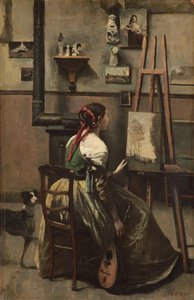
Jean-Baptiste-Camille Corot’s “The Studio,” painted in 1865, transcends mere depiction; it embodies the very essence of artistic creation. More accurately titled "Young Woman with a Mandolin," this evocative canvas captures a moment of profound introspection within an artist's workspace—a scene that continues to fascinate viewers and inspire artists today.
Style and Technique: Impressionistic Luminosity
Corot’s approach firmly establishes him as a pivotal figure in the burgeoning Impressionist movement. Rejecting academic conventions favoring meticulous detail, he prioritized capturing fleeting impressions of light and color—a technique championed by Monet and Renoir. The painting utilizes broad brushstrokes layered to create an atmospheric haze that softens edges and imbues the scene with a palpable sense of tranquility. Corot skillfully blends pigments to achieve subtle tonal variations, prioritizing luminosity over precise representation.
Historical Context: Romantic Roots Amidst Modern Innovation
Painted during the twilight years of Romanticism, “The Studio” nevertheless anticipates the stylistic advancements of Impressionism. The Romantic preoccupation with sublime landscapes—the awe-inspiring grandeur of nature confronting human insignificance—finds resonance in Corot’s depiction of the countryside surrounding Paris. However, unlike Romantic artists who sought to convey emotion through dramatic compositions and expressive brushwork, Corot strives for objectivity, presenting a serene tableau that invites contemplation rather than eliciting visceral reaction.
Symbolism: The Mandolin as Instrument of Thought
The inclusion of the mandolin—a musical instrument traditionally associated with melancholy and introspection—is laden with symbolic significance. It serves as a visual metaphor for the artist’s mind, suggesting that creativity stems from contemplation and emotional resonance. The woman's gaze directs towards the canvas, emphasizing her engagement in the creative process and highlighting the connection between music and art.
Emotional Impact: A Balm for the Soul
"The Studio" possesses a remarkable ability to evoke feelings of peace and serenity. Its muted palette—dominated by earthy tones—creates an atmosphere conducive to reflection. The carefully arranged composition—featuring the woman, the easel, the vases, and the bowl—guides the viewer’s eye towards the central focus: the artwork itself. Ultimately, Corot's masterpiece offers a poignant reminder of the transformative power of art – its capacity to inspire beauty, foster contemplation, and nourish the human spirit.
Lignende kunstværker




Om kunstneren
Jean-Baptiste-Camille Corot: En Livets Lys og Landskabets Ro
Jean-Baptiste-Camille Corot, et navn der resonerer med den rolige skønhed i det 19. århundredes franske landskabsmaleri, blev født ind i en komfortabel parisisk borgerlig familie på den 16. juli 1796. Selvom han tidligt blev styret mod en kommerciel vej, så skæbnen – og måske en iboende kunstnerisk sans – gribe ind. Hans tidlige år var præget af et usædvanligt barndomshjem; han blev sat i pleje hos en sygeplejerske i det landlige nær L’Isle-Adam, indtil han var fire år gammel, hvor han genforenedes med sine forældre. Denne tidlige immersion i den rurale ro lagde grunden til et livslangt stræben efter at fange lysets og atmosfærens flygtige kvaliteter. Hans forældre, succesfulde hattemakere, ydede økonomisk stabilitet, hvilket gav Corot friheden til at udforske sin spirende passion for maleri efter et mislykket forsøg på handel – en sjælden privilegie for aspirerende kunstnere i den tid. Denne støtte var afgørende, da den tillod ham at dedikere sig fuldt ud til kunstnerisk uddannelse uden de umiddelbare pres fra at tjene sit levebrød.Fra Akademiske Fundamenter til Plein-Air Innovation
Corots formelle kunstuddannelse begyndte med studier under Achille Etna Michallon og senere Jean-Victor Bertin, begge ærværdige landskabspolære dybt forankret i den neoklassiske tradition. Dette grundlag indgydede ham en minutiøs tilgang til komposition og form, der fremhævede klarhed og struktur. Men Corot var ikke tilfreds med blot at efterligne etablerede stilarter; han længte efter noget mere autentisk, en måde at udtrykke ikke kun *hvad* han så, men *hvordan* det føltes at være omsluttet af landskabet. Et vendepunkt kom med hans første rejse til Italien i 1825. Den romerske Campagna, badet i gyldent lys og dybt forankret i historie, antændte hans fantasi. Han brugte år på at skitsere og male en plein air – direkte fra naturen – en praksis, der stadig var relativt usædvanlig på det tidspunkt. Denne dedikation til direkte observation tillod ham at fange de subtile nuancer af lys og skygge, de delikate atmosfæriske effekter, som ville blive kendetegnende for hans stil. Han kopierede ikke blot topografiske detaljer; han stræbte efter at vække en stemning, en følelse af ro og harmoni. Hans tidlige italienske værker demonstrerer klarhed i form og lyse paletter, der er påvirket af klassiske idealer, men antyder allerede den blødere, mere evocative stil, han ville definere sin modne kunst med. Han studerede omhyggeligt mesterne, kopierede deres arbejde i de romerske gallerier, men filtrerede disse lektioner altid gennem sin egen voksende perception af naturen.En Bro mellem Traditioner
Corots kunstneriske udvikling var ikke lineær; det var en delikat balancegang mellem tradition og innovation. Han udstillede regelmæssigt på Salon i Paris, begyndte han oprindeligt at få anerkendelse for værker, der var rodfæstet i neoklassisk konvention. Men efterhånden som han udforskede plein-air maleri, begyndte hans stil at udvikle sig. Han bevægede sig væk fra højt færdige, detaljerede kompositioner mod løsere penselstrøg og en mere dæmpet palet. Denne overgang var ikke en fuldstændig afvisning af akademiske principper; snarere var det et forsøg på at infundere dem med den umiddelbarhed og følelsesmæssige resonans, der kommer fra direkte observation. Han blev mester i tonalism, ved hjælp af subtile variationer i værdi for at skabe dybde og atmosfære. Hans landskaber var ikke om dramatiske fortællinger eller store gestus; de var om stille refleksion, den smukke hverdagsscene – en skovlund, en solbeskinnet eng, en rolig flodbred. Denne tilgang resonerede med et voksende publikum, der søgte hvil og ro i den hurtige industrialisering og sociale uro i det 19. århundredes Frankrig. Han blandede dygtigt elementer af realisme med en næsten poetisk sans, hvilket skabte landskaber, der føltes både bekendte og dybt personlige. Han var ikke interesseret i store erklæringer eller politiske udsagn; hans kunst var om at finde skønhed i det almindelige, hæve det almindelige til en sfære af rolig refleksion.Arv og Vedvarende Indflydelse
Jean-Baptiste-Camille Corots indflydelse på efterfølgende generationer af kunstnere er uovertruffen. Han tjente som en afgørende bro mellem den neoklassiske tradition og den spirende impressionistiske bevægelse. Kunstnere som Monet, Pissarro og Sisley beundrede hans evne til at fange de flygtige effekter af lys og atmosfære, og de byggede videre på hans innovationer i deres egen banebrydende arbejde. Corots fokus på direkte observation og plein-air maleri banede vejen for Impressionisternes radikale afvigelse fra studiebaserede praksisser. Men Corot var ikke blot en præcursor til Impressionismen; han var en unik og betydelig kunstner i sin egen ret. Hans enorme produktion – omfattende landskaber, portrætter og figurer – fanger stadig publikum med sin rolige skønhed og følelsesmæssige dybde. Hans værker findes i store museer rundt om i verden, herunder Musée des Beaux-Arts i Dunkirk og Musée Courbet i Ornans, Frankrig, samt National Gallery i London og Metropolitan Museum of Art i New York. Han døde den 22. februar 1875 og efterlod et arv, der fortsat inspirerer kunstnere og kunstelskere – et vidnesbyrd om lysets, landskabets og roens vedvarende kraft. **The Repose**, *Interrupted Reading* og *Agostina* er ikoniske eksempler på hans mesterskab, der viser hans evne til at fange både den fysiske verden og livet i sine emner med bemærkelsesværdig følsomhed og elegance. Hans indflydelse strækker sig ud over maleriet; han fremmede en ånd af kunstnerisk frihed og opfordrede yngre kunstnere til at finde deres egen stemme, hvilket cementerede hans plads som en afgørende figur i kunsthistorien.
Jean-Baptiste-Camille Corot
1796 - 1875 , Frankrig
Hurtige fakta
- Artistic Movement Or Style: Realisme, Impressionisme
- Artists Or Movements Influenced By This Artist:
- Monet
- Pissarro
- Artists Who Influenced This Artist:
- Michallon
- Bertin
- Date Of Birth: 16. juli 1796
- Date Of Death: 22. februar 1875
- Full Name: Jean-Baptiste-Camille Corot
- Nationality: Fransk
- Notable Artworks:
- Hvile
- Læsning afbrudt
- Place Of Birth: Paris, Frankrig
Relaterede artikler

Jean-Baptiste-Camille Corot: A Poetic Realism – Bridging the Barbizon School and Early Impressionism
Explore the life & art of Camille Corot, a pivotal figure bridging the Barbizon School & Impressionism. Discover his poetic realism, signature style, and lasting influence on landscape painting. Learn more at TopImpressionists.

Master of Light: Exploring the Timeless Landscapes and Atmospheric Brilliance of Jean-Baptiste-Camille Corot
Discover the ethereal beauty of Jean-Baptiste-Camille Corot. Explore how this master of light bridged Neoclassicism and Impressionism through his atmospheric landscapes, capturing the timeless essence of the French countryside with unparalleled poetic brilliance.

Jean-Baptiste Carpeaux: Sculpting Passion & Controversy in 19th-Century France
Explore the passionate life & controversial works of Jean-Baptiste Carpeaux, a leading French sculptor of the Second Empire. Discover his realism, iconic sculptures like 'Ugolino,' and lasting legacy as a precursor to Rodin.

Jean-Baptiste Pater: Rococo Charm & Ephemeral Beauty of 18th-Century France
Explore the captivating world of Jean-Baptiste Pater, a master of Rococo painting. Discover his elegant *fête galante* scenes and shimmering portraits – a glimpse into 18th-century French aristocracy. Learn about his legacy & find high-quality reproductions.

Jean-Baptiste-Siméon Chardin: Master of Still Life & Everyday Elegance
Explore the serene world of Jean-Baptiste-Siméon Chardin, master of still life & genre painting. Discover his revolutionary techniques, enduring legacy, and timeless depictions of everyday elegance. Learn more at TopImpressionists.
Udforsk kunstværker organiseret efter temaer, stilarter og karakteristika.