

Shown: · With its frame:
 Se i rummet
 Del som kort
 Del
Del
 Detaljer
 Guide
Guide

 Download
 Lignende værker
 Røntgenundersøgelse
 Diasshow
 Q&A
Q&A Statistikker


Dkr 1782
Håndlavet oliereproduktion
Håndmalet olie på lærred i din valgte størrelse og ramme, udført efter bestilling af vores kunstnere. ( Skift til printsalg Skift til digitalt billede)
Size
·Standardstørrelse
speciallavet
CM
INCH
Vælg mellem vores forudindstillede størrelser, der matcher kunstværkets originale proportioner.
Loading sizes...

bredde
højde
Indtast den bredde og højde, du har brug for, så det passer til din ramme eller din væg. Da dette er håndmalet, kan kunstneren ved en anden form på størrelsen male lidt mere rundt om billedet eller skære lidt væk — det er op til dig. Vi sender dig et digitalt mockup til godkendelse, før maleriet påbegyndes. Billedet, der vises på denne side, viser ikke det endelige resultat — det er kun mockuppet, der gør.
 Læs mere
Finish
·
White Dkr1

Blurside Dkr1

Extended Dkr1

P118B Dkr10

P118H Dkr10

P118W Dkr10

P438Z Dkr10

P508JH Dkr12

P508YH Dkr12

P805H Dkr10

P805Z Dkr10

P919BZ Dkr10

P919G Dkr10

P919XJ Dkr10

P959ZH Dkr10

P968JZ Dkr12

W106C Dkr8

W218G Dkr10

W218JH Dkr8

W218Y Dkr10

W307PJ Dkr10

W316G Dkr10

W316PJ Dkr8

W316Y Dkr10

W398PJ Dkr8

W4111J Dkr10

W500HY Dkr15

W500JH Dkr15

W692G Dkr12

W849H Dkr8

W940BG Dkr15

W953PJ Dkr8

H24-GOLD Dkr30

H24-SILVER Dkr30

H36-GOLD Dkr45

H36-SILVER Dkr45
Shipped in a protective tube, ready for your own framer.
Above 105 cm the frame is shipped as a kit for a professional framer — read the details.
Extras
optionalWhat do the extras include?
Examples of what can be changed: Replace face with customer photo; Add pet (e.g., replace cat with dog); Include hidden message in background; Change background landscape or elements.
After order, TopImpressionists.com team will email client for instructions and provide a mockup preview
After order, TopImpressionists.com team will email client for instructions and provide a mockup preview
Verdensomspændende levering () på 3-4 uger i stedet for de standard 5 uger. (30 oktober). Ingen kompromiser med kvaliteten.
Beskyttende fernis
Navneskilt
Detaljer om indgraveret bronzeskilt
This elegant plaque features the artist's name and the title of the artwork, finely engraved for a timeless presentation.
It is made from bronze with a refined, elegant finish. The text is precisely laser-engraved for a sharp and permanent result. Measuring 9x2 cm, the plaque is compact yet easy to read. It's built to be durable and scratch-resistant, offering a professional, museum-quality look. Mounting is simple thanks to the included adhesive backing.
Detaljer om gennemsigtig akrylplade
The plaque includes essential engraved details such as the artist's name, the title of the artwork, the date it was created, the type of media used-like oil on canvas or watercolor-a brief description of the piece, and a QR code that links to the complete artwork information.
It is crafted from clear acrylic, offering a sleek, modern appearance. The text is UV-engraved in black to ensure strong visual contrast. With a size of 10x15 cm, it ensures optimal readability. It comes equipped with two metal hooks for secure wall mounting. The plaque is designed to be weather-resistant, making it suitable for various environments, and it includes interactive features that work seamlessly with smartphone scanning.
Detaljer om sort akrylplade
This elegant plaque includes engraved information such as the artist's name, the title of the artwork, the date it was created, the type of media used (like oil on canvas or watercolor), a short description of the artwork, and a QR code for quick access to more information.
The plaque itself is made from refined black acrylic with a premium finish. The text is laser-engraved in white for high contrast and readability. Its size is 10x15 cm, designed to be easy to read. It comes with two metal hooks for professional mounting. The design is sleek and fits any interior style. It is also weather-resistant and durable, with built-in digital integration for mobile compatibility.
Glasmulighed er kun tilgængelig i størrelser under 110 cm
 Glasmulighed er kun tilgængelig i størrelser under 110 cm
- Gratis ekspresforsendelse til hele verden
- Lærred af linned i høj kvalitet
- Fuld transportforsikring
- Garanti for refusion af told og importafgifter
- Garanti for præcis farvegengivelse
- 100 dages returret ved fabrikationsfejl
- 100% fuld returret
- Mængderabat ved flere køb


Beskrivelse af samlerobjektet
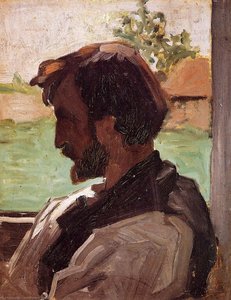
Admire Frédéric Bazille's 'Self-Portrait with Palette' (1865). A poignant glimpse into the life of an Impressionist painter, capturing his dedication and artistic spirit in a striking self-portrait.
Kunstnerbiografi
Jean Frédéric Bazille (1841-1870) var en dansk impressionist maler, kendt for sine farverige landskaber og portrætter. Hans liv blev tragisk afkortet under krigen.
About the painting
A Moment Frozen in Time: Jean Frédéric Bazille’s “Self Portrait with Palette”
Jean Frédéric Bazille's "Self Portrait with Palette," painted in 1865, is more than just a depiction of an artist; it’s a poignant snapshot of ambition, vulnerability, and the burgeoning spirit of Impressionism. Created during a remarkably brief but intensely productive period in his career, this oil-on-canvas work offers a rare glimpse into the mind of a young man grappling with his artistic aspirations amidst the vibrant, transformative atmosphere of Paris. The painting resides within the esteemed collection of the Art Institute of Chicago, a testament to its enduring quality and significance.
The composition is strikingly direct and unadorned. Bazille, dressed in a dark suit and tie – attire indicative of his medical studies before embracing art full-time – stands before a simple, dark background. His gaze meets the viewer head-on, an almost disconcerting level of intimacy that immediately draws us into the scene. In his hand, he holds a palette brimming with vibrant pigments, hinting at the creative energy simmering beneath the surface. The subtle inclusion of brushes further emphasizes his profession and the tools of his trade. The painting’s stark simplicity—a deliberate choice by Bazille—forces us to confront the artist himself, stripping away any romanticized notions of artistic genius and presenting a raw, honest portrayal.
Impressionism in Miniature: Technique and Light
Bazille's technique is firmly rooted in the principles of Impressionism, though with a distinctly personal touch. He employs loose brushstrokes and a broken color palette—a hallmark of the movement—to capture the fleeting effects of light and atmosphere. Notice how he doesn’t meticulously render every detail; instead, he uses dabs and dashes of paint to suggest form and texture. The lighting is particularly noteworthy – it's diffused and naturalistic, casting soft shadows that contribute to the painting’s overall sense of immediacy. The artist was experimenting with *plein air* painting—working outdoors directly from nature—a technique championed by Monet and others during this period, aiming to capture the transient qualities of light and color.
Interestingly, Bazille utilized a mirror to create this self-portrait, a common practice among artists seeking to accurately represent their own features. This method allowed him to observe his posture, expression, and overall appearance with meticulous detail, ensuring a truthful representation of himself. The subtle asymmetry in the composition—a slight tilt of the head, for instance—adds to the painting’s sense of spontaneity and immediacy.
A Life Cut Short: Context and Symbolism
Understanding the historical context surrounding Bazille's life is crucial to appreciating this work fully. Born in Montpellier, France, in 1841, he initially pursued a medical career alongside his artistic inclinations, a compromise dictated by his family’s desire for financial security. However, drawn to the vibrant artistic community of Paris, he abandoned medicine in favor of painting, a decision that ultimately proved tragically short-lived. Bazille was killed during the Franco-Prussian War in 1870, at just twenty-eight years old – a devastating loss for the burgeoning Impressionist movement.
The “Self Portrait with Palette” can be interpreted as a symbolic representation of this young artist’s aspirations and anxieties. The palette itself represents his creative potential, while his direct gaze suggests a desire to connect with the viewer—to share his artistic vision. Some art historians suggest that Bazille's melancholy expression hints at the pressures he faced, balancing his artistic ambitions with societal expectations and the looming shadow of war. It’s a portrait not just of an artist, but of a man on the cusp of greatness, grappling with mortality and the uncertainties of his future.
A Legacy of Light: The Painting's Enduring Appeal
Despite its brevity, Bazille’s career left an indelible mark on the Impressionist movement. His work exemplifies the movement’s focus on capturing fleeting moments of light and color, as well as its rejection of traditional academic painting techniques. “Self Portrait with Palette” remains a powerful testament to his talent and vision—a poignant reminder of a brilliant artist whose life was tragically cut short. Reproductions of this iconic piece continue to resonate with art lovers today, offering a glimpse into the heart and soul of an Impressionist master.
Spørgsmål og svar
Kan jeg bestille en oliereproduktion af "Self Portrait with Palette"?
"Self Portrait with Palette" er tilgængelig som en håndmalet oliereproduktion på lærred af hør. Du kan bestille den på dens Håndmalet reproduktion-side, hvor du kan vælge mellem forskellige størrelser.
Hvordan forbinder "Self Portrait with Palette" af Jean Frédéric Bazille Impressionist Painting med kunstnerens hjemland?
"Self Portrait with Palette" blev skabt af Jean Frédéric Bazille, født i Frankrig, inden for Impressionist Painting-bevægelsen. Kunstnerens oprindelse forbinder værket med Impressionist Painting, som det praktiseres af kunstnere fra Frankrig.
Hvilken teknik blev brugt til "Self Portrait with Palette", og hvornår blev den skabt?
"Self Portrait with Palette" af Jean Frédéric Bazille er udført i Oil On Canvas og er fra 1865.
Quick facts and art quiz
About Jean Frédéric Bazille

Jean Frédéric Bazille
1841 - 1870, Frankrig
Kunstnerbiografi
The Brief Radiance of Jean Frédéric Bazille
Jean Frédéric Bazille’s historie er en af enormt lovende potentiale, tragisk afkortet, et flygtigt men betydningsfuldt bidrag til den spirende Impressionistiske bevægelse. Han blev født i Montpellier, Frankrig, den 6. december 1841, ind i en velhavende protestantisk familie involveret i vinproduktion, og tilsyneladende var hans liv fra starten bestemt til et liv langt væk fra kunstens verden. Hans forældre, omend støttende, insisterede på, at han fulgte medicinstudier sammen med sine kunstneriske ambitioner – en kompromis afspejlet i de sociale forventninger på den tid og deres ønske om hans økonomiske sikkerhed. Denne dualitet ville forme hans tidlige år, og dele hans opmærksomhed mellem anatomisk dissektion og den fængslende tiltrækning af farve og lys. Alligevel var det indenfor den livlige atmosfære i Paris, hvor han flyttede i 1862 for at fortsætte sine medicinske studier, at Bazillies kunstneriske vej virkelig begyndte at unfolde sig.Forging a Path Amongst Giants
Paris viste sig at være en smeltedigel for den unge Bazille. Han faldt hurtigt ind i en kreds af kunstnere, der skulle blive synonyme med Impressionismen: Claude Monet, Pierre-Auguste Renoir og Alfred Sisley. Studier under Charles Gleyre gav ham formel træning, men det var den delte passion og radikale ideer, der blev udvekslet blandt disse venner, der virkelig antændte hans kunstneriske vision. Bazillies økonomiske stabilitet – en heldig kontrast til de ofte prekære eksistenser hos sine følgesvende – tillod ham at generøst støtte dem, og tilbyde studieplads og materialer. Denne generøsitet var ikke blot praktisk; den stammede fra et dybt venskab og en tro på deres kollektive potentiale. Han blev en vital hub for denne spirende gruppe, der fremmede et miljø af eksperimentering og gensidig opmuntring. Hans tidlige værker, som *The Pink Dress* (ca. 1864), demonstrerer allerede et skarpt blik for at fange flygtende øjeblikke og lysets virkninger – kendetegn, der ville definere Impressionismen. Han imiterede ikke blot etablerede stilarter; han deltog aktivt i skabelsen af noget helt nyt.A Style Defined by Light and Friendship
Bazillies kunstneriske stil, omend under udvikling, besad en unik karakter inden for den bredere Impressionistiske æstetik. Mens de delte deres fascination med *plein air* maleri – at male udendørs for direkte at fange nuancerne af det naturlige lys – havde hans kompositioner ofte en mere struktureret kvalitet end Monets eller Renoirs. Han kombinerede ofte figurmaleri med landskab, og placerede sine emner omhyggeligt i deres omgivelser, som ses i mesterværker som *Family Reunion* (1867-1868). Dette værk er ikke blot en gengivelse af et familiemøde; det er en udforskning af lys, der filtreres gennem træerne og giver scenen varme og intimitet. Hans malerier var ikke kun om *hvad* han så, men *hvordan* han så det – den følelsesmæssige resonans, der blev fremkaldt af farve, form og lys. Han var dybt påvirket af Eugène Delacroix, hvis brug af farver resonerede med hans egne kunstneriske sanser, men han bevægede sig ud over akademiske konventioner for at omfavne en mere moderne følelse.A Life Interrupted: Legacy and Remembrance
Den blomstrende karriere for Jean Frédéric Bazille blev brutalt afbrudt af den fransk-tyske krig i 1870. Drevet af en patriotisk pligt, sluttede han sig til et Zouave regiment kort før konflikten brød ud. Tragisk døde han i kamp den 28. november 1870, kun 28 år gammel. Hans tidlige død sendte chok gennem det kunstneriske samfund og fratog dem en talentfuld ven og generøs støtter. Hans pludselige død betød, at hans arbejde forblev relativt ukendt i mange år. Alligevel er Bazillies bidrag i de seneste årtier blevet anerkendt og fejret igen. I dag findes hans malerier på prestigefyldte museer som Musée d'Orsay i Paris, og reproduktioner giver kunstelskere over hele verden mulighed for at opleve skønheden og innovationen i hans vision. Bazillies arv strækker sig ud over hans kunstneriske output; han er et symbol på ungdommelig idealisme, ubetinget dedikation og venskabets magt, der definerede de tidlige dage af Impressionismen. Han forbliver en hjerteskærende påmindelse om det tabte potentiale, men også et vidnesbyrd om den vedvarende indflydelse af en kort, men strålende karriere.Quick facts about Jean Frédéric Bazille
- Artistic Movement Or Style: Impressionisme
- Artists Or Movements Influenced By This Artist: ['Impressionisme']
- Artists Who Influenced This Artist: ['Delacroix']
- Date Of Birth: 6. december 1841
- Date Of Death: 28. november 1870
- Full Name: Jean Frédéric Bazille
- Nationality: Fransk
- Notable Artworks:
- Pink Dress
- Familie Reunion
- Place Of Birth: Montpellier, Frankrig
Lignende kunstværker




Udforsk kunstværker organiseret efter temaer, stilarter og karakteristika.


Jean Frédéric Bazille
Self Portrait with Palette
() ·
With its frame: · Hand-painted in oil on linen
Total