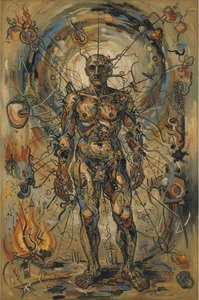
Beskrivelse af kunstværket
A Symphony of Circles: Exploring Joan Miró's “Prova d’assaig 1”
Joan Miró, born in Barcelona in 1893, wasn’t merely charting a path through artistic movements; he was embarking on an odyssey into the uncharted territories of his own subconscious. His life’s work—a breathtaking tapestry woven with dreams, memories, and the vibrant spirit of Catalonia—found its most potent expression in pieces like “Prova d’assaig 1,” a painting that transcends categorization and speaks directly to the viewer's emotional core. This artwork exemplifies Miró’s signature Surrealist style, yet it remains fundamentally rooted in his personal vision, refusing to conform to prescribed aesthetic conventions.
The Visual Language of Dreams
“Prova d’assaig 1” immediately captivates with its arresting simplicity and chromatic richness. The canvas is dominated by a constellation of circles—nine prominent discs scattered across the surface—each imbued with varying hues of yellow, orange, red, and blue. These aren't merely decorative elements; they are conduits to Miró’s inner world, symbols of spontaneity, imagination, and primal energy. As Miró himself described it, he sought to capture “the essence of things,” distilling complex emotions into these elemental forms. The artist’s meticulous attention to detail—evident in the subtle gradations of color and the slight variations in circle size—contrasts beautifully with the overall impression of dreamlike abstraction.
Catalan Roots and Gaudí's Influence
Miró’s formative years were deeply intertwined with Barcelona’s architectural heritage, particularly Antoni Gaudí’s visionary creations. Gaudí’s organic forms – flowing lines, undulating surfaces, and a masterful integration of nature into architecture – subtly permeated Miró’s artistic sensibility. This influence is palpable in “Prova d’assaig 1,” where the circles mimic the curves and contours found throughout Gaudí's buildings, suggesting a connection to Catalan identity and tradition. The artist wasn’t attempting to replicate Gaudí’s style; rather, he internalized its spirit—a belief in embracing irregularity and celebrating the beauty of natural forms—and translated it into his own unique visual vocabulary.
Symbolism Beyond Representation
The circles themselves hold profound symbolic significance within Miró's oeuvre. They represent wholeness, unity, and cyclical renewal – concepts central to Catalan folklore and spirituality. Furthermore, they embody the artist’s fascination with primal forces and instinctive impulses, mirroring the subconscious realm from which his artistic ideas originate. The deliberate placement of these circles—some larger and bolder than others—creates a dynamic composition that draws the eye across the canvas, inviting contemplation and stimulating emotional response. It's not about depicting something tangible; it’s about conveying an intangible feeling – a sense of wonder and liberation.
A Timeless Reflection of Inner Experience
“Prova d’assaig 1” stands as a testament to Miró’s unwavering commitment to artistic exploration and his refusal to compromise on his vision. Its enduring appeal lies in its ability to resonate with viewers across generations, tapping into universal themes of creativity, emotion, and the pursuit of beauty. The photograph captures the painting's essence perfectly—a celebration of color, form, and imagination that embodies Miró’s profound belief in the transformative power of art. Reproductions offer a chance to bring this captivating artwork into your home, allowing you to experience its evocative spirit firsthand.



 Preview
 Switch to Print
 Del
Del Del
Del
 Detaljer

 Download
 Lignende værker
 Røntgenundersøgelse
 Diasshow
 Se mere






































 Glasmulighed er kun tilgængelig i størrelser under 110 cm