
 Se i rummet
 Del som kort
 Del
Del
 Detaljer
 Guide
Guide

 Download
 Lignende værker
 Røntgenundersøgelse
 Diasshow
 Q&A
Q&A Statistikker
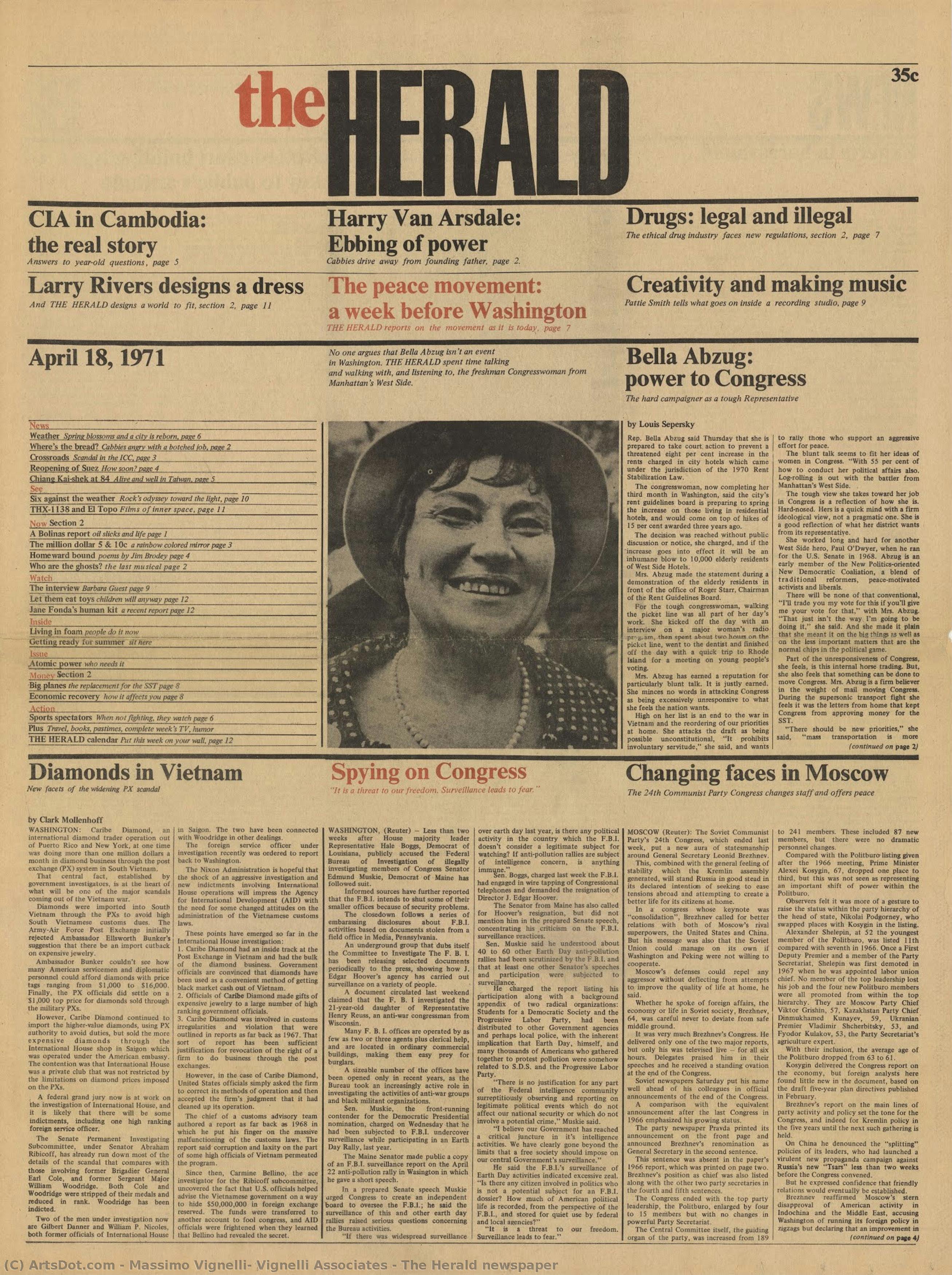
The Herald newspaper

- 43.0 x 57.0 cm


Experience the modernist grid design of The Herald newspaper by Massimo Vignelli (1971), showcasing vintage graphic communication art; discover this iconic piece today.
 Vis mere
Massimo Vignelli (1931-2014): Italiensk designikon kendt for minimalistisk grafisk kunst og ikoniske projekter som New York City Subway kortet. Udforsk hans arv!
Kunstværket vist på denne side er beskyttet af ophavsretsloven, hvilket betyder, at vi ikke lovligt kan skabe eller sælge en identisk reproduktion. Denne beskyttelse håndhæves i henhold til internationale aftaler som f.eks. den Bernerkonventionen og af nationale love, herunder de bestemmelser, der er fastlagt i Amerikansk ophavsretslov - Titel 17.
Denne metode overholder fuldt ud ophavsretsreglerne, da den ikke indebærer kopiering eller duplikering af det beskyttede kunstværk. I stedet er der tale om en kreativ nytolkning – et nyt maleri, som er inspireret af det oprindelige, men ikke identisk med det.
Giclée / Kunsttryk
Giclée- eller lærredstryk i museumskvalitet med hurtig produktion og fleksible muligheder for finish. ( Køb håndmalet maleri Skift til digitalt billede)




P118B Dkr10

P118H Dkr10

P118W Dkr10

P438Z Dkr10

P508JH Dkr12

P508YH Dkr12

P805H Dkr10

P805Z Dkr10

P919BZ Dkr10

P919G Dkr10

P919XJ Dkr10

P959ZH Dkr10

P968JZ Dkr12

W106C Dkr8

W218G Dkr10

W218JH Dkr8

W218Y Dkr10

W307PJ Dkr10

W316G Dkr10

W316PJ Dkr8

W316Y Dkr10

W398PJ Dkr8

W4111J Dkr10

W500HY Dkr15

W500JH Dkr15

W692G Dkr12

W849H Dkr8

W940BG Dkr15

W953PJ Dkr8




Standardstørrelse
speciallavet
CM
INCH
Vælg mellem vores forudindstillede størrelser, der matcher kunstværkets originale proportioner.
Loading sizes...

bredde
højde
Indtast den bredde og højde, du har brug for, så det passer til din ramme eller din væg. Et print kan kun beskæres, aldrig gøres større end selve billedet, så en størrelse med et andet format vil medføre, at dele af motivet går tabt. Vi sender dig en digital mockup til godkendelse, før vi printer noget. Billedet vist på denne side viser ikke den faktiske beskæring — det er kun mockuppen, der gør.
Verdensomspændende levering () på 2 uger i stedet for de sædvanlige 4/5 uger. (1 november)

Gratis ekspresforsendelse til hele verden

Lærred af linned i høj kvalitet

Fuld transportforsikring

Garanti for refusion af told og importafgifter

Garanti for præcis farvegengivelse

100 dages returret ved fabrikationsfejl

100% fuld returret

Mængderabat ved flere køb
 Glasmulighed er kun tilgængelig i størrelser under 110 cm

The Herald newspaper
Giclée / Kunsttryk
Størrelse på reproduktion
-


Samlet pris
Dkr 465
The Grid of Modern Communication: Vignelli's The Herald
To encounter this piece is to step directly into the vibrant, structured chaos of mid-century New York journalism. This reproduction of The Herald newspaper from April 1971, conceived by Massimo Vignelli and his associates, is far more than mere ephemera; it is a meticulously designed artifact of visual communication history. It captures a moment when design principles—simplicity, functionality, and rigorous structure—were being aggressively applied to the seemingly unruly medium of print journalism. The very act of presenting this newspaper front page transforms what might be considered disposable media into a profound study in modernist graphic discipline.
A Masterclass in Structured Design
Vignelli’s genius, always rooted in an almost architectural understanding of space, is on full display here. The description notes the structure: a rigid grid of six columns and sixteen modules per column. This underlying skeleton dictates every element—the placement of headlines like "Diamonds in Vietnam," the accompanying portrait of the smiling woman, and the smaller articles detailing everything from spying congress to changing leaves in Moscow. Vignelli’s commitment to using a single typeface, Times Roman, across various weights and sizes, speaks volumes about his belief in universal legibility. It is a powerful testament to the idea that restraint—the disciplined use of negative space and consistent typography—can generate an overwhelming sense of order and sophistication.
Historical Resonance and Materiality
The year 1971 places this work within a fascinating cultural nexus, post-war modernism grappling with the burgeoning media landscape. While the paper itself ultimately folded due to distribution issues, its surviving design remains potent. For the collector or designer, understanding this context is key. This piece speaks to an era obsessed with efficiency and clarity in information transfer. When considering a reproduction for your space, you are not just acquiring art; you are curating a dialogue about how we consume knowledge—a conversation between the fleeting headline and the enduring power of good design.
Symbolism of the Grid
The grid itself functions as the primary symbolic element. In an age where digital information often feels overwhelming, this physical manifestation of order offers a visual anchor. It symbolizes control, but not oppressive control; rather, it suggests that even complex narratives—the confluence of international events and local interest—can be organized into digestible, beautiful patterns. The interplay between the large, arresting photograph and the tightly packed textual modules creates a dynamic tension, mirroring the very energy of a bustling city like New York in that era.
Bringing Modernist Precision Home
For interior design or gallery display, this piece offers an unparalleled opportunity to inject intellectual rigor into a space. It pairs beautifully with minimalist furniture, mid-century modern accents, or any setting that appreciates the clean lines of 20th-century industrial aesthetics. Owning this reproduction is an homage to Massimo Vignelli’s lifelong dedication to elevating the mundane—the daily newspaper—into something enduringly beautiful and intellectually stimulating.
Spørgsmål og svar
Hvilken stilart tilhører "The Herald newspaper"?
Kunstretningen forbundet med "The Herald newspaper" af Massimo Vignelli, Vignelli Associates er Modernism. Denne klassificering placerer værket blandt relaterede kunstnere og kunstværker.
Hvad er den anbefalede anvendelse af et print af "The Herald newspaper"?
Det anbefales at bruge et tryk af "The Herald newspaper" til Statement.
Hvilke proportioner har "The Herald newspaper" af Massimo Vignelli, Vignelli Associates, og hvor stor er den?
Formatet på "The Herald newspaper" er Portrait, og originalen måler 43 x 57 cm. Begge oplysninger er nyttige, når man planlægger en reproduktion.
Kunstnerbiografi
Et liv dedikeret til form: Massimo Vignellis verden
Født i Milano, Italien, i 1931, var Massimo Vignellis rejse præget af en urokkelig hengivenhed til modernismens designprincipper. Fra en tidlig alder udviste han en medfødt forståelse for visuel kommunikation, hvilket startede med hans formelle uddannelse i arkitektur ved Politecnico di Milano og senere fortsatte ved Università Iuav di Venezia. Det var dog et læretid hos de respekterede Castiglioni-brødre – pionerer inden for italiensk industrielt design – der for alvor antændte hans passion for at forme verden gennem gennemsigtig og eftertænksom skabelse. Denne tidlige eksponering indpodede i ham en tro på funktionalitet, enkelhed og kraften i elegante løsninger på hverdagens problemer. Han designede ikke blot objekter; han skabte oplevelser, strømlinede interaktioner og ophøjede det trivielle til noget mindeværdigt. Denne formative periode lagde fundamentet for en karriere, der skulle redefinere den visuelle kultur på tværs af kontinenter.Fra Italien til New York: En transatlantisk vision
Vignellis vej førte ham til Amerika i 1966, hvor han spillede en afgørende rolle i etableringen af New York-kontoret for Unimark International. Dette markerede et vendepunkt, ikke blot for hans egen karriere, men også for det amerikanske designlandskab. Unimark opnåede hurtigt stor anerkendelse, og Vignellis bidrag – mest bemærkelsesværdigt det tidløse logo til American Airlines – cementerede hans ry som en mester inden for virksomhedsidentitet. En voksende divergens i den kreative filosofi motiverede ham dog til at påbegynde et selvstændigt eventyr. I 1971 grundlagde han, sammen med sin hustru og livslange samarbejdspartner, Lella Vignelli, firmaet Vignelli Associates. Dette partnerskab viste sig at være ekstraordinært frugtbart og blev synonymt med sofistikerede designløsninger, der spændte over grafisk design, interiørdesign, produktdesign og arkitektur. Firmaets etos var rodfæstet i en tro på, at godt design skal være tilgængeligt, tidløst og dybt nyttigt – principper, som de konsekvent kæmpede for gennem hele deres karriere.Ikoniske kreationer: En arv af klarhed
Massimo Vignellis indflydelse er vævet ind i det moderne livs tekstur. Hans måske mest genkendelige bedrift er redesignet af New York City Subways kort i 1972. Selvom det i begyndelsen var kontroversielt på grund af dets afvigelse fra streng geografisk nøjagtighed, var det et dristigt statement om klarhed og brugervenlighed. Vignelli prioriterede læsbarhed og intuitiv navigation over bogstavelig repræsentation, hvilket skabte et diagrammatisk kort, der fortsat guider millioner af pendlere dagligt. Dette projekt eksemplificerer hans kernefilosofi: at prioritere kommunikation over alt andet. Udover metrokortet satte Vignelli Associates et uudsletteligt præg på utallige brands og institutioner. Deres arbejde for Bloomingdale’s – herunder den ikoniske brune papirpose med det enkle hvide logo – transformerede en shoppingoplevelse til et stilmæssigt statement. De designede møbler til Knoll, emballage til Heller og virksomhedsidentiteter, der blev øjeblikkeligt genkendelige symboler på kvalitet og innovation. Hans Heller Rainbow Dinnerware står som et vidnesbyrd om hans minimalistiske æstetik, hvor levende farver præsenteres i rene, geometriske former. Plakaten til Tredicesima Triennale di Milano eksemplificerer hans dristige brug af farve og form, mens coveret til Knoll Design demonstrerer hans evne til at skabe slående visuelle udtryk for verdensberømte brands.En varig indvirkning: Bag om æstetikken
Massimo Vignellis betydning rækker langt ud over de enkelte projekter; han omformede fundamentalt vores opfattelse af selve designet. Han var en indædt fortaler for typografisk disciplin og argumenterede berømt for en begrænset palette af skrifttyper – i troen på, at sand kreativitet ikke ligger i endeløse muligheder, men i den mesterlige udførelse med nøje udvalgte værktøjer. Hans bog, The Vignelli Canon, blev et manifest for designere, der skitserede hans principper om klarhed, enkelhed og vedvarende elegance. Han skabte ikke blot visuelt smukke objekter; han stræbte efter at skabe orden ud af kaos, at kommunikere effektivt og at ophøje den menneskelige oplevelse gennem gennemtænkt design. Hans arbejde fortsætter med at inspirere generationer af designere ved at minde dem om, at sand innovation ligger i at skrælle det overflødige væk og fokusere på det essentielle. Vignelli Center for Design Studies ved Rochester Institute of Technology fungerer som en varig hyldest til hans arv, hvor et omfattende arkiv af hans arbejde bevares og fremmer fortsat udforskning af hans banebrydende idéer. Han gik bort i 2014, men hans designs er stadig kraftfuldt til stede og former vores verden med deres tidløse elegance og urokkelige engagement i klarhed.
Massimo Vignelli, Vignelli Associates
1931 - 2014 , Italien
Kort om kunstneren
- Artistic Movement Or Style: Modernisme
- Artists Or Movements Influenced By This Artist: ['Heinz Waibl']
- Artists Who Influenced This Artist:
- Achille Castiglioni
- Pier Giacomo Castiglioni
- Date Of Birth: 1931
- Date Of Death: 2014
- Full Name: Massimo Vignelli
- Nationality: Italiensk
- Notable Artworks:
- American Airlines logo
- NYC Subway mappe
- Place Of Birth: Milan
Relaterede artikler

TopImpressionists.com F.A.Q.: Discover the Vibrant Beauty of Our Premium Art Poster Prints
Explore the technical excellence of TopImpressionists.com's premium art poster prints. Discover how our 12-color pigment system and archival inks capture the luminous beauty of Impressionist masterpieces with unmatched color fidelity and museum-grade durability for the discerning collector.
Udforsk kunstværker organiseret efter temaer, stilarter og karakteristika.


