

 Se i rummet
 Send
Send Del
Del
 Detaljer
 Studieguide til kunstværker

 Download
 Lignende værker
 Røntgenundersøgelse
 Se diasshow
 Statistik
Still Life with Three Skulls


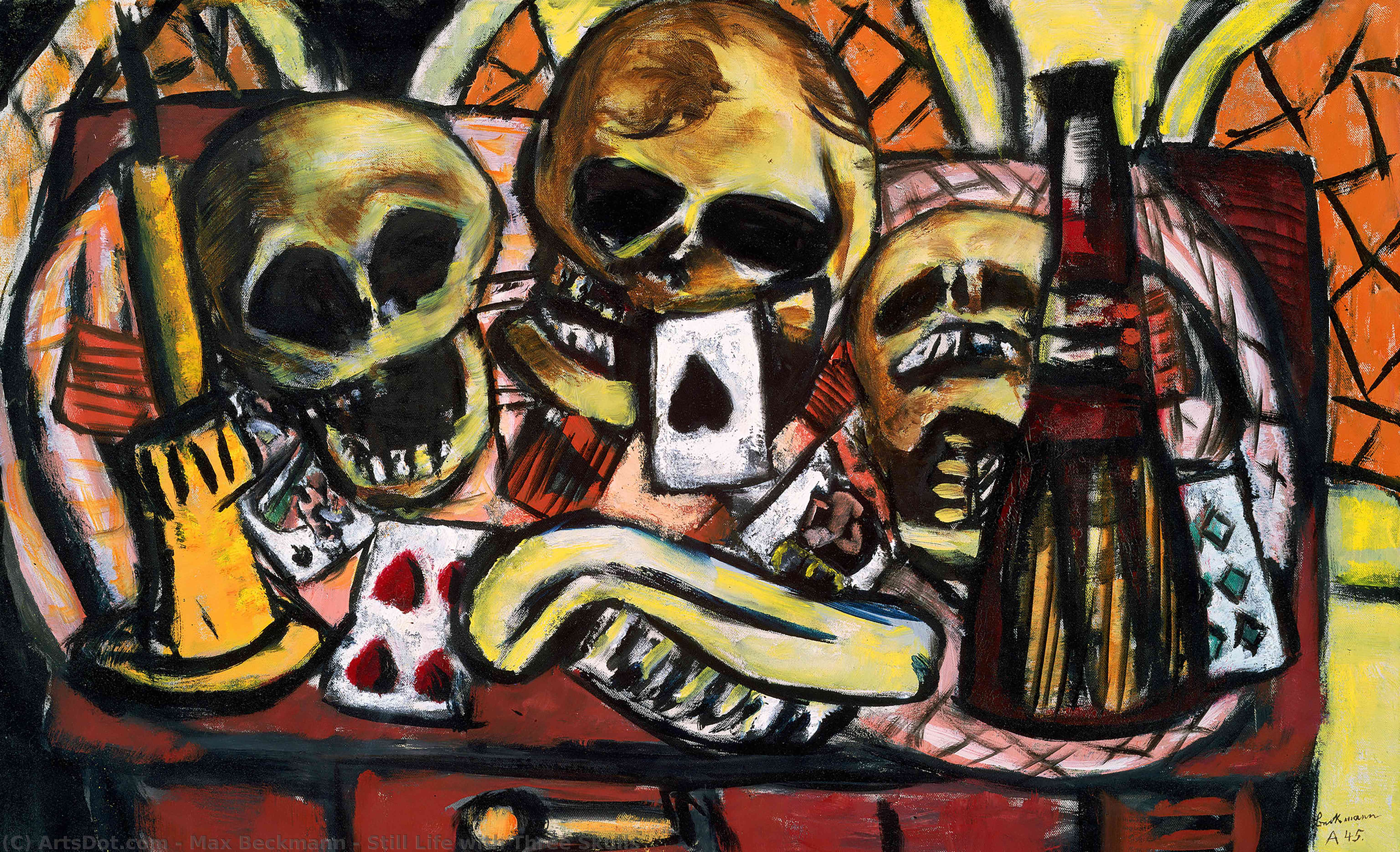
Three haunting skulls and scattered bottles create a profound sense of mortality in this powerful German Expressionist still life by Max Beckmann, inviting you to explore the depths of this evocative masterpiece.
 Læs mere
Max Beckmann var en markant tysk ekspressionist maler kendt for sine forvrængede figurer og dystre landskaber fra krigstiden. Oplev hans symboliske værker – herunder "Skuespillerne" – og hans unikke stil, der afspejler en kompleks menneskeskæbne.
Håndlavet oliereproduktion
Håndmalet olie på lærred i din valgte størrelse og ramme, udført efter bestilling af vores kunstnere. ( Skift til printversion Skift til digitalt billede)




P118B Dkr10

P118H Dkr10

P118W Dkr10

P438Z Dkr10

P508JH Dkr12

P508YH Dkr12

P805H Dkr10

P805Z Dkr10

P919BZ Dkr10

P919G Dkr10

P919XJ Dkr10

P959ZH Dkr10

P968JZ Dkr12

W106C Dkr8

W218G Dkr10

W218JH Dkr8

W218Y Dkr10

W307PJ Dkr10

W316G Dkr10

W316PJ Dkr8

W316Y Dkr10

W398PJ Dkr8

W4111J Dkr10

W500HY Dkr15

W500JH Dkr15

W692G Dkr12

W849H Dkr8

W940BG Dkr15

W953PJ Dkr8




Standardstørrelse
speciallavet
CM
INCH
Vælg mellem vores forudindstillede størrelser, der matcher kunstværkets originale proportioner.
Loading sizes...

bredde
højde
Indtast den bredde og højde, du har brug for, så det passer til din ramme eller din væg. Da dette er håndmalet, kan kunstneren ved en anden form på størrelsen male lidt mere rundt om billedet eller skære lidt væk — det er op til dig. Vi sender dig et digitalt mockup til godkendelse, før maleriet påbegyndes. Billedet, der vises på denne side, viser ikke det endelige resultat — det er kun mockuppet, der gør.
Eksempler på tilpasningsmuligheder: Udskift ansigt med kundens eget foto; Tilføj kæledyr (f.eks. udskift kat med hund); Inkluder en skjult besked i baggrunden; Ændr baggrundslandskab eller elementer.
Efter bestilling vil TopImpressionists.com team sende en e-mail til kunden for at indhente instruktioner og fremsende et udkast til gennemgang.
Efter bestilling vil TopImpressionists.com team sende en e-mail til kunden for at indhente instruktioner og fremsende et udkast til gennemgang.
Levering i hele verden () på 3-4 uger i stedet for de standard 5 uger. (27 oktober). Ingen kompromiser med kvaliteten.

Gratis ekspresforsendelse til hele verden

Lærred af linned i høj kvalitet

Komplet transportforsikring

Garanti for refusion af told og importafgifter

Garanti for autentisk farvegengivelse

100 dages returret ved fabrikationsfejl

100% fuld returret

Mængderabat ved flere køb
 Glasmulighed er kun tilgængelig i størrelser under 110 cm

Still Life with Three Skulls
Reproduktionsmateriale
Reproduktionsstørrelse
-


Samlet pris
Dkr 1768
A Memento Mori in Modernity
In the hauntingly evocative Still Life with Three Skulls, the viewer is invited into a somber, introspective space where the boundaries between life and death blur through the lens of German Expressionism. Max Beckmann, a master of capturing the psychological weight of the human condition, presents a composition that transcends mere tabletop arrangement. The painting features three skulls arranged across a dark, textured surface, their hollow sockets staring back with an unsettling permanence. Interspersed among these skeletal remains are various bottles and a solitary knife, objects that ground the macabre subject matter in a domestic, almost mundane reality. This juxtaposition creates a profound tension, as the everyday items of life sit alongside the undeniable symbols of mortality.
The technique employed by Beckmann is nothing short of visceral. Eschewing the delicate smoothness of classical still lifes, he utilizes a bold, distorted approach to space and form that reflects his experience as a medical orderly during World War I. The brushwork feels heavy and deliberate, imbuing each object with a sense of sculptural weight. There is a rhythmic quality to the placement of the bottles—one perched in the upper right, another near the center, and a third anchoring the lower left—which guides the eye through a labyrinth of light and shadow. This use of chiaroscuro, reminiscent of the Old Masters like Rembrandt, serves to heighten the drama, pulling the skulls out of the darkness and forcing a confrontation with their stark, bony architecture.
Symbolism and the Weight of Existence
To gaze upon this work is to engage with the ancient tradition of memento mori—the reminder that death is an ever-present companion. However, Beckmann breathes a modern, existential dread into this classical theme. The skulls are not merely decorative symbols; they represent the fragility of the human ego and the inevitable decay of all material things. The presence of the knife adds a layer of latent violence or perhaps the surgical precision of fate, while the bottles suggest the fleeting pleasures of the senses that cannot stave off the end. For the collector or interior designer, this piece offers more than just visual interest; it provides a profound intellectual anchor for a room, sparking conversation about the cyclical nature of life and the enduring legacy of human struggle.
For those seeking to integrate such a powerful work into a curated space, a high-quality reproduction of Still Life with Three Skulls serves as a centerpiece of immense character. It is an ideal selection for a study, a library, or a sophisticated gallery wall where art is intended to provoke thought and evoke emotion. The painting’s dark palette and commanding presence allow it to harmonize with rich textures like leather, dark wood, and velvet, creating an atmosphere of timelessness and intellectual depth. Owning this piece is an invitation to contemplate the beauty found within the shadows and to appreciate the raw, unfiltered truth of the human experience as captured by one of the twentieth century's most significant artistic voices.
Spørgsmål & svar
Er farverne i "Still Life with Three Skulls" af Max Beckmann livlige eller dæmpede?
"Still Life with Three Skulls" af Max Beckmann er gengivet med en Balanced Soft mætning og en Balanced intensitet.
Hvad er formatet på "Still Life with Three Skulls"?
"Still Life with Three Skulls" af Max Beckmann har et Panoramic format. Formatet beskriver kompositionens proportioner.
Hvordan kan jeg få et tryk af "Still Life with Three Skulls" af Max Beckmann?
Et print af "Still Life with Three Skulls" af Max Beckmann kan bestilles direkte på dens Fine art-print-side: et fine art-print på bomuldscanvas eller arkivbestandigt lærredspapir.
Om kunstneren
Early Life and Artistic Development
Max Carl Friedrich Beckmann (født 12. februar 1884 i Leipzig i Sachsen i Tyskland, død december 27, 1950 i New York i USA) var en dansk maler og kunstner, hvis kunst prægede den ekspressionistiske bevægelse i første halvdel af det 20. århundrede. Hans kunstneriske rejse begyndte med akademisk korrekte fremstillinger, hvilket senere udviklede sig til deformerede figurer og rum, der afspejlede hans ændrede verdensbillede efter tjenesten som medicinsk hjælper under første verdenskrig. Denne konflikt mellem idealisme og realitet ville komme til udtryk i hans senere værker og forme hans kunstneriske stil. Beckmanns tidlige arbejde var præget af inspiration fra klassiske kunstnere som Cézanne og Rembrandt, hvilket manifesterede sig i en nøjagtig gengivelse af anatomi og perspektiv – et kontrastfuldt billede til den ekspressionistiske æra, han senere skulle repræsentere. Han studerede på Kunstakademiet i Dresden og blev senere professor ved Städelschule i Frankfurt am Main, hvor han underviste blandt andre Josef Albers og Fritz Nagel.Artistic Style and Influences
Beckmanns kunstneriske stil udviklede sig gennem flere forskellige perioder, hvor han eksperimenterede med forskellige teknikker og udtryksformer. Hans tidlige værker var præget af en klassisk elegance og teknisk dygtighed, men efter første verdenskrig begyndte han at udforske nye territorier inden for kunstens verden. Han blev dybt påvirket af ekspressionismen, hvor han fandt inspiration i kunstnere som Edvard Munch og Vincent van Gogh, hvilket førte til brug af kraftfulde farver og dramatiske komposotioner. Beckmann var særligt fascineret af middelalderen og dets religiøse kunst – især de tyske glasmalerier – hvor han fandt både æstetik og symbolik. Denne interesse manifesterede sig i hans brug af geometriske former og klare linjer, hvilket skabte en følelse af struktur og orden inden for hans ofte dystre billeder. Han var også inspireret af kunstnere som Rembrandt og Rubens, hvor han studerede deres teknikker til lys og farve og forsøgte at efterligne deres præcision og følsomhed.Notable Works and Exhibitions
Beckmanns kunstneriske produktion omfattede et imponerende antal værker, der spændte fra oliemaleri og tegning til litografi og skulptur. Hans mest kendte værker inkluderer blandt andet "The Bark" (1925), hvor han udforskede temaet af menneskelig isolation og eksistensielle spørgsmål gennem en surrealistisk brug af geometri og perspektiv. Dette billede blev præget af en følelse af angst og fremmedgørelse, hvilket var karakteristisk for hans ekspressionistiske stil. Han skabte også flere selvportrætter, hvor han udforskede temaet identitet og subjektiv erfaring gennem psykologisk indsigt og detaljeret anatomi. Disse værker blev ofte præget af en følelse af smerte og konflikt, hvilket afspejlede hans egen personlige kamp med livet og døden. Beckmann udstillede sine værker regelmæssigt på kunstudstillinger i både Tyskland og internationale udstillinger, hvor han fik stor anerkendelse for sin kunstneriske innovation og følsomhed. Hans værker blev vist på blandt andet Frankfurter Kunstausstellung og Internationale Ausstellung für Neue Kunst i Düsseldorf.Later Life and Exile
Efter første verdenskrig oplevede Beckmann en periode af psykologisk ustabilitet og depression, hvilket førte til flere hospitalsindlæggelser og behandlinger. Han kæmpede mod alkoholmisbrug og søgte efter nye kreative udfordringer for at finde tilbage til sig selv. På grund af nazisternes stigende magt i Tyskland blev Beckmann tvunget til at forlade Frankfurt am Main og træde ud af Städelschule, hvor han havde undervist siden 1928. Hans kunstværker blev erklæret "entartete Kunst" (degenereret kunst) og blev konfiskeret af staten, hvilket førte til en betydelig økonomisk ruin. Han flyttede til Amsterdam i 1933 og søgte efter nye muligheder for at arbejde som kunstner og undervise. På grund af nazisternes politik blev hans visa nægtet og han blev tvunget til at emigrere til USA i 1947, hvor han fik en akademisk stilling ved Columbia University i New York. Han døde december 27, 1950 i New York efter et langt og produktivt kunstnerisk liv.Legacy
Max Beckmann efterlod sig en betydelig kunstnerlig arv, der fortsat inspirerer kunstnere og forskere verden over. Hans værker blev præget af en unik kombination af ekspressionisme og surrealisme, hvilket gjorde ham til en af de mest originale kunstnere i sin tid. Han udforskede komplekse temaer som menneskelig eksistens, psykologi og samfundskritik gennem et sprog fyldt med symbolik og følelsesmæssig intensitet. Hans kunst blev rost for sin tekniske dygtighed og følsomhed samt for dets evne til at udtrykke menneskelige følelser og erfaringer på en autentisk måde. Beckmanns værker er blandt andet repræsenteret i museer som Museum of Modern Art i New York og Kunsthalle Düsseldorf, hvor de fortsat fascinerer publikum og bidrager til kunsthistorien. Hans kunstneriske stil blev efterfølgende videreført af flere unge kunstnere og har haft stor indflydelse på udviklingen af ekspressionismen og surrealismen i det 20. århundrede.
Max Beckmann
1884 - 1950 , Tyskland
Hurtige fakta
- Artistic Movement Or Style: Expressionisme
- Artists Or Movements Influenced By This Artist:
- Rembrandt
- Bosch
- Artists Who Influenced This Artist:
- Georges Seurat
- Vincent van Gogh
- Date Of Birth: Februar 12, 1884
- Date Of Death: December 27, 1950
- Full Name: Max Carl Friedrich Beckmann
- Nationality: Tysk
- Notable Artworks:
- The Bark
- Selvportræt i Tuxedo
- Place Of Birth: Leipzig, Tyskland
Relaterede artikler

Unmasking Emotion: A Journey Through the Raw Power and Visceral Beauty of German Expressionism
Explore the raw emotional power of German Expressionism. From Kirchner to Die Brücke, discover how artists used distortion and vibrant color to unmask the human psyche. A deep dive into art history for the discerning collector and enthusiast.
Udforsk kunstværker organiseret efter temaer, stilarter og karakteristika.


