
Vist: · Inklusive ramme:
 Se i rummet
 Del som kort
 Del
Del
 Detaljer
 Guide
Guide

 Download
 Lignende værker
 Røntgenundersøgelse
 Diasshow
 Spørgsmål og svar
 Statistikker
- 325.0 x 250.0 cm


Dkr 1795
Håndlavet oliereproduktion
Håndmalet olie på lærred i din valgte størrelse og ramme, udført efter bestilling af vores kunstnere. ( Skift til printsalg Skift til digitalt billede)
Størrelse
·Standardstørrelse
speciallavet
CM
INCH
Vælg mellem vores forudindstillede størrelser, der matcher kunstværkets originale proportioner.
Indlæser størrelser...

bredde
højde
Indtast den bredde og højde, du har brug for, så det passer til din ramme eller din væg. Da dette er håndmalet, kan kunstneren ved en anden form på størrelsen male lidt mere rundt om billedet eller skære lidt væk — det er op til dig. Vi sender dig et digitalt mockup til godkendelse, før maleriet påbegyndes. Billedet, der vises på denne side, viser ikke det endelige resultat — det er kun mockuppet, der gør.
 Læs mere
Afslut
·
Hvid kant Dkr1

Udvasket kant Dkr1

Fortsat motiv Dkr1

P118B Dkr10

P118H Dkr10

P118W Dkr10

P438Z Dkr10

P508JH Dkr12

P508YH Dkr12

P805H Dkr10

P805Z Dkr10

P919BZ Dkr10

P919G Dkr10

P919XJ Dkr10

P959ZH Dkr10

P968JZ Dkr12

W106C Dkr8

W218G Dkr10

W218JH Dkr8

W218Y Dkr10

W307PJ Dkr10

W316G Dkr10

W316PJ Dkr8

W316Y Dkr10

W398PJ Dkr8

W4111J Dkr10

W500HY Dkr15

W500JH Dkr15

W692G Dkr12

W849H Dkr8

W940BG Dkr15

W953PJ Dkr8

H24-GOLD Dkr30

H24-SILVER Dkr30

H36-GOLD Dkr45

H36-SILVER Dkr45
Sendes i et beskyttende rør, klar til at blive indrammet hos din egen indrammer.
Over 105 cm sendes rammen som et sæt til en professionel indrammer — læs detaljerne.
Tillægsydelser
valgfritHvad indeholder de ekstra tilvalg?
Eksempler på hvad kan ændres: Udskift ansigt med kundens eget foto; Tilføj kæledyr (f.eks. udskift kat med hund); Inkluder skjult besked i baggrunden; Skift baggrundslandskab eller elementer.
Efter bestilling vil TopImpressionists.com-teamet sende en e-mail til kunden for at få instruktioner og levere et udkast til forhåndsvisning
Efter bestilling vil TopImpressionists.com-teamet sende en e-mail til kunden for at få instruktioner og levere et udkast til forhåndsvisning
Verdensomspændende levering () på 3-4 uger i stedet for de standard 5 uger. (7 november). Ingen kompromiser med kvaliteten.
Beskyttende fernis
Navneskilt
Detaljer om indgraveret bronzeskilt
This elegant plaque features the artist's name and the title of the artwork, finely engraved for a timeless presentation.
It is made from bronze with a refined, elegant finish. The text is precisely laser-engraved for a sharp and permanent result. Measuring 9x2 cm, the plaque is compact yet easy to read. It's built to be durable and scratch-resistant, offering a professional, museum-quality look. Mounting is simple thanks to the included adhesive backing.
Detaljer om gennemsigtig akrylplade
The plaque includes essential engraved details such as the artist's name, the title of the artwork, the date it was created, the type of media used-like oil on canvas or watercolor-a brief description of the piece, and a QR code that links to the complete artwork information.
It is crafted from clear acrylic, offering a sleek, modern appearance. The text is UV-engraved in black to ensure strong visual contrast. With a size of 10x15 cm, it ensures optimal readability. It comes equipped with two metal hooks for secure wall mounting. The plaque is designed to be weather-resistant, making it suitable for various environments, and it includes interactive features that work seamlessly with smartphone scanning.
Detaljer om sort akrylplade
This elegant plaque includes engraved information such as the artist's name, the title of the artwork, the date it was created, the type of media used (like oil on canvas or watercolor), a short description of the artwork, and a QR code for quick access to more information.
The plaque itself is made from refined black acrylic with a premium finish. The text is laser-engraved in white for high contrast and readability. Its size is 10x15 cm, designed to be easy to read. It comes with two metal hooks for professional mounting. The design is sleek and fits any interior style. It is also weather-resistant and durable, with built-in digital integration for mobile compatibility.
Glasmulighed er kun tilgængelig i størrelser under 110 cm
 Glasmulighed er kun tilgængelig i størrelser under 110 cm
- Gratis ekspresforsendelse til hele verden
- Lærred af linned i høj kvalitet
- Fuld transportforsikring
- Garanti for refusion af told og importafgifter
- Garanti for præcis farvegengivelse
- 100 dages returret ved fabrikationsfejl
- 100% fuld returret
- Mængderabat ved flere køb


Beskrivelse af samlerobjektet
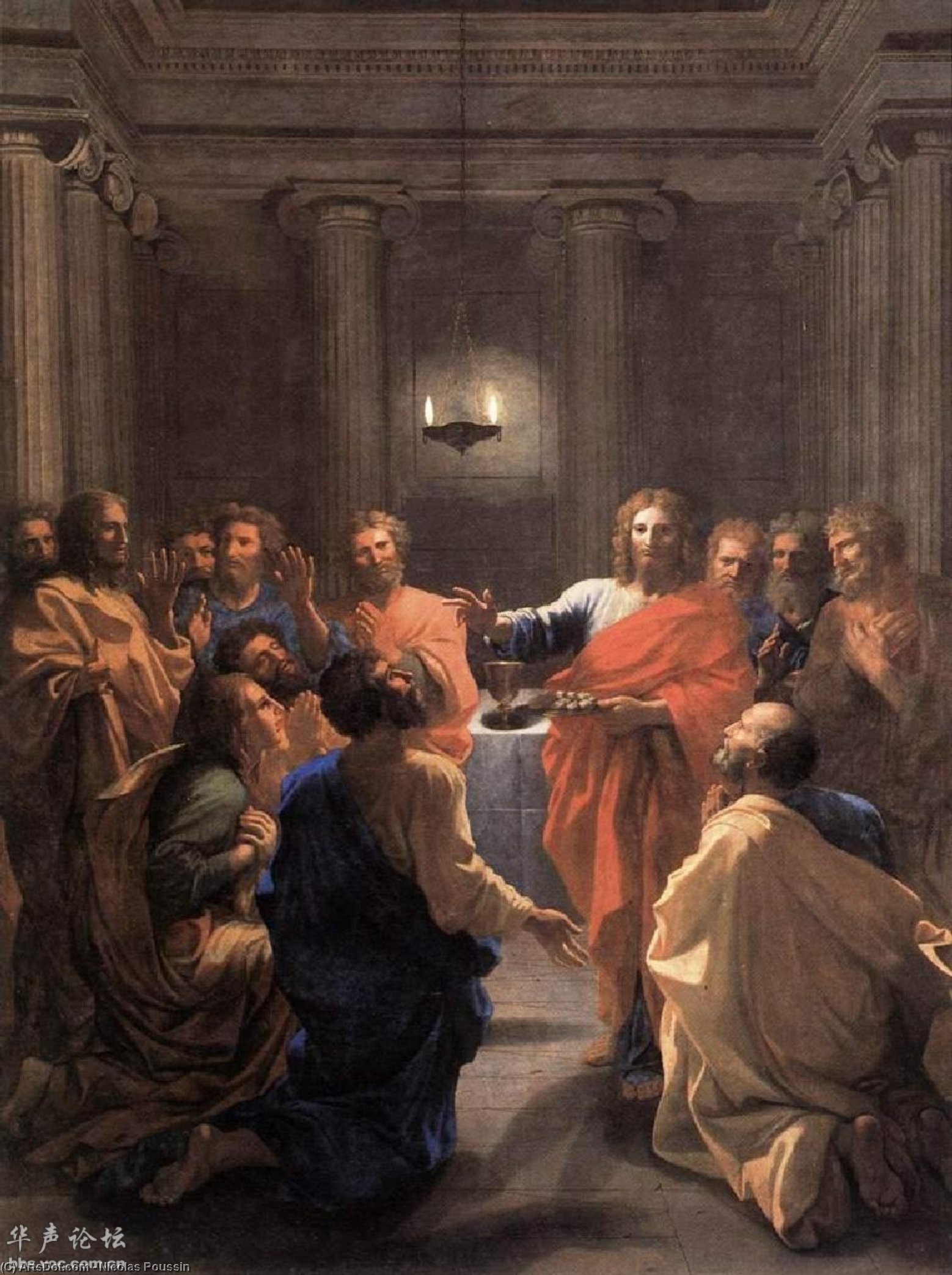
Nicolas Poussins mesterværk 'Institutionen af Euchaariet' (1640) fanger den religiøse ånd og klassiske skønhed i Barokken. Oplev et symbolsk billede af tro, menneskehed og det guddommelige.
Kunstnerbiografi
Nicolas Poussin - En fransk klassicist, hvis kunst var præget af lys og skønhed samt en dyb forståelse for klassiske idéer og temaer.
Om maleriet
Nicolas Poussin’s “The Institution of the Eucharist”: A Window into Baroque Faith
I William Pountney, art historian and curator at The Danish National Gallery – Ny Carlsberg Glyptotek, am delighted to offer you a deep dive into one of the most profoundly moving works in Western art: Nicolas Poussin’s “The Institution of the Eucharist” (1640). This painting isn't merely a depiction of a biblical scene; it’s an immersive meditation on faith, humanity’s yearning for connection with the divine, and the very essence of Christian belief. It resides within the Louvre in Paris, yet its power transcends geographical boundaries, continuing to resonate with viewers centuries after its creation.
Poussin, already a rising star in French painting, masterfully synthesizes the grandeur of classical composition—inherited from his deep admiration for Raphael—with the fervent spirituality characteristic of the Baroque period. He doesn’t simply illustrate; he *embodies* faith through carefully orchestrated light, color, and gesture. The scene unfolds within a meticulously rendered Roman triclinium – a luxurious dining room, suggesting not just a formal event but an intimate gathering of souls. At its heart sits Jesus Christ, bathed in a soft, diffused light that seems to emanate from within him, radiating both authority and profound humility. His posture is one of quiet strength, inviting contemplation and drawing the viewer into his presence.
- The Central Figure: Jesus’s deliberate placement at the table's head signifies his role as the source of grace and nourishment for his disciples.
- The Disciples: Each disciple is rendered with remarkable psychological depth, their expressions ranging from curiosity to reverence – they are not passive observers but active participants in this sacred moment. Notice how Poussin captures the nuances of their emotions; a subtle furrowed brow here, a thoughtful gaze there.
- Architectural Backdrop: The imposing columns rising towards the heavens aren’t merely decorative elements; they symbolize aspiration and connection with the divine realm, reinforcing the sanctity of the event.
Artistic Composition and Technique – A Masterclass in Perspective
Measuring 325 x 260 cm in oil on canvas, “The Institution of the Eucharist” is a testament to Poussin’s unparalleled skill as a painter. He was renowned for his ability to create an illusion of depth and space through masterful use of linear perspective – a technique he honed by studying the works of Brunelleschi and Leonardo da Vinci. Observe how the figures recede into the background, creating an almost dizzying sense of vastness and drawing the viewer’s eye towards the central figure of Christ. The color palette is restrained yet luminous—earthy tones punctuated by subtle highlights that emphasize the textures of the clothing and drapery. Poussin's meticulous attention to detail – from the folds of the fabric to the expressions on the disciples’ faces – speaks volumes about his dedication to realism, a hallmark of his artistic approach.
He employed *chiaroscuro*—the dramatic interplay of light and shadow—to heighten the emotional impact. The soft illumination around Christ contrasts sharply with the darker recesses of the room, directing our attention to the focal point and creating a sense of drama and mystery. The use of atmospheric perspective – where distant objects appear paler and less distinct – further enhances the illusion of depth and distance.
Symbolism and Religious Significance – Layers of Meaning
Beyond its visual beauty, “The Institution of the Eucharist” is rich in symbolic meaning. The cup itself represents the body and blood of Christ—central tenets of Christian belief. The act of breaking bread and distributing it among his disciples mirrors the Last Supper, a foundational event in Christian theology. Furthermore, the inclusion of the architectural setting – a Roman triclinium – references the historical context of this sacred meal, elevating its significance beyond a simple dinner. A shadowy figure retreating through the doorway is often interpreted as representing Judas Iscariot—a subtle reminder of betrayal and sacrifice.
Poussin’s work isn't just a representation of an event; it’s a carefully constructed allegory designed to evoke contemplation on faith, redemption, and humanity’s relationship with the divine. The painting subtly explores themes of humility, obedience, and the transformative power of grace. It invites us to consider not only what happened *then* but also what it means for us *now*.
Poussin in Context: A Bridge Between Antiquity and Baroque Faith
Nicolas Poussin's artistic vision was profoundly shaped by his engagement with classical art. He deeply admired the works of Raphael, particularly his use of perspective and idealized forms. However, he skillfully integrated these classical principles into a distinctly Christian narrative. His work stands as a bridge between the elegance of antiquity and the fervent spirituality of the Baroque period. Considered alongside other artists like Rembrandt van Rijn, whose “Supper at Emmaus” shares a similar focus on storytelling within a religious context, Poussin’s painting highlights the diverse ways in which artists explored faith and human experience during this transformative era. The influence of Poussin can be seen throughout subsequent generations of painters, solidifying his legacy as one of the most important figures in art history.
The TopImpressionists offers exceptional reproductions of “The Institution of the Eucharist,” allowing you to bring this iconic masterpiece into your home or office. Each reproduction is meticulously crafted using high-quality materials and printing techniques, ensuring that it faithfully captures the painting’s original beauty and detail. Explore our collection today and experience the timeless allure of Poussin's profound vision.
Spørgsmål og svar
Er "Institutionen af Euchaariet" fri for ophavsret?
Ophavsretsstatus for "Institutionen af Euchaariet" af Nicolas Poussin: værket er i det offentlige domæne – ophavsretten er udløbet. Dette afgør, om der frit må foretages reproduktioner af billedet.
Hvem har skabt "Institutionen af Euchaariet", og i hvilket år?
Kunstneren bag "Institutionen af Euchaariet" er Nicolas Poussin, og værket er fra 1640.
Hvor kan jeg se en forhåndsvisning af "Institutionen af Euchaariet"?
Siden Forhåndsvisning for "Institutionen af Euchaariet" giver dig mulighed for at se en forhåndsvisning af kunstværket, før du bestiller.
Hurtige fakta og kunstquiz
Om Nicolas Poussin

Nicolas Poussin
1594 - 1665, Frankrig
Kunstnerbiografi
Nicolas Poussin – En Klassiker Af Fransk Barokkunst
Nicolas Poussin, en navn synonymt med den majestætiske franske barok kunst, var dog en sjæl dybt rodfæstet i italiensk jord gennem størstedelen af sin kunstneriske karriere. Han blev født i Les Andelys, Normandien, i juni 1594 og hans tidlige år forbliver noget eftertragtet, hvorimod de uden tvivl lagde grundlaget for en beskæftigelse, der skulle forme klassisk tradition inden for fransk kunst. Selvom han kortvarigt studerede i Paris i begyndelsen af 1610’erne og absorberede indflydelse fra mindre kendte kunstnere på tiden, var hans rejse til Rom i 1624 virkelig en katalysator for hans kunstneriske skæbne. Dette var ikke blot en geografisk omplacering; det var en immersion i hjertet af antikken, en pilgrimsfærd til selve kilden til inspiration, der skulle definere hans æstetiske vision. Poussin’s første forsøg på maleri var præget af sensualitet, hvilket mindede om venetianske mesterværker som Titian, men selv i disse tidlige værker begyndte en næsten følelsesløs orden og intellektuel dygtighed at dukke op – et forvarsel om stilen han så perfektionerede.Rom Årene: Skabelsen Af En Klassisk Ideal
Rom viste sig mere end blot et atelier for Poussin; det blev hans intellektuelle kildehus. Han fandt sig midt i en blomstrende cirkel af forskere, arkæologer og kunstnere, hvoraf Cassiano dal Pozzo var særligt bemærkelsesværdig – hvis dybe forståelse af klassisk antikken havde en enorm indflydelse på kunstnerens tilgang. Dal Pozzo’s dedikation til omhyggeligt dokumentation af gamle rester fik Poussin til at udvikle en dyb respekt for historisk nøjagtighed og et ønske om at præge hans malerier med følelsen af tidløshed. Denne periode så Poussin træde væk fra den flamboyante ekstravagance hos nogle af sine samtidige og omfavne en stil karakteriseret af klarhed, balance og en målrettet fokus på linjekomposition. Han studerede minutiøst Rafael’s værker og absorberede deres harmoniske arrangementer og elegante former, samtidig med at han søgte inspiration fra gamle statuer og litterære kilder som Ovids *Metamorphoser*. Hans malerier begyndte at udfolde sig med figurer trukket fra klassisk historie og mytologi og blev præsenteret ikke blot som dekorative elementer, men som udtryk for moralske værdier og filosofiske idealer. Han var særligt imponeret af Rafael’s brug af perspektiv og lys – teknikker han efterfølgende perfektionerede og anvendte konsekvent i sine værker.Temaer Af Historie, Myth Og Det Hellige
Poussin’s kunstneriske produktion var bemærkelsesværdigt diversificeret, men forbundet af hans engagement i disse grundlæggende principper. Han malede ofte scener fra klassisk historie – den tragiske skæbne for Germanicus, f.eks. – hvilket blev præget af stoic visdom og moralsk vægt. Hans mytologiske billeder var ikke blot fortællinger om kendte historier; de var udforskninger af menneskelig natur og ofte fyldt med allegorisk betydning. *Arcadia*-serien, især *Et in Arcadia ego*, blev ikonisk for hans filosofiske dybde og fremkaldte refleksion over døden og den vedvarende kraft af hukommelse. Han var en stor admirer af klassisk kunst og arkitektur og søgte konstant inspiration fra gamle monumenter og kunstværker. Denne interesse manifesterede sig i hans præcise gengivelse af detaljer og hans omhyggelige brug af komposition – egenskaber, der gjorde hans værker unikke og satte nye standarder for kunstuddannelse og praksis i Frankrig. Han var en aktiv deltager i Akademiet i Paris og blev betragtet som en af de mest betydningsfulde kunstnere på sin tid.Et Efterladenskab Af Orden Og Æstetisk Reflektion
Nicolas Poussin døde i Rom i 1665 og efterlod sig et kunstnerisk arv, der fortsatte at inspirere efterfølgende generationer af kunstnere. Hans fokus på klassiske idealer var ikke blot en stilistisk præference; det repræsenterede en dyb respekt for menneskelig kultur og historie samt en søgen efter skønhed og harmoni – et testament til en kunstner, der ønskede mere end blot at gengive verden; han ville hæve den gennem linserne af fornuft og æstetisk refleksion. Hans værker blev udstillet i nogle af Europas mest prestigefulde museer og galerier og fortsætter med at fascinere publikum over hele verden. Han er blandt de få kunstnere, hvis stil og filosofi har haft en varig indflydelse på udviklingen af europæisk kunst gennem århundrederne. Hans navn vil altid være forbundet med klassisk fransk kunst og hans værker vil fortsat inspirere kunstnere og kunsthistorikere til denne dag.- Bemærkelsesværdige Værker: *The Death of Germanicus*, *The Seven Sacraments Series*, *A Roman Road*, *Orion Blinded Searching for the Sun*, *The Seasons*.
- Nøgleegenskaber: Klassisk Komposition, Linjekomposition, Historiske Og Mytologiske Temaer, Serene Landskaber.
Hurtige fakta om Nicolas Poussin
- Artistic Movement Or Style: Barok, Klassicisme
- Artists Who Influenced This Artist:
- Raphael
- Titian
- Date Of Birth: 1594
- Date Of Death: 1665
- Full Name: Nicolas Poussin
- Nationality: Fransk
- Notable Artworks:
- Døden af Germanicus
- Syv Sakramenter Serien
- Romersk Vej
- Orion Blinde Efter Solen
- Sæsonerne
- Place Of Birth: Les Andelys, Frankrig
Udforsk kunstværker organiseret efter temaer, stilarter og karakteristika.


Nicolas Poussin
Institutionen af Euchaariet
() ·
Inklusive ramme: · Håndmalet med olie på lærred
Totalbeløb