

Shown: · With its frame:
 Se i rummet
 Del som kort
 Del
Del
 Detaljer
 Guide
Guide

 Download
 Lignende værker
 Røntgenundersøgelse
 Diasshow
 Q&A
Q&A Statistikker


Dkr 1782
Håndlavet oliereproduktion
Håndmalet olie på lærred i din valgte størrelse og ramme, udført efter bestilling af vores kunstnere. ( Skift til printsalg Skift til digitalt billede)
Size
·Standardstørrelse
speciallavet
CM
INCH
Vælg mellem vores forudindstillede størrelser, der matcher kunstværkets originale proportioner.
Loading sizes...

bredde
højde
Indtast den bredde og højde, du har brug for, så det passer til din ramme eller din væg. Da dette er håndmalet, kan kunstneren ved en anden form på størrelsen male lidt mere rundt om billedet eller skære lidt væk — det er op til dig. Vi sender dig et digitalt mockup til godkendelse, før maleriet påbegyndes. Billedet, der vises på denne side, viser ikke det endelige resultat — det er kun mockuppet, der gør.
 Læs mere
Finish
·
White Dkr1

Blurside Dkr1

Extended Dkr1

P118B Dkr10

P118H Dkr10

P118W Dkr10

P438Z Dkr10

P508JH Dkr12

P508YH Dkr12

P805H Dkr10

P805Z Dkr10

P919BZ Dkr10

P919G Dkr10

P919XJ Dkr10

P959ZH Dkr10

P968JZ Dkr12

W106C Dkr8

W218G Dkr10

W218JH Dkr8

W218Y Dkr10

W307PJ Dkr10

W316G Dkr10

W316PJ Dkr8

W316Y Dkr10

W398PJ Dkr8

W4111J Dkr10

W500HY Dkr15

W500JH Dkr15

W692G Dkr12

W849H Dkr8

W940BG Dkr15

W953PJ Dkr8

H24-GOLD Dkr30

H24-SILVER Dkr30

H36-GOLD Dkr45

H36-SILVER Dkr45
Shipped in a protective tube, ready for your own framer.
Above 105 cm the frame is shipped as a kit for a professional framer — read the details.
Extras
optionalWhat do the extras include?
Examples of what can be changed: Replace face with customer photo; Add pet (e.g., replace cat with dog); Include hidden message in background; Change background landscape or elements.
After order, TopImpressionists.com team will email client for instructions and provide a mockup preview
After order, TopImpressionists.com team will email client for instructions and provide a mockup preview
Verdensomspændende levering () på 3-4 uger i stedet for de standard 5 uger. (30 oktober). Ingen kompromiser med kvaliteten.
Beskyttende fernis
Navneskilt
Detaljer om indgraveret bronzeskilt
This elegant plaque features the artist's name and the title of the artwork, finely engraved for a timeless presentation.
It is made from bronze with a refined, elegant finish. The text is precisely laser-engraved for a sharp and permanent result. Measuring 9x2 cm, the plaque is compact yet easy to read. It's built to be durable and scratch-resistant, offering a professional, museum-quality look. Mounting is simple thanks to the included adhesive backing.
Detaljer om gennemsigtig akrylplade
The plaque includes essential engraved details such as the artist's name, the title of the artwork, the date it was created, the type of media used-like oil on canvas or watercolor-a brief description of the piece, and a QR code that links to the complete artwork information.
It is crafted from clear acrylic, offering a sleek, modern appearance. The text is UV-engraved in black to ensure strong visual contrast. With a size of 10x15 cm, it ensures optimal readability. It comes equipped with two metal hooks for secure wall mounting. The plaque is designed to be weather-resistant, making it suitable for various environments, and it includes interactive features that work seamlessly with smartphone scanning.
Detaljer om sort akrylplade
This elegant plaque includes engraved information such as the artist's name, the title of the artwork, the date it was created, the type of media used (like oil on canvas or watercolor), a short description of the artwork, and a QR code for quick access to more information.
The plaque itself is made from refined black acrylic with a premium finish. The text is laser-engraved in white for high contrast and readability. Its size is 10x15 cm, designed to be easy to read. It comes with two metal hooks for professional mounting. The design is sleek and fits any interior style. It is also weather-resistant and durable, with built-in digital integration for mobile compatibility.
Glasmulighed er kun tilgængelig i størrelser under 110 cm
 Glasmulighed er kun tilgængelig i størrelser under 110 cm
- Gratis ekspresforsendelse til hele verden
- Lærred af linned i høj kvalitet
- Fuld transportforsikring
- Garanti for refusion af told og importafgifter
- Garanti for præcis farvegengivelse
- 100 dages returret ved fabrikationsfejl
- 100% fuld returret
- Mængderabat ved flere køb


Beskrivelse af samlerobjektet
Paul Sérusier's 'The Grammar' (1892) is an iconic Cloisonnism painting, pioneering abstract art & inspiring the Nabis movement. Explore its symbolism and artistic innovation.
Kunstnerbiografi
Paul Sérusier (1864-1927) var en fransk maler, pionér indenfor abstrakt kunst og inspirationen til Nabis-bevægelsen. Kendt for sin cloisonnismestil og værker som "The Talisman", der markerede et skridt mod renere former og farver.
About the painting
The Grammar: A Pioneering Exploration of Abstraction
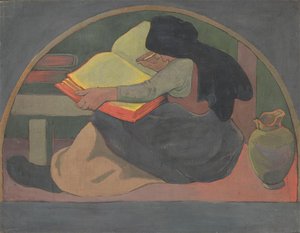
Paul Sérusier’s “Grammar,” painted in 1892, stands as a pivotal work not just within the artist's oeuvre but also as a foundational piece in the development of modern art. More than simply a portrait, it’s an intensely personal and experimental exploration of color, form, and the very nature of representation – a bold step towards abstraction that profoundly influenced generations of artists to come. The painting depicts a woman seated on the ground, absorbed in reading a book, a scene rendered with remarkable intimacy and a deliberate departure from traditional academic styles.
Sérusier’s artistic journey was deeply intertwined with the burgeoning Nabis movement, a group of Symbolist painters who sought to move beyond mere imitation of nature towards expressing inner emotions and spiritual truths. He initially studied at the Académie Julian, but it was his summer sojourn in Pont-Aven, Brittany, that proved transformative. There, under the tutelage of Paul Gauguin – a figure whose influence extended far beyond technique – Sérusier encountered the revolutionary approach of Cloisonnism, championed by Gauguin himself. This style, characterized by sharply defined outlines and areas of flat color applied in small, separate strokes, aimed to mimic the appearance of stained glass, creating a sense of luminous clarity and symbolic resonance.
Cloisonnism and the Language of Color
“Grammar” exemplifies this Cloisonnism technique with striking precision. The woman’s figure is not rendered through subtle gradations of tone but rather defined by bold, distinct outlines – a deliberate simplification that prioritizes color and form over meticulous detail. Sérusier employs a vibrant palette, dominated by deep blues, greens, and ochres, creating an atmosphere both serene and slightly melancholic. The colors aren’t blended; instead, they are applied in small, separate strokes, building up layers of hue and texture. This technique, combined with the flattened perspective, creates a sense of immediacy and directness, as if the painting is capturing a fleeting moment of contemplation.
Crucially, Sérusier’s use of color isn't merely descriptive; it carries symbolic weight. The blues evoke a sense of introspection and mystery, while the greens suggest connection to nature – a key theme in Symbolist art. The muted ochres contribute to the painting’s overall feeling of quietude and contemplation. The deliberate choice of colors, rather than realistic representation, is central to the work's expressive power.
A Study in Form and Abstraction
Beyond its technical mastery, “Grammar” represents a significant shift towards abstraction. While not entirely devoid of recognizable forms – the woman’s figure, the book, the surrounding objects – the painting prioritizes the exploration of color and form over strict representation. The simplified shapes, flattened perspective, and emphasis on pure color anticipate later developments in abstract art, foreshadowing the work of artists like Kandinsky and Mondrian. It's a deliberate move away from photographic realism towards a more subjective and expressive approach to visual language.
The painting’s title, “Grammar,” is particularly intriguing. It suggests that Sérusier was not simply depicting a scene but rather exploring the fundamental building blocks of artistic expression – the elements of color, line, and form – in a way that transcends traditional representation. The book itself becomes a symbol of knowledge and contemplation, inviting the viewer to engage with the painting on a deeper level.
Legacy and Inspiration
“Grammar” remains a vital work in the history of modern art, demonstrating Sérusier’s pioneering spirit and his profound influence on subsequent generations. It's a testament to the power of abstraction to convey emotion, ideas, and spiritual truths. Reproductions of this evocative painting continue to inspire artists and collectors alike, offering a glimpse into the heart of artistic innovation and the enduring quest for new forms of visual expression.
Spørgsmål og svar
Kan jeg bruge augmented reality til at se "The Grammar" af Paul Sérusier i mit eget rum?
Se "The Grammar" af Paul Sérusier på din egen væg via kunstværkets Se i AR-side ved hjælp af augmented reality på en kompatibel enhed.
Hvordan relaterer stilen i "The Grammar" sig til kunstnerens samtid?
"The Grammar" af Paul Sérusier tilhører Cloisonnism / Nabis-bevægelsen fra sin skabers det 19. århundrede-æra.
Hvor mættede og intense er farverne i "The Grammar" af Paul Sérusier?
Farven på "The Grammar" har en mætning på Muted og en intensitet på Monochromatic.
Quick facts and art quiz
About Paul Sérusier

Paul Sérusier
1864 - 1927, Frankrig
Kunstnerbiografi
Early Life and Artistic Beginnings
Paul Sérusier, født den 9. november 1864 i Paris, var en fransk maler, hvis navn i dag er synonymt med pionerkraften inden for abstrakt kunst og som en central figur i det banebrydende kunstnergruppeverk, Les Nabis. Hans barndom var præget af en velhavende familie, hvor hans far, en succesfuld parfumeringsmester af holstensk herkomst, sørgede for et godt uddannelsesgrundlag for sin søn. I 1885 meldte Sérusier sig ind på Académie Julian i Paris, et kunstakademi kendt for at fremme en mere fri og eksperimenterende tilgang til maleriet – en kontrast til de traditionelle, stive normer ved École des Beaux-Arts. Det var her, han begyndte sin rejse mod at definere sit eget unikke udtryk, og det var også her, han mødte Maurice Denis, som senere ville blive en af hans nærmeste samarbejdspartnere. Sérusier havde dog en tidlig fascination for filosofi, hvilket førte til studier i Athen i 1886. Denne periode med intellektuel udforskning var dog kortvarig, og han vendte tilbage til Paris med et klart ønske om at forfølge sin kunstneriske drøm. Det var under en sommerrejse til Pont-Aven i Bretagne, en landsby kendt for sine malere og kunstnere, at Sérusier virkelig fandt sin retning. Her blev han introduceret til Paul Gauguin, en kunstner der allerede var kendt for sin ukonventionelle stil og sit fokus på farve og form.The Talisman and the Dawn of Abstraction
Det var i Pont-Aven, at Sérusier skabte sit mest berømte værk, *Le Talisman* (1888). Maleriet er et afgørende øjeblik i kunsthistorien, da det repræsenterer en markant overgang mod abstraktion. Under Gauguins vejledning eksperimenterede Sérusier med at fange essensen af naturen snarere end blot at gengive dens ydre udseende. Han brugte stærke, rene farver og simple geometriske former til at skabe et billede, der var mere fokuseret på følelser og indtryk end på realistisk repræsentation. Gauguin opfordrede Sérusier til at frigøre sig fra traditionelle maleteknikker og i stedet bruge farve som et middel til at udtrykke personlige oplevelser og åndelige ideer – en tankegang, der var central for Les Nabis' kunstneriske filosofi. *Le Talisman* er derfor ikke blot et maleri; det er et symbol på den nye æra i kunsten, hvor form og farve blev set som uafhængige elementer, der kunne bruges til at skabe en dybere og mere intim forbindelse mellem betragteren og kunstværket.The Nabis and the Pursuit of Synthesis
Sérusier var en central figur i gruppen Les Nabis (der betyder "profeterne" på hebraisk), som omfattede Paul Gauguin, Maurice Denis, Pierre Bonnard og Édouard Vuillard. Denne gruppe af kunstnere delte et fælles ønske om at bryde med den traditionelle akademiske kunst og skabe en ny æstetik, der kombinerede elementer fra religiøs symbolik, dekorativ kunst og moderne farveteknikker. Les Nabis var ikke blot en kunstnerisk gruppe; de var også en intellektuel kreds, der diskuterede filosofi, litteratur og musik. De søgte at skabe et samlet kunstnerisk udtryk, der omfavnede alle former for æstetisk oplevelse – fra maleri til design til arkitektur. Sérusier bidrog væsentligt til gruppen ved at fremme ideen om, at kunst ikke blot skulle være en gengivelse af den ydre verden, men også et udtryk for indre følelser og åndelige opleveler. Han var især interesseret i at forene dekoration og fine kunst, en tankegang der var inspireret af Arts and Crafts-bevægelsen i England.Later Years and Legacy
I de senere år af sit liv underviste Sérusier på École Ranson, som han selv havde hjulpet med at grundlægge, og udgav sin bog *ABC de la peinture* (1921), hvor han beskrev sine tanker om kunstens natur. Paul Sérusier døde den 7. oktober 1927 i Morlaix. Hans arbejde har haft en enorm indflydelse på udviklingen af abstrakt kunst og har inspireret generationer af kunstnere. Han er husket som en pioner, der var villig til at udfordre konventionerne og eksperimentere med nye former for udtryk – en visionær, der banede vejen for den moderne kunsts mange retninger. Hans værker fortsætter med at fascinere og inspirere os i dag, og hans arv lever videre gennem de mange kunstnere, han har påvirket.Quick facts about Paul Sérusier
- Artistic Movement Or Style: Post-Impressionisme
- Artists Or Movements Influenced By This Artist:
- Nabis
- Synthetisme
- Artists Who Influenced This Artist:
- Paul Gauguin
- Maurice Denis
- Date Of Birth: 9. november 1864
- Date Of Death: 7. oktober 1927
- Full Name: Louis-Paul-Henri Sérusier
- Nationality: Fransk
- Notable Artworks:
- L'averse (1893)
- Portræt af Paul Ranson (1890)
- Melancholy (1890)
- Slangeædere (1894)
- Place Of Birth: Paris, Frankrig
Lignende kunstværker




Udforsk kunstværker organiseret efter temaer, stilarter og karakteristika.


Paul Sérusier
The Grammar
() ·
With its frame: · Hand-painted in oil on linen
Total