

Vist: · Inklusive ramme:
 Se i rummet
 Del som kort
 Del
Del
 Detaljer
 Guide
Guide

 Download
 Lignende værker
 Røntgenundersøgelse
 Diasshow
 Spørgsmål og svar
 Statistikker


Dkr 1797
Håndlavet oliereproduktion
Håndmalet olie på lærred i din valgte størrelse og ramme, udført efter bestilling af vores kunstnere. ( Skift til printsalg Skift til digitalt billede)
Størrelse
·Standardstørrelse
speciallavet
CM
INCH
Vælg mellem vores forudindstillede størrelser, der matcher kunstværkets originale proportioner.
Indlæser størrelser...

bredde
højde
Indtast den bredde og højde, du har brug for, så det passer til din ramme eller din væg. Da dette er håndmalet, kan kunstneren ved en anden form på størrelsen male lidt mere rundt om billedet eller skære lidt væk — det er op til dig. Vi sender dig et digitalt mockup til godkendelse, før maleriet påbegyndes. Billedet, der vises på denne side, viser ikke det endelige resultat — det er kun mockuppet, der gør.
 Læs mere
Afslut
·
Hvid kant Dkr1

Udvasket kant Dkr1

Fortsat motiv Dkr1

P118B Dkr10

P118H Dkr10

P118W Dkr10

P438Z Dkr10

P508JH Dkr12

P508YH Dkr12

P805H Dkr10

P805Z Dkr10

P919BZ Dkr10

P919G Dkr10

P919XJ Dkr10

P959ZH Dkr10

P968JZ Dkr12

W106C Dkr8

W218G Dkr10

W218JH Dkr8

W218Y Dkr10

W307PJ Dkr10

W316G Dkr10

W316PJ Dkr8

W316Y Dkr10

W398PJ Dkr8

W4111J Dkr10

W500HY Dkr15

W500JH Dkr15

W692G Dkr12

W849H Dkr8

W940BG Dkr15

W953PJ Dkr8

H24-GOLD Dkr30

H24-SILVER Dkr30

H36-GOLD Dkr45

H36-SILVER Dkr45
Sendes i et beskyttende rør, klar til at blive indrammet hos din egen indrammer.
Over 105 cm sendes rammen som et sæt til en professionel indrammer — læs detaljerne.
Tillægsydelser
valgfritHvad indeholder de ekstra tilvalg?
Eksempler på hvad kan ændres: Udskift ansigt med kundens eget foto; Tilføj kæledyr (f.eks. udskift kat med hund); Inkluder skjult besked i baggrunden; Skift baggrundslandskab eller elementer.
Efter bestilling vil TopImpressionists.com-teamet sende en e-mail til kunden for at få instruktioner og levere et udkast til forhåndsvisning
Efter bestilling vil TopImpressionists.com-teamet sende en e-mail til kunden for at få instruktioner og levere et udkast til forhåndsvisning
Verdensomspændende levering () på 3-4 uger i stedet for de standard 5 uger. (6 november). Ingen kompromiser med kvaliteten.
Beskyttende fernis
Navneskilt
Detaljer om indgraveret bronzeskilt
This elegant plaque features the artist's name and the title of the artwork, finely engraved for a timeless presentation.
It is made from bronze with a refined, elegant finish. The text is precisely laser-engraved for a sharp and permanent result. Measuring 9x2 cm, the plaque is compact yet easy to read. It's built to be durable and scratch-resistant, offering a professional, museum-quality look. Mounting is simple thanks to the included adhesive backing.
Detaljer om gennemsigtig akrylplade
The plaque includes essential engraved details such as the artist's name, the title of the artwork, the date it was created, the type of media used-like oil on canvas or watercolor-a brief description of the piece, and a QR code that links to the complete artwork information.
It is crafted from clear acrylic, offering a sleek, modern appearance. The text is UV-engraved in black to ensure strong visual contrast. With a size of 10x15 cm, it ensures optimal readability. It comes equipped with two metal hooks for secure wall mounting. The plaque is designed to be weather-resistant, making it suitable for various environments, and it includes interactive features that work seamlessly with smartphone scanning.
Detaljer om sort akrylplade
This elegant plaque includes engraved information such as the artist's name, the title of the artwork, the date it was created, the type of media used (like oil on canvas or watercolor), a short description of the artwork, and a QR code for quick access to more information.
The plaque itself is made from refined black acrylic with a premium finish. The text is laser-engraved in white for high contrast and readability. Its size is 10x15 cm, designed to be easy to read. It comes with two metal hooks for professional mounting. The design is sleek and fits any interior style. It is also weather-resistant and durable, with built-in digital integration for mobile compatibility.
Glasmulighed er kun tilgængelig i størrelser under 110 cm
 Glasmulighed er kun tilgængelig i størrelser under 110 cm
- Gratis ekspresforsendelse til hele verden
- Lærred af linned i høj kvalitet
- Fuld transportforsikring
- Garanti for refusion af told og importafgifter
- Garanti for præcis farvegengivelse
- 100 dages returret ved fabrikationsfejl
- 100% fuld returret
- Mængderabat ved flere køb


Beskrivelse af samlerobjektet
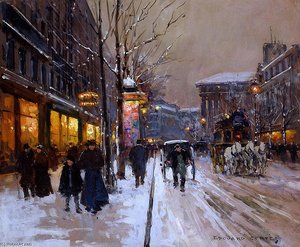
Robert Henri’s "Snow in New York" (1902) captures a gritty NYC street scene with thick impasto and muted tones, reflecting the Ashcan School's realism. Explore urban life through this iconic painting.
Kunstnerbiografi
Robert Henri (1865-1929) var en amerikansk maler, kendt for sin realistiske stil og portrætter af hverdagsfolk. En pioner indenfor Ashcan School og en vigtig indflydelse på amerikansk kunst.
Om maleriet
A Winter’s Gaze: Robert Henri's "Snow in New York"
Robert Henri’s “Snow in New York,” painted in 1902, isn’t merely a depiction of a snowy street; it’s a raw, almost brutal, distillation of urban life captured with an unprecedented honesty for its time. Far removed from the idealized landscapes favored by many of his contemporaries, Henri plunges headfirst into the gritty reality of New York City, presenting a scene both familiar and profoundly unsettling. The painting immediately commands attention not through picturesque beauty, but through its stark simplicity and the palpable sense of unease it evokes – a feeling that speaks volumes about the burgeoning anxieties of a rapidly changing America.
Henri’s style firmly places “Snow in New York” within the Ashcan School movement. Rejecting the academic traditions of the National Academy of Design, the Ashcan painters sought to portray everyday life—often the less glamorous aspects—with unflinching realism. This isn't a romanticized view; instead, we encounter a common side street, devoid of grand avenues or iconic landmarks. The composition is deliberately straightforward, utilizing a single-point perspective that draws the eye directly into the scene, emphasizing its immediacy and lack of embellishment. Thick impasto—a technique where paint is applied thickly to create texture—dominates the canvas, lending a tactile quality to the buildings, the snowdrifts, and even the figures traversing the street. The muted palette – browns, grays, and whites – further contributes to the painting’s somber mood, creating an atmosphere of quiet desperation.
The Painter's Perspective: Henri and the Ashcan School
Understanding Robert Henri requires acknowledging his pivotal role in shaping the Ashcan School. Born Robert Henry Cozad in Cincinnati in 1865, Henri’s early life was marked by instability following a fatal shooting involving his father. This event profoundly shaped his artistic vision, leading him to embrace a radical approach to painting—one that prioritized direct observation and honest representation over idealized beauty. Henri's time in Paris exposed him to the Impressionists, but he quickly moved beyond their focus on light and color, seeking instead to capture the essence of American life with unflinching detail. He famously declared that art should be “akin to journalism,” mirroring the straightforwardness and social commentary found in contemporary newspapers.
Henri’s studio became a hub for a group of like-minded artists—including George Luks, Everett Shinn, and William Glackens—collectively known as the "Philadelphia Four." They gathered regularly to discuss art, literature, and philosophy, fostering a spirit of experimentation and challenging established artistic conventions. This collaborative environment fueled their shared desire to depict the realities of urban America, often focusing on marginalized communities and the struggles faced by ordinary people.
Symbolism in the Streetscape
While seemingly simple, “Snow in New York” is rich with symbolic meaning. The absence of grand buildings or recognizable landmarks suggests a sense of anonymity and isolation within the vastness of the city. The figures walking along the street—carrying handbags, bundled in coats—represent the everyday lives of New Yorkers, their faces obscured by the gloom, lost in their own thoughts. The snow itself acts as a metaphor for both hardship and resilience – covering the streets but also creating a temporary sense of stillness. The presence of a wagon suggests commerce and the relentless cycle of urban activity, highlighting the constant struggle for survival.
Notably, Henri’s choice to depict a common street rather than a major avenue is significant. It reflects his deliberate rejection of romanticized views of New York and his focus on the overlooked corners of the city—the places where life unfolded with quiet intensity. The painting isn't about spectacle; it’s about capturing the essence of an ordinary day in an extraordinary place.
A Legacy of Realism
“Snow in New York” remains a powerful testament to Robert Henri’s artistic vision and his pioneering role in American art. It stands as a crucial example of the Ashcan School, demonstrating a commitment to realism, social commentary, and an honest portrayal of urban life. Reproductions of this evocative painting continue to resonate with viewers today, offering a glimpse into the heart of early 20th-century New York—a city grappling with rapid change, industrialization, and the challenges of modernity. Its enduring appeal lies in its ability to capture not just a scene, but also the complex emotions and experiences of those who lived within it.
Spørgsmål og svar
Hvilken følelse formidler "Snow in New York" af Robert Henri?
Den emotionelle stemning, der er registreret for "Snow in New York" af Robert Henri, er Melancholic. Den opsummerer den følelse, som værket udtrykker.
Hvilket medie er "Snow in New York" af Robert Henri udført i?
"Snow in New York" af Robert Henri er udført i Acrylic On Canvas. Reproduktionerne har til formål at gengive denne tekniks visuelle udtryk.
Fra hvilket land stammer Ashcan School-værket "Snow in New York"?
Det Ashcan School værk "Snow in New York" blev skabt af en kunstner født i USA.
Hurtige fakta og kunstquiz
Om Robert Henri

Robert Henri
1865 - 1929, USA
Kunstnerbiografi
A Turbulent Genesis: The Early Life of Robert Henri
Robert Henri, født den 24. juni 1865 i Cincinnati, Ohio, bar fra barnsben en dyb følelse af forfremmelse og omdefinering, der ville forme både hans liv og kunst på dybtgående måder. Hans barndom var langt fra idyllisk; præget af den ustabile relation mellem hans far, John Jackson Cozad – en mand drevet af ambitioner og risikovillighed som gambler og ejendomsmægler – og hans mor, Theresa Gatewood Cozad. Denne uro kulminerede i 1882 med et tragisk skudduel over en jordstrid, der tvang familien til at flygte og antage nye identiteter for at undslippe hævn. Den unge Robert blev Robert Henri, en bevidst afskedigelse fra en fortid præget af konflikt og en symbolsk genfødsel som kunstner. Vestpårejserne gennem Nebraska og Colorado, der endte med etablering i New York City og derefter Atlantic City, indgydte ham en dyb empati for dem, der levede på samfundets yderkanter – en empati, der ville blive en afgørende del af hans kunstneriske vision. Denne tidlige oplevelse af kaos og omdefinering fremmede et åndeligt uafhængighedspræg og en forpligtelse til at skildre livet som det virkelig var, uden at være bundet af konventioner eller samfundsmæssige forventninger.Forging a New Vision: Artistic Development and Influences
Henris formelle kunstneriske uddannelse begyndte på Pennsylvania Academy of the Fine Arts i Philadelphia under Thomas Anshutz, hvor han finpudsede sine tekniske færdigheder. Men det var hans efterfølgende rejse til Paris i 1888, der virkelig antændte hans kunstneriske opvågning. I første omgang tiltrukket af den akademiske tradition på Académie Julian og påvirket af mestre som William-Adolphe Bouguereau og François Millet, bevægede Henri gradvist sig mod Impressionismen. Alligevel var han ikke tilfreds med blot at gengive det, han så; han søgte en dybere engagement med virkeligheden – en måde at fange ikke kun de flygtende effekter af lys, men også den rå følelse og vitalitet i moderne liv. Dette stræben førte ham til at omfavne en mere dristig, direkte tilgang, inspireret af den hollandske realist Franz Hals, hvis løse penselstrøg og psykologiske indsigt resonerede dybt med Henri’s egen kunstneriske sans. Han begyndte at eksperimentere med *pochades*, små træplader, der blev brugt til hurtige skitser, hvilket fremmede spontanitet og øjeblikkelighed i hans arbejde. Ved hjemkomsten til Amerika blev han en dedikeret lærer, ikke kun underviste i teknik, men også i en filosofi om kunst, rodfæstet i observation, ærlighed og individuel udtryksevne.Championing the Real: The Ashcan School and “The Eight”
Robert Henri’s indflydelse på amerikansk kunst strækker sig langt ud over hans egne malerier; han blev en katalysator for forandring, udfordrede den konservative norm i det etablerede kunstmiljø. Han var en central figur i fremkomsten af Ashcan School – en gruppe kunstnere, der dristigt skildrede de grusomme realiteter i bylivet, fra travle gader til overfyldte lejligheder. Henri’s forpligtelse til realismen og hans afvisning af akademisk pragt førte ham til at organisere “The Eight” i 1908 – en kollektiv af ligesindede kunstnere, herunder William Glackens, George Luks, Everett Shinn og John Sloan – der arrangerede en uafhængig udstilling som en direkte protest mod de restriktive politikker fra National Academy of Design. Denne handling var et vendepunkt i amerikansk kunsthistorie, hvilket signalerede en skift væk fra europæisk dominans og hen imod en unikt amerikansk kunstnerlig stemme. Henri’s malerier i denne periode, såsom “Woman in Manteau” (1899) og hans evokende portrætter, fangede ærligheden og modstandsdygtigheden hos almindelige mennesker, hvilket tilbød et kraftfuldt alternativ til de idealiserede repræsentationer, der blev foretrukket af den etablerede orden.Legacy and Enduring Influence
Robert Henri’s indflydelse på efterfølgende generationer af amerikanske kunstnere er uforståelig. Som lærer mentorerede han en bemærkelsesværdig række talenter, herunder Joseph Stella, Edward Hopper, Rockwell Kent, George Bellows og Louis D. Fancher – kunstnere, der ville forme kunstens forløb i det 20. århundrede. Hans bog, *The Art Spirit*, udgivet posthumt i 1923, er en tidløs tekst for spirende kunstnere, der tilbyder værdifuld visdom om observation, teknik og vigtigheden af kunstnerisk integritet. *Henri’s engagement i at skildre livet med ærlighed og empati*, hans afvisning af konventioner og hans urokkelige tro på kunstens kraft til at forbinde sig med publikum inspirerer stadig kunstnere i dag. Hans malerier er ikke blot repræsentationer af virkeligheden; de er vinduer ind i den menneskelige tilstand – vidnesbyrd om livets skønhed, kamp og modstandsdygtighed. Han efterlod et uforglemmeligt aftryk på amerikansk Realisme, banede vejen for en mere demokratisk og inkluderende kunstverden, der fejrede de almindelige oplevelser hos almindelige mennesker. Hans arv lever videre ikke kun gennem hans mesterlige værker, men også gennem de utallige kunstnere, han inspirerede til at finde deres egen stemme og fortælle deres egne historier.Hurtige fakta om Robert Henri
- Artistic Movement Or Style: Ashcan School, Realisme
- Artists Or Movements Influenced By This Artist:
- Edward Hopper
- The Eight
- Artists Who Influenced This Artist:
- William Bouguereau
- François Millet
- Date Of Birth: 24. juni 1865
- Date Of Death: 12. juli 1929
- Full Name: Robert Henri
- Nationality: Amerikansk
- Notable Artworks:
- La Neige
- Woman in Manteau
- Place Of Birth: Cincinnati, USA
Lignende kunstværker




Udforsk kunstværker organiseret efter temaer, stilarter og karakteristika.


Robert Henri
Snow in New York
() ·
Inklusive ramme: · Håndmalet med olie på lærred
Totalbeløb