

Shown: · With its frame:
 Se i rummet
 Del som kort
 Del
Del
 Detaljer
 Guide
Guide

 Download
 Lignende værker
 Røntgenundersøgelse
 Diasshow
 Q&A
Q&A Statistikker


Dkr 1788
Håndlavet oliereproduktion
Håndmalet olie på lærred i din valgte størrelse og ramme, udført efter bestilling af vores kunstnere. ( Skift til printsalg Skift til digitalt billede)
Size
·Standardstørrelse
speciallavet
CM
INCH
Vælg mellem vores forudindstillede størrelser, der matcher kunstværkets originale proportioner.
Loading sizes...

bredde
højde
Indtast den bredde og højde, du har brug for, så det passer til din ramme eller din væg. Da dette er håndmalet, kan kunstneren ved en anden form på størrelsen male lidt mere rundt om billedet eller skære lidt væk — det er op til dig. Vi sender dig et digitalt mockup til godkendelse, før maleriet påbegyndes. Billedet, der vises på denne side, viser ikke det endelige resultat — det er kun mockuppet, der gør.
 Læs mere
Finish
·
White Dkr1

Blurside Dkr1

Extended Dkr1

P118B Dkr10

P118H Dkr10

P118W Dkr10

P438Z Dkr10

P508JH Dkr12

P508YH Dkr12

P805H Dkr10

P805Z Dkr10

P919BZ Dkr10

P919G Dkr10

P919XJ Dkr10

P959ZH Dkr10

P968JZ Dkr12

W106C Dkr8

W218G Dkr10

W218JH Dkr8

W218Y Dkr10

W307PJ Dkr10

W316G Dkr10

W316PJ Dkr8

W316Y Dkr10

W398PJ Dkr8

W4111J Dkr10

W500HY Dkr15

W500JH Dkr15

W692G Dkr12

W849H Dkr8

W940BG Dkr15

W953PJ Dkr8

H24-GOLD Dkr30

H24-SILVER Dkr30

H36-GOLD Dkr45

H36-SILVER Dkr45
Shipped in a protective tube, ready for your own framer.
Above 105 cm the frame is shipped as a kit for a professional framer — read the details.
Extras
optionalWhat do the extras include?
Examples of what can be changed: Replace face with customer photo; Add pet (e.g., replace cat with dog); Include hidden message in background; Change background landscape or elements.
After order, TopImpressionists.com team will email client for instructions and provide a mockup preview
After order, TopImpressionists.com team will email client for instructions and provide a mockup preview
Verdensomspændende levering () på 3-4 uger i stedet for de standard 5 uger. (2 november). Ingen kompromiser med kvaliteten.
Beskyttende fernis
Navneskilt
Detaljer om indgraveret bronzeskilt
This elegant plaque features the artist's name and the title of the artwork, finely engraved for a timeless presentation.
It is made from bronze with a refined, elegant finish. The text is precisely laser-engraved for a sharp and permanent result. Measuring 9x2 cm, the plaque is compact yet easy to read. It's built to be durable and scratch-resistant, offering a professional, museum-quality look. Mounting is simple thanks to the included adhesive backing.
Detaljer om gennemsigtig akrylplade
The plaque includes essential engraved details such as the artist's name, the title of the artwork, the date it was created, the type of media used-like oil on canvas or watercolor-a brief description of the piece, and a QR code that links to the complete artwork information.
It is crafted from clear acrylic, offering a sleek, modern appearance. The text is UV-engraved in black to ensure strong visual contrast. With a size of 10x15 cm, it ensures optimal readability. It comes equipped with two metal hooks for secure wall mounting. The plaque is designed to be weather-resistant, making it suitable for various environments, and it includes interactive features that work seamlessly with smartphone scanning.
Detaljer om sort akrylplade
This elegant plaque includes engraved information such as the artist's name, the title of the artwork, the date it was created, the type of media used (like oil on canvas or watercolor), a short description of the artwork, and a QR code for quick access to more information.
The plaque itself is made from refined black acrylic with a premium finish. The text is laser-engraved in white for high contrast and readability. Its size is 10x15 cm, designed to be easy to read. It comes with two metal hooks for professional mounting. The design is sleek and fits any interior style. It is also weather-resistant and durable, with built-in digital integration for mobile compatibility.
Glasmulighed er kun tilgængelig i størrelser under 110 cm
 Glasmulighed er kun tilgængelig i størrelser under 110 cm
- Gratis ekspresforsendelse til hele verden
- Lærred af linned i høj kvalitet
- Fuld transportforsikring
- Garanti for refusion af told og importafgifter
- Garanti for præcis farvegengivelse
- 100 dages returret ved fabrikationsfejl
- 100% fuld returret
- Mængderabat ved flere køb


Beskrivelse af samlerobjektet
Kunstnerbiografi
Théo van Rysselberghe: En pioner indenfor neo-impressionismen med sit unikke lysspil og farvebrug. Oplev hans billeder fra Morocco og Belgien!
About the painting
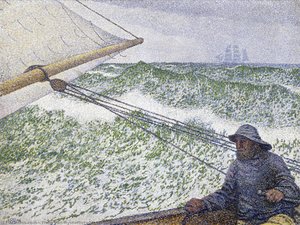
A Symphony of Light and Motion: Theo van Rysselberghe’s “Man at the Helm”
Theo van Rysselberghe, a Belgian painter who profoundly shaped the artistic landscape of his era, stands as a pivotal figure bridging Impressionism's sensual exploration with Neo-Impressionism’s scientific rigor. His artistic journey began in Ghent, Belgium, where he honed his skills under Theo Canneel at the Academy of Ghent before progressing to the Académie Royale des Beaux-Arts in Brussels, guided by Jean-François Portaels—a teacher whose influence extended beyond mere instruction, introducing him to the burgeoning fascination with Orientalism. This formative period instilled within him a foundational understanding of realism, beautifully exemplified in early works like *Self-Portrait with Pipe* (1880), where meticulous detail and somber hues mirrored the artistic sensibilities prevalent in Belgium at the time. Yet, even amidst these initial explorations, Van Rysselberghe’s gaze was already attuned to the transformative power of light—a preoccupation that would define his subsequent oeuvre.Inspired by Sailings: The Olympia Expedition
The genesis of “Man at the Helm” lies in a singular experience: Van Rysselberghe's participation in an ambitious yacht voyage aboard Olympia with fellow Impressionist Paul Signac. This expedition, undertaken in 1892, served as a catalyst for artistic innovation, propelling him toward a stylistic approach that prioritized capturing fleeting moments of light and movement—a hallmark of Divisionism. The turbulent waters depicted in the painting weren’t merely a backdrop; they represented a deliberate challenge to traditional representation, mirroring Signac's own commitment to portraying nature with unprecedented vibrancy and accuracy. This shared passion for maritime pursuits directly informed Van Rysselberghe’s artistic vision.Divisionist Technique: Precise Dots of Color
“Man at the Helm” exemplifies Divisionism—a technique championed by Signac and championed by Van Rysselberghe himself. Unlike Impressionists who blended colors on the canvas, Divisionists meticulously applied small dots of pure pigment onto the surface, allowing them to optically blend in the viewer’s eye. This method demanded painstaking precision and rewarded a heightened sensitivity to color perception—a characteristic that distinguishes Van Rysselberghe's work from its predecessors. The artist skillfully utilized this technique to render the choppy waves with remarkable fidelity, conveying both their visual texture and emotional impact. Each dot of pigment contributes to an overall impression of dynamism and luminosity, mirroring the energy of the sea itself.Symbolism Within Tranquility: A Portrait of Determination
Beyond its technical brilliance, “Man at the Helm” resonates with symbolic significance. The solitary figure at the helm embodies resilience and unwavering focus—a testament to human perseverance amidst adversity. The boat itself symbolizes navigation through life’s challenges, while the turbulent waters represent obstacles encountered on one's journey. Van Rysselberghe’s masterful composition draws attention to the central subject, placing him at an angle on the canvas – a stylistic choice that amplifies the feeling of movement and underscores the importance of maintaining composure in difficult circumstances.A Legacy Preserved: Musée d’Orsay and Artistic Context
Currently housed within the Musée d’Orsay in Paris, “Man at the Helm” occupies a prominent position within the museum's celebrated collection of French art from 1848 to 1914—a period marked by groundbreaking artistic experimentation. Alongside works by Impressionists like Pierre Bonnard and Monet, Van Rysselberghe’s painting stands as an emblem of Neo-Impressionism’s contribution to the broader artistic dialogue of its time. Its enduring appeal lies not only in its aesthetic beauty but also in its ability to convey a profound emotional truth—a reminder that even amidst chaos, human spirit can triumph through unwavering resolve and careful observation.Spørgsmål og svar
Er farverne i "Man at the Helm" af Théo van Rysselberghe mættede eller dæmpede?
Farvepaletten i "Man at the Helm" har en mætning på Subtle Color.
Hvad er årsagen til ophavsretsstatus for "Man at the Helm" af Théo van Rysselberghe?
"Man at the Helm" af Théo van Rysselberghe er i det offentlige domæne – ophavsretten er udløbet. Ophavsretten beregnes ud fra kunstnerens dødsår, og Théo van Rysselberghe døde i 1926.
Hvornår blev "Man at the Helm" skabt, og hvilken stilart tilhører det?
"Man at the Helm" blev skabt i 1892 som et værk inden for Neo-Impressionism-bevægelsen. Datoen og stilen forankrer kunstværket i kunsthistorien.
Quick facts and art quiz
About Théo van Rysselberghe

Théo van Rysselberghe
1862 - 1926, Belgien
Kunstnerbiografi
Théo van Rysselberghe: En Pioner af Lys og Farve i Belgiens Kunsthistorie
Théophile “Théo” van Rysselberghe, født i Ghent i Belgien i 1862, var en central figur, der brolagde mellem impressionismen og den nye bevægelse, Neo-impressionismen. Hans kunstneriske rejse var ikke en brat stilskifte, men snarere en gradvis udforskning, drevet af rejser, intellektuelt udveksling og en vedvarende søgen efter at fange lysets essens. Voksende op i en velhavende fransk-talende familie, modtog van Rysselberghe sin første kunstneriske træning på Ghents Akademi under Theo Canneel, før han fortsatte sine studier på det prestigefyldte Académie Royale des Beaux-Arts i Bruxelles. Disse formative år gav ham et solidt fundament i traditionel realisme, hvilket ses tydeligt i tidlige værker som *Self-Portrait with Pipe* (1880), præget af dæmpede toner og omhyggelig detalje – en refleksion over Belgiens dominerende kunstneriske klima på det tidspunkt. Alligevel begyndte der allerede i disse tidlige stykker at spire en følsomhed for lys og farve, som ville forme hans fremtidige stil. Et markant værk fra denne periode, *Child in an Open Spot of the Forest* (1880), signalerede et subtilt afsæt, der antydede den lysere palet og mere løse penselstrøg, der skulle definere hans senere arbejde.Impressioner fra Marokko og Fødslen af Les XX
En transformerende periode i van Rysselberghe’s liv udspillede sig med hans rejser til Marokko mellem 1882 og 1888. Disse lange ophold dykkede ham ned i en verden af levende farver, intenst sollys og eksotiske landskaber – et skarp kontrast til de dæmpede toner i hans tidligere værker. Malerier som *Arabian Street Cobbler* (1882), *Arabian Boy* (1882) og *Resting Guard* (1883) demonstrerer en voksende fascination med at fange lysets virkninger på formen, bevægende sig væk fra streng realisme mod en mere impressionistisk sans. Den marokkanske oplevelse var ikke blot en visuel observation; det var en indtrængning i en anden kultur, der udvidede hans kunstneriske horisonter og efterlod ham med en livslang kærlighed til rejser. Ved sin tilbagekomst til Bruxelles blev van Rysselberghe en drivende kraft i den belgiske kunstscene, hvor han sammen med Octave Maus og Émile Verhaeren grundlagde det indflydelsesrige kunstkollektiv *Les XX* (De Tyve) i 1883. Denne gruppe fungerede som en platform for at fremvise avantgarde-kunst, introducere nye bevægelser som Impressionisme og Symbolisme til et belgisk publikum, der primært var ukendt med disse innovationer. *Arabian Phantasia* (1884), et stort format maleri af det eksotiske, blev hans mest berømte værk fra denne periode, der demonstrerede hans mesterskab inden for lys og komposition.Embracering af Neo-Impressionisme: En Videnskabelig Tilgang til Farve
Det egentlige vendepunkt i van Rysselberghe’s kunstneriske udvikling indtraf med hans møde med Georges Seurats *A Sunday on La Grande Jatte* på den ottende Impressionistiske udstilling i Paris i 1886. I første omgang skeptisk over for Seurats metoder – den systematiske anvendelse af små, rene farvepunkter – begyndte van Rysselberghe gradvist at værdsætte dens videnskabelige grundlag og potentiale for at opnå lysende effekter. Han begyndte at eksperimentere med divisionismen, den Neo-Impressionistiske metode til at adskille farver i deres bestanddele og lade betragterens øje blande dem optisk. Dette var ikke blot en teknisk ændring; det repræsenterede et fundamentalt skift i hans tilgang til maleri – et skift mod en mere analytisk og objektiv repræsentation af lys og farve. Han indgik tæt venskabelige relationer med andre Neo-Impressionistiske malere som Paul Signac, hvor han rejste med ham langs den franske Riviera og udvekslede ideer om teknik og teori. Van Rysselberghe skil sig ud i bevægelsen ved at anvende pointillisme ikke kun på landskaber, men også på portrætter, hvilket skabte slående levende og psykologisk indsigtfulde gengivelser af sine familiemedlemmer og en tæt kreds af venner – værker som *Madame Charles Maus* (1890) er eksempler herpå.Ud over Pointillisme: En Varig Arv
Selvom han var dybt forpligtet til Neo-Impressionismen i en betydelig periode, bevægede van Rysselberghe sig senere væk fra dens strenge dogmer i slutningen af 1890’erne. Han søgte større frihed i sine penselstrøg og kompositioner, udforskede nye måder at udtrykke følelser og atmosfære på. Han fortsatte med at være en produktiv kunstner, der arbejdede i forskellige medier, herunder møbeldesign, bogillustration og dekorative kunstarter. Hans indflydelse spredte sig langt ud over Belgien og påvirkede kunstnere som Piet Mondrian og Jan Toorop, der blev inspireret af hans innovative brug af farve og lys. Van Rysselberghe’s arv ligger ikke kun i hans smukke malerier, men også i hans rolle som en katalysator for kunstnerisk forandring – en champion af modernismen, der introducerede nye ideer og teknikker til den belgiske kunstscene. Hans værker er nu udstillet i fremtrædende museer verden over, herunder Musée du Luxembourg i Paris og Museum voor Schone Kunsten i Gent, hvilket sikrer, at hans bidrag til kunsthistorien fortsat fejres og værdsættes af generationer fremover. *Hans dedikation til at udforske lysets, farvens og formens samspil cementerede hans plads som en sand pioner inden for moderne maleri.*Quick facts about Théo van Rysselberghe
- Artistic Movement Or Style: Neo-Impressionisme
- Artists Or Movements Influenced By This Artist:
- Les XX
- Piet Mondrian
- Jan Toorop
- Artists Who Influenced This Artist:
- Jean-François Portaels
- Georges Seurat
- Paul Signac
- Date Of Birth: 23. november 1862
- Date Of Death: 13. december 1926
- Full Name: Théo van Rysselberghe
- Nationality: Belgier
- Notable Artworks:
- Arabian Phantasia
- Spanish Woman
- Sevillan Woman
- Place Of Birth: Gent, Belgien
Lignende kunstværker







Udforsk kunstværker organiseret efter temaer, stilarter og karakteristika.


Théo van Rysselberghe
Man at the Helm
() ·
With its frame: · Hand-painted in oil on linen
Total