

Shown: · With its frame:
 Se i rummet
 Del som kort
 Del
Del
 Detaljer
 Guide
Guide

 Download
 Lignende værker
 Røntgenundersøgelse
 Diasshow
 Q&A
Q&A Statistikker
St Matthew


Dkr 1772
Håndlavet oliereproduktion
Håndmalet olie på lærred i din valgte størrelse og ramme, udført efter bestilling af vores kunstnere. ( Skift til printsalg Skift til digitalt billede)
Size
·Standardstørrelse
speciallavet
CM
INCH
Vælg mellem vores forudindstillede størrelser, der matcher kunstværkets originale proportioner.
Loading sizes...

bredde
højde
Indtast den bredde og højde, du har brug for, så det passer til din ramme eller din væg. Da dette er håndmalet, kan kunstneren ved en anden form på størrelsen male lidt mere rundt om billedet eller skære lidt væk — det er op til dig. Vi sender dig et digitalt mockup til godkendelse, før maleriet påbegyndes. Billedet, der vises på denne side, viser ikke det endelige resultat — det er kun mockuppet, der gør.
 Læs mere
Finish
·
White Dkr1

Blurside Dkr1

Extended Dkr1

P118B Dkr10

P118H Dkr10

P118W Dkr10

P438Z Dkr10

P508JH Dkr12

P508YH Dkr12

P805H Dkr10

P805Z Dkr10

P919BZ Dkr10

P919G Dkr10

P919XJ Dkr10

P959ZH Dkr10

P968JZ Dkr12

W106C Dkr8

W218G Dkr10

W218JH Dkr8

W218Y Dkr10

W307PJ Dkr10

W316G Dkr10

W316PJ Dkr8

W316Y Dkr10

W398PJ Dkr8

W4111J Dkr10

W500HY Dkr15

W500JH Dkr15

W692G Dkr12

W849H Dkr8

W940BG Dkr15

W953PJ Dkr8

H24-GOLD Dkr30

H24-SILVER Dkr30

H36-GOLD Dkr45

H36-SILVER Dkr45
Shipped in a protective tube, ready for your own framer.
Above 105 cm the frame is shipped as a kit for a professional framer — read the details.
Extras
optionalWhat do the extras include?
Examples of what can be changed: Replace face with customer photo; Add pet (e.g., replace cat with dog); Include hidden message in background; Change background landscape or elements.
After order, TopImpressionists.com team will email client for instructions and provide a mockup preview
After order, TopImpressionists.com team will email client for instructions and provide a mockup preview
Verdensomspændende levering () på 3-4 uger i stedet for de standard 5 uger. (29 oktober). Ingen kompromiser med kvaliteten.
Beskyttende fernis
Navneskilt
Detaljer om indgraveret bronzeskilt
This elegant plaque features the artist's name and the title of the artwork, finely engraved for a timeless presentation.
It is made from bronze with a refined, elegant finish. The text is precisely laser-engraved for a sharp and permanent result. Measuring 9x2 cm, the plaque is compact yet easy to read. It's built to be durable and scratch-resistant, offering a professional, museum-quality look. Mounting is simple thanks to the included adhesive backing.
Detaljer om gennemsigtig akrylplade
The plaque includes essential engraved details such as the artist's name, the title of the artwork, the date it was created, the type of media used-like oil on canvas or watercolor-a brief description of the piece, and a QR code that links to the complete artwork information.
It is crafted from clear acrylic, offering a sleek, modern appearance. The text is UV-engraved in black to ensure strong visual contrast. With a size of 10x15 cm, it ensures optimal readability. It comes equipped with two metal hooks for secure wall mounting. The plaque is designed to be weather-resistant, making it suitable for various environments, and it includes interactive features that work seamlessly with smartphone scanning.
Detaljer om sort akrylplade
This elegant plaque includes engraved information such as the artist's name, the title of the artwork, the date it was created, the type of media used (like oil on canvas or watercolor), a short description of the artwork, and a QR code for quick access to more information.
The plaque itself is made from refined black acrylic with a premium finish. The text is laser-engraved in white for high contrast and readability. Its size is 10x15 cm, designed to be easy to read. It comes with two metal hooks for professional mounting. The design is sleek and fits any interior style. It is also weather-resistant and durable, with built-in digital integration for mobile compatibility.
Glasmulighed er kun tilgængelig i størrelser under 110 cm
 Glasmulighed er kun tilgængelig i størrelser under 110 cm
- Gratis ekspresforsendelse til hele verden
- Lærred af linned i høj kvalitet
- Fuld transportforsikring
- Garanti for refusion af told og importafgifter
- Garanti for præcis farvegengivelse
- 100 dages returret ved fabrikationsfejl
- 100% fuld returret
- Mængderabat ved flere køb


Beskrivelse af samlerobjektet
Discover "St Matthew" by Titian Ramsay Peale II – a rediscovered Renaissance masterpiece showcasing the artist's refined style and attention to detail. Explore this sacred art piece today!
Kunstnerbiografi
Titian Ramsay Peale IIs ikoniske "Døden af Aktaeon" udforsker klassisk mytologi og menneskelig psykologi med imponerende detaljer og dramatiske farver – et mesterværk fra Renæssancen.
About the painting
A Renaissance Echo in American Shores: Titian Ramsay Peale II’s “St Matthew”
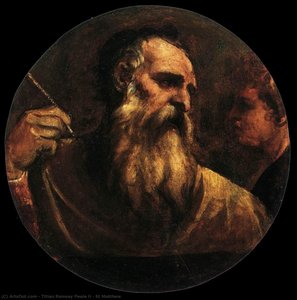
Titian Ramsay Peale II's “St Matthew” is not merely a portrait; it’s a quiet contemplation rendered in oil, a testament to the enduring influence of the High Renaissance filtered through the sensibilities of an early 19th-century American artist. The painting depicts two figures engaged in what appears to be earnest conversation – one, presumably St. Matthew himself, distinguished by a flowing robe and a thoughtful beard, holding a pencil as if poised to capture inspiration. His companion, younger and clean-shaven, listens intently, creating a dynamic interplay of age and experience, wisdom and receptivity. The intimacy of the scene is striking; the figures are closely positioned, drawing the viewer into their private world. The circular frame adds an unusual depth, almost like peering through a window into another time, enhancing the sense of focused introspection.
Inheriting a Legacy: Peale II and the Renaissance Revival
To understand “St Matthew,” one must consider Titian Ramsay Peale II’s lineage. Born in 1799, he was the son of Charles Willson Peale, a pivotal figure in American portraiture and founder of one of the nation's first museums. This familial connection wasn’t simply about inheritance; it was an immersion into a world where art was intertwined with scientific inquiry and civic duty. Peale II consciously embraced the aesthetic principles of the High Renaissance – a period characterized by harmonious composition, idealized forms, and a profound interest in humanism. While many American artists of his time were grappling with distinctly national styles, Peale II looked to Italy for inspiration, specifically to masters like Raphael and Titian (from whom he took his first name), seeking to recreate the elegance and spiritual depth of their work. This dedication to classical ideals is evident in the careful modeling of forms, the subtle use of chiaroscuro – the play of light and shadow – and the overall sense of balance and serenity that permeates “St Matthew.”
Decoding the Symbolism: Faith, Knowledge, and Artistic Creation
The symbolism within "St. Matthew" is layered and invites contemplation. The inclusion of a pencil in the hand of St. Matthew is particularly significant. Traditionally depicted with writing implements like quills or books, the pencil suggests a more modern approach to recording divine inspiration – perhaps alluding to the evolving role of art itself as a means of interpreting faith. It’s a subtle nod towards the artist's own profession and the power of visual representation. The attentive posture of the younger man could represent the burgeoning Christian community or even the artist himself, seeking guidance from the apostle. The painting isn’t a dramatic narrative scene; it’s a moment of quiet revelation, emphasizing the intellectual and spiritual journey inherent in both faith and artistic creation. It's a visual meditation on how knowledge is passed down, interpreted, and ultimately, given new form.
A Rediscovered Voice: The Enduring Appeal of Peale II
For many years, Titian Ramsay Peale II remained somewhat overshadowed by his more famous father and brother, Rembrandt. However, recent scholarship has begun to recognize the unique qualities of his work – a refined technique, a deep understanding of Renaissance principles, and a quiet emotional resonance that sets him apart. “St Matthew” exemplifies this rediscovery. It’s a painting that rewards close viewing, revealing subtle details and inviting viewers to engage with its timeless themes. As an artwork for the modern home, it offers a touch of historical elegance and intellectual depth, capable of transforming any space into a haven of contemplation and beauty. A reproduction of “St Matthew” isn't just acquiring a beautiful image; it’s welcoming a piece of American artistic heritage – a Renaissance echo resonating across time.
Spørgsmål og svar
Hvad er den anbefalede anvendelse af et print af "St Matthew"?
Den foreslåede anvendelse af "St Matthew" af Titian Ramsay Peale II er Accent, men den kan også tjene andre formål.
Hvilke andre navne eller pseudonymer bruger Titian Ramsay Peale II?
Andre navne registreret for Titian Ramsay Peale II, skaberen af "St Matthew", inkluderer Titian Peale.
Hvor kommer de besøgende til "St Matthew" af Titian Ramsay Peale II fra?
Der findes en Besøgsstatistik-side for "St Matthew", som viser de månedlige besøgstal for kunstværket og kunstnerens øvrige værker, opdelt efter land og sprog.
Quick facts and art quiz
About Titian Ramsay Peale II

Titian Ramsay Peale II
1799 - 1885, USA
Kunstnerbiografi
En Renæssanceekko i Den Nye Verden
Titian Ramsay Peale II indtager en fascinerende, ofte overset plads i det 19. århundredes amerikanske kunstlandskab. Født i Philadelphia i 1799 voksede han op i et stærkt kunstnerisk miljø som den yngste søn af Charles Willson Peale, en central figur i tidlig amerikansk portrætkunst og grundlæggeren af nationens første museum. Selvom faderens arv var betydelig, smedede Titian sin egen vej, dybt forankret i de æstetiske idealer fra Højrenæssancen, især dem der udgik fra Venedig. Han blot genskabte ikke stilarter; han kanaliserende en dyb kunstnerisk følsomhed og indgydte sine lærreder med minutiøse detaljer og en levende farvepalet, der adskilte ham fra mange af sine samtidige. Hans liv udfoldede sig i baggrunden af en spirende amerikansk identitet, men hans kunstneriske hjerte forblev bundet til de klassiske mestre, hvilket skabte en overbevisende spænding mellem gammel verdens ærbødighed og ny verdens udtryk.Fra Naturalistens Skitsebog til Malerens Lærred
Peales tidlige år var præget af en dobbelt fascination af kunst og naturhistorie – en kombination fremmet af faderens mangefacetterede bestræbelser. Han deltog i ekspeditioner, bemærkelsesværdigt Stephen Harriman Longs rejse til Rocky Mountains i 1819-20, hvor han dokumenterede flora og fauna med et stadigt mere raffineret kunstnerisk øje. Denne periode handlede ikke blot om at registrere observationer; det handlede om *at forstå* form, lys og tekstur – færdigheder, der skulle vise sig uvurderlige, da han vendte sin fulde opmærksomhed mod malerkunsten. Hans arbejde som naturalist informerede hans kunst, gav en videnskabelig præcision til hans skildringer af naturen, men indgydte dem også med en følelsesmæssig resonans, der overskred blot dokumentation. Han viste os ikke bare, hvordan tingene så ud; han afslørede deres iboende skønhed og åndelige betydning. Denne dedikation til begge discipliner er tydelig i værker som ”The Tribute Money”, en dramatisk gengivelse, der viser mesterlig lys- og skyggeleg i stil med Rubens, og "Nymph and Shepherd", der blander natur, mytologi og sensuel skønhed.Venedigs Indflydelse og Hellige Visioner
Indflydelsen fra venetiansk kolorisme – vægten på rige, lysende farver og atmosfæriske effekter fremmet af kunstnere som Titian (hvorfra han tog sit fornavn) – er uomtvistelig i Peales oeuvre. Han blot kopierede ikke disse mestre; han internaliserede deres principper og tilpassede dem til sin egen kunstneriske vision. Dette ses især i hans religiøse værker, såsom ”Altar Shrine with Four Saints” og "Adoration of the Shepherds". Disse malerier er ikke blot skildringer af bibelske scener; de er fordybende oplevelser, der trækker beskueren ind i en verden af åndelig kontemplation gennem omhyggeligt orkestrerede kompositioner og en mesterlig brug af farve til at fremkalde følelser. Den minutiøse opmærksomhed på detaljer i disse værker taler ikke kun til hans tekniske dygtighed, men også til en dyb ærbødighed for sit emne. ”The Beauty”, et slående portræt, demonstrerer yderligere hans evne til at fange menneskelig form og karakter med elegance og raffinement.Genopdagelse og Varig Betydning
I det meste af det 20. århundrede forblev Titian Ramsay Peale II stort set skjult fra kunsthistoriske fortællinger. Hans arbejde passede ikke pænt ind i de fremherskende tendenser, og hans dedikation til en klassisk stil virkede anakronistisk i et hurtigt skiftende kunstnerisk landskab. Men de seneste år har vidnet om en voksende revurdering af hans bidrag. Forskere og samlere anerkender den unikke blanding af amerikanske følelser og europæiske traditioner, der kendetegner hans malerier. Genopdagelsen af hans arbejde handler ikke blot om at udfylde huller i kunsthistorien; det handler om at opnå en dybere forståelse af de komplekse kulturelle kræfter, der formede det 19. århundredes Amerika. Peale repræsenterer en bro mellem verdener, et vidnesbyrd om klassiske ideals varige kraft og en påmindelse om, at kunstnerisk innovation ofte opstår fra uventede kombinationer af indflydelser. Hans malerier, der nu findes i samlinger som dem på TopImpressionists, Uffizi Gallery og Palazzo Pitti, tilbyder et overbevisende glimt ind i et glemt hjørne af amerikansk kunsthistorie – et hjørne oplyst af renæssancens strålende skær.En Familiearv
- Charles Willson Peale (1741-1827): Titian Ramsay Peales far, en fremtrædende portrætmaler og grundlægger af det første museum i USA. Hans indflydelse var enorm på sin søns kunstneriske udvikling.
- Tidlige interesser: Udover malerkunsten viste Titian Ramsay Peale tidligt en passion for naturhistorie, hvilket førte til deltagelse i flere ekspeditioner og omfattende studier af flora og fauna.
- Stephen Harriman Longs ekspedition (1819-20): Denne rejse til Rocky Mountains var afgørende for Peales udvikling som naturalistisk illustrator, hvor han dokumenterede landskaber og dyreliv med stor præcision.
- Venetiansk kolorisme: Peale blev stærkt påvirket af venetianske maleres brug af rige farver og atmosfæriske effekter, især Titian, som han tog sit fornavn efter.
- U.S. Exploring Expedition (1838-42): Som chefnaturalist på denne ekspedition rejste Peale rundt om Stillehavet og skabte detaljerede illustrationer af eksotiske landskaber og dyreliv.
- Senere liv: Efter en periode med succes som naturalist vendte Peale tilbage til malerkunsten, men hans arbejde blev i vid udstrækning overset indtil for nylig.
Kort om kunstneren
- Bemærkelsesværdige Værker:
- Altar Shrine
- Adoration of Shepherds
- Dødsdato: 1885
- Fulde Navn: Titian Ramsay Peale II
- Fødselsdato: 1799
- Inspireret Af Kunstnere:
- Titian
- Rubens
- Kunstnerisk Stil: Højrenæssance
- Nationalitet: Amerikansk
Udforsk kunstværker organiseret efter temaer, stilarter og karakteristika.




St Matthew
·