
Shown: · With its frame:
 Se i rummet
 Del som kort
 Del
Del
 Detaljer
 Guide
Guide

 Download
 Lignende værker
 Røntgenundersøgelse
 Diasshow
 Q&A
Q&A Statistikker

Dkr 1788
Håndlavet oliereproduktion
Håndmalet olie på lærred i din valgte størrelse og ramme, udført efter bestilling af vores kunstnere. ( Skift til printsalg Skift til digitalt billede)
Size
·Standardstørrelse
speciallavet
CM
INCH
Vælg mellem vores forudindstillede størrelser, der matcher kunstværkets originale proportioner.
Loading sizes...

bredde
højde
Indtast den bredde og højde, du har brug for, så det passer til din ramme eller din væg. Da dette er håndmalet, kan kunstneren ved en anden form på størrelsen male lidt mere rundt om billedet eller skære lidt væk — det er op til dig. Vi sender dig et digitalt mockup til godkendelse, før maleriet påbegyndes. Billedet, der vises på denne side, viser ikke det endelige resultat — det er kun mockuppet, der gør.
 Læs mere
Finish
·
White Dkr1

Blurside Dkr1

Extended Dkr1

P118B Dkr10

P118H Dkr10

P118W Dkr10

P438Z Dkr10

P508JH Dkr12

P508YH Dkr12

P805H Dkr10

P805Z Dkr10

P919BZ Dkr10

P919G Dkr10

P919XJ Dkr10

P959ZH Dkr10

P968JZ Dkr12

W106C Dkr8

W218G Dkr10

W218JH Dkr8

W218Y Dkr10

W307PJ Dkr10

W316G Dkr10

W316PJ Dkr8

W316Y Dkr10

W398PJ Dkr8

W4111J Dkr10

W500HY Dkr15

W500JH Dkr15

W692G Dkr12

W849H Dkr8

W940BG Dkr15

W953PJ Dkr8

H24-GOLD Dkr30

H24-SILVER Dkr30

H36-GOLD Dkr45

H36-SILVER Dkr45
Shipped in a protective tube, ready for your own framer.
Above 105 cm the frame is shipped as a kit for a professional framer — read the details.
Extras
optionalWhat do the extras include?
Examples of what can be changed: Replace face with customer photo; Add pet (e.g., replace cat with dog); Include hidden message in background; Change background landscape or elements.
After order, TopImpressionists.com team will email client for instructions and provide a mockup preview
After order, TopImpressionists.com team will email client for instructions and provide a mockup preview
Verdensomspændende levering () på 3-4 uger i stedet for de standard 5 uger. (1 november). Ingen kompromiser med kvaliteten.
Beskyttende fernis
Navneskilt
Detaljer om indgraveret bronzeskilt
This elegant plaque features the artist's name and the title of the artwork, finely engraved for a timeless presentation.
It is made from bronze with a refined, elegant finish. The text is precisely laser-engraved for a sharp and permanent result. Measuring 9x2 cm, the plaque is compact yet easy to read. It's built to be durable and scratch-resistant, offering a professional, museum-quality look. Mounting is simple thanks to the included adhesive backing.
Detaljer om gennemsigtig akrylplade
The plaque includes essential engraved details such as the artist's name, the title of the artwork, the date it was created, the type of media used-like oil on canvas or watercolor-a brief description of the piece, and a QR code that links to the complete artwork information.
It is crafted from clear acrylic, offering a sleek, modern appearance. The text is UV-engraved in black to ensure strong visual contrast. With a size of 10x15 cm, it ensures optimal readability. It comes equipped with two metal hooks for secure wall mounting. The plaque is designed to be weather-resistant, making it suitable for various environments, and it includes interactive features that work seamlessly with smartphone scanning.
Detaljer om sort akrylplade
This elegant plaque includes engraved information such as the artist's name, the title of the artwork, the date it was created, the type of media used (like oil on canvas or watercolor), a short description of the artwork, and a QR code for quick access to more information.
The plaque itself is made from refined black acrylic with a premium finish. The text is laser-engraved in white for high contrast and readability. Its size is 10x15 cm, designed to be easy to read. It comes with two metal hooks for professional mounting. The design is sleek and fits any interior style. It is also weather-resistant and durable, with built-in digital integration for mobile compatibility.
Glasmulighed er kun tilgængelig i størrelser under 110 cm
 Glasmulighed er kun tilgængelig i størrelser under 110 cm
- Gratis ekspresforsendelse til hele verden
- Lærred af linned i høj kvalitet
- Fuld transportforsikring
- Garanti for refusion af told og importafgifter
- Garanti for præcis farvegengivelse
- 100 dages returret ved fabrikationsfejl
- 100% fuld returret
- Mængderabat ved flere køb


Beskrivelse af samlerobjektet
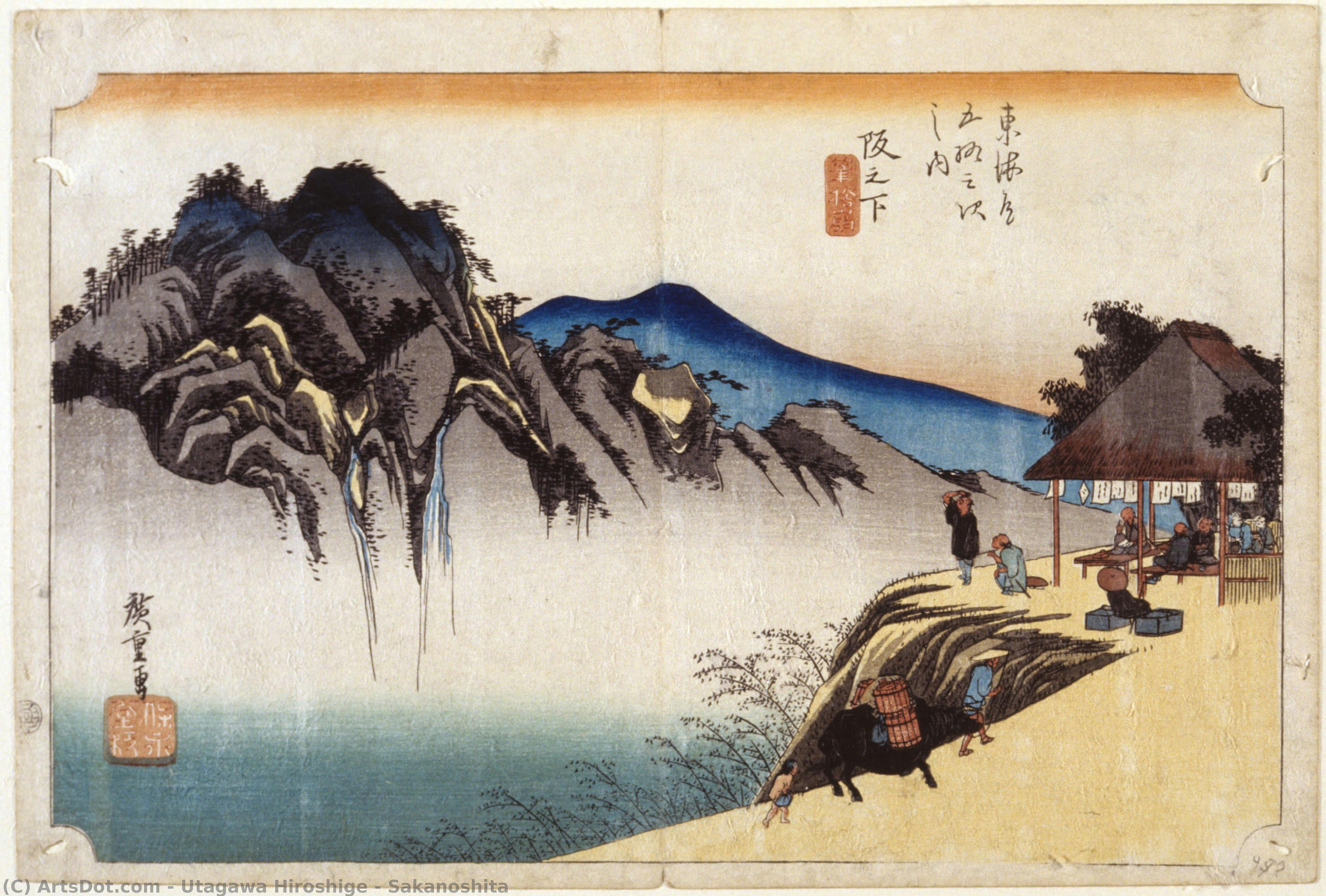
Experience Hiroshige's 'Sakanoshita': A stunning ukiyo-e print capturing the rugged beauty of the Tōkaidō road & Fudesute Mountain. Explore Edo Japan's poetic landscapes!
Kunstnerbiografi
"DanskMetaDescription": "Utagawa Hiroshige (1797-1858) var en japansk kunstner kendt for sine poetiske landskabsbilleder, især 'Femogtyve Stationer på Tōkaidō'. Hans stil inspirerede impressionister som Van Gogh og er et vigtigt eksempel på Japonisme."
About the painting
A Poetic Glimpse of Edo Japan: Exploring Utagawa Hiroshige's "Sakanoshita"
Utagawa Hiroshige’s “Sakanoshita,” part of his renowned series The Fifty-three Stations of the Tōkaidō, offers more than just a scenic view; it provides a window into the heart of Edo period Japan. This evocative woodblock print captures a moment in time along one of the nation's most vital trade routes, transforming a practical thoroughfare into a landscape imbued with profound beauty and subtle narrative. The scene unfolds near Sakanoshita, a particularly challenging stretch of the Tōkaidō road known for its steep inclines and rugged terrain – a reality reflected in Hiroshige’s masterful depiction.
The Journey and the Landscape: Context and Technique
Completed during the Edo period (1603-1868), a time of relative peace and prosperity under the Tokugawa shogunate, “Sakanoshita” reflects a burgeoning interest in travel and landscape art. The Tōkaidō itself was more than just a road; it was a lifeline connecting Edo, the political heart of Japan, with Kyoto, its former imperial capital. Hiroshige’s series documented this journey, not merely as a geographical record but as an exploration of the emotional and aesthetic experiences encountered along the way. The print exemplifies ukiyo-e, meaning "pictures of the floating world," a genre that celebrated everyday life, landscapes, and popular culture. Hiroshige's approach within this tradition was particularly poetic, moving beyond simple representation to capture atmosphere and feeling. His technique involved meticulous carving on woodblocks by skilled artisans, followed by multiple layers of color printing—a process demanding precision and artistry. The subtle gradations of blue and green, achieved through the skillful application of bokashi (color gradation), create a sense of depth and distance that draws the viewer into the scene.
Symbolism in Stone and Shadow: A Narrative Unfolds
Beyond its visual appeal, “Sakanoshita” is rich with symbolic meaning. The towering presence of Fudesute-yama, or "Brush-Discarding Mountain," dominates the composition. Legend has it that a frustrated painter, unable to capture the mountain's beauty, threw his brush away in despair – a poignant reminder of the limitations of human artistry and the overwhelming power of nature. The travelers depicted on the winding path represent the constant flow of life along the Tōkaidō—merchants, pilgrims, government officials—all engaged in their own journeys. Their small size relative to the landscape emphasizes humanity’s place within a vast and timeless world. Even the dog accompanying one of the figures adds a touch of domesticity and companionship amidst the ruggedness of the terrain. The overall impression is not merely of a scenic view but of a microcosm of Edo period society, interwoven with the grandeur of the natural world.
An Enduring Legacy: Emotion and Influence
Hiroshige’s “Sakanoshita” resonates deeply because it transcends mere representation; it evokes a feeling—a sense of quiet contemplation, perhaps tinged with melancholy. The atmospheric perspective, the subtle color palette, and the carefully composed arrangement of elements all contribute to an emotional richness that continues to captivate viewers today. The print’s influence extended far beyond Japan, profoundly impacting Western artists like Vincent van Gogh and Claude Monet, who were captivated by its innovative compositions and poetic sensibility. It stands as a testament to Hiroshige's genius—a master of capturing the fleeting beauty of the natural world and transforming it into an enduring work of art.
Spørgsmål og svar
Er farverne i "Sakanoshita" af Hiroshige mættede eller dæmpede?
Farvepaletten i "Sakanoshita" har en mætning på Subtle Color.
Hvilken farve dominerer kompositionen i "Sakanoshita" af Hiroshige?
Putty (#e6ddc9) er den dominerende farve i "Sakanoshita" af Hiroshige.
Hvor kan jeg købe en håndmalet reproduktion af "Sakanoshita" af Hiroshige?
Du kan bestille en håndmalet reproduktion af "Sakanoshita" af Hiroshige direkte på dens Håndmalet reproduktion-side: en håndmalet oliereproduktion på lærred af hør, lavet efter bestilling.
Quick facts and art quiz
About Hiroshige

Hiroshige
1797 - 1858, Japan
Kunstnerbiografi
Utagawa Hiroshige: En Poetisk Betragter af Edo-Japan
Utagawa Hiroshige, født Andō Tokutarō i 1797 i den pulserende by Edo (moderne Tokyo), står som en central figur i verden af *ukiyo-e*, eller “billeder fra det flydende verden.” Selvom han var dybt forankret i traditionerne i japansk træblokstik, overgik Hiroshige blot at reproducere; han indgydede sine landskaber med en poetisk sanselighed, der resonerede dybt både inden for Japan og senere på tværs af den vestlige kunstverden. Hans liv udspillede sig under en periode med relativ fred og velstand under Tokugawa-shogunen, men også én præget af stigende social forandring og den efterfølgende vestliggørelse – kræfter, der bidrog til *ukiyo-e’s* nedgang, selvom de forstærkede Hiroshige's vedvarende arv. I første omgang var han bestemt til en mere konventionel vej inden for en samurai-familie – hans far tjente som brandvagt – men Hiroshige's kunstneriske tilbøjeligheder førte ham til et lærerskab under Utagawa Toyohiro, en mester i Utagawas skole. Dette viste sig at være et afgørende vendepunkt, der drev ham væk fra de populære fremstillinger af kurtisiner og skuespillere, som mange *ukiyo-e*-kunstnere foretrak, mod fokus på landskab, en genre han i sidste ende ville gendefinere.Fra Genrebilleder til Evocative Landskaber
Hiroshige's tidlige arbejde fulgte skolens konventioner, med portrætter og scener fra dagligdagen. Men det var hans omfavnelse af landskab, der virkelig skilte ham ud. Påvirket af tidligere mestre som Hokusai – hvis *Tretti seks visninger af Fuji* allerede havde fangeres publikums opmærksomhed – udviklede Hiroshige en unik stil karakteriseret ved atmosfærisk perspektiv, subtile farvepaletter og en dyb følsomhed over for skiftene årstider. Han portrætterede ikke blot steder; han fremkaldte deres stemning, fangede essensen af et bestemt øjeblik i tiden. Serien *De femtysne stationer på Tōkaidō* (1833–1834), måske hans mest berømte præstation, dokumenterede rejsen langs Tōkaidō-vejen, den vigtigste rute mellem Edo og Kyoto, ikke som en simpel rejsebeskrivelse, men som en serie af evocative vignetter – et pludseligt regnskyl i Shono, en fjerntliggende udsigt til Fuji fra Kanaya, den travle aktivitet ved Odawara. Hvert tryk er gennemsyret af en følelse af forgængelighed og stille skønhed, der inviterer seerne til at opleve rejsen sammen med de reisende. Han udnyttede mesterligt *bokashi*, en teknik, der involverer flere tryk i samme område for at skabe subtile nuancer af farve, hvilket tilføjede dybde og atmosfære til sine kompositioner.En Mester af Atmosfære og Teknik
Hiroshige's tekniske færdigheder var lige så bemærkelsesværdige som hans kunstneriske vision. Han var ikke blot interesseret i nøjagtig gengivelse; han søgte at fange *følelsen* af et sted. Hans brug af farver, selvom den ofte var mere sparsommelig end hos nogle af sine samtidige, var afgørende for at opnå dette. Han udnyttede ofte flere blokke for en enkelt farve, hvilket tillod ham at skabe nuancerede nuancer og atmosfæriske effekter, der var utroligt vanskelige at efterligne. De delikate blå nuancer i hans fremstillinger af regn eller tåge, de varme toner af efterårsblade – disse var ikke tilfældige; de var omhyggeligt overvejede elementer designet til at vække specifikke følelser og sansninger. Udover *bokashi* var Hiroshige dygtig til at udnytte tomrum – *ma*, et koncept centralt for japansk æstetik, der tillod områder af trykket at "trække vejret" og forbedrede den overordnede følelse af ro. Hans serie *En hundrede berømte visninger af Edo* (1856–1858) viste yderligere hans mesterskab, hvilket tilbød intime glimt ind i livet og landskaberne i hans elskede by.Indflydelse og Arv
Hiroshige's arbejde var ikke uden forudgående indflydelser. Han var dybt påvirket af den kinesiske traditionelle malerkunst, især *sumi-e*, og af den mere formelle kanon i den ældre *ukiyo-e*-skole. Samtidig lærte han af Hokusai's radikale tilgang til landskabstrykkene, der var en markant afvigelse fra de traditionelle motiver. Hiroshige fandt sin egen unikke stil ved at kombinere disse elementer og skabe et mere atmosfærisk og poetisk udtryk. Hans tryk blev hurtigt populære i Japan, men det var først i Vesten, hvor de blev anerkendt for deres kunstneriske værdi og deres evne til at fange den flygtige skønhed i naturen. Impressionister og post-impressionister som Monet og Van Gogh var dybt fascineret af Hiroshiges farver og kompositioner, der inspirerede dem til at eksperimentere med lignende teknikker og motiver i deres egne værker. Hiroshige's død markerede starten på en hurtig nedgang i *ukiyo-e*-traditionen, accelereret af Meiji-restaureringen og den efterfølgende vestliggørelse. Alligevel har hans indflydelse på kunstverdenen vist sig at være bemærkelsesværdigt vedvarende. I det sene 19. århundrede strømmede japanske tryk til Europa, hvilket udløste et fænomen kendt som *Japonisme*. Kunstnere som Manet og Van Gogh blev betaget af *ukiyo-e’s* dristige kompositioner, flade perspektiver og ukonventionelle farveskalaer, der inspirerede dem til at inkorporere disse elementer i deres egne værker. Hiroshige's arbejde er et vidnesbyrd om en kunstners evne til at fange essensen af øjeblikket og skabe billeder, der fortsat fascinerer og inspirerer os i dag.Quick facts about Hiroshige
- Artistic Movement Or Style: *Ukiyo-e*
- Artists Or Movements Influenced By This Artist: ['Impressionisme']
- Artists Who Influenced This Artist: ['Hokusai']
- Date Of Birth: 1797
- Date Of Death: 1858
- Full Name: Utagawa Hiroshige
- Nationality: Japansk
- Notable Artworks:
- 53 Stationer
- 100 Visninger
- Place Of Birth: Tokyo, Japan
Udforsk kunstværker organiseret efter temaer, stilarter og karakteristika.




Hiroshige
Sakanoshita
() ·
With its frame: · Hand-painted in oil on linen
Total