


 Se i rummet
 Send
Send Del
Del
 Detaljer
 Studieguide til kunstværker

 Download
 Lignende værker
 Røntgenundersøgelse
 Se diasshow
 Statistik
Clouds and Spitfires
 Impressionism
 1943
1943 51.0 x 61.0 cm
Walter Thomas Monnington’s ‘Clouds & Spitfires’ (1943) captures WWII aerial action in a vibrant oil painting. Explore this evocative piece of aviation history, showcasing realism & impressionism.
Sir Walter Thomas Monnington (1902-1976) was a British painter known for large murals, war art & presidency of the Royal Academy. Explore his diverse works: portraits, landscapes & aerial combat scenes.
 Læs mere
Kunstværket vist på denne side er beskyttet af ophavsretsloven, hvilket betyder, at vi ikke lovligt kan skabe eller sælge en identisk reproduktion. Denne beskyttelse håndhæves i henhold til internationale aftaler som f.eks. den Bernerkonventionen og af nationale love, herunder de bestemmelser, der er fastlagt i Amerikansk ophavsretslov - Titel 17.
Som et respektfuldt og lovligt alternativ tilbyder vi skræddersyede, håndmalede kunstværker inspireret af originalen. Vores dygtige og professionelle kunstnere studerer omhyggeligt originalens stil, stemning og kunstneriske essens for at skabe et nyt, unikt værk, der fremkalder den samme følelse – samtidig med at det forbliver en original skabelse i egen ret.
Denne metode overholder fuldt ud ophavsretsreglerne, da den ikke indebærer kopiering eller duplikering af det beskyttede kunstværk. I stedet er der tale om en kreativ nytolkning – et nyt maleri, som er inspireret af det oprindelige, men ikke identisk med det.
Håndlavet oliereproduktion
Håndmalet olie på lærred i din valgte størrelse og ramme, udført efter bestilling af vores kunstnere. ( Skift til printversion Skift til digitalt billede)




































Standardstørrelse
speciallavet
CM
INCH
Vælg mellem vores forudindstillede størrelser, der matcher kunstværkets originale proportioner.
Loading sizes...

bredde
højde
Indtast den bredde og højde, du har brug for, så det passer til din ramme eller din væg. Da dette er håndmalet, kan kunstneren ved en anden form på størrelsen male lidt mere rundt om billedet eller skære lidt væk — det er op til dig. Vi sender dig et digitalt mockup til godkendelse, før maleriet påbegyndes. Billedet, der vises på denne side, viser ikke det endelige resultat — det er kun mockuppet, der gør.
Eksempler på tilpasningsmuligheder: Udskift ansigt med kundens eget foto; Tilføj kæledyr (f.eks. udskift kat med hund); Inkluder en skjult besked i baggrunden; Ændr baggrundslandskab eller elementer.
Efter bestilling vil TopImpressionists.com team sende en e-mail til kunden for at indhente instruktioner og fremsende et udkast til gennemgang.
Efter bestilling vil TopImpressionists.com team sende en e-mail til kunden for at indhente instruktioner og fremsende et udkast til gennemgang.
Levering i hele verden () på 3-4 uger i stedet for de standard 5 uger. (24 oktober). Ingen kompromiser med kvaliteten.

Gratis ekspresforsendelse til hele verden

Lærred af linned i høj kvalitet

Komplet transportforsikring

Garanti for refusion af told og importafgifter

Garanti for autentisk farvegengivelse

100 dages returret ved fabrikationsfejl

100% fuld returret

Mængderabat ved flere køb
 Glasmulighed er kun tilgængelig i størrelser under 110 cm

Clouds and Spitfires
Reproduktionsmateriale
Reproduktionsstørrelse
-


Samlet pris
Dkr 1765
Om kunstneren
The Visionary Brush of Sir Walter Thomas Monnington
Sir Walter Thomas Monnington (1902–1976) remains a towering figure in the landscape of British art, a painter whose career was defined by an extraordinary ability to navigate between the classical grandeur of the past and the turbulent realities of the twentieth century. Born in Westminster, his early years were deeply influenced by the pastoral serenity of the Sussex countryside. This connection to the natural world provided a foundational layer of observation and craftsmanship that would later inform even his most dynamic wartime compositions. His formal journey began at the Slade School of Fine Art, where he refined a technical prowess that would eventually lead him to the prestigious British School in Rome. It was during this Italian sojourn that Monnington encountered the enduring echoes of the Renaissance, an experience that instilled in him a lifelong fascination with classical ideals, balanced proportions, and the monumental scale of historical narrative.
The emergence of Monnington as a significant voice in modern British art was cemented by his early triumphs in academic competition. His work Allegory, which earned him recognition at the British School of Fine Art, remains a testament to his ability to blend realism with idealized forms. The acquisition of this piece by the Tate Collection served as a definitive milestone, signaling the arrival of an artist capable of translating complex, symbolic concepts into visually arresting oil paintings. As he moved into the professional sphere in London, Monnington’s versatility became his hallmark. He was not merely a painter of canvases but a creator of environments, collaborating on ambitious decorative schemes for institutions such as the Bank of England and St Stephen’s Hall in Westminster Palace. These mural projects demonstrated his capacity to handle large-scale narratives, weaving together history and artistry to serve the public consciousness.
A Legacy Forged in Conflict and Camouflage
The trajectory of Monnington’s life was irrevocably altered by the onset of World War II, a period that transitioned his focus from the serene and the allegorical to the visceral and the urgent. Serving with the Directorate of Camouflage at Leamingly Spa, he applied his keen eye for detail and spatial awareness to the innovative task of designing camouflage for airfields and factories. This period of service was not a departure from his artistry but an evolution of it. The tension of wartime Britain found its way onto his canvases through works that captured the mechanical power and the perilous beauty of aerial combat. In masterpieces such as Fortresses and Southern England Spitfires Attacking Flying Bombs, one can witness the artist’s ability to use bold, expressive brushstrokes to convey motion, energy, and the heavy atmosphere of a world at war.
Beyond the battlefield, Monnington’s repertoire expanded to include evocative landscapes and intimate portraits, proving that his technical mastery could scale from the vastness of a sky filled with aircraft to the quietude of a secluded grove. His work The Orchard exemplifies this softer, impressionistic side, where light and shadow dance across a landscape to evoke a sense of peace and timelessness. This duality—the ability to capture both the roar of engines and the whisper of leaves—is what makes his body of work so profoundly human.
In the later stages of his career, Monnington’s influence reached the highest echelons of the art establishment when he served as President of the Royal Academy. His leadership and dedication to the craft ensured that his commitment to excellence and historical continuity remained central to British artistic identity. To look upon a Monnington painting is to witness a life lived at the intersection of duty and wonder, a career that successfully bridged the gap between the classical traditions of the Old Masters and the modern complexities of a changing world.

Walter Thomas Monnington
1902 - 1976 , United Kingdom
Hurtige fakta
- Full Name: Walter Thomas Monnington
- Nationality: British
- Date Of Birth: 1902
- Date Of Death: 1976
- Place Of Birth: Westminster, United Kingdom
- Notable Artworks:
- Allegory
- Southern England Spitfires Attacking Flying Bombs
- The Orchard
- Artistic Movement Or Style: Impressionism
- Artists Who Influenced This Artist:
- George Clausen
- William Rothenstein
Relaterede artikler

1940'ernes Mestre: Top 10 Kunstværker der Fanger Ånden – TopImpressionists.dk
Oplev 1940'ernes ånd gennem 10 ikoniske kunstværker! Fra krigskunst til ekspressionisme – lær historierne bag Jackson Pollock, Frida Kahlo & mere. Find museumskvalitets reproduktioner og inspiration til dit hjem på TopImpressionists.dk

Beyond the Portrait: Félix Nadar & the Psychological Depths of 19th-Century Photography
Explore the revolutionary photography of Félix Nadar – pioneer of portraiture, aerial imaging & psychological depth. Discover his iconic portraits of Baudelaire, Hugo & more. A deep dive into 19th-century art history.
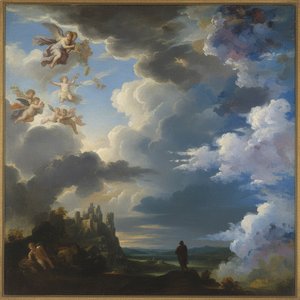
Ephemeral Visions: Clouds as Motif & Metaphor in Western Art History
Explore the captivating history of clouds in Western art! From Romantic masterpieces to Symbolist visions, discover how artists captured atmosphere, emotion & spirituality. A guide for collectors and enthusiasts.

Evoking Mood & Space: A History of Atmospheric Painting Techniques
Explore the history of atmospheric painting techniques – from Renaissance masters to American Tonalism. Learn how artists evoke mood & depth with aerial perspective, light, and color. Discover masterpieces & expert insights at TopImpressionists.