

Vist: · Inklusive ramme:
 Se i rummet
 Del som kort
 Del
Del
 Detaljer
 Guide
Guide

 Download
 Lignende værker
 Røntgenundersøgelse
 Diasshow
 Spørgsmål og svar
 Statistikker

Dkr 2128
Håndlavet oliereproduktion
Håndmalet olie på lærred i din valgte størrelse og ramme, udført efter bestilling af vores kunstnere. ( Skift til printsalg Skift til digitalt billede)
Størrelse
·Standardstørrelse
speciallavet
CM
INCH
Vælg mellem vores forudindstillede størrelser, der matcher kunstværkets originale proportioner.
Indlæser størrelser...

bredde
højde
Indtast den bredde og højde, du har brug for, så det passer til din ramme eller din væg. Da dette er håndmalet, kan kunstneren ved en anden form på størrelsen male lidt mere rundt om billedet eller skære lidt væk — det er op til dig. Vi sender dig et digitalt mockup til godkendelse, før maleriet påbegyndes. Billedet, der vises på denne side, viser ikke det endelige resultat — det er kun mockuppet, der gør.
 Læs mere
Afslut
·
Hvid kant Dkr1

Udvasket kant Dkr1

Fortsat motiv Dkr1

P118B Dkr10

P118H Dkr10

P118W Dkr10

P438Z Dkr10

P508JH Dkr12

P508YH Dkr12

P805H Dkr10

P805Z Dkr10

P919BZ Dkr10

P919G Dkr10

P919XJ Dkr10

P959ZH Dkr10

P968JZ Dkr12

W106C Dkr8

W218G Dkr10

W218JH Dkr8

W218Y Dkr10

W307PJ Dkr10

W316G Dkr10

W316PJ Dkr8

W316Y Dkr10

W398PJ Dkr8

W4111J Dkr10

W500HY Dkr15

W500JH Dkr15

W692G Dkr12

W849H Dkr8

W940BG Dkr15

W953PJ Dkr8

H24-GOLD Dkr30

H24-SILVER Dkr30

H36-GOLD Dkr45

H36-SILVER Dkr45
Sendes i et beskyttende rør, klar til at blive indrammet hos din egen indrammer.
Over 105 cm sendes rammen som et sæt til en professionel indrammer — læs detaljerne.
Tillægsydelser
valgfritHvad indeholder de ekstra tilvalg?
Eksempler på hvad kan ændres: Udskift ansigt med kundens eget foto; Tilføj kæledyr (f.eks. udskift kat med hund); Inkluder skjult besked i baggrunden; Skift baggrundslandskab eller elementer.
Efter bestilling vil TopImpressionists.com-teamet sende en e-mail til kunden for at få instruktioner og levere et udkast til forhåndsvisning
Efter bestilling vil TopImpressionists.com-teamet sende en e-mail til kunden for at få instruktioner og levere et udkast til forhåndsvisning
Verdensomspændende levering () på 3-4 uger i stedet for de standard 5 uger. (7 november). Ingen kompromiser med kvaliteten.
Beskyttende fernis
Navneskilt
Detaljer om indgraveret bronzeskilt
This elegant plaque features the artist's name and the title of the artwork, finely engraved for a timeless presentation.
It is made from bronze with a refined, elegant finish. The text is precisely laser-engraved for a sharp and permanent result. Measuring 9x2 cm, the plaque is compact yet easy to read. It's built to be durable and scratch-resistant, offering a professional, museum-quality look. Mounting is simple thanks to the included adhesive backing.
Detaljer om gennemsigtig akrylplade
The plaque includes essential engraved details such as the artist's name, the title of the artwork, the date it was created, the type of media used-like oil on canvas or watercolor-a brief description of the piece, and a QR code that links to the complete artwork information.
It is crafted from clear acrylic, offering a sleek, modern appearance. The text is UV-engraved in black to ensure strong visual contrast. With a size of 10x15 cm, it ensures optimal readability. It comes equipped with two metal hooks for secure wall mounting. The plaque is designed to be weather-resistant, making it suitable for various environments, and it includes interactive features that work seamlessly with smartphone scanning.
Detaljer om sort akrylplade
This elegant plaque includes engraved information such as the artist's name, the title of the artwork, the date it was created, the type of media used (like oil on canvas or watercolor), a short description of the artwork, and a QR code for quick access to more information.
The plaque itself is made from refined black acrylic with a premium finish. The text is laser-engraved in white for high contrast and readability. Its size is 10x15 cm, designed to be easy to read. It comes with two metal hooks for professional mounting. The design is sleek and fits any interior style. It is also weather-resistant and durable, with built-in digital integration for mobile compatibility.
Glasmulighed er kun tilgængelig i størrelser under 110 cm
 Glasmulighed er kun tilgængelig i størrelser under 110 cm
- Gratis ekspresforsendelse til hele verden
- Lærred af linned i høj kvalitet
- Fuld transportforsikring
- Garanti for refusion af told og importafgifter
- Garanti for præcis farvegengivelse
- 100 dages returret ved fabrikationsfejl
- 100% fuld returret
- Mængderabat ved flere køb


Beskrivelse af samlerobjektet
Explore Walter Ufer’s ‘Sleep,’ a poignant oil painting of Native American women in Taos. Discover realism, rich detail & cultural symbolism – a unique 20th-century artwork.
Kunstnerbiografi
Walter Ufer (1876-1936) var en tyskfødt amerikansk kunstner, berømt for sine stemningsfulde malerier af Native American-livet i Taos, New Mexico. Et nøglemedlem af 'Taos Ten', kendt for genremalerier og livlige landskaber.
Om maleriet
The Weight of Tradition: An Encounter with Walter Ufer’s “Sleep”
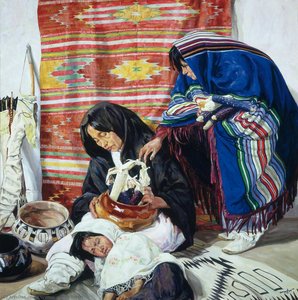
Walter Ufer's "Sleep," painted in 1923, isn’t merely a depiction of three Native American women; it’s an immersion into a world steeped in ritual and profound reverence. The painting immediately draws the viewer in with its rich tapestry of color – predominantly warm reds, oranges, and browns that evoke the earth itself, grounded by cooler blues and greens woven through the textiles and pottery. This palette isn't simply decorative; it speaks to the cultural heritage of the subjects, hinting at a deep connection to the land and ancestral traditions. The composition is carefully orchestrated, centering on the kneeling woman as a focal point, yet subtly inviting us into the periphery of the scene, suggesting an active participation in this sacred space.
Ufer’s masterful technique reveals layers of painstaking detail. He employs a layered oil painting approach, building up texture with deliberate brushstrokes that create a palpable sense of roughness on the clothing – perhaps representing the wear and tear of daily life intertwined with ceremonial garb – while simultaneously rendering the pottery with smooth, almost polished surfaces. This juxtaposition speaks to the duality inherent in Native American culture: the balance between practicality and spirituality, the tangible and the intangible. The lighting, soft and diffused, isn’t dramatic; it's deliberately muted, casting subtle shadows that lend a sense of solemnity and depth to the figures and objects, as if illuminating a secret whispered within a sacred space.
A Window into Taos: Contextualizing Ufer’s Vision
To fully appreciate “Sleep,” it's crucial to understand its historical context. Painted in 1923, during his time in Taos Pueblo, New Mexico, the artwork represents a pivotal moment in Walter Ufer’s career and his deep engagement with Native American culture. He was part of the "Taos Ten," a group of artists who sought to document and celebrate the lives and traditions of the region's indigenous communities. This wasn’t simply an act of observation; it was a deliberate attempt at understanding and portraying these cultures with respect and authenticity, a rare undertaking for American art at the time.
Ufer’s background as a German-born artist profoundly shaped his approach. His training in Europe instilled a meticulous attention to detail and a sophisticated understanding of composition – elements he skillfully translated into his depictions of Native American life. However, it was his immersion within the Taos community that truly informed his work, allowing him to capture not just appearances but also the spirit and essence of these traditions. The painting’s realism is tempered by an underlying sense of mystery, inviting viewers to contemplate the deeper meanings embedded within the scene.
Symbolism Woven into the Fabric
The details within “Sleep” are laden with symbolic significance. The intricately patterned rug serves as a visual anchor, framing the central figures and providing a rich backdrop that speaks to the importance of storytelling and communal life within Native American culture. The pottery, often adorned with geometric designs and natural motifs, represents both artistic skill and spiritual connection – a tangible link to ancestors and the earth. The women themselves, engaged in what appears to be a ritualistic activity, are not simply subjects; they embody generations of tradition, wisdom, and connection to the divine.
The act depicted—kneeling in reverence—suggests healing or a profound spiritual ceremony. The quiet dignity of the figures, coupled with the muted colors and soft lighting, evokes a sense of solemnity and timelessness. It’s an image that transcends mere representation, offering a glimpse into a world governed by ancient beliefs and deeply rooted traditions.
A Legacy of Authenticity: Reproductions and Beyond
Walter Ufer's "Sleep" remains a powerful testament to the beauty and complexity of Native American culture. TopImpressionists offers high-quality, hand-painted reproductions that faithfully capture the painting’s rich detail and evocative atmosphere. These reproductions are more than just images; they are windows into another world—a world of sacred rituals, profound traditions, and enduring wisdom. Investing in a reproduction is an investment in preserving this important piece of American art history and honoring the legacy of Walter Ufer's insightful portrayal.
Spørgsmål og svar
Hvordan balancerer "Sleep" lys og mørke?
De registrerede værdier for "Sleep" af Walter Ufer er: bright lysstyrke og Gentle Luminance luminans.
Hvilket stemningsleje udtrykker "Sleep" af Walter Ufer inden for Contemporary Realism?
Den Melancholic stemning i "Sleep" ledsager dens Contemporary Realism stil.
Hvem er ophavsmanden til "Sleep", og hvilken kunstretning tilhører værket?
"Sleep" blev skabt af Walter Ufer i Contemporary Realism-stil. Kunstneren og stilen identificerer værkets tradition.
Hurtige fakta og kunstquiz
Om Walter Ufer

Walter Ufer
1876 - 1936, Tyskland
Kunstnerbiografi
Sydvestens sjæl: Walter Ufers liv og eftermæle
Walter Ufer står som en skelsættende skikkelse i den amerikanske impressionisme, en maler hvis penselstrøg gjorde mere end blot at indfange lyset; de indfangede selve hjerteslaget i en kultur. Ufer blev født i 1876 i Hückeslag, Tyskland, og hans rejse mod New Mexicos høje ørkener var brolagt med streng europæisk træning og en dybtliggende nysgerrighed over for den menneskelige tilstand. Hans tidlige år blev formet af den tysk-amerikanske diaspora i Louisville, Kentucky, hvor han først begyndte at absorbere sin kulturarvs rige teksturer. Denne grundlæggende periode, præget af studier i litografi og grafik, gav ham en teknisk præcision, som senere gjorde det muligt for ham at navigere i lysets og skyggens kompleksitet med uovertruffen mesterskab.
Hans stræben efter kunstnerisk excellence førte ham ud på en transformativ odyssé gennem Europa. Som vandrende svend fordybede Ufer sig i kontinentets mangfoldige kunstneriske traditioner og forfinede sin teknik ved de prestigefyldte akademier i Hamborg og Dresden. Denne periode med intens intellektuel og kreativ ekspansion kulminerede under hans ophold i München, hvor han dedikerede sig til en intensiv atelierpraksis. Da han endelig vendte tilbage til USA i 1911, bar han en sofistikeret europæisk sanselighed med sig, som var parat til et dybtgående møde med det barske, solbeskinnede landskab i det amerikanske Vesten.
En visionær fra Taos Ten
Året 1914 markerede et afgørende vendepunkt i Ufers liv og i den amerikanske kunsts bane. Da han bevægede sig ind i Taos Pueblo, New Mexico, blev han en del af en ekstraordinær kunstnerisk revolution. Ved at slutte sig til den indflydelsesrige gruppe kendt som "Taos Ten," blev Ufer en central figur i et kolleltiv, der søgte at bevæge sig ud over det rene landskabsmaleri mod en mere autentisk og sanselig skildring af Native American-livet. I modsætning til mange af sine samtidige, der betragtede det amerikanske sydvest gennem en romantiseret eller kolonial linse, nærmede Ufer sine motiver med dyb respekt og et blik for den daglige eksistens' værdighed.
Hans arbejde blev en bro mellem europæiske impressionistiske teknikker og den rå, spirituelle energi hos Pueblo-folket. Han var ikke blot en iagttager, men en kronikør af ritualer, landskaber og det stille rytme i samfundslivet. Central for denne kreative udvikling var hans relation til Jim Mirabal, en Taos-indianer, der fungerede som både Ufers muse og samarbejdspartner. Gennem denne forbindelse opnåede Ufer en intim forståelse for de kulturelle nuancer, der definerer regionen, hvilket gjorde det muligt for ham at gennemvæde sine lærreder med en følelse af levet sandhed, der resonerede langt ud over New Mexicos grænser.
Teknik, symbolik og historisk betydning
Ufers værk er karakteriseret ved et mesterligt herredømme over farven og en dristig, ekspressiv påføring af maling. Hans stil, selvom den var rodfæstet i de amerikanske impressionistiske principper, lænede sig ofte mod en mere robust og tekstureret tilgang, der indfangede varmen fra ørkensolen og jordens tyngde. Han brugte lyset ikke blot til at oplyse formen, men til at fremkalme følelser – og skabte scener, hvor atmosfæren føles tung af historie og tradition.
Den historiske betydning af Walter Ufer ligger i hans evne til at ophøje genremaleriet til et dybtgående socialt og kulturelt udsagn. Hans bedrifter inkluderer:
- Autentisk repræsentation: Et brud med de "pittoreske" stereotyper om Native American-livet for at præsentere et mere nuanceret og humaniseret portræt af Taos-folket.
- Kunstnerisk syntese: En succesfuld forening af den formelle akademiske træning fra Tyskland med den levende, utøjlede ånd fra det amerikanske sydvest.
- Arven fra Taos Ten: En afgørende rolle i at etablere Taos som en førende destination for amerikansk modernisme og et vitalt centrum for kunst med fokus på oprindelige folk.
I dag står Ufers malerier som vedvarende vidnesbyrd om en periode med intens kulturel sammensmeltning. Hans evne til at væve den tekniske stringens fra sin europæiske uddannelse sammen med den spirituelle dybde i Pueblo-kulturen sikrer, at hans værk fortsat fanger beskueren og inviterer moderne øjne til at vidne om Taos-dalens tidløse ånd gennem hans evokative og mesterlige blik.
Hurtige fakta om Walter Ufer
- Artistic Movement Or Style: Taos-impressionisme
- Artists Or Movements Influenced By This Artist: ['']
- Artists Who Influenced This Artist: ['']
- Date Of Birth: 1876
- Date Of Death: 1936
- Full Name: Walter Ufer
- Nationality: Tysk-amerikaner
- Notable Artworks:
- Hendes datter
- Ørkenens byggere
- Efter dem
- Place Of Birth: Hückeswagen, Tyskland


Walter Ufer
Sleep
() ·
Inklusive ramme: · Håndmalet med olie på lærred
Totalbeløb