

Vist: · Inklusive ramme:
 Se i rummet
 Del som kort
 Del
Del
 Detaljer
 Guide
Guide

 Download
 Lignende værker
 Røntgenundersøgelse
 Diasshow
 Spørgsmål og svar
 Statistikker


Dkr 1797
Håndlavet oliereproduktion
Håndmalet olie på lærred i din valgte størrelse og ramme, udført efter bestilling af vores kunstnere. ( Skift til printsalg Skift til digitalt billede)
Størrelse
·Standardstørrelse
speciallavet
CM
INCH
Vælg mellem vores forudindstillede størrelser, der matcher kunstværkets originale proportioner.
Indlæser størrelser...

bredde
højde
Indtast den bredde og højde, du har brug for, så det passer til din ramme eller din væg. Da dette er håndmalet, kan kunstneren ved en anden form på størrelsen male lidt mere rundt om billedet eller skære lidt væk — det er op til dig. Vi sender dig et digitalt mockup til godkendelse, før maleriet påbegyndes. Billedet, der vises på denne side, viser ikke det endelige resultat — det er kun mockuppet, der gør.
 Læs mere
Afslut
·
Hvid kant Dkr1

Udvasket kant Dkr1

Fortsat motiv Dkr1

P118B Dkr10

P118H Dkr10

P118W Dkr10

P438Z Dkr10

P508JH Dkr12

P508YH Dkr12

P805H Dkr10

P805Z Dkr10

P919BZ Dkr10

P919G Dkr10

P919XJ Dkr10

P959ZH Dkr10

P968JZ Dkr12

W106C Dkr8

W218G Dkr10

W218JH Dkr8

W218Y Dkr10

W307PJ Dkr10

W316G Dkr10

W316PJ Dkr8

W316Y Dkr10

W398PJ Dkr8

W4111J Dkr10

W500HY Dkr15

W500JH Dkr15

W692G Dkr12

W849H Dkr8

W940BG Dkr15

W953PJ Dkr8

H24-GOLD Dkr30

H24-SILVER Dkr30

H36-GOLD Dkr45

H36-SILVER Dkr45
Sendes i et beskyttende rør, klar til at blive indrammet hos din egen indrammer.
Over 105 cm sendes rammen som et sæt til en professionel indrammer — læs detaljerne.
Tillægsydelser
valgfritHvad indeholder de ekstra tilvalg?
Eksempler på hvad kan ændres: Udskift ansigt med kundens eget foto; Tilføj kæledyr (f.eks. udskift kat med hund); Inkluder skjult besked i baggrunden; Skift baggrundslandskab eller elementer.
Efter bestilling vil TopImpressionists.com-teamet sende en e-mail til kunden for at få instruktioner og levere et udkast til forhåndsvisning
Efter bestilling vil TopImpressionists.com-teamet sende en e-mail til kunden for at få instruktioner og levere et udkast til forhåndsvisning
Verdensomspændende levering () på 3-4 uger i stedet for de standard 5 uger. (6 november). Ingen kompromiser med kvaliteten.
Beskyttende fernis
Navneskilt
Detaljer om indgraveret bronzeskilt
This elegant plaque features the artist's name and the title of the artwork, finely engraved for a timeless presentation.
It is made from bronze with a refined, elegant finish. The text is precisely laser-engraved for a sharp and permanent result. Measuring 9x2 cm, the plaque is compact yet easy to read. It's built to be durable and scratch-resistant, offering a professional, museum-quality look. Mounting is simple thanks to the included adhesive backing.
Detaljer om gennemsigtig akrylplade
The plaque includes essential engraved details such as the artist's name, the title of the artwork, the date it was created, the type of media used-like oil on canvas or watercolor-a brief description of the piece, and a QR code that links to the complete artwork information.
It is crafted from clear acrylic, offering a sleek, modern appearance. The text is UV-engraved in black to ensure strong visual contrast. With a size of 10x15 cm, it ensures optimal readability. It comes equipped with two metal hooks for secure wall mounting. The plaque is designed to be weather-resistant, making it suitable for various environments, and it includes interactive features that work seamlessly with smartphone scanning.
Detaljer om sort akrylplade
This elegant plaque includes engraved information such as the artist's name, the title of the artwork, the date it was created, the type of media used (like oil on canvas or watercolor), a short description of the artwork, and a QR code for quick access to more information.
The plaque itself is made from refined black acrylic with a premium finish. The text is laser-engraved in white for high contrast and readability. Its size is 10x15 cm, designed to be easy to read. It comes with two metal hooks for professional mounting. The design is sleek and fits any interior style. It is also weather-resistant and durable, with built-in digital integration for mobile compatibility.
Glasmulighed er kun tilgængelig i størrelser under 110 cm
 Glasmulighed er kun tilgængelig i størrelser under 110 cm
- Gratis ekspresforsendelse til hele verden
- Lærred af linned i høj kvalitet
- Fuld transportforsikring
- Garanti for refusion af told og importafgifter
- Garanti for præcis farvegengivelse
- 100 dages returret ved fabrikationsfejl
- 100% fuld returret
- Mængderabat ved flere køb


Beskrivelse af samlerobjektet
Kandinsky’s artistic journey began with a transformative encounter with Monet’s Haystacks, sparking his fascination with color symbolism and influencing his exploration of musical composition. His Bauhaus teaching experience solidified his commitment to geometric abstraction and experimental art forms.
Kunstnerbiografi
Vaskassij Kandinskij (1866-1944) var en revolutionerende kunstner, der skabte abstrakt kunst med farver og former. Oplev hans spirituelle univers gennem smukke reproduktioner!
Om maleriet
Division -Unit: A Symphony of Color and Spirit
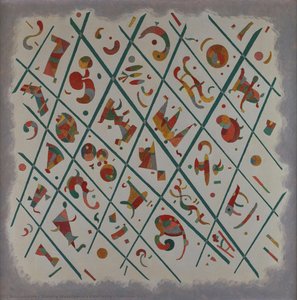
Wassily Kandinsky’s “Division - Unite,” created in 1934 during his formative Parisian period, stands as an emblem of abstract expressionism and a testament to the artist's relentless pursuit of spiritual resonance within visual art. Born in Moscow in 1866, Kandinsky embarked on a transformative artistic odyssey fueled by encounters with Impressionist painting—particularly Claude Monet’s “Haystacks”—and profoundly moved by Wagner’s opera "Lohengrin." These experiences instilled within him an unwavering conviction that art could transcend mere representation and communicate directly with the soul. This conviction would become the cornerstone of his groundbreaking approach to abstraction, forever altering the landscape of modern artistic endeavor. Early influences extended beyond purely visual stimuli; Kandinsky absorbed the vibrant hues and symbolic narratives of Russian folk art, gleaned from expeditions into the Vologda region. He meticulously documented these observations, recognizing their capacity to evoke emotional responses akin to musical harmonies—a concept he would champion throughout his career. This intellectual framework underpinned his artistic explorations, guiding him toward a deliberate rejection of conventional pictorial conventions in favor of forms that prioritized color and composition as primary expressive vehicles. The painting itself presents a striking visual experience: a square grid serves as the foundational structure for an astonishing array of organic shapes—circles, squares, triangles—interwoven with scattered letters. These elements are not uniformly distributed; rather, they cluster and overlap, generating a palpable sense of controlled chaos that belies Kandinsky’s meticulous planning. Diagonal lines intersect the grid, injecting dynamism into the composition and reinforcing the feeling of movement. The color palette is extraordinarily rich and diverse, encompassing reds, greens, blues, yellows, oranges, and purples—applied in both solid blocks and blended areas to create subtle gradations that heighten visual interest. Dominating the background is a pale grey or off-white hue, allowing the vibrant colors of the shapes to command attention and radiate luminosity. Kandinsky’s technique reflects his unwavering commitment to capturing inner experience. Executed primarily with oil paints on canvas—likely stretched taut—the application appears remarkably smooth, minimizing visible brushstrokes and prioritizing tonal harmony. This deliberate restraint underscores Kandinsky's belief that color alone could convey profound emotional significance. The resulting surface possesses a subtle textural quality, suggestive of the paper-like texture of his preparatory sketches, hinting at the artist’s ongoing engagement with traditional drawing methods alongside his pioneering explorations of abstraction. “Division - Unite” embodies Kandinsky’s mature abstract style—characterized by its rejection of representational imagery and its masterful manipulation of color relationships to evoke spiritual contemplation. It aligns seamlessly with the tenets of Abstract Expressionism, a movement that championed spontaneous gesture and emotional intensity as paramount considerations in artistic creation. More than just a visual spectacle, this artwork invites viewers into a realm where form and color coalesce to communicate unspoken truths—a legacy that continues to inspire artists and collectors alike.Composition & Structure
The square grid serves as the central organizing principle of “Division - Unite,” providing a framework for the arrangement of disparate elements while simultaneously fostering a sense of controlled dynamism. Unlike traditional perspectival representations, Kandinsky eschews depth illusion, opting instead for a flattened surface that emphasizes color and form as independent expressive forces. Diagonal lines intersect the grid, injecting movement into the composition and disrupting any potential static equilibrium. This deliberate disruption mirrors Kandinsky’s philosophical conviction that art should transcend rational thought and tap into primal instincts—a core tenet of his spiritual worldview.Color Palette & Harmony
Kandinsky's masterful use of color is arguably the painting's most striking feature. The palette encompasses a spectrum of hues—reds, greens, blues, yellows, oranges, and purples—each carefully positioned to create visual harmony and convey specific emotional resonances. Solid blocks of color coexist with blended areas, generating subtle gradations that enrich the overall tonal range. The dominant off-white background serves as a counterpoint to the vibrant shapes, maximizing their luminosity and enhancing their impact on the viewer’s eye. Kandinsky's meticulous attention to color theory—informed by Goethean aesthetics—demonstrates his profound understanding of how color can stimulate sensory perception and evoke psychological responses.Technique & Materials
The painting was crafted using oil paints on canvas, a medium favored by Kandinsky for its ability to achieve exceptional tonal fidelity and textural nuance. The application technique prioritizes smoothness and tonal consistency, minimizing visible brushstrokes and emphasizing the artist’s commitment to capturing inner experience through visual form. This deliberate restraint underscores Kandinsky's belief that color alone could convey profound emotional significance—a conviction that underpinned his entire artistic practice.Symbolic Significance & Emotional Impact
“Division - Unite” transcends mere aesthetic beauty; it embodies Kandinsky’s aspiration to communicate spiritual truths through abstraction. The scattered letters within the composition serve as visual anchors, grounding the organic shapes in a realm of intellectual contemplation—a reflection of Kandinsky's engagement with philosophical ideas and his belief that art could illuminate hidden dimensions of human consciousness. Ultimately, this painting invites viewers into a meditative state—a testament to Kandinsky’s enduring legacy as one of the foremost pioneers of abstract expressionism and a visionary artist who dared to explore the uncharted territories of visual perception.Historical Context
Created in 1934, “Division - Unite” emerged during Kandinsky's Parisian period—a time marked by profound intellectual ferment and artistic experimentation. The painting reflects the influence of Bauhaus, where Kandinsky taught from 1922 to 1933, and embodies the broader ethos of Abstract Expressionism—a movement that championed spontaneity and emotional intensity as paramount considerations in artistic creation. It stands as a pivotal work within Kandinsky’s oeuvre, solidifying his reputation as one of the most innovative and influential artists of the 20th century.Size & Dimensions
Unknown Date: 1934Spørgsmål og svar
Hvor mættet er farvepaletten i "Division -Unit"?
"Division -Unit" af Wassily Wassilyevich Kandinsky er gengivet med en Dæmpet mætning.
Er "Division -Unit" af Wassily Wassilyevich Kandinsky i det offentlige domæne?
"Division -Unit" af Wassily Wassilyevich Kandinsky er i det offentlige domæne – ophavsretten er udløbet. Denne status bestemmer, hvordan billedet af værket må reproduceres.
Hvilken lysstyrke har "Division -Unit" af Wassily Wassilyevich Kandinsky?
Farverne i "Division -Unit" har en Blød lysstyrke luminans.
Hurtige fakta og kunstquiz
Om Wassily Wassilyevich Kandinsky

Wassily Wassilyevich Kandinsky
1866 - 1944, Rusland
Kunstnerbiografi
A Life Immersed in Color and Spirit
Wassily Wassilyevich Kandinsky, født i Moskva i 1866, var en revolutionerende figur, der uomgængeligt ændrede kunstens gang. Hans rejse var ikke én af øjeblikkelig kunstnerisk kaldelse; han var oprindeligt bestemt til en karriere inden for jura og økonomi ved Moskva Universitet, men det var en dybtgående møde med impressionistisk maleri – specifikt Claude Monets “Høje” – og en bevægende oplevelse under at være vidne til Wagners opera "Lohengrin", der tændte et uimodståeligt ønske om at forfølge kunst. Dette afgørende øjeblik, omkring 30 års alderen, markerede ikke blot en karriereændring, men en fuldstændig perspektivtransformation, der satte ham på vejen mod pionerarbejde inden for abstraktion. Han flyttede hurtigt til München og blev optaget på den prestigefyldte Kunstakademi, hvor han studerede under Franz von Stuck, selvom endda inden for formel uddannelse længtes Kandinskys ånd efter udforskning ud over konventionelle grænser.
Tidlige indflydelser inkluderede russisk folkeligt kunst, opnået fra en etnografisk ekspedition til Vologda-regionen i 1889, hvilket gav anledning til en fascination med livlige farvepaletter og symbolske billeder. Denne grundlag ville vise sig at være afgørende, da han begyndte at udvikle sit unikke kunstneriske sprog. Disse tidlige udforskninger var ikke blot baseret på æstetisk præference; de var dybt forankret i en kulturel forbindelse og en voksende forståelse af, hvordan kunst kunne kommunikere ud over det bogstavelige. Han så farver som et middel til at formidle følelser og ideer – en tanke, der ville drive hans arbejde gennem hele sit liv.
The Dawn of Abstraction: From Expressionism to Inner Necessity
Kandinskys tidlige værker afslører en stærk ekspressionistisk tendens, karakteriseret ved dristige farver og følelsesmæssig intensitet – værker som “Papeln (Poplars)” fra 1902 illustrerer denne periode. Men han var ikke tilfreds med blot at repræsentere den ydre verden; han søgte at udtrykke indre realiteter, åndelige sandheder, der gik ud over simpel visuel gengivelse. Dette stræben førte ham gradvist væk fra repræsentation og mod en revolutionerende udforskning af farve, form og deres følelsesmæssige resonans. Han begyndte at se maleriet som et middel til at transcendere den fysiske verden og nå ind i det spirituelle.
Han var især inspireret af musik – Wagners operaer i særdeleshed – og mente, at farver kunne have en rytme og harmoni svarende til musik. Han eksperimenterede med forskellige former for arrangement og kombination, forsøgte at skabe et visuelt sprog, der kunne udtrykke de samme følelser som musik. Dette var ikke blot et ønske om at skabe smuk kunst; det var en dyb søgen efter en måde at kommunikere med sjælen på.
The Blue Rider and Early Abstraction
I begyndelsen af 1900-tallet begyndte Kandinsky at eksperimentere med mere abstrakte former og farver, ofte i kombination med ekspressionistiske elementer. Han var en del af den berømte kunstnergruppe “De Blå Ryggere” (Der Blaue Reiter), som han grundlagde sammen med Mikhail Larionov og Franz Marc. Gruppen søgte at udforske nye former for kunstnerisk udtryk, der gik ud over traditionelle repræsentationer. Deres arbejde var præget af en fascination af farve, form og symbolik, og de eksperimenterede med forskellige teknikker, herunder akvarel, collage og mixed media.
I denne periode skabte Kandinsky værker som “Improvisation 28” (1912) og “Composition VII” (1913), der er kendt for deres intense farver, dynamiske former og abstrakte kompositioner. Disse værker repræsenterer et afgørende skridt i Kandinskys udvikling mod abstraktion, da han begyndte at fokusere på de grundlæggende elementer af farve og form snarere end at forsøge at gengive den ydre verden.
Bauhaus and Late Works
Efter Første Verdenskrig flyttede Kandinsky til Tyskland, hvor han underviste på Bauhaus-skolen i Weimar. Her videreudviklede han sine teorier om farve og form og inspirerede en hel generation af kunstnere. Han mente, at farverne kunne udtrykke forskellige følelser og ideer, og at de kunne bruges til at skabe et harmonisk og balanceret visuelt rum. Hans undervisning på Bauhaus var præget af en kombination af teoretiske diskussioner og praktiske øvelser.
I sine sene værker fortsatte Kandinsky med at eksperimentere med abstrakte former og farver, ofte i store skalaer. Han brugte lagdelt impasto-teknik til at skabe dybe, teksturerede overflader, der tilføjede kompleksitet og dimension til sine kompositioner. Hans sidste værker, såsom “Composition VIII” (1936) og “Suites,” er kendt for deres intense farver, dynamiske former og spirituelle indhold. Han fortsatte at søge efter en måde at udtrykke de dybeste følelser og ideer gennem abstrakt kunst, selv i de mørke tider af nazisternes magtovertagelse.
Legacy and Influence
Kandinsky døde i München i 1944. Hans arbejde havde en enorm indflydelse på udviklingen af abstrakt kunst og har inspireret generationer af kunstnere. Han er betragtet som en pioner inden for abstraktion, og hans værker findes i de største museer verden over. Kandinskys tanker om farve og form fortsætter med at blive studeret og diskuteret af kunsthistorikere og kunstnere i dag. Hans bidrag til kunsten er uomgængeligt, og han vil altid være husket som en af de mest banebrydende og visionære kunstnere på det 20. århundrede.
Hurtige fakta om Wassily Wassilyevich Kandinsky
- Artistic Movement Or Style: Abstrakt kunst, Ekspressionisme
- Artists Or Movements Influenced By This Artist: ['Abstrak Ekspressionisme']
- Artists Who Influenced This Artist:
- Claude Monet
- Richard Wagner
- Date Of Birth: 1866
- Full Name: Wassily Wassilyevich Kandinsky
- Nationality: Russisk, Fransk
- Notable Artworks:
- Murnau med Regnbue
- Tempereret Elan
- En intim fest
- Place Of Birth: Moskva, Rusland
Udforsk kunstværker organiseret efter temaer, stilarter og karakteristika.


Wassily Wassilyevich Kandinsky
Division -Unit
() ·
Inklusive ramme: · Håndmalet med olie på lærred
Totalbeløb