

Shown: · With its frame:
 Se i rummet
 Del som kort
 Del
Del
 Detaljer
 Guide
Guide

 Download
 Lignende værker
 Røntgenundersøgelse
 Diasshow
 Q&A
Q&A Statistikker

Dkr 1782
Håndlavet oliereproduktion
Håndmalet olie på lærred i din valgte størrelse og ramme, udført efter bestilling af vores kunstnere. ( Skift til printsalg Skift til digitalt billede)
Size
·Standardstørrelse
speciallavet
CM
INCH
Vælg mellem vores forudindstillede størrelser, der matcher kunstværkets originale proportioner.
Loading sizes...

bredde
højde
Indtast den bredde og højde, du har brug for, så det passer til din ramme eller din væg. Da dette er håndmalet, kan kunstneren ved en anden form på størrelsen male lidt mere rundt om billedet eller skære lidt væk — det er op til dig. Vi sender dig et digitalt mockup til godkendelse, før maleriet påbegyndes. Billedet, der vises på denne side, viser ikke det endelige resultat — det er kun mockuppet, der gør.
 Læs mere
Finish
·
White Dkr1

Blurside Dkr1

Extended Dkr1

P118B Dkr10

P118H Dkr10

P118W Dkr10

P438Z Dkr10

P508JH Dkr12

P508YH Dkr12

P805H Dkr10

P805Z Dkr10

P919BZ Dkr10

P919G Dkr10

P919XJ Dkr10

P959ZH Dkr10

P968JZ Dkr12

W106C Dkr8

W218G Dkr10

W218JH Dkr8

W218Y Dkr10

W307PJ Dkr10

W316G Dkr10

W316PJ Dkr8

W316Y Dkr10

W398PJ Dkr8

W4111J Dkr10

W500HY Dkr15

W500JH Dkr15

W692G Dkr12

W849H Dkr8

W940BG Dkr15

W953PJ Dkr8

H24-GOLD Dkr30

H24-SILVER Dkr30

H36-GOLD Dkr45

H36-SILVER Dkr45
Shipped in a protective tube, ready for your own framer.
Above 105 cm the frame is shipped as a kit for a professional framer — read the details.
Extras
optionalWhat do the extras include?
Examples of what can be changed: Replace face with customer photo; Add pet (e.g., replace cat with dog); Include hidden message in background; Change background landscape or elements.
After order, TopImpressionists.com team will email client for instructions and provide a mockup preview
After order, TopImpressionists.com team will email client for instructions and provide a mockup preview
Verdensomspændende levering () på 3-4 uger i stedet for de standard 5 uger. (30 oktober). Ingen kompromiser med kvaliteten.
Beskyttende fernis
Navneskilt
Detaljer om indgraveret bronzeskilt
This elegant plaque features the artist's name and the title of the artwork, finely engraved for a timeless presentation.
It is made from bronze with a refined, elegant finish. The text is precisely laser-engraved for a sharp and permanent result. Measuring 9x2 cm, the plaque is compact yet easy to read. It's built to be durable and scratch-resistant, offering a professional, museum-quality look. Mounting is simple thanks to the included adhesive backing.
Detaljer om gennemsigtig akrylplade
The plaque includes essential engraved details such as the artist's name, the title of the artwork, the date it was created, the type of media used-like oil on canvas or watercolor-a brief description of the piece, and a QR code that links to the complete artwork information.
It is crafted from clear acrylic, offering a sleek, modern appearance. The text is UV-engraved in black to ensure strong visual contrast. With a size of 10x15 cm, it ensures optimal readability. It comes equipped with two metal hooks for secure wall mounting. The plaque is designed to be weather-resistant, making it suitable for various environments, and it includes interactive features that work seamlessly with smartphone scanning.
Detaljer om sort akrylplade
This elegant plaque includes engraved information such as the artist's name, the title of the artwork, the date it was created, the type of media used (like oil on canvas or watercolor), a short description of the artwork, and a QR code for quick access to more information.
The plaque itself is made from refined black acrylic with a premium finish. The text is laser-engraved in white for high contrast and readability. Its size is 10x15 cm, designed to be easy to read. It comes with two metal hooks for professional mounting. The design is sleek and fits any interior style. It is also weather-resistant and durable, with built-in digital integration for mobile compatibility.
Glasmulighed er kun tilgængelig i størrelser under 110 cm
 Glasmulighed er kun tilgængelig i størrelser under 110 cm
- Gratis ekspresforsendelse til hele verden
- Lærred af linned i høj kvalitet
- Fuld transportforsikring
- Garanti for refusion af told og importafgifter
- Garanti for præcis farvegengivelse
- 100 dages returret ved fabrikationsfejl
- 100% fuld returret
- Mængderabat ved flere køb


Beskrivelse af samlerobjektet
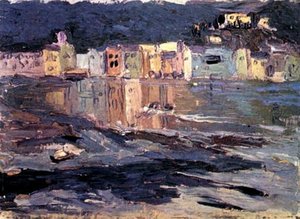
Wassily Kandinsky’s 1901 ‘Study for a Sluice’ is a captivating Post-Impressionist landscape showcasing a serene water scene with a white building, reflecting the artist's pioneering spirit and early exploration of abstraction. Discover or own this iconic artwork.
Kunstnerbiografi
Vaskassij Kandinskij (1866-1944) var en revolutionerende kunstner, der skabte abstrakt kunst med farver og former. Oplev hans spirituelle univers gennem smukke reproduktioner!
About the painting
Wassily Kandinsky’s ‘Study for a Sluice’: A Dawn of Abstract Emotion
Wassily Kandinsky's 'Study for a Sluice,' painted in 1901, represents a pivotal moment not just in the artist’s career but in the very trajectory of modern art. This seemingly simple landscape – a serene body of water reflecting a white building nestled amongst trees – is far more than a picturesque depiction; it's an intensely personal and profoundly influential exploration of color and form that foreshadowed the rise of abstract expressionism. Born in Moscow in 1866, Kandinsky’s artistic journey was initially marked by a pragmatic pursuit of law and economics before a transformative encounter with Monet’s “Haystacks” ignited within him a fervent desire to translate inner experience onto canvas. This nascent impulse found further resonance in Wagner's opera "Lohengrin," fueling his ambition to move beyond representational accuracy and capture the essence of emotion through purely visual means.
Post-Impressionist Roots & Early Experimentation
‘Study for a Sluice’ firmly establishes Kandinsky within the Post-Impressionist movement, though he quickly sought to transcend its limitations. The painting's style is characterized by bold color choices and expressive brushwork – hallmarks of the period – yet it demonstrates an unprecedented focus on the *relationships* between colors rather than their objective depiction. Notice how the blues and greens of the water subtly shift and blend, creating a sense of movement and depth. The white building, rendered with simplified forms, acts as a focal point, drawing the eye while simultaneously contributing to the overall atmospheric effect. This early work reveals Kandinsky’s nascent desire to use color not merely to represent reality but to evoke feeling and spiritual experience – a core tenet of his later artistic philosophy.
Symbolic Resonance & Spiritual Intent
Beyond its formal qualities, ‘Study for a Sluice’ is laden with symbolic resonance. The “sluice” itself, a structure designed to control water flow, can be interpreted as representing the artist's own attempt to channel and direct his creative energies. The surrounding landscape – the water, the trees, the building – all contribute to a sense of tranquility and contemplation, suggesting a yearning for spiritual harmony. Kandinsky was deeply interested in the intersection of art, religion, and psychology, believing that color possessed inherent spiritual qualities. This painting exemplifies this belief, demonstrating how he sought to translate subjective experience into tangible form.
Technique & Reproduction – A Window to the Original
This hand-painted reproduction meticulously recreates Kandinsky’s original technique, capturing the nuances of his brushwork and color palette with remarkable fidelity. The artist employed a layering method, building up thin washes of paint to achieve the luminous effects characteristic of his work. The textured surface, achieved through multiple applications of pigment, adds depth and richness to the image, inviting close observation. TopImpressionists’s skilled artisans have painstakingly reproduced this artwork, ensuring that you receive a faithful representation of Kandinsky's vision – a piece that will undoubtedly become a treasured addition to any art collection or interior space.
Spørgsmål og svar
Hvem har skabt "Study for a Sluice", og hvilken stilart er det?
Wassily Wassilyevich Kandinsky skabte "Study for a Sluice" inden for Post-Impressionist Landscape-bevægelsen.
Er "Study for a Sluice" tilgængelig som et fine art-print?
"Study for a Sluice" er tilgængelig som et fine art-print på bomuldscanvas eller arkivbestandigt lærredspapir. Du kan bestille den i den ønskede størrelse på dens Kunstprint i høj kvalitet-side.
Hvor kommer de besøgende til "Study for a Sluice" af Wassily Wassilyevich Kandinsky fra?
Der findes en Besøgsstatistik-side for "Study for a Sluice", som viser de månedlige besøgstal for kunstværket og kunstnerens øvrige værker, opdelt efter land og sprog.
Quick facts and art quiz
About Wassily Wassilyevich Kandinsky

Wassily Wassilyevich Kandinsky
1866 - 1944, Rusland
Kunstnerbiografi
A Life Immersed in Color and Spirit
Wassily Wassilyevich Kandinsky, født i Moskva i 1866, var en revolutionerende figur, der uomgængeligt ændrede kunstens gang. Hans rejse var ikke én af øjeblikkelig kunstnerisk kaldelse; han var oprindeligt bestemt til en karriere inden for jura og økonomi ved Moskva Universitet, men det var en dybtgående møde med impressionistisk maleri – specifikt Claude Monets “Høje” – og en bevægende oplevelse under at være vidne til Wagners opera "Lohengrin", der tændte et uimodståeligt ønske om at forfølge kunst. Dette afgørende øjeblik, omkring 30 års alderen, markerede ikke blot en karriereændring, men en fuldstændig perspektivtransformation, der satte ham på vejen mod pionerarbejde inden for abstraktion. Han flyttede hurtigt til München og blev optaget på den prestigefyldte Kunstakademi, hvor han studerede under Franz von Stuck, selvom endda inden for formel uddannelse længtes Kandinskys ånd efter udforskning ud over konventionelle grænser.
Tidlige indflydelser inkluderede russisk folkeligt kunst, opnået fra en etnografisk ekspedition til Vologda-regionen i 1889, hvilket gav anledning til en fascination med livlige farvepaletter og symbolske billeder. Denne grundlag ville vise sig at være afgørende, da han begyndte at udvikle sit unikke kunstneriske sprog. Disse tidlige udforskninger var ikke blot baseret på æstetisk præference; de var dybt forankret i en kulturel forbindelse og en voksende forståelse af, hvordan kunst kunne kommunikere ud over det bogstavelige. Han så farver som et middel til at formidle følelser og ideer – en tanke, der ville drive hans arbejde gennem hele sit liv.
The Dawn of Abstraction: From Expressionism to Inner Necessity
Kandinskys tidlige værker afslører en stærk ekspressionistisk tendens, karakteriseret ved dristige farver og følelsesmæssig intensitet – værker som “Papeln (Poplars)” fra 1902 illustrerer denne periode. Men han var ikke tilfreds med blot at repræsentere den ydre verden; han søgte at udtrykke indre realiteter, åndelige sandheder, der gik ud over simpel visuel gengivelse. Dette stræben førte ham gradvist væk fra repræsentation og mod en revolutionerende udforskning af farve, form og deres følelsesmæssige resonans. Han begyndte at se maleriet som et middel til at transcendere den fysiske verden og nå ind i det spirituelle.
Han var især inspireret af musik – Wagners operaer i særdeleshed – og mente, at farver kunne have en rytme og harmoni svarende til musik. Han eksperimenterede med forskellige former for arrangement og kombination, forsøgte at skabe et visuelt sprog, der kunne udtrykke de samme følelser som musik. Dette var ikke blot et ønske om at skabe smuk kunst; det var en dyb søgen efter en måde at kommunikere med sjælen på.
The Blue Rider and Early Abstraction
I begyndelsen af 1900-tallet begyndte Kandinsky at eksperimentere med mere abstrakte former og farver, ofte i kombination med ekspressionistiske elementer. Han var en del af den berømte kunstnergruppe “De Blå Ryggere” (Der Blaue Reiter), som han grundlagde sammen med Mikhail Larionov og Franz Marc. Gruppen søgte at udforske nye former for kunstnerisk udtryk, der gik ud over traditionelle repræsentationer. Deres arbejde var præget af en fascination af farve, form og symbolik, og de eksperimenterede med forskellige teknikker, herunder akvarel, collage og mixed media.
I denne periode skabte Kandinsky værker som “Improvisation 28” (1912) og “Composition VII” (1913), der er kendt for deres intense farver, dynamiske former og abstrakte kompositioner. Disse værker repræsenterer et afgørende skridt i Kandinskys udvikling mod abstraktion, da han begyndte at fokusere på de grundlæggende elementer af farve og form snarere end at forsøge at gengive den ydre verden.
Bauhaus and Late Works
Efter Første Verdenskrig flyttede Kandinsky til Tyskland, hvor han underviste på Bauhaus-skolen i Weimar. Her videreudviklede han sine teorier om farve og form og inspirerede en hel generation af kunstnere. Han mente, at farverne kunne udtrykke forskellige følelser og ideer, og at de kunne bruges til at skabe et harmonisk og balanceret visuelt rum. Hans undervisning på Bauhaus var præget af en kombination af teoretiske diskussioner og praktiske øvelser.
I sine sene værker fortsatte Kandinsky med at eksperimentere med abstrakte former og farver, ofte i store skalaer. Han brugte lagdelt impasto-teknik til at skabe dybe, teksturerede overflader, der tilføjede kompleksitet og dimension til sine kompositioner. Hans sidste værker, såsom “Composition VIII” (1936) og “Suites,” er kendt for deres intense farver, dynamiske former og spirituelle indhold. Han fortsatte at søge efter en måde at udtrykke de dybeste følelser og ideer gennem abstrakt kunst, selv i de mørke tider af nazisternes magtovertagelse.
Legacy and Influence
Kandinsky døde i München i 1944. Hans arbejde havde en enorm indflydelse på udviklingen af abstrakt kunst og har inspireret generationer af kunstnere. Han er betragtet som en pioner inden for abstraktion, og hans værker findes i de største museer verden over. Kandinskys tanker om farve og form fortsætter med at blive studeret og diskuteret af kunsthistorikere og kunstnere i dag. Hans bidrag til kunsten er uomgængeligt, og han vil altid være husket som en af de mest banebrydende og visionære kunstnere på det 20. århundrede.
Quick facts about Wassily Wassilyevich Kandinsky
- Artistic Movement Or Style: Abstrakt kunst, Ekspressionisme
- Artists Or Movements Influenced By This Artist: ['Abstrak Ekspressionisme']
- Artists Who Influenced This Artist:
- Claude Monet
- Richard Wagner
- Date Of Birth: 1866
- Full Name: Wassily Wassilyevich Kandinsky
- Nationality: Russisk, Fransk
- Notable Artworks:
- Murnau med Regnbue
- Tempereret Elan
- En intim fest
- Place Of Birth: Moskva, Rusland



Udforsk kunstværker organiseret efter temaer, stilarter og karakteristika.


Wassily Wassilyevich Kandinsky
Study for a Sluice
() ·
With its frame: · Hand-painted in oil on linen
Total