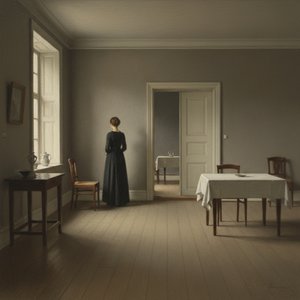
The Quietude of the Unnoticed
The lens of Alfred Madsen focuses on the periphery. While others sought the grand spectacle, Madsen turned his gaze toward the mundane, the overlooked, and the silent corners of Danish life. His work finds a specific, grounded reality in the everyday, rendering the unremarkable with a precision that demands attention. There is a stillness in his compositions, a sense of a moment caught in the pause between actions. He does not seek to dramatize; he seeks to observe.
His training at the Kunstakademiet in Copenhagen between 1949 and 1954 provided the technical foundation for this observational rigor. Under the guidance of teachers such as Vilhelm Lundstrøm, Aksel Jørgensen, and Albert Elmstedt, he developed a command over form and structure. This education did not lead him toward abstraction, but rather toward a heightened realism that found weight in the simplest subjects.
Technique and Subject Matter
Madsen’s output is characterized by a devotion to the tangible. His motifs often consist of:
- The textures of domestic or industrial debris, such as in Skurbillede (1965).
- The geometry of everyday objects and settings, seen in his still lifes.
- The quiet architecture of the landscape, such as the schoolhouse or the shed.
His versatility is evident in his choice of medium. He moved between the graphic, stark lines of linocut and the layered depth of oil painting. In works like The Shed at the Dump, seen from the South, a quiet Summer Day (1972), the light is not a theatrical spotlight but a natural presence that defines the space. His ability to find dignity in a dump or a schoolyard in the background speaks to a fundamental interest in the structural truth of his surroundings.
Recognition and Legacy
By the mid-1970s, his contribution to Danish art was formally acknowledged. In 1976, he was awarded the Eckersbergs Medalje, a significant distinction for a painter dedicated to such a specific, grounded vision. His membership in the group Kammeraterne from 1960 to 1986 placed him within a specific community of practitioners, yet his focus remained singular. He remained committed to the quietude of the real, even as the art world shifted around him.
Today, his presence is felt in the permanent collections of the Statens Museum For Kunst in Copenhagen. His works, such as The School in the Background (1984), remain as they were intended: direct, unadorned, and deeply rooted in the physical reality of the world he inhabited.
Spørgsmål og svar
Kan jeg gennemse Alfred Madsens værker efter medie?
Siden Alle medier grupperer Alfred Madsens værker efter teknik.
Hvilke farver brugte Alfred Madsen oftest?
Farvepalettens DNA for Alfred Madsen er en side, der præsenterer farveprofilen i kunstnerens samlede værk.
Hvor kommer Alfred Madsen fra?
Alfred Madsen blev født i Kingdom of Denmark.
Hvor mange kunstværker af Alfred Madsen er tilgængelige at gennemse?
Du kan gennemse 2 kunstværker værker af Alfred Madsen på siden Alle kunstværker.