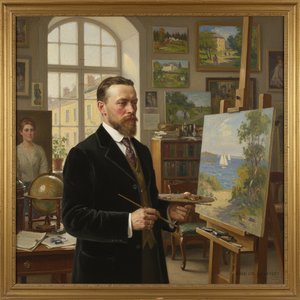
A Life Between Two Worlds
Born in Germany in 1854, Aurélio Zimmermann carried the traditions of European training across the Atlantic to the landscapes of Brazil. His early years were shaped by the rigorous academic environments of the Berlin Academy of Fine Arts and the Academy of Dresden. These institutions provided him with a technical foundation that he would eventually apply to the vast, unfamiliar terrains of his new home. In 1884, he arrived in Brazil, initially finding his footing in the southern regions of Santa Catarina and Paraná before eventually settling in São Paulo in 1898.
His transition from a student in Germany to a settled artist in Brazil allowed him to observe the specific light and atmosphere of the South American landscape. He became a painter and illustrator, focusing his gaze on the natural world. His work often captured the quietude of the countryside and the specificities of the Brazilian interior, moving away from the structured settings of his youth toward a more observational style of landscape painting.
Artistic Recognition and Legacy
Zimmermann’s ability to translate the essence of the Brazilian landscape earned him significant attention within the local art community. His presence in the cultural life of São Paulo was marked by a notable solo exhibition in 1907 at Fotografia Rizzo. This period of his life saw him gaining formal recognition for his skill, particularly when he was awarded the Silver Medal at the 1907 General Exhibition of Fine Arts in Rio de Janeiro.
The following details summarize the key aspects of his professional life:
- Primary Occupations: Painter, visual artist, and illustrator.
- Specialization: Landscape painting.
- Major Recognition: Silver Medal at the 1907 General Exhibition of Fine Arts.
The Visual Record
Zimmermann’s paintings capture the specific light and atmosphere of the Brazilian landscape. His works record the environment and the people living within it. His pieces are held in collections that keep his view of the land accessible to those studying the region's history. These works provide a look at the natural world as it appeared during his lifetime, from his arrival in Brazil in 1884 to his later years in São Paulo.
His compositions, including Pouso no Sertão - Queimada, 1826 and Bênção das canoas (Porto Feliz), show a close connection to his subjects. These works are part of the permanent collections that document his time as a painter. He died in São Paulo in 1920, and his work remains in collections like the Museu Paulista.
Spørgsmål og svar
Findes der et overblik over alle de motiver, som Aurélio Zimmermann har malet?
Aurélio Zimmermanns værker kan udforskes efter emne på kunstnerens Emneoversigt-side.
Kan jeg studere Aurélio Zimmermanns farvebrug på tværs af alle værker?
Farvepalettens DNA for Aurélio Zimmermann er en side, der præsenterer farveprofilen i kunstnerens samlede værk.
Kan jeg udforske Aurélio Zimmermanns værker efter farvespektrum?
Farveindeks for Aurélio Zimmermann er en side, der organiserer kunstnerens værker efter farve.
Hvordan finder jeg værker af Aurélio Zimmermann i en specifik farvepalette?
Siden Efter farvepalet grupperer Aurélio Zimmermanns kunstværker efter deres farvepaletter.