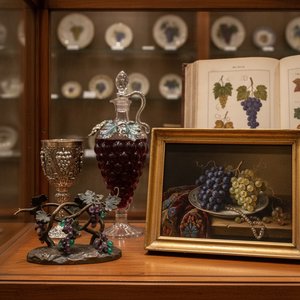
A Life in Stillness
Born in Bamberg on May 21, 1743, Catharina Treu entered a world defined by the brushstrokes of her kin. She was raised within a family of painters, receiving her earliest lessons from her father, Joseph Marquard Treu, alongside her brothers and sisters. This domestic apprenticeship grounded her in the technical rigors of the craft long before she sought the wider recognition of the German courts.
Her early reputation was built upon a particular skill: the ability to replicate the quiet intensity of 17th-century still life paintings. These copies brought her local fame, eventually catching the eye of Adam Friedrich von Seinsheim, the Prince-Bishop of Bamberg. In 1762, he commissioned her to paint overdoors for his Würzburg Residence, a task that signaled her transition from a talented student to a recognized professional.
Courtly Appointments and Academic Milestones
The trajectory of Treu’s career was closely tied to the movements of the Bavarian court. In 1769, she achieved the title of court painter for Charles Theodore, Elector of Bavaria. This period saw her serving as a cabinet painter for his second residence at Mannheim Palace. Her work during these years often took the form of large-scale series designed specifically for the architectural needs of grand palaces.
Beyond the private commissions of nobility, Treu achieved a significant milestone in the academic sphere. When the court moved to Schloss Benrath in Düsseldorf, she was appointed as the first female teacher under Lambert Krahe at the Kunstakademie Düsseldorf. This role placed her at the center of formal artistic instruction during a period of shifting cultural tides.
The Language of Fruit and Flora
Treu’s repertoire focused heavily on the still life, particularly compositions featuring fruit, flowers, and various objects. Her paintings often functioned as pendants or parts of larger decorative schemes, such as those intended for Schloss Bruchsal in 1766. She possessed a particular talent for capturing the textures of nature, from the weight of grapes to the delicate presence of butterflies.
Her later years were marked by a quieter existence following her marriage to Jakob Konig in 1781. In various historical inventories, she is sometimes recorded under the name Mme König. While much of her physical work was lost to the destruction of war and bombing, her presence remains documented through archives and surviving pieces such as:
- Still Life with Fruit (1768)
- Früchtestilleben mit Vogel und Schmetterling (1766)
- A glass dish of wild strawberries with a rose (1807)
She passed away in Mannheim on October 11, 1811, leaving behind a record of a life spent observing the small, tangible details of the natural world.
Spørgsmål og svar
I hvilken historisk periode arbejdede Catharina Treu?
Catharina Treu var aktiv i Early Modern-perioden. Denne periode placerer kunstnerens virke i en historisk kontekst.
Hvordan finder jeg værker af Catharina Treu inden for et specifikt tema?
Udforsk Catharina Treus værker via nøgleord på kunstnerens Efter nøgleord-side, hvor hvert nøgleord samler de relaterede kunstværker.
Hvor kommer Catharina Treu fra?
Catharina Treu blev født i Germany.
Hvor kan man finde Catharina Treus værker grupperet efter teknik?
Siden Alle medier grupperer Catharina Treus værker efter teknik.