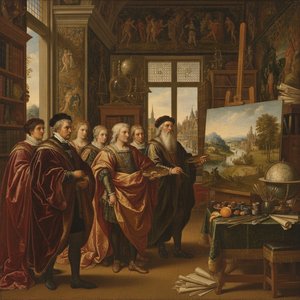
The Luminous Glow of a Hidden Technique
A flicker of light emerges from the darkness under ultraviolet rays. This is the signature of Emile Alexay, a painter who manipulated light through a specialized method known as luminous painting. His canvases do not merely reflect light; they seem to emit it. In works such as The Descent from the Cross, the pigments react to specific light spectrums, creating a brilliant glow that transforms the viewing experience.
This technical innovation defined his career. While many of his contemporaries focused on traditional oil textures, Alexay experimented with materials that allowed for this internal radiance. He was an art educator who understood the science behind the spectacle. His ability to command light made him a pioneer in fine art, pushing the boundaries of how color and luminosity interact with the human eye.
From Budapest to the Hapsburg Court
The path begins in the School of Industrial Art in Budapest. At fourteen, Alexay is already immersed in formal training. By his fourth year, he is winning competitions in portraiture and life drawing. The momentum carries him toward the Academy of Fine Arts in Munich, but his early professional successes are rooted in Central Europe.
At nineteen, a significant responsibility arrives. He takes complete charge of the mural decorations for a Greek Catholic Church, planning and executing the entire chapel decoration. This achievement brings him to the attention of the elite. His talent leads to a position as a court painter to the Hapsburgs in Austria. He moves through circles of high society, capturing the likenesses of eminent personages, including Archduke Joseph of Hungary.
His skill with the brush extends to the most influential figures of his era:
- Archduke Joseph of Hungary
- Edith Bolling Galt (Mrs. Woodrow Wilson), whose 1924 portrait resides in the Smithsonian Institute
A Life Across Borders
The geography of his life shifts as much as his palette. Born in 1891, his early years are tied to the art scenes of Budapest and Munich. However, his later years find him in Newark, New Jersey. This transition from the imperial courts of Europe to the United States marks the final chapter of a career that spanned continents.
His legacy remains anchored in specific, tangible works held in major institutions. The East Slovak Gallery houses Podobizeň dievčaťa, an oil on board piece from 1919. His personal history is also etched into his subjects, such as the 1908 painting of his mother's effigy. He remains a figure defined by the intersection of technical experimentation and the formal traditions of portraiture.
Spørgsmål og svar
Hvor kan man finde Emile Alexays kunstværker grupperet efter farvepalette?
Se Emile Alexays værker sorteret efter farvepalette på kunstnerens Efter farvepalet side.
Hvor kommer Emile Alexay fra?
Emile Alexay blev født i Ukraine.
I hvilken historisk periode arbejdede Emile Alexay?
Emile Alexay var aktiv i Modern-perioden. Denne periode placerer kunstnerens virke i en historisk kontekst.
Hvor mange kunstværker af Emile Alexay er tilgængelige at gennemse?
Du kan gennemse 7 kunstværker værker af Emile Alexay på siden Alle kunstværker.