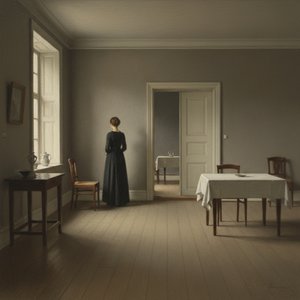
The Quiet Observer of Form
In the quiet corners of the Kingdom of Denmark, a painter named Gunnar Nikolajsen began to observe the world through a lens of subtle intention. Born in 1898, he moved through the decades with a steady hand, finding his purpose in the delicate interplay of light and the presence of the human figure. His life was not one of loud proclamations, but rather a dedicated pursuit of the essence found in landscapes and the human form. He sought to capture the stillness of a moment, whether it was the rugged character of the Faroe Islands or the soft contours of a sitter's face.
His work reveals a man deeply attuned to the nuances of his surroundings. He did not merely paint what he saw; he sought to understand the weight of the air and the way light settles upon a subject. This patient approach allowed him to navigate the shifting aesthetics of the twentieth century while remaining anchored to the fundamental truths of his craft.
A Life Captured in Pigment
The development of his skill can be traced through the subjects he chose to honor. He was a painter of both the land and the person, a duality that allowed him to explore both the vastness of nature and the intimacy of a portrait. His hands were guided by a desire to translate the physical world into a language of color and shape.
- The rugged, natural landscapes of the Faroe Islands.
- The structured elegance of formal portraiture.
- The atmospheric qualities of the Danish countryside.
In 1943, he produced a notable work titled Portrait of a Lady, a piece that found its way into the esteemed collection of the Statens Museum For Kunst in Copenhagen. This work remains a significant marker of his ability to render the human presence with dignity and grace. It is a piece that speaks to his technical command and his ability to hold a gaze across the decades.
The Legacy of a Danish Painter
As the years passed, Nikolajsen’s place in the artistic fabric of his nation became more defined. He was a man of his time, yet his focus on the essential qualities of his subjects gave his work a lasting presence. He lived until 1983, leaving behind a body of work that reflects a lifetime of careful observation and a deep respect for the subjects he encountered.
His contribution to the art of Denmark is found in the quiet strength of his compositions. He did not seek to overwhelm, but to reveal. Through his paintings, the viewer is invited to see the world as he did—with a steady eye and a hand that understood the profound beauty in the simple act of seeing.
Spørgsmål og svar
Hvilke andre navne eller pseudonymer bruger Gunnar Nikolajsen?
Gunnar Nikolajsen optræder under de alternative navne Hans Gunnar Nikolajsen.
Findes der en kronologisk gennemgang af Gunnar Nikolajsen?
Kronologi for Gunnar Nikolajsen er en rullevenlig tidslinje, der præsenterer kunstnerens værker i kronologisk rækkefølge, opdelt i kapitler efter karriereperioder.
Kan jeg sortere Gunnar Nikolajsens værker efter farve?
Siden Farveindeks organiserer Gunnar Nikolajsens værker efter farve.
Hvor kan man finde Gunnar Nikolajsens kunstværker grupperet efter nøgleord?
Siden Efter nøgleord for Gunnar Nikolajsen grupperer kunstnerens værker efter nøgleord.