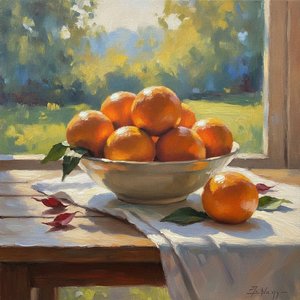
The Quiet Observer of Zutphen
In the heart of the Netherlands, within the historic streets of Zutphen, a painter named Karel Christiaan Donner began to observe the world through a lens of careful detail. Born in 1800, he moved through the first half of the nineteenth century with a steady hand and a keen eye for the textures of life. While some artists sought the grandiosity of history or the drama of myth, Donner found his purpose in the stillness of the immediate surroundings. His presence in the art world was marked by a period of activity that flourished between 1839 and 1848, a time when he sought to capture the essence of his environment through the medium of oil and pigment.
His work reflects a man deeply attuned to the specificities of his Dutch surroundings. He did not merely paint objects; he recorded the weight of a fruit or the silhouette of a landmark against the sky. This dedication to the tangible made him a significant figure in the local artistic landscape of his era.
A Study in Form and Place
The brushwork of Donner reveals a fascination with how light interacts with different surfaces. He possessed a particular talent for the still life, a genre that demands patience and a precise understanding of composition. His ability to render the subtle curves and colors of nature allowed him to transform simple subjects into profound studies of existence. His repertoire includes notable works that highlight his versatility:
- Hendrik Gerrit Ruempol, Still Life with Fruit (1846)
- View of Kasteel Ruurlo (1846)
In his depiction of Kasteel Ruurlo, one senses a desire to anchor the viewer in a specific sense of place. He captured the architecture and the atmosphere of the landscape with a clarity that speaks to his disciplined approach. Whether he was focusing on the intimate details of a tabletop or the sprawling lines of a castle, his intent remained the same: to document the world as it appeared to his watchful eyes.
The Legacy of a Local Master
As the years passed, Donner’s influence remained tied to the traditions of his homeland. He lived out his days in Zutphen, the same city that had seen his emergence as an artist, until his passing in 1877. Though his active years were concentrated in a specific window of time, the works he left behind continue to offer a window into the visual language of the mid-1800s. He remains a painter of substance, remembered for his ability to find meaning in the quietest corners of the Dutch landscape and the simplest arrangements of the natural world.
Spørgsmål og svar
Findes der en tidslinje over K.C. Donners værker?
Se en tidslinje over K.C. Donners værker på siden Tidslinje for kunstværker, hvor kunstværkerne er sorteret efter dato.
Kan jeg udforske K.C. Donners værker via nøgleord?
For at finde værker af K.C. Donner inden for et specifikt tema kan du bruge kunstnerens Efter nøgleord-side, som grupperer værkerne efter nøgleord.
Findes der et overblik over alle de motiver, som K.C. Donner har malet?
Siden Emneoversigt kortlægger K.C. Donners kunstværker efter motiv.
I hvilken historisk periode arbejdede K.C. Donner?
K.C. Donner var aktiv i 19th Century-perioden. Denne periode placerer kunstnerens virke i en historisk kontekst.