

Gezeigt: · Inklusive Rahmen:
 Versenden
 Teilen
 Details anzeigen
 Leitfaden

 Herunterladen
 Ähnliche Objekte
 Diashow
 Fragen & Antworten
 Statistiken
- 26.0 x 33.0 cm


€ 240
Handgefertigte Ölreproduktion
Handgemaltes Ölgemälde auf Leinwand in Ihrer Wunschgröße und mit Rahmen, auf Bestellung von unseren Künstlern angefertigt. ( Zum Druck wechseln Zum digitalen Bild wechseln)
Größe
·Standardformat
individuell anpassbar
CM
INCH
Wählen Sie aus unseren vordefinierten Formaten, die den ursprünglichen Proportionen des Kunstwerks entsprechen.
Größen werden geladen...

Breite
Höhe
Geben Sie die Breite und die Höhe an, die Sie für Ihren Rahmen oder Ihre Wand benötigen. Da dieses Werk handgemalt ist, kann der Künstler bei einer anderen Form etwas mehr um das Bild herum malen oder etwas abschneiden – Sie entscheiden. Wir senden Ihnen ein digitales Mockup zur Freigabe, bevor mit dem Malen begonnen wird. Das auf dieser Seite gezeigte Bild stellt nicht das tatsächliche Ergebnis dar – dies tut nur das Mockup.
 Mehr erfahren
Abschließen
·
Weißer Rand €1

verlaufende Kanten €1

Umrandung €1

P118B €10

P118H €10

P118W €10

P438Z €10

P508JH €12

P508YH €12

P805H €10

P805Z €10

P919BZ €10

P919G €10

P919XJ €10

P959ZH €10

P968JZ €12

W106C €8

W218G €10

W218JH €8

W218Y €10

W307PJ €10

W316G €10

W316PJ €8

W316Y €10

W398PJ €8

W4111J €10

W500HY €15

W500JH €15

W692G €12

W849H €8

W940BG €15

W953PJ €8

H24-GOLD €30

H24-SILVER €30

H36-GOLD €45

H36-SILVER €45
Versand in einer Schutzröhre, bereit für die Rahmung durch Ihren Rahmenmacher.
Extras
optionalWas sind die Extras enthalten?
Beispiele für Anpassungsmöglichkeiten: Gesicht durch Kundenfoto ersetzen; Haustier hinzufügen (z. B. Katze durch Hund ersetzen); Versteckte Botschaft im Hintergrund einfügen; Hintergrundlandschaft oder Elemente ändern.
Nach der Bestellung wird das Team von TopImpressionists.com den Kunden per E-Mail kontaktieren, um Anweisungen einzuholen und eine Vorschau des Entwurfs bereitzustellen
Nach der Bestellung wird das Team von TopImpressionists.com den Kunden per E-Mail kontaktieren, um Anweisungen einzuholen und eine Vorschau des Entwurfs bereitzustellen
Weltweiter Versand () in nur 3 bis 4 Wochen statt der üblichen 5 Wochen. (9 November). Keine Kompromisse bei der Qualität.
Schutzlackierung
Beschriftung
Details der gravierten Bronzetafel
This elegant plaque features the artist's name and the title of the artwork, finely engraved for a timeless presentation.
It is made from bronze with a refined, elegant finish. The text is precisely laser-engraved for a sharp and permanent result. Measuring 9x2 cm, the plaque is compact yet easy to read. It's built to be durable and scratch-resistant, offering a professional, museum-quality look. Mounting is simple thanks to the included adhesive backing.
Details zur Acrylglas-Plakette (transparent)
The plaque includes essential engraved details such as the artist's name, the title of the artwork, the date it was created, the type of media used-like oil on canvas or watercolor-a brief description of the piece, and a QR code that links to the complete artwork information.
It is crafted from clear acrylic, offering a sleek, modern appearance. The text is UV-engraved in black to ensure strong visual contrast. With a size of 10x15 cm, it ensures optimal readability. It comes equipped with two metal hooks for secure wall mounting. The plaque is designed to be weather-resistant, making it suitable for various environments, and it includes interactive features that work seamlessly with smartphone scanning.
Details zur schwarzen Acryltafel
This elegant plaque includes engraved information such as the artist's name, the title of the artwork, the date it was created, the type of media used (like oil on canvas or watercolor), a short description of the artwork, and a QR code for quick access to more information.
The plaque itself is made from refined black acrylic with a premium finish. The text is laser-engraved in white for high contrast and readability. Its size is 10x15 cm, designed to be easy to read. It comes with two metal hooks for professional mounting. The design is sleek and fits any interior style. It is also weather-resistant and durable, with built-in digital integration for mobile compatibility.
Die Glasoption ist nur für Größen unter 110 cm verfügbar.
 Die Glasoption ist nur für Größen unter 110 cm verfügbar.
- Kostenloser weltweiter Expressversand
- Hochwertige Leinenleinwand
- Umfassender Versicherungsschutz beim Versand
- Zollgebühren-Rückerstattungsgarantie
- Garantie für exakte Farbtreue
- 100 Tage Rückgaberecht (nur bei Mängeln)
- 100% Geld-zurück-Garantie
- Mengenrabatt verfügbar


Beschreibung des Sammlerstücks
Marvel at Benvenuto Cellini's opulent 'Salt Cellar,' a Renaissance masterpiece of gold, enamel, and intricate symbolism—a testament to artistry & luxury from 1543 Vienna.
Künstlerbiografie
Benvenuto Cellini (1500-1571): Florentiner Goldschmied & Bildhauer der Manierismus-Ära, berühmt für 'Perseus' & den exquisiten Cellini-Salzbehälter. Entdecken Sie seine Kunst & sein Leben!
Über das Gemälde
A Gilded Echo of Antiquity
Benvenuto Cellini's Salt Cellar, a shimmering testament to the heights of Renaissance goldsmithing, isn’t merely a container for salt; it’s a miniature cosmos, a meticulously crafted allegory brimming with symbolism and technical brilliance. Completed in 1543 for King Francis I of France, this extraordinary object transcends its functional purpose, becoming a profound meditation on the relationship between earth and sea, divinity and humanity. It's a piece that whispers tales of ambition, artistry, and the intoxicating allure of the Italian Renaissance—a world where beauty was paramount and skill elevated to an almost religious pursuit.
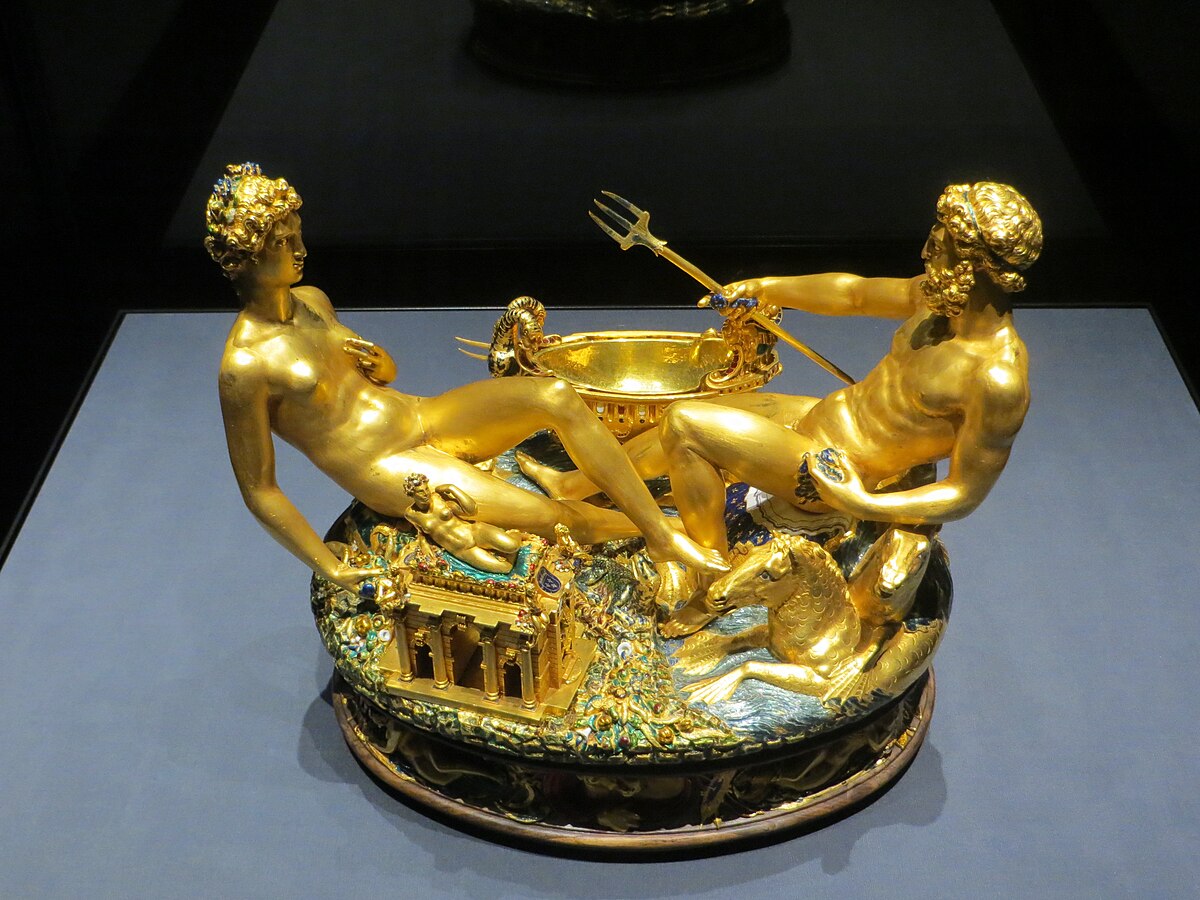
Image of Benvenuto Cellini’s Salt Cellar
The Anatomy of a Masterpiece
Crafted primarily from gold, the Salt Cellar is an astonishing feat of technical mastery. Cellini, renowned for his flamboyant personality and equally impressive skill, eschewed traditional casting methods, instead meticulously hammering the gold into its delicate, flowing form by hand. The base is elegantly fashioned from ebony, providing a striking contrast to the radiant gold, while ivory bearings allow the sculpture to gracefully roll across a banquet table – a deliberate feature designed for display and conversation. But it’s the enameling that truly elevates the piece; intricate scenes depicting figures representing the four seasons and the four winds are painstakingly applied, adding layers of visual complexity and narrative depth. The sheer scale of detail—from the meticulously rendered folds of clothing to the lifelike expressions on the faces of Neptune and Tellus – speaks volumes about Cellini’s dedication and unparalleled skill.
- Material: Gold, Ebony, Ivory, Enamel
- Dimensions: Approximately 10.5 inches (267 mm) tall, 13.1 inches (333 mm) wide
- Technique: Hand-hammered gold, intricate enamel work
A Dialogue with the Divine
The Salt Cellar’s symbolism is as captivating as its aesthetic beauty. At its heart lies a potent allegory of Terra e Mare – Earth and Sea – embodied by the figures of Neptune, god of the ocean, and Tellus, goddess of the earth. These two powerful deities are depicted in an intimate embrace, their legs intertwined, suggesting a harmonious connection between the terrestrial and aquatic realms. The sculpture is further enriched with symbolic details: a small boat carries the salt, representing the flow of commerce and sustenance; a temple dedicated to peppercorns stands alongside Tellus, signifying the pleasures of earthly life. The inclusion of animals—horses, dogs, dolphins—adds another layer of meaning, drawing upon classical iconography and reinforcing the sculpture’s connection to mythology and antiquity.
A Legacy Forged in Ambition
Cellini's autobiography, *Vita*, offers invaluable insight into the creation of this extraordinary piece. He recounts his initial reluctance to accept the commission from Cardinal Ippolito d’Este, dismissing the cardinal’s suggestions with characteristic arrogance and asserting sole credit for the design. The story is rife with anecdotes about Cellini’s daring exploits—including a dramatic escape from bandits while transporting the gold—further cementing his image as a larger-than-life figure of Renaissance Italy. The Salt Cellar, therefore, isn't just an artistic achievement; it’s a reflection of Cellini’s own complex and often contradictory personality – a testament to ambition, skill, and a profound appreciation for beauty. It remains one of the most celebrated examples of Renaissance goldsmithing, captivating viewers with its exquisite detail and enduring symbolism.
Fragen & Antworten
Welche Stimmung und welche Emotion vermittelt "Salt Cellar" von Benvenuto Cellini?
Die festgehaltene Stimmung von "Salt Cellar" von Benvenuto Cellini ist Edel und klassisch, und ihr emotionaler Tonfall ist Reflektierend.
Wie viel Licht scheinen die Farben von "Salt Cellar" zu reflektieren?
"Salt Cellar" von Benvenuto Cellini weist eine Luminanz von Sanfter Schatten auf. Die Luminanz beschreibt, wie viel Licht die Farben scheinbar reflektieren.
Ist "Salt Cellar" von Benvenuto Cellini ein Gemälde, eine Zeichnung oder ein Druck?
"Salt Cellar" ist ein Werk der Gattung Skulptur.
Kurzinfos und Kunst-Quiz
Über Benvenuto Cellini

Benvenuto Cellini
1500 - 1571, Italien
Künstlerbiografie
Benvenuto Cellini: Ein Renaissance-Universalgenie
- Geboren: Florenz, Italien (1. November 1500)
- Gestorben: 13. Februar 1571
Benvenuto Cellini war eine bemerkenswerte Figur der italienischen Renaissance, bekannt für sein Können als Goldschmied, Bildhauer, Zeichner, Soldat, Musiker und Schriftsteller. Seine vielseitigen Talente und seine extravagante Persönlichkeit werden in seinem gefeierten autobiografischen Werk lebendig, das neben seinen künstlerischen Leistungen einen bedeutenden literarischen Wert darstellt. Er verkörpert den Geist des Manierismus, einer Periode nach der Hochrenaissance, die durch dramatische Effekte und stilistische Komplexität gekennzeichnet ist.
Frühes Leben und Künstlerische Ausbildung
Geboren in eine Familie mit musikalischen Neigungen – sein Vater war Musiker und Instrumentenbauer – zeigte Cellini zunächst vielversprechendes Talent für Musik. Mit fünfzehn Jahren widmete er sich jedoch leidenschaftlich einer Karriere als Goldschmied und überzeugte seinen widerwilligen Vater, ihn bei Antonio di Sandro (bekannt als Marcone) auszubilden. Dies markierte den Beginn seiner formellen künstlerischen Ausbildung. Seine frühen Jahre waren nicht ohne Zwischenfälle; mit sechzehn geriet er in eine Schlägerei mit Gefährten, was zu einer Verbannung aus Florenz und einer Zeit der Arbeit in Siena unter dem Goldschmied Fracastoro führte.
Hauptwerke und Stil
- Salzkasten: Dieses aufwendige Silbermeisterwerk, das von König Franz I. von Frankreich in Auftrag gegeben wurde, ist wohl sein berühmtestes Werk. Es zeigt komplizierte Details und dynamische Figuren und befindet sich heute im Kunsthistorischen Museum in Wien.
- Perseus mit dem Kopf der Medusa: Eine Bronzestatue, die Perseus darstellt, wie er triumphierend den enthaupteten Kopf der Medusa hält. Dieses Werk veranschaulicht Cellinis Meisterschaft in Form und dramatischer Komposition. Es ist ein Beweis für sein Können, Bewegung und Emotionen im Metall einzufangen.
- Goldmedaille von Leda und dem Schwan: Diese Medaille, die für Gonfaloniere Gabriello Cesarino geschaffen wurde, demonstriert Cellinis Fähigkeit, klassische Mythologie mit exquisiter Handwerkskunst zu verbinden.
- Entwurf für ein Siegel: Eine Zeichnung aus dem British Museum, die seine gestalterischen Fähigkeiten zeigt.
Cellinis Stil zeichnet sich durch Dynamik, Realismus und Detailgenauigkeit aus. Er ließ sich von der klassischen Antike und Michelangelos kraftvollen Figuren inspirieren, verlieh seiner Arbeit jedoch eine unverwechselbare manieristische Sensibilität – verlängerte Formen, übertriebene Posen und ein Gefühl für Theatralik.
Leben jenseits der Kunst: Soldat, Musiker und Autobiograf
Cellinis Leben erstreckte sich weit über die Werkstatt hinaus. Er diente als Soldat während Belagerungen und behauptete, eine entscheidende Rolle bei der Verteidigung Roms gegen kaiserliche Truppen gespielt zu haben. Er war auch ein begabter Musiker, spielte Cornett und Flöte am päpstlichen Hof. Doch gerade seine Autobiografie hebt ihn von anderen ab.
- Das Leben des Benvenuto Cellini: Dieser offene und oft prahlerische Bericht bietet unschätzbare Einblicke in Kunst, Kultur und Gesellschaft der Renaissance. Es ist eine fesselnde Erzählung voller Anekdoten über Auftraggeber, Rivalen und persönliche Abenteuer und bietet eine einzigartige Perspektive auf die Epoche.
Seine Autobiografie ist nicht nur eine Aufzählung von Ereignissen; sie ist ein sorgfältig konstruiertes Selbstporträt, das darauf abzielt, seine Talente zu präsentieren und sein Handeln zu rechtfertigen. Obwohl sie aufgrund von Cellinis eigener Voreingenommenheit manchmal unzuverlässig ist, bleibt sie eine unverzichtbare Primärquelle für das Verständnis des Lebens in der Renaissance.
Vermächtnis und Historische Bedeutung
Benvenuto Cellini starb 1571 in Florenz und hinterließ ein Vermächtnis als einer der wichtigsten Künstler des Manierismus. Seine technische Fertigkeit, künstlerische Innovation und seine fesselnde Autobiografie inspirieren weiterhin Künstler und Kunstliebhaber gleichermaßen. Er repräsentiert das typische Renaissance-Ideal – ein Universalgenie mit Fähigkeiten in mehreren Disziplinen, getrieben von Ehrgeiz und unerschrocken, seine Individualität auszudrücken. Seine Werke werden für ihre Schönheit, Handwerkskunst und dramatische Kraft gefeiert und festigen so seinen Platz als zentrale Figur in der westlichen Kunstgeschichte.
Kurzinfos zu Benvenuto Cellini
- Beeinflusste Künstler: ['Michelangelo']
- Bemerkenswerte Werke:
- Salzgefäß von François I.
- Perseus mit der Medusa
- Goldmedaille Leda und Schwan
- Geburtsdatum: 1. November 1500
- Geburtsort: Florenz, Italien
- Künstlerische Richtung: Manierismus
- Nationalität: Italienisch
- Sterbedatum: 13. Februar 1571
- Vollständiger Name: Benvenuto Cellini
Entdecken Sie Kunstwerke, die nach Themen, Stilen und Merkmalen sortiert sind.


Benvenuto Cellini
Salt Cellar
() ·
Inklusive Rahmen: · Handgemalt mit Öl auf Leinen
Gesamtbetrag