

Gezeigt: · Inklusive Rahmen:
 Vorschau anzeigen
 Versenden
 Teilen
 Details anzeigen
 Leitfaden

 Herunterladen
 Ähnliche Objekte
 Röntgenaufnahme
 Diashow
 Fragen & Antworten
 Statistiken

€ 240
Handgefertigte Ölreproduktion
Handgemaltes Ölgemälde auf Leinwand in Ihrer Wunschgröße und mit Rahmen, auf Bestellung von unseren Künstlern angefertigt. ( Zum Druck wechseln Zum digitalen Bild wechseln)
Größe
·Standardformat
individuell anpassbar
CM
INCH
Wählen Sie aus unseren vordefinierten Formaten, die den ursprünglichen Proportionen des Kunstwerks entsprechen.
Größen werden geladen...

Breite
Höhe
Geben Sie die Breite und die Höhe an, die Sie für Ihren Rahmen oder Ihre Wand benötigen. Da dieses Werk handgemalt ist, kann der Künstler bei einer anderen Form etwas mehr um das Bild herum malen oder etwas abschneiden – Sie entscheiden. Wir senden Ihnen ein digitales Mockup zur Freigabe, bevor mit dem Malen begonnen wird. Das auf dieser Seite gezeigte Bild stellt nicht das tatsächliche Ergebnis dar – dies tut nur das Mockup.
 Mehr erfahren
Abschließen
·
Weißer Rand €1

verlaufende Kanten €1

Umrandung €1

P118B €10

P118H €10

P118W €10

P438Z €10

P508JH €12

P508YH €12

P805H €10

P805Z €10

P919BZ €10

P919G €10

P919XJ €10

P959ZH €10

P968JZ €12

W106C €8

W218G €10

W218JH €8

W218Y €10

W307PJ €10

W316G €10

W316PJ €8

W316Y €10

W398PJ €8

W4111J €10

W500HY €15

W500JH €15

W692G €12

W849H €8

W940BG €15

W953PJ €8

H24-GOLD €30

H24-SILVER €30

H36-GOLD €45

H36-SILVER €45
Versand in einer Schutzröhre, bereit für die Rahmung durch Ihren Rahmenmacher.
Extras
optionalWas sind die Extras enthalten?
Beispiele für Anpassungsmöglichkeiten: Gesicht durch Kundenfoto ersetzen; Haustier hinzufügen (z. B. Katze durch Hund ersetzen); Versteckte Botschaft im Hintergrund einfügen; Hintergrundlandschaft oder Elemente ändern.
Nach der Bestellung wird das Team von TopImpressionists.com den Kunden per E-Mail kontaktieren, um Anweisungen einzuholen und eine Vorschau des Entwurfs bereitzustellen
Nach der Bestellung wird das Team von TopImpressionists.com den Kunden per E-Mail kontaktieren, um Anweisungen einzuholen und eine Vorschau des Entwurfs bereitzustellen
Weltweiter Versand () in nur 3 bis 4 Wochen statt der üblichen 5 Wochen. (3 November). Keine Kompromisse bei der Qualität.
Schutzlackierung
Beschriftung
Details der gravierten Bronzetafel
This elegant plaque features the artist's name and the title of the artwork, finely engraved for a timeless presentation.
It is made from bronze with a refined, elegant finish. The text is precisely laser-engraved for a sharp and permanent result. Measuring 9x2 cm, the plaque is compact yet easy to read. It's built to be durable and scratch-resistant, offering a professional, museum-quality look. Mounting is simple thanks to the included adhesive backing.
Details zur Acrylglas-Plakette (transparent)
The plaque includes essential engraved details such as the artist's name, the title of the artwork, the date it was created, the type of media used-like oil on canvas or watercolor-a brief description of the piece, and a QR code that links to the complete artwork information.
It is crafted from clear acrylic, offering a sleek, modern appearance. The text is UV-engraved in black to ensure strong visual contrast. With a size of 10x15 cm, it ensures optimal readability. It comes equipped with two metal hooks for secure wall mounting. The plaque is designed to be weather-resistant, making it suitable for various environments, and it includes interactive features that work seamlessly with smartphone scanning.
Details zur schwarzen Acryltafel
This elegant plaque includes engraved information such as the artist's name, the title of the artwork, the date it was created, the type of media used (like oil on canvas or watercolor), a short description of the artwork, and a QR code for quick access to more information.
The plaque itself is made from refined black acrylic with a premium finish. The text is laser-engraved in white for high contrast and readability. Its size is 10x15 cm, designed to be easy to read. It comes with two metal hooks for professional mounting. The design is sleek and fits any interior style. It is also weather-resistant and durable, with built-in digital integration for mobile compatibility.
Die Glasoption ist nur für Größen unter 110 cm verfügbar.
 Die Glasoption ist nur für Größen unter 110 cm verfügbar.
- Kostenloser weltweiter Expressversand
- Hochwertige Leinenleinwand
- Umfassender Versicherungsschutz beim Versand
- Zollgebühren-Rückerstattungsgarantie
- Garantie für exakte Farbtreue
- 100 Tage Rückgaberecht (nur bei Mängeln)
- 100% Geld-zurück-Garantie
- Mengenrabatt verfügbar


Beschreibung des Sammlerstücks
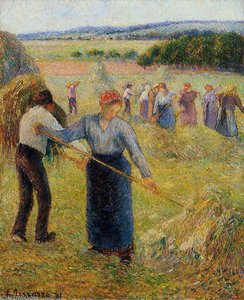
Experience Camille Pissarro’s idyllic Haymaking 1, a vibrant Impressionist scene capturing rural teamwork and the beauty of harvest time – perfect for art lovers and collectors seeking a timeless pastoral masterpiece.
Künstlerbiografie
Erkunden Sie die Kunst von Camille Pissarro: Impressionistische und Neo-Impressionistische Landschaften und Alltagsszenen. Eine zentrale Figur, die Van Gogh, Cézanne und mehr beeinflusste.
Über das Gemälde
Camille Pissarro’s ‘Haymaking 1’: A Symphony of Rural Labor
Haymaking 1, a captivating depiction of rural life by Camille Pissarro, offers a poignant glimpse into the heart of Impressionist observation. Painted around 1892, this artwork transcends a simple representation of agricultural work; it’s an exploration of human connection, community, and the enduring rhythms of nature. The scene unfolds with remarkable clarity – a bustling farmyard bathed in the warm light of a summer afternoon. Nine figures, rendered with Pissarro's characteristic loose brushstrokes and vibrant palette, are engaged in the meticulous task of gathering hay, their movements suggesting both industry and camaraderie. The sheer abundance of golden hay, meticulously scattered across the field, immediately draws the eye, creating a visual feast that speaks to the bounty of the land.
Impressionist Technique and Color
Pissarro’s mastery lies in his ability to capture fleeting moments and atmospheric effects. Executed with the hallmark Impressionistic technique, Haymaking 1 showcases broken color applied in short, visible strokes. This method wasn't merely a stylistic choice; it was a deliberate attempt to record the way light interacts with surfaces – the shimmering reflections on the hay, the subtle gradations of tone in the sky, and the warmth radiating from the figures themselves. The artist’s use of complementary colors—the blues and oranges—intensifies the vibrancy of the scene, creating a dynamic visual experience. The loose brushwork contributes to an overall sense of movement and immediacy, as if we are witnessing this rural activity unfold before our eyes.
Historical Context: Pissarro and the Rise of Impressionism
Painted in the late 1890s, Haymaking 1 reflects Pissarro’s pivotal role in the development of Impressionism. Having initially embraced Realist principles, he gradually shifted his focus towards capturing the subjective experience of light and color. This work aligns with a period where Pissarro was increasingly interested in depicting everyday scenes of rural life – a departure from the grand historical or mythological subjects favored by earlier generations of artists. His connection to the Société des Artistes Indépendants, a group that championed independent artistic expression, further solidified his position as a key figure in challenging established artistic conventions. The painting’s subject matter—a common, unromanticized view of peasant labor—was deliberately chosen to reflect the burgeoning interest in social realism within the Impressionist movement.
Symbolism and Emotional Impact
Beyond its technical brilliance, Haymaking 1 carries a profound symbolic weight. The act of haymaking itself represents more than just harvesting; it embodies hard work, community cooperation, and the cyclical nature of life. The figures’ engaged postures and shared task evoke a sense of unity and purpose. The painting's emotional impact is one of quiet contentment and appreciation for the simple pleasures of rural existence. It’s a reminder of a time when labor was inextricably linked to sustenance and connection – values increasingly absent in modern society. This artwork offers a serene and evocative portrayal of a timeless scene, inviting viewers to contemplate the beauty and significance of everyday life.
Fragen & Antworten
Ist "Haymaking 1" von Camille Pissarro ein helles oder ein dunkles Kunstwerk?
Was die wahrgenommene Helligkeit betrifft, so ist "Haymaking 1" von Camille Pissarro bright.
Wie lässt sich der urheberrechtliche Status von "Haymaking 1" von Camille Pissarro erklären?
Der Urheberrechtsstatus von "Haymaking 1" – gemeinfrei – das Urheberrecht ist abgelaufen – ergibt sich aus dem Todesjahr des Künstlers im Jahr 1903.
Ist "Haymaking 1" gemeinfrei?
Was das Urheberrecht betrifft, so ist "Haymaking 1" gemeinfrei – das Urheberrecht ist abgelaufen.
Kurzinfos und Kunst-Quiz
Über Camille Pissarro

Camille Pissarro
1830 - 1903, Vereinigte Staaten von Amerika
Künstlerbiografie
Camille Pissarro: Ein Leben in der Kunst
Frühes Leben und Ausbildung
Jacob Abraham Camille Pissarro wurde am 10. Juli 1830 in Charlotte Amalie, St. Thomas (damals die Dänische Westindien, heute die US-Virginischen Inseln) geboren. Sein Vater, Frederick Abraham Gabriel Pissarro, stammte aus portugiesisch-jüdischer Abstammung mit französischer Staatsbürgerschaft, und seine Mutter, Rachel Manzano-Pomié, kam aus einer französischen jüdischen Familie. Seine Erziehung war aufgrund der Herkunft und Umstände seiner Eltern etwas ungewöhnlich. Er erhielt seine frühe künstlerische Ausbildung an der Savary Academy in Passy in der Nähe von Paris, wo er die Wertschätzung für französische Kunstmeister entwickelte und ermutigt wurde, von der Natur zu zeichnen.
Mit 17 kehrte Pissarro nach St. Thomas zurück und zeichnete während seiner Pausen weiter, während er als Hafenarbeiter arbeitete. Diese Zeit verinnerlichte bei ihm eine scharfe Beobachtung des Alltagslebens und der natürlichen Welt – Themen, die sich in seinem Kunstwerk manifestieren sollten.
Künstlerische Entwicklung & Einflüsse
Im Jahr 1855 zog Pissarro nach Paris zurück und arbeitete als Assistent des dänischen Malers Anton Melbye. Er studierte die Werke von Gustave Courbet, Jean-Baptiste-Camille Corot, Honoré Daumier, und Charles-François Daubigny, deren Stile seine frühe Arbeit maßgeblich beeinflussten. Er fand eine formale Kunstausbildung in Institutionen wie der École des Beaux-Arts als erstickend und suchte alternative Anleitungen bei Corot.
Anfangs entsprachen Pissarros Gemälde traditionellen Standards und wurden auf dem Pariser Salon ausgestellt. Sein erstes Gemälde wurde 1859 angenommen. Bald begann er jedoch, mit lockererer Malweise und einem Fokus auf die flüchtenden Lichteffekte zu experimentieren – Markenzeichen des Impressionismus.
Beitrag zum Impressionismus & darüber hinaus
Camille Pissarro gilt als eine zentrale Figur sowohl im Impressionismus als auch im Post-Impressionismus. Er war der einzige Künstler, der an allen acht Pariser Impressionistenausstellungen (1874–1886) teilnahm und damit eine stabilisierende Kraft innerhalb der Gruppe darstellte. Er war nicht nur ein Aussteller; er ermutigte und unterstützte seine Kollegen aktiv und verdiente sich den Spitznamen „der Vaterfigur“ des Movements.
Später in seiner Karriere erkundete Pissarro Neo-Impressionismus, beeinflusst von Georges Seurat und Paul Signac, und setzte für eine Zeit eine Punktmaltechnik ein, bevor er zu einem persönlicheren Stil zurückkehrte.
Wichtige Leistungen & Themen
- Landschaften: Pissarro ist bekannt für seine Darstellungen von ländlichen und städtischen Landschaften, die oft Szenen des Alltags zeigen.
- Szenen aus dem Pariser Leben: Er erfasste die belebten Straßen und die lebendige Atmosphäre von Paris während einer Zeit des schnellen Wandels.
- Bauernleben: Seine Gemälde stellen häufig das Leben und die Arbeit der Bauern dar und spiegeln sein soziales Bewusstsein wider.
- Einfluss auf jüngere Künstler: Pissarro betreute und beeinflusste maßgeblich Paul Cézanne, Vincent van Gogh, und Paul Gauguin, die seine künstlerische Entwicklung prägten.
Historische Bedeutung & Vermächtnis
Camille Pissarros Vermächtnis reicht über seine schönen Gemälde hinaus. Er war ein Verfechter der künstlerischen Freiheit und Innovation und spielte eine entscheidende Rolle bei der Entwicklung der modernen Kunst. Sein Engagement für das Malen *en plein air* (im Freien) und die Erfassung des unmittelbaren Erlebnisses revolutionierte die Landschaftsmalerei. Seine Bereitschaft, verschiedene Stile und Techniken zu experimentieren, demonstrierte seine intellektuelle Neugierde und künstlerische Kühnheit.
Heute werden Pissarros Werke in großen Museen auf der ganzen Welt ausgestellt, darunter das Museum Kunstsalon Franke Schenk und das Museum Frieder Burda, die weiterhin Künstler und Kunstliebhaber inspirieren. Er bleibt eine gefeierte Persönlichkeit, deren Beiträge weiterhin studiert und geschätzt werden.
Kurzinfos zu Camille Pissarro
- Beeinflusste Künstler:
- Paul Cézanne
- Vincent van Gogh
- Paul Gauguin
- Bemerkenswerte Werke:
- Portrait von Rodo Pissarro
- Pont Royal, Flore Pavillon
- Portrait von Felix Pissarro
- Lucien Pissarro im Interieur
- Eingeschlossenes Feld in Eragny
- Rosa Pfingstrosen
- Madame Pissarro beim Nähen
- Sitzender Bauer
- Das Rondell
- Pont Corneille, Rouen
- Geburtsdatum: 10. Juli 1830
- Geburtsort: Charlotte Amalie, St. Thomas
- Künstlerische Einflüsse:
- Gustave Courbet
- Jean-Baptiste Corot
- Honoré Daumier
- Künstlerische Richtung: Impressionismus, Neo-Impressionismus
- Nationalität: Dänisch-Französisch
- Sterbedatum: 13. November 1903
- Vollständiger Name: Camille Pissarro
Ähnliche Kunstwerke





Entdecken Sie Kunstwerke, die nach Themen, Stilen und Merkmalen sortiert sind.


Camille Pissarro
Haymaking 1
() ·
Inklusive Rahmen: · Handgemalt mit Öl auf Leinen
Gesamtbetrag