

Gezeigt: · Inklusive Rahmen:
 Vorschau anzeigen
 Versenden
 Teilen
 Details anzeigen
 Leitfaden

 Herunterladen
 Ähnliche Objekte
 Röntgenaufnahme
 Diashow
 Fragen & Antworten
 Statistiken

€ 240
Handgefertigte Ölreproduktion
Handgemaltes Ölgemälde auf Leinwand in Ihrer Wunschgröße und mit Rahmen, auf Bestellung von unseren Künstlern angefertigt. ( Zum Druck wechseln Zum digitalen Bild wechseln)
Größe
·Standardformat
individuell anpassbar
CM
INCH
Wählen Sie aus unseren vordefinierten Formaten, die den ursprünglichen Proportionen des Kunstwerks entsprechen.
Größen werden geladen...

Breite
Höhe
Geben Sie die Breite und die Höhe an, die Sie für Ihren Rahmen oder Ihre Wand benötigen. Da dieses Werk handgemalt ist, kann der Künstler bei einer anderen Form etwas mehr um das Bild herum malen oder etwas abschneiden – Sie entscheiden. Wir senden Ihnen ein digitales Mockup zur Freigabe, bevor mit dem Malen begonnen wird. Das auf dieser Seite gezeigte Bild stellt nicht das tatsächliche Ergebnis dar – dies tut nur das Mockup.
 Mehr erfahren
Abschließen
·
Weißer Rand €1

verlaufende Kanten €1

Umrandung €1

P118B €10

P118H €10

P118W €10

P438Z €10

P508JH €12

P508YH €12

P805H €10

P805Z €10

P919BZ €10

P919G €10

P919XJ €10

P959ZH €10

P968JZ €12

W106C €8

W218G €10

W218JH €8

W218Y €10

W307PJ €10

W316G €10

W316PJ €8

W316Y €10

W398PJ €8

W4111J €10

W500HY €15

W500JH €15

W692G €12

W849H €8

W940BG €15

W953PJ €8

H24-GOLD €30

H24-SILVER €30

H36-GOLD €45

H36-SILVER €45
Versand in einer Schutzröhre, bereit für die Rahmung durch Ihren Rahmenmacher.
Extras
optionalWas sind die Extras enthalten?
Beispiele für Anpassungsmöglichkeiten: Gesicht durch Kundenfoto ersetzen; Haustier hinzufügen (z. B. Katze durch Hund ersetzen); Versteckte Botschaft im Hintergrund einfügen; Hintergrundlandschaft oder Elemente ändern.
Nach der Bestellung wird das Team von TopImpressionists.com den Kunden per E-Mail kontaktieren, um Anweisungen einzuholen und eine Vorschau des Entwurfs bereitzustellen
Nach der Bestellung wird das Team von TopImpressionists.com den Kunden per E-Mail kontaktieren, um Anweisungen einzuholen und eine Vorschau des Entwurfs bereitzustellen
Weltweiter Versand () in nur 3 bis 4 Wochen statt der üblichen 5 Wochen. (7 November). Keine Kompromisse bei der Qualität.
Schutzlackierung
Beschriftung
Details der gravierten Bronzetafel
This elegant plaque features the artist's name and the title of the artwork, finely engraved for a timeless presentation.
It is made from bronze with a refined, elegant finish. The text is precisely laser-engraved for a sharp and permanent result. Measuring 9x2 cm, the plaque is compact yet easy to read. It's built to be durable and scratch-resistant, offering a professional, museum-quality look. Mounting is simple thanks to the included adhesive backing.
Details zur Acrylglas-Plakette (transparent)
The plaque includes essential engraved details such as the artist's name, the title of the artwork, the date it was created, the type of media used-like oil on canvas or watercolor-a brief description of the piece, and a QR code that links to the complete artwork information.
It is crafted from clear acrylic, offering a sleek, modern appearance. The text is UV-engraved in black to ensure strong visual contrast. With a size of 10x15 cm, it ensures optimal readability. It comes equipped with two metal hooks for secure wall mounting. The plaque is designed to be weather-resistant, making it suitable for various environments, and it includes interactive features that work seamlessly with smartphone scanning.
Details zur schwarzen Acryltafel
This elegant plaque includes engraved information such as the artist's name, the title of the artwork, the date it was created, the type of media used (like oil on canvas or watercolor), a short description of the artwork, and a QR code for quick access to more information.
The plaque itself is made from refined black acrylic with a premium finish. The text is laser-engraved in white for high contrast and readability. Its size is 10x15 cm, designed to be easy to read. It comes with two metal hooks for professional mounting. The design is sleek and fits any interior style. It is also weather-resistant and durable, with built-in digital integration for mobile compatibility.
Die Glasoption ist nur für Größen unter 110 cm verfügbar.
 Die Glasoption ist nur für Größen unter 110 cm verfügbar.
- Kostenloser weltweiter Expressversand
- Hochwertige Leinenleinwand
- Umfassender Versicherungsschutz beim Versand
- Zollgebühren-Rückerstattungsgarantie
- Garantie für exakte Farbtreue
- 100 Tage Rückgaberecht (nur bei Mängeln)
- 100% Geld-zurück-Garantie
- Mengenrabatt verfügbar


Beschreibung des Sammlerstücks
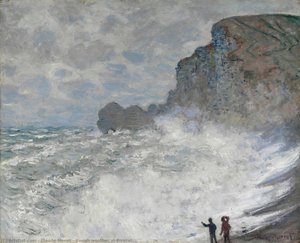
Erleben Sie Monets 'Raues Meer – Étretat'! Ein dynamischer Impressionistischer Seeblick, der turbulenten Wellen und dramatische Klippen einfängt. Erkunden Sie die Textur, Farbe und die mächtige Komposition dieses ikonischen Gemäldes des 19. Jahrhunderts.
Künstlerbiografie
Erkunden Sie Claude Monet (1840-1926), den Begründer des Impressionismus! Entdecken Sie ikonische Seerosen, Heuhaufen und Landschaften, die Licht und die Essenz der Natur einfangen. Eine zentrale Figur in der modernen Kunst.
Über das Gemälde
A Tempestuous Encounter: Claude Monet’s ‘Rough Sea – Etretat’
Immerse yourself in the raw power and breathtaking beauty of nature with Claude Monet's captivating seascape, Rough Sea – Etretat. Painted circa 1868-1883, this work is a quintessential example of Impressionism at its most evocative, transporting viewers to the dramatic coastline of Normandy, France.
Subject and Setting: The Allure of Étretat
The painting depicts the iconic cliffs of Étretat, a location that profoundly inspired Monet throughout his career. These majestic chalk formations, sculpted by centuries of wind and wave action, served as a constant source of artistic fascination. Here, we witness not a serene coastal view, but a scene charged with energy – turbulent waves crash against the base of the cliffs, while small boats bravely navigate the choppy waters. The focus isn’t on precise topographical detail, but rather on capturing the feeling of being present amidst this dynamic interplay between land and sea.
Style and Technique: A Masterclass in Impressionism
- Impressionistic Brushwork: Monet’s signature loose, broken brushstrokes are immediately apparent. He doesn't attempt to meticulously recreate reality; instead, he uses short, expressive marks to convey the movement of water, the texture of rock, and the fleeting effects of light.
- Impasto Texture: The thick application of paint – known as impasto – adds a palpable physicality to the work. You can almost feel the wind and spray of the sea. This technique enhances the sense of energy and immediacy.
- Color Palette & Light: A muted palette of blues, greys, and browns dominates, reflecting the overcast conditions often found along the Normandy coast. However, flashes of yellow and white capture the glint of sunlight on the waves and cliffs, creating a dynamic contrast.
- Compositional Dynamics: The strong diagonal lines created by the wave crests draw the viewer’s eye into the scene, emphasizing the relentless energy of the ocean. The towering cliffs provide a solid counterpoint, grounding the composition and highlighting the scale of nature's power.
Historical Context: A Pivotal Moment in Art History
Monet painted several versions of Etretat throughout his career, reflecting his ongoing exploration of light and atmosphere. This work emerged during a period of significant artistic upheaval. Rejecting the rigid conventions of academic painting, Monet and his fellow Impressionists sought to capture their subjective impressions of the world around them. They embraced plein air painting – working outdoors directly from nature – as a means of achieving greater authenticity and spontaneity. This approach revolutionized art, paving the way for modernism.
Symbolism and Emotional Impact
Beyond its aesthetic beauty, Rough Sea – Etretat carries symbolic weight. The turbulent sea can be interpreted as a metaphor for the challenges and uncertainties of life. The small boats represent humanity’s vulnerability in the face of nature's immense power. Yet, there is also a sense of awe and wonder evoked by the scene—a recognition of the sublime beauty inherent in even the most formidable forces. The painting invites contemplation on our place within the natural world.
For Collectors & Interior Designers
A reproduction of Rough Sea – Etretat would be a stunning addition to any collection, bringing a touch of French Impressionist elegance and dramatic energy to a space. Its cool color palette and dynamic composition make it particularly well-suited for living rooms, dining areas, or home offices. The painting’s evocative power will undoubtedly spark conversation and inspire contemplation.
Photo Description: --Overall Impression-- The artwork is a dynamic and evocative oil painting depicting a rugged coastline with turbulent waves crashing against towering cliffs. It’s a landscape scene dominated by the raw power of nature, rendered in an impressionistic style characterized by loose brushstrokes and a focus on capturing light and atmosphere rather than precise detail. Compositionally, the painting utilizes a strong diagonal line created by the wave crests, leading the viewer’s eye into the scene from left to right. The cliffs occupy the majority of the upper portion of the canvas, creating a sense of scale and imposing presence. Foreground elements include boats partially submerged in the water, suggesting human activity amidst the natural forces. The use of color is predominantly muted browns, blues, and greys, with highlights of yellow and white where light reflects off the water and cliffs. Lines are short, broken strokes that convey movement and texture. Shapes are largely organic – waves, cliffs, boats – rendered in a somewhat abstracted manner. The texture is thick and visible, indicative of impasto technique, adding to the sense of physicality and energy. Lighting appears diffused, suggesting an overcast day or perhaps early morning/late afternoon light. Perspective is somewhat flattened, typical of impressionism, prioritizing the overall mood and effect over strict realism. Depth is created through atmospheric perspective – objects in the distance are paler and less defined. Size: Unknown Date: Unknown ARTIST INFORMATION: ================== Artist: Claude Monet Birth Year: 1840 Death Year: 1926 Birth City: Paris Birth Country: France Biography:A Life Immersed in Light: The World of Claude Monet
Oscar-Claude Monet, a name synonymous with Impressionism, wasn't merely a painter of landscapes; he was a chronicler of fleeting moments, a poet of light and color. Born in Paris on November 14, 1840, his early life took an unexpected turn when his family relocated to Le Havre, Normandy, at the age of five. While initially destined for a commercial career by his father, young Claude’s innate artistic talent quickly surfaced, manifesting first in charcoal caricatures sold locally — a testament to both his skill and entrepreneurial spirit.
Monet’s formal training began in Paris, briefly at the Acadéemie Beaux-Arts, where he studied under Jean-Auguste Ingres. However, Monet quickly abandoned academic conventions, favoring instead the revolutionary approach championed by Eugène Boudin—plein air painting—which involved working outdoors directly from nature.
Boudin’s influence profoundly shaped Monet's artistic vision, instilling within him the belief that true beauty resided in capturing the ephemeral qualities of light and atmosphere. This conviction would become the cornerstone of Monet’s oeuvre, guiding his relentless pursuit of innovative techniques and stylistic explorations throughout his illustrious career.
Monet married Camille Doncieux in 1873, forging a partnership that proved both intellectually stimulating and emotionally turbulent. Their relationship endured despite Camille's illness and eventual death in 1879, leaving Monet deeply scarred by grief.
Throughout his subsequent years, Monet continued to reside in Giverny, France—a location he transformed into an idyllic garden sanctuary—where he cultivated a prolific artistic output. His dedication to capturing the subtleties of light and color on canvas solidified his reputation as one of the most influential figures in Impressionist art.
Claude Monet passed away peacefully in Giverny on December 5, 1926, leaving behind an unparalleled legacy of paintings that continue to inspire awe and admiration worldwide. His artistic achievements stand as a testament to the transformative power of observation and the enduring beauty of the natural world.
Fragen & Antworten
Für welche Verwendung wird "Raues Meer – Étretat" von Claude Monet empfohlen?
Die empfohlene Verwendung für "Raues Meer – Étretat" von Claude Monet ist Statement-Piece. Es kann jedoch auch für andere Zwecke genutzt werden.
Welche Motive sind in "Raues Meer – Étretat" von Claude Monet zu sehen?
Die Themen in "Raues Meer – Étretat" von Claude Monet umfassen küstenszene, turbulente meere, dramatische klippen, impressionistische wellen, monets etretat, naturkraft, französische küste und fassen gemeinsam den Gegenstand des Kunstwerks zusammen.
Welche Atmosphäre würde eine Reproduktion von "Raues Meer – Étretat" von Claude Monet in einen Raum bringen?
Mit seiner Dramatisch Stimmung wird „Raues Meer – Étretat“ für ein Wohnbereich empfohlen.
Kurzinfos und Kunst-Quiz
Über Claude Monet

Claude Monet
1840 - 1926, Frankreich
Künstlerbiografie
Frühkindliche Jahre und Einflüsse (1840-1860)
Claude Monet wurde am 14. November 1840 in Paris, Frankreich, geboren. Seine frühen Lebensjahre waren geprägt von einem Umzug seiner Familie nach Le Havre, Normandie, als er erst fünf Jahre alt war. Sein Vater, ein Großhändler, sah zunächst eine Karriere für jungen Claude im Handel, aber der Junge zeigte schon in sehr jungem Alter ein unbestreitbares Talent und Leidenschaft für Zeichnen. Während sein Vater sich darüber beschwerte, ermutigte seine Mutter seine künstlerischen Neigungen.
Ein einschneidendes Ereignis war Begegnungen von Monet mit Eugène Boudin, einem Landschaftsmaler, der ihm die Prinzipien des plein air-Malens – das Festhalten von Szenen direkt aus der Natur – näherbrachte. Diese Erfahrung prägte Monets Herangehensweise an die Kunst grundlegend und betonte Beobachtung und Spontaneität gegenüber Studio-basierter Präzision. Er begann auch, Karikaturen für lokale Unternehmen zu zeichnen und demonstrierte so schon in jungen Jahren einen unternehmerischen Geist neben seinem künstlerischen Talent.
Formale Ausbildung und Frühe Werke (1860-1874)
Im Jahr 1859 zog Monet nach Paris und tauchte ein in die lebendige Kunstszene der Stadt. Er besuchte kurzzeitig die Académie Suisse und studierte bei Charles Gleyre, wo er Künstler wie Auguste Renoir kennenlernte. Diese frühen Jahre waren durch Experimente mit verschiedenen Stilen, darunter Realismus und Porträtmalerei, gekennzeichnet. Seine anfänglichen Werke, wie Landschaften und Seenasichten, spiegelten eine sich entwickelnde Fähigkeit wider, aber sie enthielten noch nicht den charakteristischen Stil, der ihn später definieren sollte.
Der Franco-Preußenkrieg (1870-1871) störte seinen künstlerischen Fortschritt und zwang ihn, Zuflucht in London zu suchen. Während dieser Zeit studierte er englische Landschaftsmaler wie J.M.W. Turner, deren atmosphärische Effekte Monets eigenen sich entwickelnden Stil tief beeinflussten.
Die Geburt des Impressionismus und die "Impression, soleil levant" (1874-1883)
Monet, zusammen mit anderen Künstlern, die mit dem konservativen Salon-System unzufrieden waren, begannen, ihre Werke unabhängig zu zeigen. Die Ausstellung von 1874, die von diesen Künstlern organisiert wurde, gilt als ein Meilenstein in der Kunstgeschichte und leitete den Begriff "Impressionismus" ein. Monets Gemälde “Impression, soleil levant” (Impression, Sunrise), das auf dieser Schau ausgestellt wurde, gab dem Bewegung ihren Namen.
Diese Periode sah Monet die Entwicklung seines charakteristischen Stils: lockere Pinselstriche, leuchtende Farben und einen Fokus auf das Festhalten flüchtiger Momente von Licht und Atmosphäre. Er malte häufig en plein air und arbeitete schnell, um seine unmittelbaren Eindrücke der Landschaft festzuhalten.
Giverny und die Seerosen-Serie (1883-1926)
Im Jahr 1883 ließ sich Monet in Giverny nieder, einem Dorf nordwestlich von Paris. Er kaufte ein Haus mit einem großen Garten, den er in einen elaborierten Paradiesgarten verwandelte, der Seerosen, Weiden und japanische Brücken – all dies wurden wiederkehrende Motive in seiner Kunst.
Die letzten Jahrzehnte Monets Lebens waren größtenteils dem Malen des Seerosenteichs in Giverny gewidmet. Dies führte zu der monumentalen Seerosen-Serie (Nymphéas), einer umfangreichen Sammlung von Gemälden, die die Reflexionen und sich ändernden Lichtverhältnisse des Teichs darstellen. Diese Werke, die durch ihre Größe und ihren immersiven Charakter geprägt sind, gelten als einige seiner größten Leistungen.
Künstlerische Entwicklung & Techniken
Plein Air Painting: Monets Engagement für das Malen im Freien war zentral für seine künstlerische Entwicklung. Es ermöglichte ihm, Licht und Atmosphäre direkt zu beobachten und einzufangen. Broken Color: Er setzte eine Technik namens "Broken Color" ein, bei der kleine Pinselstriche aus reinen, ungemischten Farben nebeneinander platziert wurden, sodass das Auge des Betrachters sie optisch miteinander verbindet. Series Painting: Monets Erkundung der Serie-Malerei – das Abbilden desselben Motivs unter verschiedenen Lichtverhältnissen und Wetterbedingungen – war revolutionär und demonstrierte die transformative Kraft von Licht und Zeit.Wichtige Errungenschaften & Anerkennung
- Gründer des Impressionismus
- Schöpfer der ikonischen Seerosen-Serie
- Revolutionierung der Landschaftsmalerei durch plein air-Techniken
- Erreichen von beträchtlichem kommerziellem Erfolg während seines Lebens, was für avantgardistische Künstler eine Seltenheit war.
Historische Bedeutung
Monets Einfluss auf die Kunstgeschichte ist unbestreitbar. Er hat nicht nur die Impressionistenbewegung ins Leben gerufen, sondern auch den Weg für die moderne Kunst geebnet, die sich mit Subjektivität und Abstraktion auseinandersetzt. Sein Fokus auf das Festhalten flüchtiger Momente und die subjektive Erfahrung des Sehens beeinflusste nachfolgende Generationen von Künstlern nachhaltig. Sein Werk inspiriert weiterhin Ehrfurcht und Bewunderung und festigt seinen Platz als eine der wichtigsten Figuren der westlichen Kunst.
Monet starb am 5. Dezember 1926 und hinterließ ein Vermächtnis, das unsere Auffassung von Licht, Farbe und der Schönheit der Natur weiterhin prägt. Museen wie das Musée d'Orsay und das Musée Marmottan Monet in Paris beherbergen bedeutende Sammlungen seiner Werke und sichern so seine dauerhafte Präsenz in der Kunstwelt.
Kurzinfos zu Claude Monet
- Bemerkenswerte Werke:
- Impression, soleil levant
- Seerosen-Serie
- Heuhaufen-Gemälde
- Rouen Kathedrale Serie
- Geburtsdatum: 14. November 1840
- Geburtsort: Paris, Frankreich
- Künstlerische Bewegung: Impressionismus
- Künstlerische Einflüsse:
- Eugène Boudin
- J.M.W. Turner
- Nationalität: Französisch
- Todatum: 5. Dezember 1926
- Vollständiger Name: Claude Monet
Ähnliche Kunstwerke




Entdecken Sie Kunstwerke, die nach Themen, Stilen und Merkmalen sortiert sind.


Claude Monet
Raues Meer – Étretat
() ·
Inklusive Rahmen: · Handgemalt mit Öl auf Leinen
Gesamtbetrag