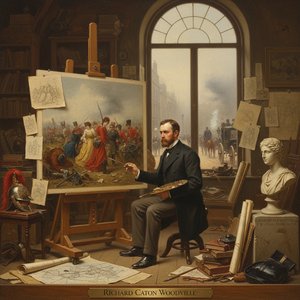
Biografie des Künstlers
Edward Richard Taylor: A Victorian Visionary of Light and Landscape
Edward Richard Taylor (1838-1911) wasn’t merely a painter; he was an architect of atmosphere, a meticulous observer of light, and a pivotal figure in the burgeoning Arts and Crafts movement. Born into a family steeped in artistic tradition – his father, also named Edward Richard Taylor, was a successful artist – young Edward inherited not just talent but a profound respect for craftsmanship and a deep connection to the natural world. His life unfolded against the backdrop of Victorian England, a period of rapid industrialization yet simultaneously yearning for a return to simpler, more beautiful ways of creating. This tension fueled his artistic vision, shaping a body of work characterized by serene landscapes, intimate portraits, and an almost obsessive attention to detail.
Taylor’s early training was rigorous, reflecting the values instilled by his father. He studied under various masters, honing his skills in both oils and watercolors – mediums he employed with equal mastery. However, it wasn't simply technical proficiency that distinguished him; Taylor possessed a remarkable ability to capture not just what he saw but *how* he felt about what he saw. His paintings aren’t static representations of scenes; they are imbued with a sense of quiet contemplation and a deep appreciation for the subtle nuances of light and color. He was a student of the masters, particularly the Luminists – artists who sought to capture the effects of natural light—and this influence is evident in his atmospheric renderings of landscapes bathed in golden hues or shrouded in misty twilight.
A significant turning point in Taylor’s career arrived with his appointment as headmaster at the Birmingham Municipal School of Arts and Crafts in 1877. This role wasn't merely administrative; it was a deliberate act of mentorship, shaping a generation of artists who would champion the principles of the Arts and Crafts movement. He instilled in his pupils a belief in hand-made objects, rejecting mass production and celebrating the beauty of skilled craftsmanship. His influence extended beyond painting, encompassing decorative arts and design – a testament to his holistic approach to art education. Amongst his notable students were William Logsdail and Frank Bramley, both significant figures within the Birmingham artistic community.
Taylor’s work is often categorized as part of the broader Victorian landscape tradition, yet it possesses a unique quality that sets him apart. He eschewed the grand, dramatic vistas favored by some of his contemporaries, instead opting for smaller-scale scenes – intimate glimpses into rural life, quiet corners of gardens, and evocative depictions of local landmarks like Lincoln Cathedral. His meticulous attention to detail—the texture of bark on a tree trunk, the ripple of water in a stream, the delicate folds of fabric—creates a sense of immediacy and invites the viewer to step into the scene. The use of muted colors – predominantly greens, browns, and blues – further enhances this effect, lending his paintings a timeless quality. His Lincoln Cathedral series, for example, showcases not just the architectural grandeur of the cathedral but also the way light filters through its stained-glass windows, transforming the interior space into a kaleidoscope of color.
Beyond his artistic achievements, Taylor’s legacy lies in his founding of Ruskin Pottery at Smethwick in 1898. This venture was born from a desire to revive traditional pottery techniques and create objects that were both beautiful and functional. The pottery, named after the influential critic John Ruskin, embraced the Arts and Crafts ethos, utilizing hand-crafted methods and incorporating natural materials. Following his death in 1911, his son, William Howson Taylor, continued the pottery’s production, ensuring that Taylor's commitment to craftsmanship lived on. Ruskin Pottery remains a significant example of Victorian industrial design, demonstrating the enduring influence of Taylor’s artistic principles.
Taylor’s Artistic Techniques and Influences
Taylor’s technical skill was remarkable, but it wasn’t simply about replicating what he saw; it was about translating his experience onto canvas with precision and sensitivity. He employed a layered glazing technique, building up thin washes of color to create subtle tonal variations and atmospheric effects. His brushwork was often loose and expressive, particularly in depicting foliage and water—a deliberate departure from the more rigid conventions of academic painting. He meticulously studied the effects of light, capturing its shifting qualities throughout the day with remarkable accuracy.
His artistic influences were diverse, ranging from the Luminists to the Pre-Raphaelites. The Luminists’ emphasis on capturing the fleeting effects of natural light resonated deeply with Taylor's own aesthetic sensibilities. Similarly, the Pre-Raphaelites’ interest in detail and their celebration of beauty found expression in his meticulous renderings of landscapes and portraits. However, Taylor wasn’t simply imitating these influences; he synthesized them into a distinctly personal style—one characterized by quiet contemplation, understated elegance, and an unwavering commitment to craftsmanship. The influence of the Arts and Crafts movement is also evident in his choice of subjects – rural life, traditional crafts, and the beauty of the natural world—all themes central to the movement’s ideals.
Notable Works and Legacy
Among Taylor's most celebrated works are "Lincoln Cathedral from the Witham," a stunning depiction of the cathedral bathed in the golden light of sunset; “Ellen Bennett,” a poignant portrait capturing the innocence and vulnerability of a young girl; and his series of paintings depicting Lincoln Cathedral, showcasing the building’s architectural grandeur and the interplay of light and shadow. These works exemplify Taylor's ability to capture not just the physical appearance of his subjects but also their essence—their beauty, their dignity, and their connection to the natural world.
Edward Richard Taylor’s legacy extends far beyond his individual paintings. He was a pivotal figure in the Arts and Crafts movement, shaping the artistic sensibilities of an entire generation of artists. His founding of Ruskin Pottery demonstrated his commitment to reviving traditional crafts and creating objects that were both beautiful and functional. Today, Taylor's work is admired for its technical skill, its atmospheric qualities, and its enduring beauty—a testament to the vision of a Victorian artist who sought to capture not just what he saw but *how* he felt about it. His paintings continue to resonate with viewers today, offering a glimpse into a bygone era and reminding us of the importance of craftsmanship, beauty, and connection to the natural world.



 Vorschau anzeigen
 Zum Druck wechseln
 Versenden
 Teilen
 Details anzeigen

 Herunterladen
 Ähnliche Objekte
 Röntgenaufnahme
 Diashow anzeigen


 Weiterlesen






































 Die Glasoption ist nur in Größen unter 110 cm verfügbar.