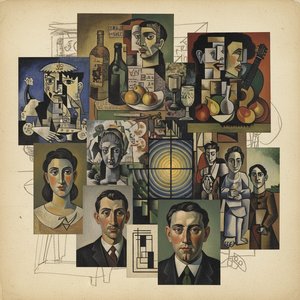
A Fragmented World: Exploring Braque’s “The Red Pedestal”
Georges Braque's "The Red Pedestal" is a compelling example of his pivotal role in the development of Cubism, painted during a period of intense artistic experimentation in the early 20th century. This work isn’t simply a depiction of objects; it’s a radical deconstruction and re-presentation of reality, challenging traditional notions of perspective and form.
Deconstructing Reality: Style & Technique
The painting exemplifies Analytical Cubism – a style Braque pioneered alongside Pablo Picasso. Notice how recognizable forms—a chair, bottle, bowls, and cups—are broken down into geometric shapes and fragmented planes. These facets are then reassembled on the canvas in a way that rejects single viewpoint perspective.
Braque employs a muted palette dominated by ochres, browns, greys, and blacks, punctuated by the striking presence of the titular red pedestal. This limited color scheme focuses attention on the interplay of forms and textures rather than vibrant hues. The technique involves layering these fragmented shapes, creating a sense of depth and ambiguity. It’s not about *seeing* objects as they are, but rather *understanding* their essential structure through intellectual analysis.
Subject Matter & Composition
The composition centers around the red pedestal, acting as a stage for an assortment of everyday objects. The chair is particularly noteworthy; it's been almost entirely abstracted, its recognizable form dissolving into angular planes. This isn’t merely a stylistic choice—it reflects Cubism’s aim to represent not just what *is* seen, but also what *is known* about the object.
The inclusion of commonplace items like bottles and bowls elevates them beyond their utilitarian function, transforming them into subjects worthy of artistic investigation. The arrangement isn't accidental; Braque carefully balances these elements to create a dynamic yet harmonious composition.
Historical Context & Artistic Innovation
“The Red Pedestal” was created during a period when artists were questioning the very foundations of representation. Traditional academic painting, with its emphasis on realism and illusionism, was being challenged by new movements like Impressionism and Post-Impressionism. Braque and Picasso responded to this shift by developing Cubism—a revolutionary style that sought to depict objects from multiple viewpoints simultaneously. This work demonstrates a move *away* from depicting the surface appearance of things and *towards* exploring their underlying structure.
Braque’s contribution was crucial in refining the analytical approach, focusing on dissecting forms with precision and intellectual rigor.
Symbolism & Emotional Impact
While Cubism isn't inherently symbolic, “The Red Pedestal” evokes a sense of fragmentation and dislocation—reflecting the anxieties and uncertainties of the modern world. The broken-down forms can be interpreted as representing the breakdown of traditional values and beliefs.
The red pedestal itself might symbolize a platform for these fragmented ideas, or perhaps a grounding element amidst the chaos. However, the painting isn’t necessarily pessimistic; there's also a sense of intellectual curiosity and artistic liberation in its radical approach. The overall emotional impact is one of quiet contemplation—an invitation to engage with the artwork on an intellectual and aesthetic level.
For Collectors & Interior Designers
“The Red Pedestal” – or a high-quality reproduction thereof – offers a sophisticated statement piece for any collection or interior space. Its muted palette and geometric forms lend themselves well to modern and contemporary settings, adding depth and intellectual intrigue.
- Its abstract nature allows it to complement a variety of color schemes.
- The painting’s historical significance makes it a conversation starter.
- It embodies the spirit of innovation and artistic experimentation.
This artwork is not just a visual experience; it's an invitation to explore the complexities of perception, representation, and the modern world.



 Gemälde kaufen
 Versenden
 Teilen
 Details anzeigen

 Herunterladen
 Ähnliche Objekte
 Röntgenaufnahme
 Diashow anzeigen

 Weiterlesen






































 Die Glasoption ist nur in Größen unter 110 cm verfügbar.