

 In echtem Maßstab anzeigen
 Versenden als Grußkarte
 Teilen
 Details anzeigen
 Leitfaden öffnen

 Herunterladen
 Ähnliche Objekte
 Röntgenaufnahme
 Diashow
 Besucherstatistiken
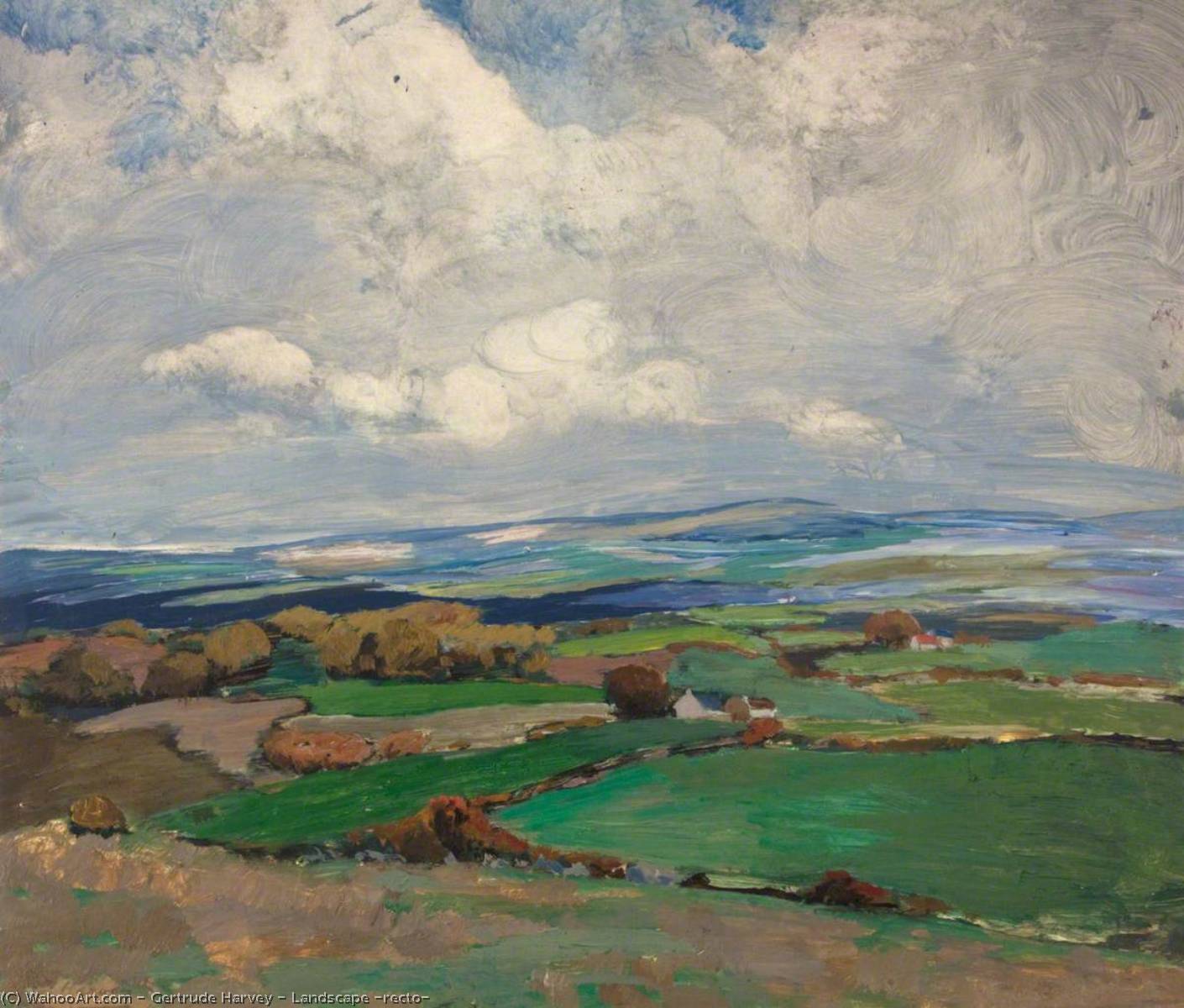
Landscape (recto)
 45.0 x 52.0 cm
Discover Gertrude Harvey, a British artist of the Newlyn School. Known for evocative landscapes & still lifes, her work reflects Cornish life & featured in Royal Academy exhibitions.
 Mehr anzeigen
Die auf dieser Seite dargestellten Kunstwerke sind urheberrechtlich geschützt, was bedeutet, dass wir keine identische Reproduktion rechtmäßig erstellen oder verkaufen dürfen. Dieser Schutz wird durch internationale Abkommen wie die Berner Übereinkunft und durch nationale Gesetze, einschließlich derer, die von den ... festgelegt wurden US-Urheberrecht – Titel 17.
Als respektvolle und rechtlich einwandfreie Alternative bieten wir individuelle, handgemalte Kunstwerke an, die vom Original inspiriert sind. Unsere geschickten und professionellen Künstler studieren sorgfältig den Stil, die Stimmung und das künstlerische Wesen des Originals, um ein neues, einzigartiges Werk zu schaffen, das dasselbe Gefühl hervorruft – während es zugleich eine eigenständige Originalschöpfung bleibt.
Diese Methode entspricht vollumfänglich den Urheberrechtsbestimmungen, da sie keine Kopie oder Vervielfältigung des geschützten Kunstwerks darstellt. Stattdessen handelt es sich um eine kreative Neuinterpretation – ein neues Gemälde, das vom Original inspiriert, aber nicht identisch mit ihm ist.
Handgefertigte Ölreproduktion
Handgemaltes Ölgemälde auf Leinwand in Ihrer Wunschgröße und mit Rahmen, auf Bestellung von unseren Künstlern angefertigt. ( Zum Druck wechseln Zum digitalen Bild wechseln)




































Standardformat
individuell anpassbar
CM
INCH
Wählen Sie aus unseren vordefinierten Formaten, die den ursprünglichen Proportionen des Kunstwerks entsprechen.
Loading sizes...

Breite
Höhe
Geben Sie die Breite und die Höhe an, die Sie für Ihren Rahmen oder Ihre Wand benötigen. Da dieses Werk handgemalt ist, kann der Künstler bei einer anderen Form etwas mehr um das Bild herum malen oder etwas abschneiden – Sie entscheiden. Wir senden Ihnen ein digitales Mockup zur Freigabe, bevor mit dem Malen begonnen wird. Das auf dieser Seite gezeigte Bild stellt nicht das tatsächliche Ergebnis dar – dies tut nur das Mockup.
Beispiele für Anpassungsmöglichkeiten: Gesicht durch Kundenfoto ersetzen; Haustier hinzufügen (z. B. Katze durch Hund ersetzen); eine versteckte Nachricht im Hintergrund einfügen; Hintergrundlandschaft oder -elemente ändern.
Nach der Bestellung wird das TopImpressionists.com-Team dem Kunden Anweisungen per E-Mail zusenden und eine Mockup-Vorschau bereitstellen.
Nach der Bestellung wird das TopImpressionists.com-Team dem Kunden Anweisungen per E-Mail zusenden und eine Mockup-Vorschau bereitstellen.
Weltweiter Versand () in nur 3 bis 4 Wochen statt der üblichen 5 Wochen. (22 Oktober). Keine Kompromisse bei der Qualität.

Kostenloser weltweiter Expressversand

Hochwertige Leinenleinwand

Vollständiger Versicherungsschutz beim Versand

Zollgebühren-Rückerstattungsgarantie

Garantie für exakte Farbtreue

100-tägiges Rückgaberecht (nur bei Mängeln)

100% Geld-zurück-Garantie

Angebot für Mengenrabatt
 Die Glasoption ist nur für Größen unter 110 cm verfügbar.

Landscape (recto)
Reproduktionsmedium
Format der Reproduktion
-


Gesamtpreis
€ 235
Biografie des Künstlers
Gertrude Harvey: A Cornish Visionary Bridging Impressionism and Spiritual Renewal
In the salt-sprayed landscapes of early twentieth-century Cornwall, Gertrude Harvey (née Bodinnar, 1879–1966) emerged as a profound voice within the Newlyn School, a collective renowned for its devotion to the rugged coastal beauty and the intimate rhythms of local life. Her artistry was far more than a mere recording of scenery; it was a deeply personal dialogue between the external world and an internal landscape of faith and observation. Born into a family where the natural world was intimately understood—her maternal grandfather, William Curnow, being a notable botanist and market gardener—Gertrude possessed an innate sensitivity to the botanical intricacies and atmospheric shifts that define the Cornish peninsula. This early immersion in the textures of flora and earth provided the foundational vocabulary for a career defined by meticulous detail and an evocative use of light.
The trajectory of her creative life was irrevocably altered through her connection with Harold Harvey, a fellow artist whose professional and personal partnership would become a cornerstone of her legacy. Initially entering the artistic circle as a model for students at the Forbes School of Painting in Newlyn, Gertrude’s presence in the studio was transformative. Her role as a muse for Harold did not merely provide subject matter; it fostered a shared spiritual conviction and an aesthetic synergy that permeated their collaborative existence. Under the guidance of mentors like Norman Garstin at the Penzance School of Arts, she embraced the tenets of Impressionism, learning to manipulate loose brushstrokes and vibrant palettes to capture the ephemeral, fleeting qualities of light as it dances across the Atlantic swells and settles upon the rolling hills of her homeland.
Artistic Mastery and the Newlyn Legacy
Gertrude Harvey’s work is characterized by a remarkable ability to balance the structural integrity of her subjects with the atmospheric fluidity of the Impressionist style. Her paintings often serve as windows into a tranquil, pastoral world, where the boundaries between the earth and sky seem to dissolve in the mist. Whether depicting a solitary landscape or a delicate still life, her hand is evident in the nuanced textures that suggest both the weight of the Cornish soil and the lightness of coastal air. Her membership in the Newlyn School placed her at the heart of a movement dedicated to truth in painting, yet she infused this realism with a spiritual introspection that set her work apart.
Her achievements were recognized by the most prestigious institutions of her era, including regular exhibitions at the Royal Academy, which solidified her standing within the British art establishment. Her oeuvre remains a testament to several key artistic pillars:
- Impressionistic Technique: A mastery of light and color that captures the transient moods of the Cornish landscape.
- Botanical Precision: An inherited passion for the natural world, visible in her detailed floral compositions and verdant landscapes.
- Spiritual Depth: The integration of Christian faith and quiet contemplation into the very fabric of her visual narratives.
- Cultural Connection: A profound engagement with the Newlyn School’s mission to document the authentic character of Cornish life.
Today, the significance of Gertrude Harvey lies in her ability to have bridged the gap between the observational rigor of the Newlyn tradition and the emotive freedom of Impressionism. She remains a vital figure for those studying the evolution of British landscape painting, representing a period where art served as both a mirror to the natural world and a vessel for the enduring human spirit.

Eckdaten zum Künstler
- Artistic Movement Or Style: Newlyn School
- Artists Or Movements Influenced By This Artist: ['George Bernard Shaw']
- Artists Who Influenced This Artist: ['Harold Harvey']
- Date Of Birth: 1879 Cornwall, United Kingdom
- Date Of Death: 1966 St Just, Cornwall
- Full Name: Gertrude Harvey Bodinnar
- Nationality: British
- Notable Artworks:
- Landscape (verso)
- Landscape (recto)
- Farmhouse on a Mound
- Place Of Birth: Cornwall