

Shown: · With its frame:
 Vorschau anzeigen
 Versenden
 Teilen
 Details anzeigen
 Leitfaden

 Herunterladen
 Ähnliche Objekte
 Röntgenaufnahme
 Diashow
 Q&A
Q&A Statistiken
- 66.0 x 82.0 cm


€ 239
Handgefertigte Ölreproduktion
Handgemaltes Ölgemälde auf Leinwand in Ihrer Wunschgröße und mit Rahmen, auf Bestellung von unseren Künstlern angefertigt. ( Zum Druck wechseln Zum digitalen Bild wechseln)
Size
·Standardformat
individuell anpassbar
CM
INCH
Wählen Sie aus unseren vordefinierten Formaten, die den ursprünglichen Proportionen des Kunstwerks entsprechen.
Loading sizes...

Breite
Höhe
Geben Sie die Breite und die Höhe an, die Sie für Ihren Rahmen oder Ihre Wand benötigen. Da dieses Werk handgemalt ist, kann der Künstler bei einer anderen Form etwas mehr um das Bild herum malen oder etwas abschneiden – Sie entscheiden. Wir senden Ihnen ein digitales Mockup zur Freigabe, bevor mit dem Malen begonnen wird. Das auf dieser Seite gezeigte Bild stellt nicht das tatsächliche Ergebnis dar – dies tut nur das Mockup.
 Mehr erfahren
Finish
·
White €1

Blurside €1

Extended €1

P118B €10

P118H €10

P118W €10

P438Z €10

P508JH €12

P508YH €12

P805H €10

P805Z €10

P919BZ €10

P919G €10

P919XJ €10

P959ZH €10

P968JZ €12

W106C €8

W218G €10

W218JH €8

W218Y €10

W307PJ €10

W316G €10

W316PJ €8

W316Y €10

W398PJ €8

W4111J €10

W500HY €15

W500JH €15

W692G €12

W849H €8

W940BG €15

W953PJ €8

H24-GOLD €30

H24-SILVER €30

H36-GOLD €45

H36-SILVER €45
Shipped in a protective tube, ready for your own framer.
Above 105 cm the frame is shipped as a kit for a professional framer — read the details.
Extras
optionalWhat do the extras include?
Examples of what can be changed: Replace face with customer photo; Add pet (e.g., replace cat with dog); Include hidden message in background; Change background landscape or elements.
After order, TopImpressionists.com team will email client for instructions and provide a mockup preview
After order, TopImpressionists.com team will email client for instructions and provide a mockup preview
Weltweiter Versand () in nur 3 bis 4 Wochen statt der üblichen 5 Wochen. (2 November). Keine Kompromisse bei der Qualität.
Schutzlackierung
Beschriftung
Details der gravierten Bronzetafel
This elegant plaque features the artist's name and the title of the artwork, finely engraved for a timeless presentation.
It is made from bronze with a refined, elegant finish. The text is precisely laser-engraved for a sharp and permanent result. Measuring 9x2 cm, the plaque is compact yet easy to read. It's built to be durable and scratch-resistant, offering a professional, museum-quality look. Mounting is simple thanks to the included adhesive backing.
Details zur Acrylglas-Plakette (transparent)
The plaque includes essential engraved details such as the artist's name, the title of the artwork, the date it was created, the type of media used-like oil on canvas or watercolor-a brief description of the piece, and a QR code that links to the complete artwork information.
It is crafted from clear acrylic, offering a sleek, modern appearance. The text is UV-engraved in black to ensure strong visual contrast. With a size of 10x15 cm, it ensures optimal readability. It comes equipped with two metal hooks for secure wall mounting. The plaque is designed to be weather-resistant, making it suitable for various environments, and it includes interactive features that work seamlessly with smartphone scanning.
Details zur schwarzen Acryltafel
This elegant plaque includes engraved information such as the artist's name, the title of the artwork, the date it was created, the type of media used (like oil on canvas or watercolor), a short description of the artwork, and a QR code for quick access to more information.
The plaque itself is made from refined black acrylic with a premium finish. The text is laser-engraved in white for high contrast and readability. Its size is 10x15 cm, designed to be easy to read. It comes with two metal hooks for professional mounting. The design is sleek and fits any interior style. It is also weather-resistant and durable, with built-in digital integration for mobile compatibility.
Die Glasoption ist nur für Größen unter 110 cm verfügbar.
 Die Glasoption ist nur für Größen unter 110 cm verfügbar.
- Kostenloser weltweiter Expressversand
- Hochwertige Leinenleinwand
- Umfassender Versicherungsschutz beim Versand
- Zollgebühren-Rückerstattungsgarantie
- Garantie für exakte Farbtreue
- 100 Tage Rückgaberecht (nur bei Mängeln)
- 100% Geld-zurück-Garantie
- Mengenrabatt verfügbar


Beschreibung des Sammlerstücks
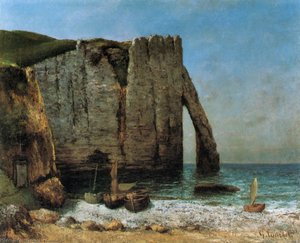
Experience Gustave Courbet's iconic Cliffs at Étretat! This stunning oil painting captures Normandy’s rugged beauty with raw realism & dramatic coastal views. A masterpiece of the Realist movement.
Künstlerbiografie
Gustave Courbet (1819-1877): Pionier des Realismus! Entdecken Sie Gemälde, die Alltag & Arbeiter zeigen – wie 'Eine Beerdigung in Ornans'. Revolutionärer Einfluss auf die Kunst des 19. Jh.
About the painting
A Vision of Normandy’s Rugged Beauty: Gustave Courbet's Cliffs at Étretat
Gustave Courbet, a Rebel’s Brush: The Life and Legacy of Gustave Courbet Born in the quiet village of Ornans, France, in 1819, Jean Désiré Gustave Courbet emerged as a defiant force against the established artistic norms of his time. His story isn't simply one of paint and canvas; it’s a narrative woven with threads of social commentary, political conviction, and an unwavering commitment to portraying the world exactly as he saw it – unidealized, raw, and profoundly real. Growing up in a relatively prosperous bourgeois family, Courbet received encouragement from his mother to pursue his artistic inclinations, a nurturing that would ultimately fuel a revolution in the art world. His formal training began at the École des Beaux-Arts in Paris in 1839, but he quickly found himself chafing against the academic conventions and Romantic idealism prevalent there. While acknowledging influences like Eugène Delacroix and Théodore Géricault, Courbet forged his own path, one that prioritized observation over imitation—a stance that would define his artistic identity for decades to come.The Landscape of Realism: Context and Conception
Courbet’s Cliffs at Étretat embodies the core tenets of the Realist movement, a reaction against Romantic sentimentality and academic formalism. Artists like Courbet rejected idealized depictions of nature and instead sought to capture the tangible world with unflinching accuracy. Étretat, a dramatic chalk cliff coastline in Normandy, served as inspiration for this monumental canvas—a deliberate choice reflecting Courbet’s fascination with the natural environment and his desire to represent it without embellishment. The painting emerged during a period marked by social unrest and political upheaval, mirroring Courbet's own rebellious spirit and aligning him with artists who championed artistic independence and challenged societal expectations.Composition and Technique: Capturing Movement and Texture
Courbet’s masterful technique is immediately apparent upon viewing Cliffs at Étretat. Employing thick impasto—a technique involving applying paint in heavy layers—he achieved remarkable textural richness, conveying the ruggedness of the cliffs and the turbulent sea with palpable immediacy. The pyramidal composition draws the viewer's eye upwards towards the towering cliffs, while horizontal bands delineate the shoreline and emphasize the expansive vista. Courbet skillfully utilized atmospheric perspective to create depth, subtly blurring distant elements and enhancing the sense of grandeur. Furthermore, he incorporated figures—a boat, people, and a dog—to ground the scene in reality and suggest human interaction with the landscape.Symbolism Within Nature: A Reflection of Courage and Resilience
Beyond its technical brilliance, Cliffs at Étretat carries symbolic weight. The cliffs themselves represent strength and permanence, mirroring Courbet’s own unwavering conviction in portraying the world truthfully. The turbulent sea symbolizes challenges and uncertainties—themes that resonated deeply with Courbet's artistic vision. The presence of a solitary dog adds an element of vulnerability amidst the imposing landscape, hinting at the human spirit's capacity for perseverance and appreciation for beauty even in difficult circumstances.A Legacy Enduring Inspiration
Gustave Courbet’s Cliffs at Étretat remains a cornerstone of Realist art and continues to inspire artists today. Its uncompromising realism challenged artistic conventions and solidified Courbet’s position as a pioneer of modern painting. Explore the masterpiece's profound impact on subsequent generations of artists—a testament to Courbet’s enduring legacy as an artist who dared to confront beauty with unflinching honesty. TopImpressionists.com offers handmade oil painting reproductions of Gustave Courbet's works, allowing art enthusiasts to bring a piece of history into their homes.Fragen & Antworten
Welche Emotion vermittelt das Werk der Contemporary Realism „Cliffs at Étretat“?
"Cliffs at Étretat" vermittelt eine Beschaulich emotionale Stimmung innerhalb der Contemporary Realism-Strömung.
Welches Gefühl wird mit "Cliffs at Étretat" assoziiert?
„Cliffs at Étretat“ vermittelt ein Beschaulich Gefühl. Der emotionale Ton beschreibt den Eindruck, den das Werk hinterlässt.
Welcher Phase der Karriere von Gustave Courbet ist „Cliffs at Étretat“ (1870) zuzuordnen?
Die Datierung auf 1870 ordnet „Cliffs at Étretat“ der Mature Period von Gustave Courbets künstlerischer Entwicklung zu.
Quick facts and art quiz
About Gustave Courbet

Gustave Courbet
1819 - 1877, Frankreich
Künstlerbiografie
Gustave Courbet: Ein Pionier des Realismus
Frühes Leben und Ausbildung
- Gustave Courbet wurde am 31. Juli 1819 in Ornans, Frankreich, geboren und stammte aus einer relativ wohlhabenden bürgerlichen Familie.
- Seine frühen künstlerischen Neigungen wurden von seiner Mutter gefördert, die seine Zeichenfähigkeiten ermutigte.
- Er erhielt eine formale Ausbildung an der École des Beaux-Arts in Paris, beginnend im Jahr 1839, obwohl er oft mit akademischen Konventionen in Konflikt geriet.
- Einflüsse in dieser Zeit waren Eugène Delacroix und Théodore Géricault, aber Courbet lehnte ihren romantischen Idealismus letztendlich ab.
Künstlerische Entwicklung und Schlüsselthemen
- Courbets künstlerische Entwicklung war durch eine bewusste Ablehnung der akademischen Malstile gekennzeichnet. Er suchte, die Welt so darzustellen, wie er sie sah, ohne Idealizierung oder Verzierungen.
- Seine frühen Werke erkundeten Landschaften und Porträts und verschoben sich allmählich zu Szenen aus dem Alltag und arbeitslosen Bevölkerungsgruppen.
- Schlüsselthemen in seinem Werk sind sozialer Realismus, Landleben und die Würde der Arbeit.
- Er wählte oft große Formate, die traditionell für historische oder religiöse Gemälde reserviert waren, um gewöhnliche Menschen und Ereignisse darzustellen.
Wichtige Werke und Leistungen
- “Die Steinbrecher” (1849): Dieses frühe Meisterwerk, das leider während des Zweiten Weltkriegs zerstört wurde, veranschaulichte Courbets Engagement, die harten Realitäten des Arbeitsvolks darzustellen.
- “Eine Beerdigung in Ornans” (1850): Ein monumentales Gemälde, das konventionelle Vorstellungen von Geschichtsgemälden herausforderte, indem es eine provinzielle Beerdigung mit unerbittlicher Realität darstellte.
- “Das Atelier des Malers” (1855): Eine allegorische Arbeit, die Courbets künstlerphilosophie widerspiegelte und seinen Umgang mit zeitgenössischen sozialen Problemen zeigte.
- “Ansicht im Fontainebleau-Wald” (1855): Demonstriert seine Fähigkeiten in der Landschaftsmalerei und fängt die natürliche Schönheit des Waldes ein, während er einen realistischen Ansatz beibehält.
- Seine Teilnahme am Salon des Refusés im Jahr 1863, bei dem Werke gezeigt wurden, die vom offiziellen Salon abgelehnt worden waren, festigte seinen Ruf als rebellischer Künstler weiter.
Einflüsse und Vermächtnis
- Während er akademische Traditionen ablehnte, war Courbet von früheren Meistern wie Caravaggio beeinflusst, für ihren dramatischen Realismus und ihre Verwendung von Licht und Schatten.
- Er hatte einen tiefgreifenden Einfluss auf nachfolgende Kunstbewegungen, insbesondere Impressionismus und Post-Impressionismus, indem er Künstler von den Zwängen der traditionellen Darstellung befreite.
- Sein Schwerpunkt auf soziale Kommentare ebnete den Weg für spätere sozial engagierte Künstler.
- Courbets Vermächtnis reicht über seine Gemälde hinaus; er war ein engagierter Verfechter künstlerischer Freiheit und politischer Veränderungen.
Historische Bedeutung
- Gustave Courbet spielte eine entscheidende Rolle bei der Entwicklung des Realismus als dominierende Kraft im 19. Jahrhundert.
- Sein Werk stellte etablierte Normen in Frage und löste Debatten über den Zweck und die Funktion von Kunst in der Gesellschaft aus.
- Er nahm aktiv an den politischen Umwälzungen seiner Zeit teil, darunter die Pariser Kommune von 1871, die zu einer Exilzeit in der Schweiz führte.
- Courbet starb am 29. April 1877 und hinterließ ein Werk, das bis heute inspiriert und provoziert.
Quick facts about Gustave Courbet
- Beeinflusste Kunstrichtungen:
- Impressionismus
- Post-Impressionismus
- Beeinflusste Künstler:
- Eugène Delacroix
- Théodore Géricault
- Bemerkenswerte Werke:
- Die Steinbrecher
- Eine Beerdigung in Ornans
- Das Atelier des Malers
- Ansicht im Fontainebleau-Wald
- Die Entstehung der Welt
- Geburtsdatum: 31. Juli 1819
- Geburtsort: Orléans, Frankreich
- Künstlerische Richtung: Realismus
- Nationalität: Französisch
- Sterbedatum: 29. April 1877
- Vollständiger Name: Gustave Courbet
- Von Künstlern Beeinflusst: ['Caravaggio']
Ähnliche Kunstwerke


Entdecken Sie Kunstwerke, die nach Themen, Stilen und Merkmalen sortiert sind.


Gustave Courbet
Cliffs at Étretat
() ·
With its frame: · Hand-painted in oil on linen
Total