

Gezeigt: · Inklusive Rahmen:
 Vorschau anzeigen
 Versenden
 Teilen
 Details anzeigen
 Leitfaden

 Herunterladen
 Ähnliche Objekte
 Röntgenaufnahme
 Diashow
 Fragen & Antworten
 Statistiken
- 132.0 x 140.0 cm

€ 240
Handgefertigte Ölreproduktion
Handgemaltes Ölgemälde auf Leinwand in Ihrer Wunschgröße und mit Rahmen, auf Bestellung von unseren Künstlern angefertigt. ( Zum Druck wechseln Zum digitalen Bild wechseln)
Größe
·Standardformat
individuell anpassbar
CM
INCH
Wählen Sie aus unseren vordefinierten Formaten, die den ursprünglichen Proportionen des Kunstwerks entsprechen.
Größen werden geladen...

Breite
Höhe
Geben Sie die Breite und die Höhe an, die Sie für Ihren Rahmen oder Ihre Wand benötigen. Da dieses Werk handgemalt ist, kann der Künstler bei einer anderen Form etwas mehr um das Bild herum malen oder etwas abschneiden – Sie entscheiden. Wir senden Ihnen ein digitales Mockup zur Freigabe, bevor mit dem Malen begonnen wird. Das auf dieser Seite gezeigte Bild stellt nicht das tatsächliche Ergebnis dar – dies tut nur das Mockup.
 Mehr erfahren
Abschließen
·
Weißer Rand €1

verlaufende Kanten €1

Umrandung €1

P118B €10

P118H €10

P118W €10

P438Z €10

P508JH €12

P508YH €12

P805H €10

P805Z €10

P919BZ €10

P919G €10

P919XJ €10

P959ZH €10

P968JZ €12

W106C €8

W218G €10

W218JH €8

W218Y €10

W307PJ €10

W316G €10

W316PJ €8

W316Y €10

W398PJ €8

W4111J €10

W500HY €15

W500JH €15

W692G €12

W849H €8

W940BG €15

W953PJ €8

H24-GOLD €30

H24-SILVER €30

H36-GOLD €45

H36-SILVER €45
Versand in einer Schutzröhre, bereit für die Rahmung durch Ihren Rahmenmacher.
Extras
optionalWas sind die Extras enthalten?
Beispiele für Anpassungsmöglichkeiten: Gesicht durch Kundenfoto ersetzen; Haustier hinzufügen (z. B. Katze durch Hund ersetzen); Versteckte Botschaft im Hintergrund einfügen; Hintergrundlandschaft oder Elemente ändern.
Nach der Bestellung wird das Team von TopImpressionists.com den Kunden per E-Mail kontaktieren, um Anweisungen einzuholen und eine Vorschau des Entwurfs bereitzustellen
Nach der Bestellung wird das Team von TopImpressionists.com den Kunden per E-Mail kontaktieren, um Anweisungen einzuholen und eine Vorschau des Entwurfs bereitzustellen
Weltweiter Versand () in nur 3 bis 4 Wochen statt der üblichen 5 Wochen. (4 November). Keine Kompromisse bei der Qualität.
Schutzlackierung
Beschriftung
Details der gravierten Bronzetafel
This elegant plaque features the artist's name and the title of the artwork, finely engraved for a timeless presentation.
It is made from bronze with a refined, elegant finish. The text is precisely laser-engraved for a sharp and permanent result. Measuring 9x2 cm, the plaque is compact yet easy to read. It's built to be durable and scratch-resistant, offering a professional, museum-quality look. Mounting is simple thanks to the included adhesive backing.
Details zur Acrylglas-Plakette (transparent)
The plaque includes essential engraved details such as the artist's name, the title of the artwork, the date it was created, the type of media used-like oil on canvas or watercolor-a brief description of the piece, and a QR code that links to the complete artwork information.
It is crafted from clear acrylic, offering a sleek, modern appearance. The text is UV-engraved in black to ensure strong visual contrast. With a size of 10x15 cm, it ensures optimal readability. It comes equipped with two metal hooks for secure wall mounting. The plaque is designed to be weather-resistant, making it suitable for various environments, and it includes interactive features that work seamlessly with smartphone scanning.
Details zur schwarzen Acryltafel
This elegant plaque includes engraved information such as the artist's name, the title of the artwork, the date it was created, the type of media used (like oil on canvas or watercolor), a short description of the artwork, and a QR code for quick access to more information.
The plaque itself is made from refined black acrylic with a premium finish. The text is laser-engraved in white for high contrast and readability. Its size is 10x15 cm, designed to be easy to read. It comes with two metal hooks for professional mounting. The design is sleek and fits any interior style. It is also weather-resistant and durable, with built-in digital integration for mobile compatibility.
Die Glasoption ist nur für Größen unter 110 cm verfügbar.
 Die Glasoption ist nur für Größen unter 110 cm verfügbar.
- Kostenloser weltweiter Expressversand
- Hochwertige Leinenleinwand
- Umfassender Versicherungsschutz beim Versand
- Zollgebühren-Rückerstattungsgarantie
- Garantie für exakte Farbtreue
- 100 Tage Rückgaberecht (nur bei Mängeln)
- 100% Geld-zurück-Garantie
- Mengenrabatt verfügbar


Beschreibung des Sammlerstücks
Künstlerbiografie
Entdecken Sie Ito Jakuchu (1716-1800), einen Pionier der japanischen Malerei! Berühmt für lebendige Hühnerdarstellungen, innovative Perspektiven & revolutionäres Kunstverständnis.
Über das Gemälde
This double-sided, freestanding screen, known as a tsuitate in Japanese, features a pair of ink paintings by one of early-modern Japan’s most imaginative and celebrated painters, Itō Jakuchū. On the front side of the screen, Jakuchū offers a slow, quiet scene, where three crabs of varying sizes—a large red king crab and a pair of smaller Japanese mitten crabs—seem to pass idly by one another on a grassy beach. The varied textures and colors of the crabs’ bodies serve as a playground for one of Jakuchū’s favorite ink-painting techniques, the so-called boneless method, mokkotsu, where he forgoes contour lines in favor of using carefully gradated and layered ink washes to define form. Jakuchū’s deliberate layering of washes and delineation of the red-tinted gray shell, spiny legs, eyes, and claws of the king crab contrast with his wetter, more exuberant treatment of the smaller crabs’ distinctively furry bodies, described variously by taking advantage of the splitting of hairs at the tip of his brush. On the verso, Jakuchū takes the viewer on an equally playful but profoundly contrasting exploration, this one grounded in his dynamic linework. Spirited and supremely confident, Jakuchū shows a grassy embankment where a clump of peonies is buffeted violently by the wind, its lower leaves and heavy blossoms twisted around a garden rock. His brush dances along the paper, creating repeating arcing shapes so that each ruffled petal and leaf of the peony, each blade of grass, all respond in unison to a strong, whipping wind. Like the crabs, the peony composition exemplifies Jakuchū’s keen sense of tonal balance. Where dark dots and flicks add texture to the crabs, here he anchors his composition with the jet-black contours and stippling of the rock.
Fragen & Antworten
Wo kann ich die Abbildung von "Crabs and Peonies" von Ito Jakuchū herunterladen?
Das Bild von "Crabs and Peonies" von Ito Jakuchū kann auf der Download-Seite des Kunstwerks heruntergeladen werden: hochauflösender digitaler Bild-Download.
Welche Leuchtkraft weist "Crabs and Peonies" von Ito Jakuchū auf?
Die Farben von "Crabs and Peonies" weisen eine Gentle Luminance Luminanz auf.
Wie stark ist der Kontrast in "Crabs and Peonies" von Ito Jakuchū?
Der Hell-Dunkel-Kontrast von „Crabs and Peonies“ wird mit Balanced angegeben. Der Kontrast beschreibt, wie stark sich helle und dunkle Bereiche voneinander unterscheiden.
Kurzinfos und Kunst-Quiz
Über Ito Jakuchū

Ito Jakuchū
1716 - 1800, Japan
Künstlerbiografie
Frühes Leben und Hintergrund
- Name: Ito Jakuchu (伊藤 若冲)
- Andere Namen: Keine
- Herkunft: TopImpressionists, ursprünglich aus Kyoto, Japan
- Geboren: 2. März 1716 in Kyoto, Japan
- Gestorben: 27. Oktober 1800 (im Alter von 84 Jahren)
- Familienhintergrund: Ito Jakuchu war der älteste Sohn von Ito Genzaemon, einem Gemischtwarenhändler im Stadtzentrum Kyotos im Bezirk Nishiki. Dies deutet auf einen relativ komfortablen Aufstieg innerhalb eines kommerziellen Umfelds hin.
- Frühe künstlerische Neigung: Er zeigte bereits in der Kindheit ein Talent zum Malen.
Künstlerischer Stil und Hauptwerke
- Unverwechselbarer Stil: Ito Jakuchu ist bekannt für seine einzigartige Mischung aus traditionellen japanischen Themen mit experimentellen Perspektiven und modernen stilistischen Elementen. Sein realistischer Stil erlangte große Popularität neben Maruyama Okyo.
- Wiederkehrende Themen: Viele seiner Gemälde zeigen traditionell japanische Motive, insbesondere Hühner und andere Vögel. Er erforschte auch Themen im Zusammenhang mit dem Zen-Buddhismus.
- Bemerkenswerte Werke:
- Fünfhundert Arhats: Ein bedeutendes Werk, das sein künstlerisches Können demonstriert.
- Hanshan und Shide (Japanisch: Kanzan und Jittoku): Zeigt seine Fähigkeit, die japanische Kultur einzufangen.
- Krabben und Pfingstrosen: Ein weiteres Beispiel für seinen charakteristischen Stil.
- Bohnenranke: Ein Sumi-e Meisterwerk, das die Natur und die Zen-Philosophie darstellt und komplizierte Details und eine friedliche Schönheit hervorhebt.
- Zwei Kraniche: Veranschaulicht weiter sein künstlerisches Können.
- Alte Kiefer: Ein Meisterwerk, das seinen charakteristischen Pinselstrichstil zeigt (101 x 40 cm, Seide).
- Doshoku Sai-e: Er ist besonders berühmt für seine akribischen polychromen Darstellungen von Vögeln und Blumen.
Einflüsse und künstlerische Entwicklung
- Zen-buddhistische Ideale: Jakuchus Werk wurde tiefgreifend von den Prinzipien des Zen-Buddhismus beeinflusst, was einen kontemplativen Ansatz in der Kunst widerspiegelt.
- Kyotos kommerzielle Gesellschaft: Sein Bewusstsein für seine Rolle innerhalb der zunehmend kommerziellen kyotischen Gesellschaft prägte auch seine künstlerische Perspektive.
- Mögliche Mentorenschaft: Es wird gesagt, dass er unter Ōoka Shunboku studierte, einem in Osaka ansässigen Künstler der Kano-Schule, der für Vogel- und Blumenmalereien bekannt ist.
- "Lineage of Eccentrics": Nobuo Tsujis Buch *Kisō no Keifu* (Lineage of Eccentrics) hatte einen bedeutenden Einfluss auf das Verständnis von Jakuchus Platz in der Kunstgeschichte und hob ihn als Schlüsselfigur innerhalb dieser Bewegung hervor, die sich von der Tradition löste.
Historische Bedeutung und Vermächtnis
- Revolutionierte die japanische Kunstgeschichte: Tsujis *Kisō no Keifu* popularisierte Malerei der Edo-Zeit und etablierte Ito Jakuchu als ihre prominenteste Figur.
- Einfluss auf Ukiyo-e: Seine Verbindung zur Ukiyo-e-Kunstbewegung festigte seinen Einfluss auf die japanische Kunst weiter.
- Einzigartige künstlerische Vision: Jakuchus Bereitschaft, zu experimentieren und Konventionen herauszufordern, machte ihn zu einem Pionier der japanischen Malerei und hinterließ ein bleibendes Erbe für zukünftige Künstler.
- Daiten Kenjos Biographie: Eine Biographie des Zen-Mönchs Daiten Kenjo aus dem Jahr 1766 liefert wertvolle Einblicke in Jakuchus künstlerische Philosophie, weist auf seine Abneigung hin, Menschen darzustellen, und hebt seinen Fokus auf Vögel und Blumen hervor.
Kurzinfos zu Ito Jakuchū
- Beeinflusste Künstler: ['Ōoka Shunboku']
- Bemerkenswerte Werke:
- Fünfhundert Arhats
- Hanshan und Shide
- Krabben und Pfingstrosen
- Bohnenranke
- Zwei Kraniche
- Alte Kiefer
- Geburtsdatum: 2. März 1716
- Geburtsort: Kyoto, Japan
- Künstlerische Richtung: Ukiyo-e, Zen Buddhismus
- Nationalität: Japanisch
- Sterbedatum: 27. Oktober 1800
- Vollständiger Name: Ito Jakuchu
- Von Künstlern Beeinflusst:
- Maruyama Ōkyo
- Lineage of Eccentrics
Entdecken Sie Kunstwerke, die nach Themen, Stilen und Merkmalen sortiert sind.

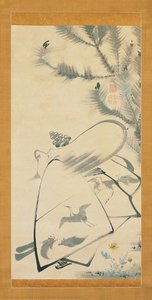


Ito Jakuchū
Crabs and Peonies
() ·
Inklusive Rahmen: · Handgemalt mit Öl auf Leinen
Gesamtbetrag