


 Vorschau anzeigen
 Versenden
 Teilen
 Details anzeigen
 Leitfaden

 Herunterladen
 Ähnliche Objekte
 Röntgenaufnahme
 Diashow
 Statistiken
Melrose


Experience J.M.W. Turner's 'Melrose': A breathtaking landscape capturing the Scottish Borders’ beauty with atmospheric light and evocative detail. Explore its romantic style & historical significance.
 Weiterlesen
Entdecken Sie J.M.W. Turner (1775-1851), Pionier der Romantik! Erleben Sie seine Landschaftsbilder, stürmischen Meeresansichten & Einfluss auf den Impressionismus. Kunstwerke entdecken & mehr über diesen britischen Meister erfahren.
Handgefertigte Ölreproduktion
Handgemaltes Ölgemälde auf Leinwand in Ihrer Wunschgröße und mit Rahmen, auf Bestellung von unseren Künstlern angefertigt. ( Zum Druck wechseln Zum digitalen Bild wechseln)




P118B €10

P118H €10

P118W €10

P438Z €10

P508JH €12

P508YH €12

P805H €10

P805Z €10

P919BZ €10

P919G €10

P919XJ €10

P959ZH €10

P968JZ €12

W106C €8

W218G €10

W218JH €8

W218Y €10

W307PJ €10

W316G €10

W316PJ €8

W316Y €10

W398PJ €8

W4111J €10

W500HY €15

W500JH €15

W692G €12

W849H €8

W940BG €15

W953PJ €8




Standardformat
individuell anpassbar
CM
INCH
Wählen Sie aus unseren vordefinierten Formaten, die den ursprünglichen Proportionen des Kunstwerks entsprechen.
Loading sizes...

Breite
Höhe
Geben Sie die Breite und die Höhe an, die Sie für Ihren Rahmen oder Ihre Wand benötigen. Da dieses Werk handgemalt ist, kann der Künstler bei einer anderen Form etwas mehr um das Bild herum malen oder etwas abschneiden – Sie entscheiden. Wir senden Ihnen ein digitales Mockup zur Freigabe, bevor mit dem Malen begonnen wird. Das auf dieser Seite gezeigte Bild stellt nicht das tatsächliche Ergebnis dar – dies tut nur das Mockup.
Beispiele für Anpassungsmöglichkeiten: Gesicht durch Kundenfoto ersetzen; Haustier hinzufügen (z. B. Katze durch Hund ersetzen); eine versteckte Nachricht im Hintergrund einfügen; Hintergrundlandschaft oder -elemente ändern.
Nach der Bestellung wird das TopImpressionists.com-Team dem Kunden Anweisungen per E-Mail zusenden und eine Mockup-Vorschau bereitstellen.
Nach der Bestellung wird das TopImpressionists.com-Team dem Kunden Anweisungen per E-Mail zusenden und eine Mockup-Vorschau bereitstellen.
Weltweiter Versand () in nur 3 bis 4 Wochen statt der üblichen 5 Wochen. (25 Oktober). Keine Kompromisse bei der Qualität.

Kostenloser weltweiter Expressversand

Hochwertige Leinenleinwand

Umfassender Versicherungsschutz beim Versand

Zollgebühren-Rückerstattungsgarantie

Garantie für exakte Farbtreue

100 Tage Rückgaberecht (nur bei Mängeln)

100% Geld-zurück-Garantie

Mengenrabatt verfügbar
 Die Glasoption ist nur für Größen unter 110 cm verfügbar.

Melrose
Art der Reproduktion
Format der Reproduktion
-


Endpreis
€ 280
Melrose: A Vision of Light and Landscape by J.M.W. Turner
J.M.W. Turner’s “Melrose,” painted in 1831, isn't merely a depiction of a Scottish landscape; it’s an immersive experience—a fleeting moment captured on canvas where light, atmosphere, and the sublime intertwine. The painting transports us to the rolling hills and verdant valleys surrounding Melrose Abbey in the Borders region, rendered not with precise detail but with Turner’s signature blend of emotion and evocative color. It's a work that speaks volumes about his revolutionary approach to landscape art, moving beyond topographical accuracy towards an exploration of feeling and the transient beauty of nature.
Turner’s style at this period is characterized by its loose, expressive brushwork—a deliberate departure from the rigid conventions of academic painting. He employs a technique that prioritizes capturing the *impression* of light and color rather than meticulously recreating every element. Notice how the broad strokes of ochre, brown, and gray dominate the foreground, suggesting the earth and vegetation while allowing the sky to bleed into the landscape. The river, a ribbon of shimmering blues and greens, flows with an almost liquid grace, reflecting the diffused sunlight above. This deliberate blurring of edges and forms is central to Turner’s Romantic vision—a world where nature reigns supreme and human perception is secondary.
A Historical Context: Romanticism and the Sublime
“Melrose” firmly resides within the heart of the Romantic movement, a period defined by its emphasis on emotion, imagination, and the power of nature. The Romantics rejected the Enlightenment’s focus on reason and logic, instead celebrating the individual experience and the awe-inspiring grandeur of the natural world. Turner was deeply influenced by this shift, seeking to capture not just what he *saw*, but what he *felt* in response to the landscape. The concept of the “sublime”—a feeling of overwhelming beauty mixed with a sense of terror or insignificance—is powerfully evoked here. The vastness of the hills and sky, combined with the hazy atmosphere, creates an effect that is both captivating and slightly unsettling.
Interestingly, this painting was created during a period when Turner embarked on extensive travels throughout Europe, particularly in Italy and Switzerland. These journeys profoundly shaped his artistic vision, exposing him to new light conditions and inspiring him to experiment with different techniques. The influence of the Italian landscapes—particularly their dramatic lighting effects—can be seen in “Melrose,” contributing to its atmospheric intensity.
Symbolism and Emotional Resonance
Beyond its purely visual qualities, "Melrose" is rich in symbolic meaning. The distant town, barely discernible through the haze, represents human settlement and industry, dwarfed by the overwhelming power of nature. The river, a symbol of life and movement, flows relentlessly onward, suggesting the passage of time and the impermanence of all things. The prominent mountain on the left side acts as a vertical anchor, grounding the composition while simultaneously emphasizing the vastness of the scene.
Perhaps most powerfully, “Melrose” evokes a sense of tranquility and contemplation. The muted colors, soft lighting, and loose brushwork create an atmosphere of serenity—a reminder of the beauty and restorative power of nature. It’s a painting that invites us to slow down, breathe deeply, and lose ourselves in the moment, mirroring Turner's own desire to capture fleeting experiences of light and color.
Technical Details & Reproduction Considerations
Turner employed watercolor on paper for this work, utilizing layering techniques and delicate washes to achieve his characteristic atmospheric effects. The visible brushstrokes contribute to the painting’s sense of movement and energy, while the subtle blending of colors creates a luminous quality. Reproductions, particularly high-quality prints, strive to capture these nuances—the interplay of light and shadow, the texture of the paper, and the overall feeling of atmosphere. When selecting a reproduction, consider the medium – archival inks on fine art paper will best preserve the painting’s delicate colors and details for years to come.
Size: Unknown
Date: 1831
Fragen & Antworten
Wie viel Licht scheinen die Farben von "Melrose" zu reflektieren?
Die Farben von "Melrose" weisen eine Helle Balance Luminanz auf.
Wie schafft "Melrose" das Gleichgewicht zwischen Hell und Dunkel?
"Melrose" von J.M.W. Turner weist eine Helligkeit von strahlend mit einer Luminanz von Helle Balance auf.
Wer ist der Künstler hinter "Melrose"?
"Melrose" wurde von J.M.W. Turner geschaffen. Die Informationen auf dieser Seite beschreiben das Originalwerk von J.M.W. Turner.
Künstlerbiografie
Frühes Leben und Karriere
Joseph Mallord William Turner, bekannt in seiner Zeit als William Turner, war ein renommierter englischer Maler der Romantik, Grafiker und Aquarellist. Er wurde am 23. April 1775 in Maiden Lane, Covent Garden, London, in einer bescheidenen Familie des unteren Mittelstandes geboren. Turners künstlerische Reise begann schon in jungen Jahren. * **Wunderkind:** Schon mit 14 Jahren schrieb sich Turner an der Royal Academy of Arts ein und stellte bereits im Alter von 15 Jahren seine erste Arbeit aus. * **Architekturzeichner:** Er arbeitete auch als Architekturzeichner und verbesserte dabei seine Fähigkeiten in Perspektive und Design.Künstlerischer Stil und Beiträge
Turners ausdrucksstarke Farbgebung, fantasievolle Landschaftsbilder und turbulente Meeresmalereien hinterließen einen bleibenden Eindruck auf die britische Kunst. Seine Werke umfassen: * **Von John Ruskin gefördert:** Ab 1840 wurde Turners Werk vom führenden englischen Kunstkritiker John Ruskin gewürdigt, der die Landschaftsmalerei in eine beispiellose Stufe der Bedeutung erhob.Persönliches Leben und späte Jahre
* **Intensiv privat und zurückgezogen:** Turners persönliches Leben war von Exzentrik und Rückzug geprägt. * **Vaterrolle:** Er zeugte zwei Töchter, Evelina (1801–1874) und Georgiana (1811–1843), mit der verwitweten Sarah Danby. * **Späteres Leben und Tod:** Turners Gemütszustand verschlechterte sich nach dem Tod seines Vaters im Jahr 1829. Er lebte ab 1845 in Elend und schlechter Gesundheit und verstarb am 19. Dezember 1851 in London im Alter von 76 Jahren.Vermächtnis und Erinnerung
* **Beerdigt in St. Paul’s Cathedral:** Turner wurde in der St. Paul's Cathedral, London beigeselt, ein Beweis für sein bleibendes Vermächtnis. * **Erkunden Sie mehr:** Tauchen Sie in Turners Welt ein über [https://TopImpressionists.com/@/j-m-william-turner](https://TopImpressionists.com/@/j-m-william-turner) und entdecken Sie die Meisterwerke, die Kunstliebhaber auf der ganzen Welt weiterhin inspirieren. Entdecken Sie das turbulente Genie von J.M. William Turner * **Sehen Sie sich seine Werke an:** /de/art/list/ * **Erfahren Sie mehr über die britische Kunst:** [https://en.wikipedia.org/wiki/category:british_art](https://en.wikipedia.org/wiki/category:british_art)
J.M.W. Turner
1775 - 1851 , Vereinigtes Königreich
Kurzinfos
- Bemerkenswerte Werke:
- Der Kampfschiff Temeraire
- Regen, Dampf und Geschwindigkeit
- Die Verbrennung des Parlamentsgebäudes
- Geburtsdatum: 23. April 1775
- Geburtsort: London, Vereinigtes Königreich
- Künstlerische Richtung: Romantik
- Nationalität: Britisch
- Sterbedatum: 19. Dezember 1851
- Vollständiger Name: J.M.W. Turner
Ähnliche Artikel

Capturing the Soul: The Emotional Magic and Sublime Grandeur of Romantic Landscape Painting
Explore the profound emotional depth of Romantic landscape painting. Discover how masters like Friedrich and Turner captured the sublime through light, shadow, and nature's power in this expert art history retrospective for discerning collectors.
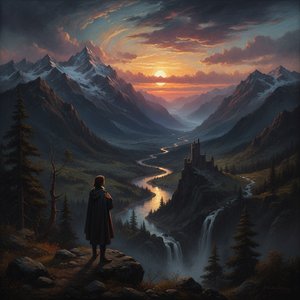
Capturing the Soul: The Emotional Majesty and Sublime Power of Romantic Landscape Painting
Explore the profound emotional depth of Romantic landscape painting. Discover how masters like Turner and Friedrich captured the sublime power of nature through intuition and imagination in this expert art history retrospective.
Entdecken Sie Kunstwerke, die nach Themen, Stilen und Merkmalen sortiert sind.


