

 In echtem Maßstab anzeigen
 Versenden als Grußkarte
 Teilen
 Details anzeigen
 Leitfaden öffnen

 Herunterladen
 Ähnliche Objekte
 Röntgenaufnahme
 Diashow
 Besucherstatistiken
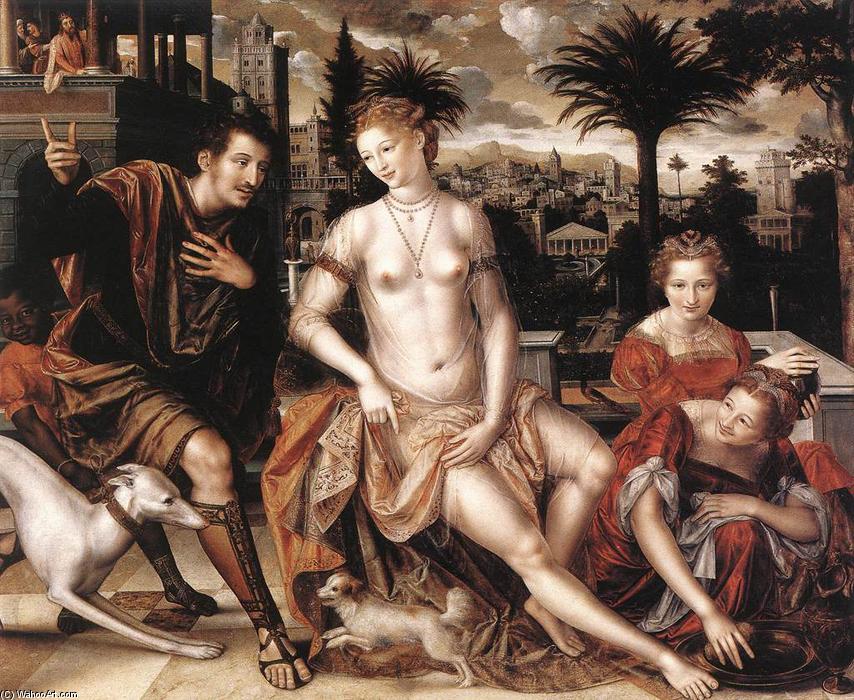
David and Bathsheba
 Oil On Canvas
- WallArt
- Baroque Renaissance Fusion
 1562
1562- Renaissance
 162.0 x 197.0 cm
 Louvre
Experience the dramatic chiaroscuro of Jan Massys's 1562 David and Bathsheba, a Renaissance masterpiece capturing an intimate biblical moment you will want to own.
 Mehr anzeigen
Entdecken Sie Jan Massys (1466-1530), den bedeutenden flämischen Maler & Begründer der Antwerpener Schule! Religiöse Kunst, satirische Szenen & bleibender Einfluss.
Erwerben Sie ein hochauflösendes, optimiertes digitales Bild, das der Online-Vorschau weit überlegen ist.
Jede Datei wird von unseren hauseigenen Spezialisten mit modernsten Werkzeugen und fachmännischer manueller Retusche sorgfältig vorbereitet. Wir stellen sicher, dass jedes Bild eine außergewöhnliche Klarheit, präzise Farbgenauigkeit und feinste Details aufweist.
Die endgültige Datei wird innerhalb von 72 Stunden per E-Mail zugestellt und ist für den sofortigen Einsatz in professionellen, redaktionellen und Druckumgebungen optimiert. Es handelt sich um dieselbe Qualität, der führende Designstudios, Verlage und Galerien vertrauen.
Digitales Bild
Laden Sie eine hochauflösende Datei für die persönliche Präsentation, den Druck und kreative Projekte herunter. ( Zum Druck wechseln Handgemalte Reproduktion kaufen)
In jeder Bestellung digitaler Bilder enthalten
Professionelle digitale Bereitstellung, garantiert
Wenn Sie sich für TopImpressionists.com entscheiden, erhalten Sie nicht nur ein Bild – Sie erhalten ein professionell aufbereitetes digitales Kunstwerk, das mit höchster Präzision erstellt und durch eine Zufriedenheitsgarantie abgesichert wird. Hier ist alles, was automatisch mit Ihrer Bestellung geliefert wird:

Schnelle E-Mail-Zustellung
Ihre hochauflösende digitale Bilddatei wird Ihnen innerhalb von 72 Stunden nach der Bestellung per E-Mail zugestellt – bereit zur sofortigen Verwendung.

KI-optimierte digitale Datei
Ihre Kunstwerke werden professionell mithilfe fortschrittlicher KI-Tools und manueller Bearbeitung optimiert, um maximale Detailtreue, Klarheit und Farbgenauigkeit zu gewährleisten.

Kostenloser lebenslanger Neudruckservice
Datei versehentlich gelöscht oder verloren? Keine Sorge – wir senden sie Ihnen jederzeit kostenlos erneut zu.

Keine Einfuhrgebühren – jemals
Genießen Sie Ihr Kunstwerk sofort ohne Zollgebühren, Einfuhrabgaben oder Versandkosten – digitale Downloads sind immer steuerfrei.

Garantierte Farbtreue
Wir garantieren, dass Ihr digitales Bild mithilfe professioneller Werkzeuge und Farbmanagement die Originalfarben so präzise wie möglich wiedergibt.

100-Tage-Zufriedenheitsgarantie
Sollten Sie mit Ihrem digitalen Bild nicht zufrieden sein, werden wir es überarbeiten oder 100% innerhalb von 100 Tagen erstatten – ohne Wenn und Aber.

100% Geld-zurück-Garantie
Nicht zufrieden? Erhalten Sie innerhalb von 100 Tagen nach Erhalt Ihrer digitalen Datei eine vollständige Rückerstattung – ohne Wenn und Aber.

Rabatte bei Großbestellungen
3 Bilder kaufen, 10% sparen – 5 Bilder kaufen, 15% sparen – Ab 10 Bildern 20% sparen. Ideal für kreative Projekte, Galerien und Agenturen.
A Moment Frozen in Time: The Allure of Jan Massys’s David and Bathsheba
In the heart of Renaissance Antwerp, a period defined by both profound religious devotion and burgeoning worldly curiosity, Jan Massys captured a scene of unparalleled emotional and narrative tension. His 1562 masterpiece, David and Bathsheba, is far more than a mere biblical illustration; it is a window into the human psyche, capturing the exact moment where desire meets consequence. The painting recounts the clandestine encounter between King David and the Moabite woman, Bathsheba, a narrative of illicit passion that has captivated viewers for centuries. As we gaze upon this monumental canvas, we are drawn into an intimate tableau where every gesture and glance speaks of a secret shared between the figures and the observer.
The composition is masterfully orchestrated to guide the eye through a landscape of moral ambiguity. David, positioned with a commanding yet contemplative presence, gestures toward something unseen—perhaps a divine warning or a silent acknowledgment of the gravity of his transgression. Opposite him, Bathsheba lies in a state of palpable vulnerability, her upward gaze creating a powerful diagonal line of tension that connects the two protagonists. This intimacy is not solitary; Massys surrounds the central pair with supporting figures, including a servant attending to Bathsheba’s needs, which serves to remind us of the societal eyes and the inevitable repercussions that follow such private indiscretions. Even the small, quiet presence of a dog nestled near the edge of the scene adds a layer of symbolic depth, perhaps representing the lost innocence or the concept of fidelity amidst a moment of profound betrayal.
Mastery of Light and Texture in the Flemish Tradition
To behold this work is to witness the pinnacle of Renaissance oil technique. Massys utilized the medium of oil on canvas to achieve a level of realism that feels almost tactile. Through the meticulous application of paint, he renders the heavy, intricate folds of David’s robes with such precision that one can almost sense the weight of the fabric. This technical prowess extends to the delicate rendering of Bathsheba’s skin, where subtle glazing effects create a luminous, soft quality that contrasts beautifully with the more structured elements of the background.
Central to the painting's emotional impact is Massys’s use of chiaroscuro. By employing dramatic contrasts between deep shadows and brilliant highlights, the artist sculpts the figures out of the darkness, lending them a three-dimensional presence that commands the room. This manipulation of light does more than just define form; it heightens the atmospheric intensity, casting a somber, reflective mood over the entire scene. For the collector or the interior designer, such a piece offers a profound sense of drama and historical weight, making it an ideal centerpiece for spaces that value sophisticated storytelling and the timeless elegance of the Flemish masters.
Fragen & Antworten
In welchem Jahr und welcher Stilrichtung wurde "David and Bathsheba" geschaffen?
"David and Bathsheba" entstand im Jahr 1562 innerhalb der Baroque Renaissance Fusion-Bewegung.
Welcher Künstler und welcher Stil stehen hinter "David and Bathsheba"?
Jan Massys schuf „David and Bathsheba“ im Rahmen der Baroque Renaissance Fusion-Bewegung.
Ist "David and Bathsheba" von Jan Massys ein Gemälde, eine Zeichnung oder ein Druck?
"David and Bathsheba" von Jan Massys wird als WallArt klassifiziert. Die Kategorie beschreibt die Art des Kunstwerks, um das es sich beim Original handelt.
Welche Farbpalette wird in "David and Bathsheba" von Jan Massys verwendet?
Die Farbpalette von "David and Bathsheba" von Jan Massys wird als Earthy beschrieben. Es handelt sich um eine kompakte Beschreibung der Farben des Werkes.
Worum geht es in "David and Bathsheba"?
Die Motive von "David and Bathsheba" sind biblical narrative, royal intrigue, sensuality, allegory, human emotion, renaissance painting, religious iconography.
Welche Sättigung und Intensität weist "David and Bathsheba" von Jan Massys auf?
Die Farbe von "David and Bathsheba" weist eine Sättigung von Subtle Color und eine Intensität von Balanced auf.
Befindet sich "David and Bathsheba" von Jan Massys im Heimatland des Künstlers?
Nein – das Kunstwerk wird im Ausland aufbewahrt. Jan Massys wurde in Belgien geboren, und das Original von „David and Bathsheba“ befindet sich in einem Museum in Frankreich.
Welche Farbsättigung weist "David and Bathsheba" von Jan Massys auf?
"David and Bathsheba" von Jan Massys ist mit einer Subtle Color Sättigung festgehalten.
Künstlerbiografie
Jan Massys: Ein flämischer Renaissancemaler
- Name: Jan Massys (auch bekannt als Jan Massijs)
- Herkunft: TopImpressionists
- Geboren: Antwerpen, Belgien (1466)
- Gestorben: 1530
Frühes Leben und Ausbildung
- Jan Massys wurde um 1466 in Leuven, Belgien, geboren. Seine Eltern waren Joost Matsys und Catherine van Kincken. Legenden besagen, dass er anfänglich als Schmied arbeitete, bevor er sich der Malerei widmete. Historische Berichte deuten jedoch darauf hin, dass seine Familie ein respektables Einkommen hatte, was eine finanzielle Notwendigkeit für seinen Karrierewechsel unwahrscheinlich macht.
- Karel van Mander behauptete, dass die Schmiede aufgrund einer Krankheit aufgegeben wurde, während derer Massys Drucke für Karnevalsfeiern dekorierte.
- Er erhielt wahrscheinlich zunächst in Leuven eine Ausbildung, bevor er um 1491 nach Antwerpen zog, wo er zum Meistersmann innerhalb der Heiligen Lukas Gilde wurde.
- Es wird allgemein angenommen, dass Joachim Patinir bei Massys lernte und zu einigen seiner Landschaftsbilder beitrug.
- Sein Stil spiegelt den Einfluss von Dirk Bouts wider, der die künstlerischen Qualitäten von Hans Memling und Rogier van der Weyden nach Leuven brachte.
Künstlerischer Stil und Hauptwerke
- Massys' Werk ist durch eine Wiederbelebung der flämischen Kunst in der Tradition von Jan van Eyck und Rogier van der Weyden gekennzeichnet, wobei Festigkeit der Kontur, klare Modellierung und gründliche Detailgenauigkeit mit der leuchtenden Reichhaltigkeit transparenter Pigmente kombiniert werden.
- Seine Gemälde spiegeln oft einen aufrichtigen Ausdruck, fein detaillierte Darstellungen und gedämpfte Licht- und Schattenspiele wider. Er schenkte großer Aufmerksamkeit Schmuck, Saumverzierungen und Verzierungen.
- Er ist sowohl für religiöse Werke als auch für satirische Szenen bekannt, was ein scharfes Auge für menschliche Gefühle und Gesellschaft zeigt.
- Hauptwerke:
- Die hässliche Gräfin (1515) - Ein berühmtes satirisches Porträt, das Alterung und gesellschaftliche Wahrnehmungen kommentiert.
- Porträt eines älteren Mannes (1513) – Ein weiteres Beispiel für seinen satirischen Kommentar.
- Der Geldwechsler und seine Frau (1514) – Eine Darstellung, die Gier und Habgier innerhalb der Kaufmannsklasse aufdeckt.
- Religiöse Altarbilder und mehrteilige Tafeln, darunter solche für die Kirche St. Peter in Leuven.
- Venus von Cythera (1561) - Ein bedeutendes Werk, das sein Interesse an weiblicher Schönheit zeigt und möglicherweise von der italienischen Kunst beeinflusst wurde.
Einflüsse und historische Bedeutung
- Einflüsse: Dirk Bouts, Hans Memling, Rogier van der Weyden, Jan van Eyck.
- Massys gilt als Mitbegründer der Antwerpener Schule und hat wesentlich zu ihrer Entwicklung beigetragen, neben Künstlern wie seinem Vater Quinten Massys und seinem Bruder Cornelis Massys.
- Seine satirischen Werke waren für ihre Zeit bahnbrechend und boten durch Porträts einen gesellschaftlichen Kommentar, der in der früheren flämischen Kunst relativ ungewöhnlich war.
- Er trug dazu bei, traditionelle flämische künstlerische Qualitäten wiederzubeleben und gleichzeitig Einflüsse aus Italien und anderen Teilen der Niederlande zu integrieren.
- Massys' Betonung des individuellen Charakters und die realistische Darstellung menschlicher Emotionen beeinflussten nachfolgende Generationen von Künstlern.
Späteres Leben und Vermächtnis
- Im Jahr 1544 wurden Jan Massys und sein Bruder Cornelis aufgrund ihrer religiösen Überzeugungen aus Antwerpen verbannt. Er verbrachte Zeit in Italien und Frankreich, bevor er nach Antwerpen zurückkehrte.
- Später im Leben war er in Erbschaftsstreitigkeiten mit seinen Geschwistern verwickelt.
- Trotz einer Zeit der reduzierten Umstände erhielt er Aufträge vom Stadtrat vor seinem Tod im Jahr 1575.
- Sein Vermächtnis liegt in seinem Beitrag zur Antwerpener Schule und seinem bahnbrechenden Ansatz für satirische Porträts innerhalb religiöser und weltlicher Kunst. Er wird für seine technische Fertigkeit, Detailgenauigkeit und aufschlussreiche Beobachtungen der menschlichen Natur in Erinnerung behalten.

Jan Massys
1466 - 1530 , Belgien
Kurzprofil
- Artistic Movement Or Style: Flandrische Renaissance
- Artists Or Movements Influenced By This Artist:
- Arian van Overbeke
- Willem Muelenbroec
- Joachim Patinir
- Artists Who Influenced This Artist:
- Dirk Bouts
- Hans Memling
- Rogier van der Weyden
- Jan van Eyck
- Date Of Birth: 1466
- Date Of Death: 1530
- Full Name: Jan Massys
- Nationality: Belgisch
- Notable Artworks:
- Das Hässliche Gräfin
- Porträt eines alten Mannes
- Der Geldwechsler und seine Frau
- Place Of Birth (City And Country): Antwerpen, Belgien