Vorschau anzeigen
 Versenden
 Teilen
 Details anzeigen
 Leitfaden

 Herunterladen
 Ähnliche Objekte
 Röntgenaufnahme
 Diashow
 Q&A
Q&A Statistiken
Self-Portrait

Write a English compelling meta description in maximum 230 characters for this artwork.
Explore Jean-Baptiste-Camille Corot’s ‘Self-Portrait,’ embodying Impressionist innovation with luminous landscapes and emotive brushstrokes—a serene reflection of artistic vision.
Explore Jean-Baptiste-Camille Corot's masterpiece 'Self-Portrait,' capturing the artist's essence and pioneering Impressionist tec
 Weiterlesen
Entdecken Sie Jean-Baptiste-Camille Corot (1796-1875), französischen Landschaftsmeister! Seine Werke verbinden Neoklassik & Impressionismus. Erleben Sie ruhige Landschaften & inspirierende Porträts!
Giclée / Kunstdruck
Giclée- oder Leinwanddruck in Museumsqualität mit schneller Produktion und flexiblen Veredelungsoptionen. ( Handgemalte Reproduktion bestellen Zum digitalen Bild wechseln)




P118B €10

P118H €10

P118W €10

P438Z €10

P508JH €12

P508YH €12

P805H €10

P805Z €10

P919BZ €10

P919G €10

P919XJ €10

P959ZH €10

P968JZ €12

W106C €8

W218G €10

W218JH €8

W218Y €10

W307PJ €10

W316G €10

W316PJ €8

W316Y €10

W398PJ €8

W4111J €10

W500HY €15

W500JH €15

W692G €12

W849H €8

W940BG €15

W953PJ €8




Standardformat
individuell anpassbar
CM
INCH
Wählen Sie aus unseren vordefinierten Formaten, die den ursprünglichen Proportionen des Kunstwerks entsprechen.
Loading sizes...

Breite
Höhe
Geben Sie die benötigte Breite und Höhe an, damit der Druck perfekt in Ihren Rahmen oder an Ihre Wand passt. Ein Druck kann nur beschnitten, aber niemals größer als das Originalbild angefertigt werden; daher verliert ein Format mit anderen Proportionen einen Teil des Bildes. Wir senden Ihnen ein digitales Mockup zur Freigabe, bevor wir den Druck ausführen. Das auf dieser Seite gezeigte Bild zeigt nicht den tatsächlichen Beschnitt – dies ist nur im Mockup ersichtlich.
Weltweiter Versand () innerhalb von 2 Wochen statt der üblichen 4/5 Wochen. (28 Oktober)

Kostenloser weltweiter Expressversand

Hochwertige Leinenleinwand

Umfassender Versicherungsschutz beim Versand

Zollgebühren-Rückerstattungsgarantie

Garantie für exakte Farbtreue

100 Tage Rückgaberecht (nur bei Mängeln)

100% Geld-zurück-Garantie

Mengenrabatt verfügbar
 Die Glasoption ist nur für Größen unter 110 cm verfügbar.

Self-Portrait
Giclée / Kunstdruck
Format der Reproduktion
-


Endpreis
€ 61
Introduction to the Artist and his Work
Jean Baptiste Camille Corot, a French landscape and portrait painter, was born on July 16, 1796, in Paris. He is considered one of the most influential artists of the 19th century, with his vast output referencing Neo-Classical traditions while anticipating plein-air innovations of Impressionism. Corot's works are known for their mastery of light and shadow, which he used to create depth and volume in his compositions. Self-Portrait, painted around 1825, is an excellent example of Corot's early work. This painting may have been created at the request of his parents before he embarked on a study trip to Italy. The self-portrait showcases Corot's skill in capturing light and shadow, as well as his ability to convey emotion through facial expression.Corot's Study Trip to Italy
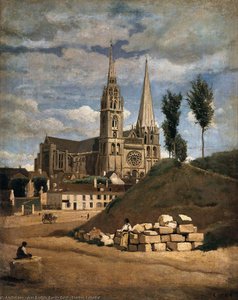
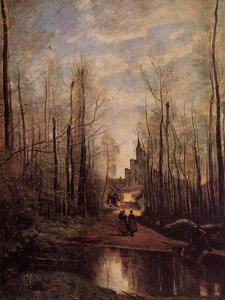
Italy had a profound impact on Corot's artistic development. During his stay from 1825 to 1828, he focused on capturing the effects of light in his landscapes, which marked a significant phase in his own painting and in the evolution of landscape painting as a whole. The Cathedral of Chartres, painted in 1830 after Corot's return to France, reflects the influence of his Italian sojourn. The highly original framing and luminosity of this work demonstrate Corot's experiments with light and shadow, which he had developed during his time in Italy.Corot's Impact on Landscape Painting
Corot's innovative approach to landscape painting laid the groundwork for Impressionism. His emphasis on capturing natural light and color, as well as his use of plein-air techniques, helped redefine the genre and paved the way for future artistic movements.Conclusion
Jean Baptiste Camille Corot's contributions to landscape and portrait painting are immeasurable. His mastery of light and shadow, as well as his innovative approach to capturing natural scenes, have solidified his place as one of the most influential artists in history. Discover more about Jean Baptiste Camille Corot's works by visiting our collection at /en/art/show/art-7z4q9p-en/.- Explore our collection of art movements
- Learn about other influential artists like Giovanni Fattori
Fragen & Antworten
Weist "Self-Portrait" starke Hell-Dunkel-Kontraste auf?
Der Hell-Dunkel-Kontrast von „Self-Portrait“ wird mit Bold angegeben. Der Kontrast beschreibt, wie stark sich helle und dunkle Bereiche voneinander unterscheiden.
Ist "Self-Portrait" von Jean-Baptiste-Camille Corot ein helles oder ein dunkles Kunstwerk?
"Self-Portrait" von Jean-Baptiste-Camille Corot weist eine Helligkeit von deep_shadow mit einer Luminanz von Dark auf.
Wie spiegeln sich Stilrichtung und Epoche in "Self-Portrait" von Jean-Baptiste-Camille Corot wider?
"Self-Portrait" von Jean-Baptiste-Camille Corot lässt sich der Strömung des Impressionistic Landscape innerhalb der – 19. Jahrhundert-Ära seines Schöpfers zuordnen.
Künstlerbiografie
Frühe Jahre und Ausbildung
Jean-Baptiste-Camille Corot, ein renommierter französischer Landschafts- und Porträtmaler, wurde am 16. Juli 1796 in Paris geboren. Seine Familie, die zum Bürgertum gehörte, bot ihm eine Umgebung, die seine künstlerischen Neigungen förderte. Anfänglich lagen Corots Interessen woanders, doch er entdeckte um 1821 seine Leidenschaft für das Malen. Dies markierte den Beginn seiner produktiven Karriere, die später die Entwicklung des Impressionismus beeinflussen sollte.Künstlerische Laufbahn und bedeutende Werke
Corots künstlerischer Weg ist geprägt von einer Mischung aus neoklassischer Tradition und plein-air Innovationen. Er kombinierte sorgfältige Kompositionen mit der direkten Beobachtung der Natur im Freien, was zu einer einzigartigen Atmosphäre in seinen Werken führte. Zu seinen bemerkenswertesten Arbeiten zählen:- Die Ruhe (La Repose) (Öl auf Leinwand, ca. 1860er Jahre), ein fesselndes Werk, das Corots Meisterschaft in der Darstellung von Gelassenheit zeigt.
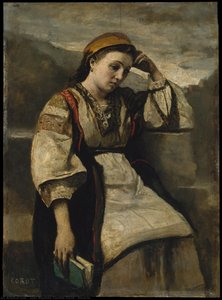
- Unterbrochenes Lesen (Lecture Interrompue) (Realismus, Öl, ca. 1850er Jahre), ein ergreifendes Beispiel für Corots Fähigkeit, den Alltag mit Tiefe und Emotion darzustellen.
- Agostina (Realismus, Öl, ca. 1860er Jahre), ein beeindruckendes Porträt, das Corots Geschicklichkeit in der Darstellung des Wesens seiner Motive veranschaulicht.
Einflüsse und Entwicklung
Corots künstlerische Entwicklung wurde von verschiedenen Einflüssen geprägt. Er studierte zunächst bei den neoklassizistischen Malern Jacques-Louis David und Jean-Antoine Houdon, was seine frühen Werke beeinflusste. Später fand er Inspiration in der Landschaftsmalerei des 17. Jahrhunderts, insbesondere bei Meistern wie Claude Lorrain und Nicolas Poussin. Corot entwickelte jedoch seinen eigenen Stil, indem er die klassische Komposition mit den direkten Beobachtungen der Natur im Freien verband. Er gilt als Brücke zwischen dem Klassizismus und dem Impressionismus. Seine Plein-Air-Malerei war revolutionär für seine Zeit und ebnete den Weg für zukünftige Generationen von Künstlern, darunter die Impressionisten.Vermächtnis und Bedeutung
Corots umfangreicher Output hatte einen nachhaltigen Einfluss auf die Entwicklung der Landschaftsmalerei. Sein innovativer Ansatz, traditionelle Techniken mit plein-air Innovationen zu verbinden, ebnete den Weg für zukünftige Generationen von Künstlern. Obwohl er zu Lebzeiten nicht immer Anerkennung fand, wurde Corot nach seinem Tod als einer der wichtigsten französischen Maler des 19. Jahrhunderts anerkannt. Seine Werke werden heute in bedeutenden Museen auf der ganzen Welt ausgestellt und seine Bedeutung für die Kunstgeschichte ist unbestreitbar. Entdecken Sie mehr über Jean-Baptiste-Camille Corots Gemälde auf TopImpressionists.com: https://TopImpressionists.com/@/jean-baptiste-camille-corot Erfahren Sie mehr über das Musée Courbet auf Wikipedia: https://en.wikipedia.org/wiki/mus%c3%a9e_courbet_(ornans,_france)
Jean-Baptiste-Camille Corot
1796 - 1875 , Frankreich
Kurzinfos
- Beeinflusste Künstler: ['Gustave Courbet']
- Bemerkenswerte Werke:
- Die Ruhe
- Unterbrochenes Lesen
- Agostina
- Geburtsdatum: 16. Juli 1796
- Geburtsort: Paris, Frankreich
- Künstlerische Richtung: Neoklassizismus, Pleinair
- Nationalität: Französisch
- Sterbedatum: 1875
- Vollständiger Name: Jean-Baptiste-Camille Corot
- Von Künstlern Beeinflusst: ['Keine Angaben']
Ähnliche Artikel

Claude Monet: Die 25 Meisterwerke des Impressionismus für Ihr Zuhause | TopImpressionists
Entdecken Sie die 25 Meisterwerke von Claude Monet! Tauchen Sie ein in die Welt des Impressionismus, erleben Sie Seerosen, Sonnenaufgänge & Kathedralen. Hochwertige Reproduktionen für Ihr Zuhause – exklusiv auf TopImpressionists.com.

Marianne North: Die 25 schönsten Blumenmalereien der viktorianischen Reisenden | TopImpressionists
Entdecken Sie die 25 schönsten Werke der viktorianischen Blumenmalerin Marianne North! Erleben Sie ihre exotischen Reisebilder & botanischen Illustrationen. Hochwertige Kunst Reproduktionen für Ihr Zuhause auf TopImpressionists.com.

Katsushika Hokusai: Die 25 Meisterwerke des Ukiyo-e – Kunst für Ihr Zuhause | TopImpressionists
Entdecken Sie die 25 Meisterwerke von Katsushika Hokusai! Tauchen Sie ein in die Welt des Ukiyo-e, berühmte Holzschnitte wie 'Die große Welle' & Fuji-Ansichten. Hochwertige Kunstdrucke für Ihr Zuhause – jetzt auf TopImpressionists.com!

Joan Mirós Meisterwerke: Die Top 25 für Kunstliebhaber & stilvolles Wohnen
Entdecken Sie die Top 25 Gemälde von Joan Miró! Tauchen Sie ein in die Welt des Surrealismus, abstrakter Kunst & katalanischer Farben. Hochwertige Kunstdrucke & Reproduktionen für Ihr Zuhause – jetzt auf TopImpressionists.com!

Meisterwerke Berlins: Die Top 25 Kunstwerke der Staatlichen Museen | TopImpressionists
Entdecken Sie die 25 bedeutendsten Kunstwerke der Staatlichen Museen Berlin! Von Nefertiti bis zur Romantik – erfahren Sie faszinierende Geschichten über Künstler, Stile & Techniken. Kunstreproduktionen in Museumsqualiät auf TopImpressionists.com.
Entdecken Sie Kunstwerke, die nach Themen, Stilen und Merkmalen sortiert sind.