Vorschau anzeigen
 Versenden
 Teilen
 Details anzeigen
 Leitfaden

 Herunterladen
 Ähnliche Objekte
 Röntgenaufnahme
 Diashow
 Q&A
Q&A Statistiken
Interior


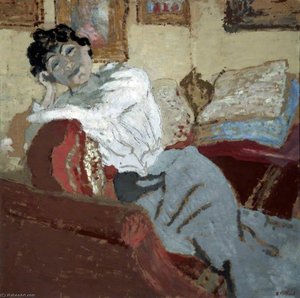
Jean-Édouard Vuillard’s “Interior” exemplifies the Nabi movement’s innovative use of color and form, depicting a serene domestic scene with muted tones and subtle textures. Created around 1900, this painting showcases Vuillard's mastery in capturing intimate moments within a home setting and is prominently displayed at the Detroit Institute of Arts.
 Weiterlesen
Jean-Édouard Vuillard (1868–1940) war ein französischer Maler und Mitglied der Nabis Gruppe, bekannt für seine intimistischen Innenräume und seinen Einfluss auf die frühe Moderne wie Kubismus. Entdecken Sie sein Kunstwerk!
Giclée / Kunstdruck
Giclée- oder Leinwanddruck in Museumsqualität mit schneller Produktion und flexiblen Veredelungsoptionen. ( Handgemalte Reproduktion bestellen Zum digitalen Bild wechseln)




P118B €10

P118H €10

P118W €10

P438Z €10

P508JH €12

P508YH €12

P805H €10

P805Z €10

P919BZ €10

P919G €10

P919XJ €10

P959ZH €10

P968JZ €12

W106C €8

W218G €10

W218JH €8

W218Y €10

W307PJ €10

W316G €10

W316PJ €8

W316Y €10

W398PJ €8

W4111J €10

W500HY €15

W500JH €15

W692G €12

W849H €8

W940BG €15

W953PJ €8




Standardformat
individuell anpassbar
CM
INCH
Wählen Sie aus unseren vordefinierten Formaten, die den ursprünglichen Proportionen des Kunstwerks entsprechen.
Loading sizes...

Breite
Höhe
Geben Sie die benötigte Breite und Höhe an, damit der Druck perfekt in Ihren Rahmen oder an Ihre Wand passt. Ein Druck kann nur beschnitten, aber niemals größer als das Originalbild angefertigt werden; daher verliert ein Format mit anderen Proportionen einen Teil des Bildes. Wir senden Ihnen ein digitales Mockup zur Freigabe, bevor wir den Druck ausführen. Das auf dieser Seite gezeigte Bild zeigt nicht den tatsächlichen Beschnitt – dies ist nur im Mockup ersichtlich.
Weltweiter Versand () innerhalb von 2 Wochen statt der üblichen 4/5 Wochen. (2 November)

Kostenloser weltweiter Expressversand

Hochwertige Leinenleinwand

Umfassender Versicherungsschutz beim Versand

Zollgebühren-Rückerstattungsgarantie

Garantie für exakte Farbtreue

100 Tage Rückgaberecht (nur bei Mängeln)

100% Geld-zurück-Garantie

Mengenrabatt verfügbar
 Die Glasoption ist nur für Größen unter 110 cm verfügbar.

Interior
Giclée / Kunstdruck
Format der Reproduktion
-


Endpreis
€ 61
Jean-Édouard Vuillard: Capturing Quietude in “Interior”
The painting "Interior," executed by Jean-Édouard Vuillard around 1900-1905, stands as a quintessential example of Nabis art—a movement that sought to revolutionize artistic expression through radical simplification and the exploration of color’s emotive power. More than just a depiction of domestic space, it embodies Vuillard's profound fascination with capturing fleeting moments of stillness and intimacy within the everyday world. Located at the Detroit Institute of Arts, this artwork invites viewers into a carefully constructed tableau that speaks volumes about artistic innovation and perceptual experience.A Synthesis of Impressionism and Japanese Influence
Vuillard’s approach to painting was deeply rooted in Impressionist principles—particularly the emphasis on capturing light and atmosphere—yet he decisively moved beyond its limitations. Influenced by the pioneering work of Paul Gauguin, Vuillard embraced a bold departure from academic conventions. However, his artistic vision gained significant impetus from Japanese prints (ukiyo-e), which had begun to circulate in Europe during this period. Like Serusier’s “The Talisman,” Vuillard utilized flattened planes of color—a technique borrowed directly from Japanese aesthetics—to create an illusion of depth and spatial ambiguity. This deliberate simplification wasn't merely stylistic; it represented a fundamental rethinking of how artists could represent reality, prioritizing feeling over precise observation.Composition and Color Palette: Orchestrating Emotion
The composition itself is deceptively simple. Two chairs dominate the scene, one occupied by a figure whose presence is subtly suggested rather than overtly portrayed—a characteristic Vuillard technique that encourages contemplation and invites viewers to fill in the gaps of perception. A window frames a glimpse of foliage outside, bathed in soft light, contributing to the overall sense of tranquility. Yet, it’s the color palette that truly distinguishes “Interior.” Vuillard employed hues of pink, peach, and pale yellow—colors chosen not for their literal representation but for their ability to evoke emotion. These shades coalesce into a harmonious blend that conveys warmth, comfort, and perhaps even melancholy—a testament to Vuillard's masterful control over chromatic orchestration.Symbolism Within Everyday Reality
Beyond its formal qualities, “Interior” resonates with symbolic significance. The empty chair serves as a poignant reminder of absence and solitude, while the window represents connection to nature—a recurring motif in Vuillard’s oeuvre. The bird perched on the windowsill symbolizes freedom and aspiration, subtly elevating the scene beyond mere visual description. These elements intertwine to create a narrative that transcends the surface appearance of the room, prompting viewers to consider themes of contemplation, memory, and the beauty inherent in ordinary life.Legacy and Influence
Vuillard’s innovative approach to color and form profoundly impacted subsequent artistic movements—most notably Cubism and Fauvism—establishing him as a pivotal figure in the transition from Impressionism to abstraction. His unwavering commitment to capturing subjective experience continues to inspire artists today, demonstrating the enduring power of art to convey emotion and illuminate the complexities of human perception. “Interior” remains an unforgettable masterpiece, embodying Vuillard’s artistic genius and securing his place among the most celebrated painters of the Belle Époque.Fragen & Antworten
Wie hoch ist der Kontrast von "Interior" von Jean-Édouard Vuillard?
Der Kontrastwert von "Interior" von Jean-Édouard Vuillard ist Serene.
Welche Farbtönung dominiert in "Interior"?
"Interior" weist einen Ochre to Sepia Farbton auf.
Kann ich Augmented Reality nutzen, um "Interior" von Jean-Édouard Vuillard in meinem Raum zu sehen?
Auf der AR-Vorschau-Seite von "Interior" von Jean-Édouard Vuillard können Sie das Kunstwerk mithilfe von Augmented Reality auf einem kompatiblen Gerät direkt in Ihren eigenen Räumlichkeiten erleben.
Ähnliche Kunstwerke
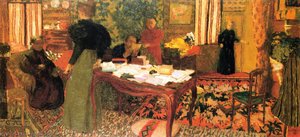
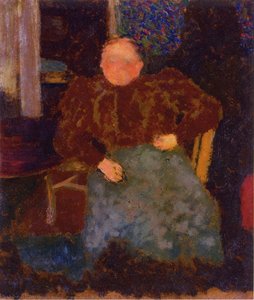


Künstlerbiografie
Jean-Édouard Vuillard: Ein Maler der Intimität und des Lichtes
Jean-Édouard Vuillard, geboren am 11. November 1868 in Cuiseaux im Departement Saône-et-Loire, Frankreich, war ein Maler, Grafiker und Dekorateur, dessen Werk die Kunst des späten 19. Jahrhunderts nachhaltig prägte. Seine Gemälde, insbesondere seine Intimitätsdarstellungen von Innenräumen, sind geprägt von einer subtilen Sensibilität für Licht, Farbe und Form – eine einzigartige Kombination, die ihn zu einem der bedeutendsten Vertreter des Postimpressionismus und der Nabis-Bewegung machte. Vuillard verbrachte seine Kindheit in Paris und erhielt zunächst eine militärische Ausbildung, bevor er sich schließlich der Kunst widmete. Seine künstlerische Entwicklung wurde maßgeblich von den Impressionisten beeinflusst, doch er entwickelte schnell einen eigenen Stil, der sich durch eine reduzierte Farbpalette, flache Perspektiven und eine besondere Betonung des Innenraums auszeichnete.Die Nabis: Eine Gruppe der Avantgarde
Vuillard war 1889 Mitglied der Nabis – einer Künstlergruppe, die sich von den etablierten Kunstströmungen abgrenzte und eine eigene künstlerische Vision entwickelte. Die Nabis, zu denen auch Maurice Denis, Pierre Bonnard und Paul Sérusier gehörten, orientierten sich an den Theorien des Positivismus und suchten Inspiration in der japanischen Kunst, insbesondere in Holzschnitten. Sie experimentierten mit neuen Techniken und Ansätzen, die darauf abzielten, die Essenz eines Motivs zu erfassen, anstatt es naturalistisch darzustellen. Vuillard trug maßgeblich zur Entwicklung der Nabis-Ästhetik bei, indem er seine Innenräume mit einer subtilen Melancholie und einem Hauch von Geheimnis umhüllte. Seine Werke sind geprägt von einer Atmosphäre der Intimität und des Verweilens, die den Betrachter in eine andere Zeit und einen anderen Raum versetzt.Die Technik und das Spiel mit Licht
Vuillard’s charakteristische Maltechnik zeichnet sich durch eine reduzierte Farbpalette aus, die oft auf gedämpfte Töne wie Grau-, Beige- und Blautöne beschränkt ist. Er verwendete diese Farben jedoch nicht willkürlich, sondern achtete sorgfältig auf ihre Wechselwirkungen miteinander. Durch das Spiel mit Licht und Schatten erzeugte er eine besondere Atmosphäre in seinen Gemälden – eine Atmosphäre der Ruhe, des Friedens und der Melancholie. Vuillard war ein Meister darin, die flüchtigen Effekte von Licht zu erfassen und sie in seine Bilder einzubringen. Seine Pinselstriche sind oft weich und verschwommen, was den Eindruck erweckt, als ob das Licht selbst durch die Leinwand dringt. Er experimentierte auch mit verschiedenen Maltechniken, wie z.B. dem Glanzmalen, um die Oberfläche seiner Gemälde zu verändern und ihnen eine besondere Textur zu verleihen.Intimität und Alltagsleben
Vuillard’s bekannteste Werke sind seine Darstellungen von Innenräumen – Wohnungen, Schlafzimmer, Arbeitszimmer –, in denen er Frauen in alltäglichen Situationen zeigt. Diese Gemälde sind geprägt von einer subtilen Sensibilität für die Details des Lebens – das Licht, das durch die Fenster fällt, die Muster der Tapeten, die Textur der Stoffe. Vuillard war kein Porträtmaler im herkömmlichen Sinne; er interessierte sich nicht für die äußere Erscheinung seiner Modelle, sondern vielmehr für ihre innere Welt. Seine Gemälde sind Einblicke in das Leben und die Gedanken einer Frau – ein Moment der Kontemplation, ein Gespräch, eine Tätigkeit. Diese Intimität macht seine Werke so faszinierend und bewegend.Ein Vermächtnis der Moderne
Jean-Édouard Vuillard starb am 21. Juni 1940 in La Baule, Frankreich. Sein Werk hatte einen großen Einfluss auf die Entwicklung der modernen Kunst, insbesondere auf den Kubismus und die abstrakte Malerei. Seine innovativen Ansätze zur Farbgebung, Komposition und Darstellung von Raum legten den Grundstein für neue künstlerische Ausdrucksformen. Vuillard’s Gemälde werden bis heute in bedeutenden Museen weltweit ausgestellt und sind ein Beweis für seine außergewöhnliche künstlerische Begabung. Er bleibt eine zentrale Figur der französischen Kunst des späten 19. Jahrhunderts, dessen Werke uns immer wieder aufs Neue mit ihrer subtilen Schönheit und emotionalen Tiefe berühren.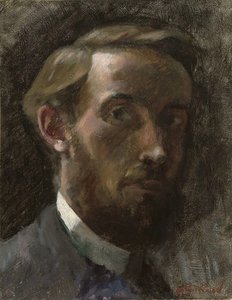
Jean-Édouard Vuillard
1868 - 1940 , Frankreich
Kurzinfos
- Artistic Movement Or Style: Nabis
- Artists Or Movements Influenced By This Artist:
- Cubism
- Fauvism
- Artists Who Influenced This Artist: ['Paul Gauguin']
- Date Of Birth: November 11, 1868
- Date Of Death: June 21, 1940
- Full Name: Jean-Édouard Vuillard
- Nationality: Französisch
- Notable Artworks:
- Woman Sweeping
- Sunlit Interior
- Place Of Birth: Cuiseaux, Frankreich
Ähnliche Artikel

The Art of Atmosphere: Elevating Luxury Hotel Interiors with Timeless Impressionist Masterpieces
Elevate luxury hospitality with timeless Impressionist reproductions. Discover how professional designers use light, color, and Post-Impressionist depth to create unforgettable hotel atmospheres through bespoke, hand-painted oil masterpieces.
Entdecken Sie Kunstwerke, die nach Themen, Stilen und Merkmalen sortiert sind.