

Gezeigt: · Inklusive Rahmen:
 Vorschau anzeigen
 Versenden
 Teilen
 Details anzeigen
 Leitfaden

 Herunterladen
 Ähnliche Objekte
 Röntgenaufnahme
 Diashow
 Fragen & Antworten
 Statistiken
- 48.0 x 41.0 cm


€ 239
Handgefertigte Ölreproduktion
Handgemaltes Ölgemälde auf Leinwand in Ihrer Wunschgröße und mit Rahmen, auf Bestellung von unseren Künstlern angefertigt. ( Zum Druck wechseln Zum digitalen Bild wechseln)
Größe
·Standardformat
individuell anpassbar
CM
INCH
Wählen Sie aus unseren vordefinierten Formaten, die den ursprünglichen Proportionen des Kunstwerks entsprechen.
Größen werden geladen...

Breite
Höhe
Geben Sie die Breite und die Höhe an, die Sie für Ihren Rahmen oder Ihre Wand benötigen. Da dieses Werk handgemalt ist, kann der Künstler bei einer anderen Form etwas mehr um das Bild herum malen oder etwas abschneiden – Sie entscheiden. Wir senden Ihnen ein digitales Mockup zur Freigabe, bevor mit dem Malen begonnen wird. Das auf dieser Seite gezeigte Bild stellt nicht das tatsächliche Ergebnis dar – dies tut nur das Mockup.
 Mehr erfahren
Abschließen
·
Weißer Rand €1

verlaufende Kanten €1

Umrandung €1

P118B €10

P118H €10

P118W €10

P438Z €10

P508JH €12

P508YH €12

P805H €10

P805Z €10

P919BZ €10

P919G €10

P919XJ €10

P959ZH €10

P968JZ €12

W106C €8

W218G €10

W218JH €8

W218Y €10

W307PJ €10

W316G €10

W316PJ €8

W316Y €10

W398PJ €8

W4111J €10

W500HY €15

W500JH €15

W692G €12

W849H €8

W940BG €15

W953PJ €8

H24-GOLD €30

H24-SILVER €30

H36-GOLD €45

H36-SILVER €45
Versand in einer Schutzröhre, bereit für die Rahmung durch Ihren Rahmenmacher.
Extras
optionalWas sind die Extras enthalten?
Beispiele für Anpassungsmöglichkeiten: Gesicht durch Kundenfoto ersetzen; Haustier hinzufügen (z. B. Katze durch Hund ersetzen); Versteckte Botschaft im Hintergrund einfügen; Hintergrundlandschaft oder Elemente ändern.
Nach der Bestellung wird das Team von TopImpressionists.com den Kunden per E-Mail kontaktieren, um Anweisungen einzuholen und eine Vorschau des Entwurfs bereitzustellen
Nach der Bestellung wird das Team von TopImpressionists.com den Kunden per E-Mail kontaktieren, um Anweisungen einzuholen und eine Vorschau des Entwurfs bereitzustellen
Weltweiter Versand () in nur 3 bis 4 Wochen statt der üblichen 5 Wochen. (5 November). Keine Kompromisse bei der Qualität.
Schutzlackierung
Beschriftung
Details der gravierten Bronzetafel
This elegant plaque features the artist's name and the title of the artwork, finely engraved for a timeless presentation.
It is made from bronze with a refined, elegant finish. The text is precisely laser-engraved for a sharp and permanent result. Measuring 9x2 cm, the plaque is compact yet easy to read. It's built to be durable and scratch-resistant, offering a professional, museum-quality look. Mounting is simple thanks to the included adhesive backing.
Details zur Acrylglas-Plakette (transparent)
The plaque includes essential engraved details such as the artist's name, the title of the artwork, the date it was created, the type of media used-like oil on canvas or watercolor-a brief description of the piece, and a QR code that links to the complete artwork information.
It is crafted from clear acrylic, offering a sleek, modern appearance. The text is UV-engraved in black to ensure strong visual contrast. With a size of 10x15 cm, it ensures optimal readability. It comes equipped with two metal hooks for secure wall mounting. The plaque is designed to be weather-resistant, making it suitable for various environments, and it includes interactive features that work seamlessly with smartphone scanning.
Details zur schwarzen Acryltafel
This elegant plaque includes engraved information such as the artist's name, the title of the artwork, the date it was created, the type of media used (like oil on canvas or watercolor), a short description of the artwork, and a QR code for quick access to more information.
The plaque itself is made from refined black acrylic with a premium finish. The text is laser-engraved in white for high contrast and readability. Its size is 10x15 cm, designed to be easy to read. It comes with two metal hooks for professional mounting. The design is sleek and fits any interior style. It is also weather-resistant and durable, with built-in digital integration for mobile compatibility.
Die Glasoption ist nur für Größen unter 110 cm verfügbar.
 Die Glasoption ist nur für Größen unter 110 cm verfügbar.
- Kostenloser weltweiter Expressversand
- Hochwertige Leinenleinwand
- Umfassender Versicherungsschutz beim Versand
- Zollgebühren-Rückerstattungsgarantie
- Garantie für exakte Farbtreue
- 100 Tage Rückgaberecht (nur bei Mängeln)
- 100% Geld-zurück-Garantie
- Mengenrabatt verfügbar


Beschreibung des Sammlerstücks
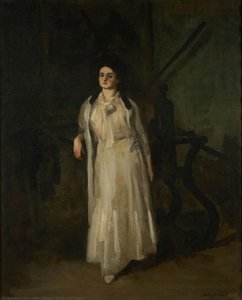
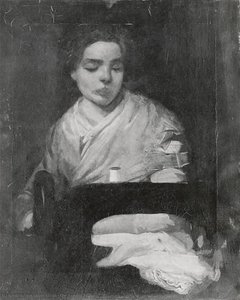
John French Sloan's "Die Näherin" fängt die Einsamkeit und Kontemplation einer Arbeiterin ein. Ein bewegendes Werk des Ashcan School Realismus.
Künstlerbiografie
John French Sloan: Ein Pionier der Ashcan School und amerikanischer Realismus! Seine beeindruckenden Stadtbilder und sozialkritische Kunstwerke erzählen Geschichten vom Alltag und wirken bis heute.
Über das Gemälde
Das stille Handwerk: Eine Betrachtung von Sloans "Die Weberin"
John French Sloans Gemälde “Die Weberin” (1901) ist mehr als nur eine Darstellung einer Frau, die am Tuchspindel arbeitet. Es ist ein Fenster in eine Welt der einfachen Arbeit, der stillen Kontemplation und des amerikanischen Lebens um die Jahrhundertwende. In einem von Grau dominierten Farbpalett, das an die düstere Atmosphäre der Großstädte erinnert, entfaltet Sloan eine intime Szene, die den Betrachter unmittelbar in die Welt einer Arbeiterin hineinzieht. Das Bild ist ein Meisterwerk der Beobachtungsgabe und des impressionistischen Stils, der sich durch lockere Pinselstriche und eine subtile Betonung von Licht und Schatten auszeichnet.
Sloan, ein Schlüsselfigur der Ashcan School in New York City, war bekannt für seine realistischen Darstellungen des Alltagslebens. Er suchte nicht nach glorifizierten Helden oder pompösen Ereignissen, sondern widmete sich stattdessen der Darstellung der einfachen Menschen und ihrer Routinen – oft aus einer kritischen Perspektive. “Die Weberin” ist ein typisches Beispiel für diesen Ansatz: Die Frau, deren Gesicht im Schatten verborgen bleibt, wird dennoch durch ihre Haltung und die Details ihrer Arbeit in den Mittelpunkt des Bildes gestellt. Das Zusammenspiel von Licht und Schatten betont ihre Müdigkeit, aber auch ihre Würde.
Die Technik der subtilen Darstellung
Sloans Technik ist geprägt von einer bedachten Schichtführung. Er verwendete vermutlich Ölfarben auf Leinwand und baute die Formen und Werte durch dünne, überlappende Farbschichten auf – eine Methode, die oft als „Verwenden“ bezeichnet wird. Diese Technik erzeugt eine subtile Textur, die das Gemälde lebendig macht und gleichzeitig die gedrückte Atmosphäre des Bildes unterstreicht. Die lockeren Pinselstriche sind ein charakteristisches Merkmal seines Stils und verleihen dem Werk einen Hauch von Spontaneität und Lebendigkeit. Es ist, als würde man durch den Blickfenster in eine andere Welt blicken.
Die Komposition ist bewusst reduziert. Der Fokus liegt ganz auf der Frau und ihrem Handwerk. Die Umgebung – ein einfacher Tisch mit Werkzeugen, ein Stuhl – wird nur schemenhaft angedeutet. Diese Konzentration auf das Wesentliche verstärkt die emotionale Wirkung des Bildes und lässt den Betrachter in die intime Welt der Weberin eintauchen. Die flache Perspektive, die kaum räumliche Tiefe suggeriert, trägt ebenfalls zur Intensität der Szene bei – es ist ein Moment eingefangen, ohne Ablenkung.
Symbolik und Emotionen
“Die Weberin” ist mehr als nur eine Darstellung einer Arbeitsszene. Sie evoziert ein Gefühl von Einsamkeit und Kontemplation. Die Frau scheint in ihren Gedanken versunken zu sein, während sie ihre Arbeit verrichtet. Das Gemälde erinnert an die oft übersehenen Frauen der Arbeiterklasse, deren Leben von harter Arbeit und Selbstversorgung geprägt war. Es ist eine Hommage an ihre Stärke und Widerstandsfähigkeit.
Die gedämpften Farben und die zurückhaltende Darstellung unterstreichen die melancholische Stimmung des Bildes. Es ist ein Moment der Ruhe inmitten eines hektischen Lebens, ein Ausdruck von Würde und Demut. “Die Weberin” ist ein Kunstwerk, das zum Nachdenken anregt und uns daran erinnert, die Geschichten der einfachen Menschen zu würdigen – Geschichten, die oft im Verborgenen bleiben.
Fragen & Antworten
Aus welcher Epoche stammt "Die Näherin"?
"Die Näherin" von John French Sloan stammt aus der Epoche der – 19. Jahrhundert. Diese Einordnung ordnet das Werk kunsthistorisch ein.
Wo kann ich einen Druck von "Die Näherin" von John French Sloan kaufen?
Einen Druck von "Die Näherin" von John French Sloan können Sie direkt auf der entsprechenden Kunstdruck in Premiumqualität-Seite bestellen: ein Fine Art Print auf Baumwollkanvas oder Archiv-Leinwandpapier.
Wie viel Licht scheinen die Farben von "Die Näherin" zu reflektieren?
"Die Näherin" von John French Sloan weist eine Luminanz von Weicher Schatten auf. Die Luminanz beschreibt, wie viel Licht die Farben scheinbar reflektieren.
Kurzinfos und Kunst-Quiz
Über John French Sloan

John French Sloan
1871 - 1951, Vereinigte Staaten
Künstlerbiografie
Early Life and Artistic Awakening
John French Sloan, born August 2, 1871, in Lock Haven, Pennsylvania, emerged from humble beginnings that profoundly shaped his artistic vision. His childhood was marked by a familial need for support; his father’s struggles with mental health necessitated young John taking on responsibilities beyond his years. This early exposure to the realities of working-class life—a world often overlooked by the established art circles—would become a defining characteristic of his oeuvre. He moved with his family to Philadelphia, where he honed his skills initially not through formal academic training, but as an assistant cashier at Porter and Coates, a bookstore brimming with prints and illustrations. This environment proved formative; it allowed him to study masters like Dürer and Rembrandt, fostering a deep appreciation for draftsmanship and etching techniques. It was here, amidst the commerce of printed images, that Sloan began creating his own art, quietly developing a style rooted in observation and meticulous detail. His early work wasn’t born from privilege or leisure, but from necessity and a keen eye for the world around him—a foundation upon which he would build a remarkable career.The Ashcan School and Urban Realism
Sloan's trajectory shifted dramatically with his encounter with Robert Henri, a charismatic painter who championed artistic independence and a commitment to portraying everyday life. This connection led Sloan to the heart of what became known as the Ashcan School—a group of artists dedicated to depicting the gritty realities of turn-of-the-century New York City. Alongside William Glackens, George Luks, Everett Shinn, and others, Sloan rejected the idealized landscapes and portraits favored by many of their contemporaries, instead turning their attention to the bustling streets, crowded tenements, and vibrant social life of the city’s poorer neighborhoods. His work became a visual chronicle of this often-ignored world—capturing scenes from McSorley’s Bar to women drying their hair on rooftops. Sloan wasn’t merely documenting; he was imbuing these scenes with a sense of empathy and dignity, elevating the lives of ordinary people onto the canvas. He possessed an uncanny ability to capture the *essence* of neighborhood life, the subtle gestures and fleeting moments that revealed the character of a place and its inhabitants. This commitment to realism wasn’t simply aesthetic; it was also informed by his socialist leanings, though he always maintained a distinction between his art and his political beliefs.Style and Influences
Sloan's artistic style is characterized by a distinctive blend of influences. While rooted in realism, his work wasn’t devoid of stylistic nuance. He employed dark, rich hues—often emphasizing the contrast between light and shadow—to create a sense of drama and atmosphere. His compositions were carefully constructed, often utilizing strong diagonals to draw the viewer's eye into the scene. The influence of etching is evident in his precise linework and attention to detail, even in his paintings. Beyond Henri, Sloan drew inspiration from European masters like Edgar Degas and Honoré Daumier, admiring their ability to capture movement and social commentary. However, he forged a uniquely American voice, one that resonated with the energy and dynamism of New York City. His work wasn’t about grand narratives or historical events; it was about the small moments, the everyday experiences that constituted the fabric of urban life. He found beauty in the mundane, transforming ordinary scenes into compelling works of art. Wake of the Ferry exemplifies his ability to imbue a seemingly simple scene with emotional depth and symbolic resonance.Major Achievements
Sloan’s career as a commercial newspaper artist began while he was still in his teens. As a young man, he was forced to leave the prestigious Central High School to help support his family. One of his early jobs was at A. Edward Newton, where he produced cards, gift books, and other novelties. Many of these items were produced as etchings, a medium he taught himself in the late 1880s. For Newton, Sloan depicted the homes of famous poets, designed pretty calendars, and etched booklets like *Thoughts* *from Tennyson*. His delicate, precise renderings reveal a flair for decoration, which helped him earn a position on the staff of the *Philadelphia Inquirer *in 1892. He continued at the *Inquirer*, until he received a better offer from the competing *Philadelphia Press*. At the newspapers, Sloan produced a wide range of illustrations including on-the-spot news pictures, though it quickly became apparent that this was not his strength, unlike his friends William Glackens, George Luks, and Everett Shinn who excelled at rapid sketches. He specialized in decorative work, like headings, puzzles, and illustrations for fiction and the society pages. His later paintings explored themes of solitude and melancholy, reflecting a profound sensitivity to human emotion. ## Legacy and Lasting Impact Sloan’s influence can be seen in the works of subsequent realist painters and continues to inspire artists who seek to find beauty and meaning in the everyday world. He was a dedicated teacher, sharing his knowledge and passion with countless students throughout his career. His paintings are not merely historical documents; they are timeless portraits of life, love, and loss. Sloan’s legacy extends far beyond his contributions to the Ashcan School.Kurzinfos zu John French Sloan
- Artistic Movement Or Style: Ashcan School
- Artists Who Influenced This Artist: ['Robert Henri']
- Date Of Birth: August 2, 1871
- Full Name: John French Sloan
- Nationality: Amerikaner
- Notable Artworks:
- Wake of the Ferry
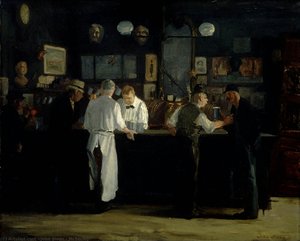
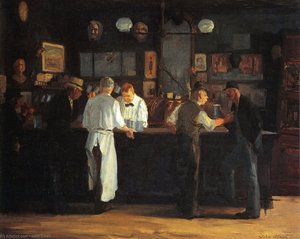
- McSorley’s Bar
- Place Of Birth: Lock Haven, USA
Entdecken Sie Kunstwerke, die nach Themen, Stilen und Merkmalen sortiert sind.


John French Sloan
Die Näherin
() ·
Inklusive Rahmen: · Handgemalt mit Öl auf Leinen
Gesamtbetrag