
 Vorschau anzeigen
 Versenden
 Teilen
 Details anzeigen
 Leitfaden

 Herunterladen
 Ähnliche Objekte
 Röntgenaufnahme
 Diashow
 Q&A
Q&A Statistiken
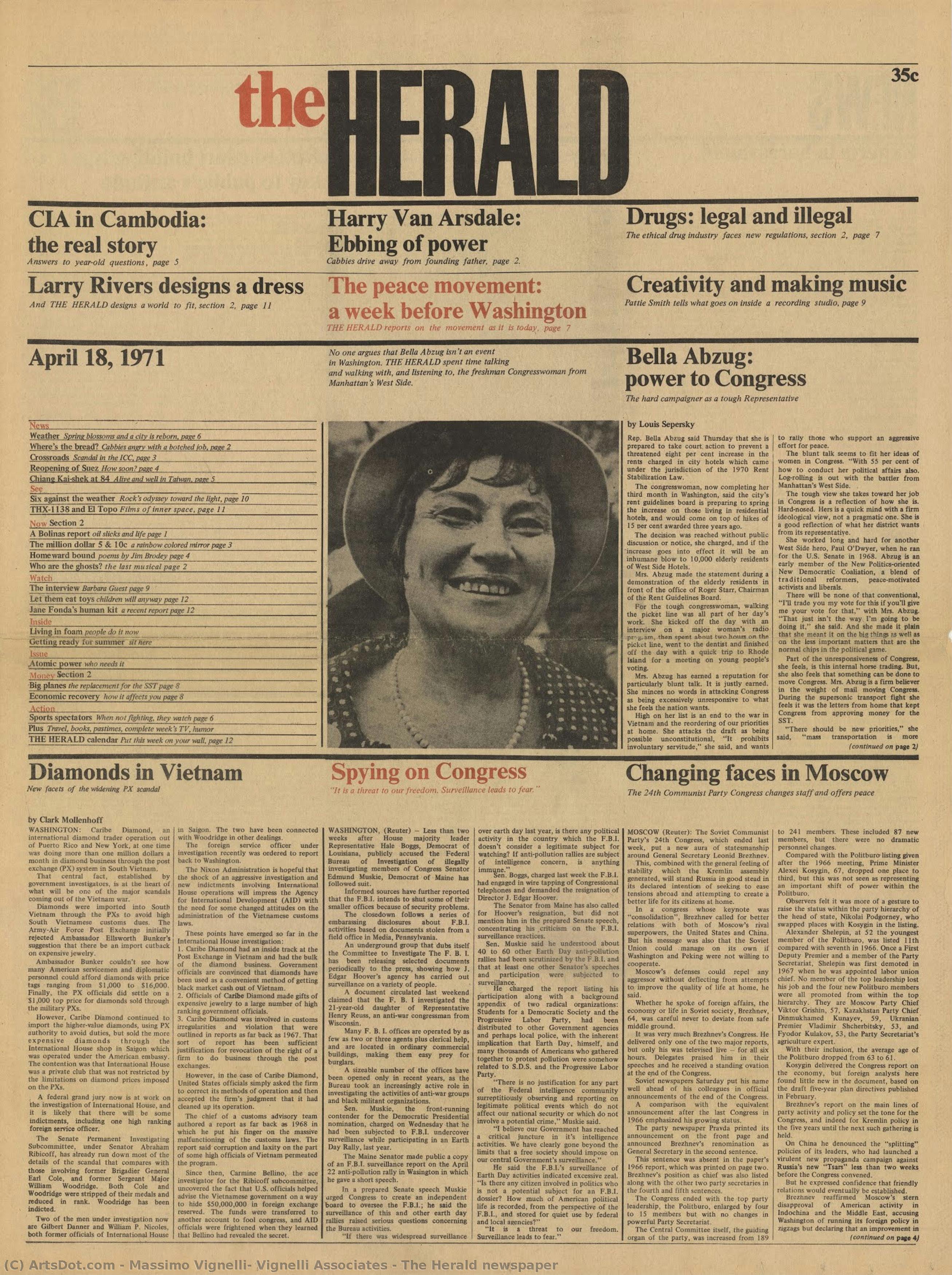
The Herald newspaper

- 43.0 x 57.0 cm


Experience the modernist grid design of The Herald newspaper by Massimo Vignelli (1971), showcasing vintage graphic communication art; discover this iconic piece today.
 Weiterlesen
Massimo Vignelli (1931-2014): Italienischer Designikon für Minimalismus und klare Grafik – bekannt für die NYC Subway Karte & Firmenlogos! Entdecken Sie sein Vermächtnis!
Die auf dieser Seite dargestellten Kunstwerke sind urheberrechtlich geschützt, was bedeutet, dass wir keine identische Reproduktion rechtmäßig erstellen oder verkaufen dürfen. Dieser Schutz wird durch internationale Abkommen wie die Berner Übereinkunft und durch nationale Gesetze, einschließlich derer, die von den US-Urheberrecht – Titel 17.
Diese Methode entspricht vollumfänglich den Urheberrechtsbestimmungen, da sie keine Kopie oder Vervielfältigung des geschützten Kunstwerks darstellt. Stattdessen handelt es sich um eine kreative Neuinterpretation – ein neues Gemälde, das vom Original inspiriert, aber nicht identisch mit ihm ist.
Giclée / Kunstdruck
Giclée- oder Leinwanddruck in Museumsqualität mit schneller Produktion und flexiblen Veredelungsoptionen. ( Handgemalte Reproduktion bestellen Zum digitalen Bild wechseln)




P118B €10

P118H €10

P118W €10

P438Z €10

P508JH €12

P508YH €12

P805H €10

P805Z €10

P919BZ €10

P919G €10

P919XJ €10

P959ZH €10

P968JZ €12

W106C €8

W218G €10

W218JH €8

W218Y €10

W307PJ €10

W316G €10

W316PJ €8

W316Y €10

W398PJ €8

W4111J €10

W500HY €15

W500JH €15

W692G €12

W849H €8

W940BG €15

W953PJ €8




Standardformat
individuell anpassbar
CM
INCH
Wählen Sie aus unseren vordefinierten Formaten, die den ursprünglichen Proportionen des Kunstwerks entsprechen.
Loading sizes...

Breite
Höhe
Geben Sie die benötigte Breite und Höhe an, damit der Druck perfekt in Ihren Rahmen oder an Ihre Wand passt. Ein Druck kann nur beschnitten, aber niemals größer als das Originalbild angefertigt werden; daher verliert ein Format mit anderen Proportionen einen Teil des Bildes. Wir senden Ihnen ein digitales Mockup zur Freigabe, bevor wir den Druck ausführen. Das auf dieser Seite gezeigte Bild zeigt nicht den tatsächlichen Beschnitt – dies ist nur im Mockup ersichtlich.
Weltweiter Versand () innerhalb von 2 Wochen statt der üblichen 4/5 Wochen. (1 November)

Kostenloser weltweiter Expressversand

Hochwertige Leinenleinwand

Umfassender Versicherungsschutz beim Versand

Zollgebühren-Rückerstattungsgarantie

Garantie für exakte Farbtreue

100 Tage Rückgaberecht (nur bei Mängeln)

100% Geld-zurück-Garantie

Mengenrabatt verfügbar
 Die Glasoption ist nur für Größen unter 110 cm verfügbar.

The Herald newspaper
Giclée / Kunstdruck
Format der Reproduktion
-


Endpreis
€ 61
The Grid of Modern Communication: Vignelli's The Herald
To encounter this piece is to step directly into the vibrant, structured chaos of mid-century New York journalism. This reproduction of The Herald newspaper from April 1971, conceived by Massimo Vignelli and his associates, is far more than mere ephemera; it is a meticulously designed artifact of visual communication history. It captures a moment when design principles—simplicity, functionality, and rigorous structure—were being aggressively applied to the seemingly unruly medium of print journalism. The very act of presenting this newspaper front page transforms what might be considered disposable media into a profound study in modernist graphic discipline.
A Masterclass in Structured Design
Vignelli’s genius, always rooted in an almost architectural understanding of space, is on full display here. The description notes the structure: a rigid grid of six columns and sixteen modules per column. This underlying skeleton dictates every element—the placement of headlines like "Diamonds in Vietnam," the accompanying portrait of the smiling woman, and the smaller articles detailing everything from spying congress to changing leaves in Moscow. Vignelli’s commitment to using a single typeface, Times Roman, across various weights and sizes, speaks volumes about his belief in universal legibility. It is a powerful testament to the idea that restraint—the disciplined use of negative space and consistent typography—can generate an overwhelming sense of order and sophistication.
Historical Resonance and Materiality
The year 1971 places this work within a fascinating cultural nexus, post-war modernism grappling with the burgeoning media landscape. While the paper itself ultimately folded due to distribution issues, its surviving design remains potent. For the collector or designer, understanding this context is key. This piece speaks to an era obsessed with efficiency and clarity in information transfer. When considering a reproduction for your space, you are not just acquiring art; you are curating a dialogue about how we consume knowledge—a conversation between the fleeting headline and the enduring power of good design.
Symbolism of the Grid
The grid itself functions as the primary symbolic element. In an age where digital information often feels overwhelming, this physical manifestation of order offers a visual anchor. It symbolizes control, but not oppressive control; rather, it suggests that even complex narratives—the confluence of international events and local interest—can be organized into digestible, beautiful patterns. The interplay between the large, arresting photograph and the tightly packed textual modules creates a dynamic tension, mirroring the very energy of a bustling city like New York in that era.
Bringing Modernist Precision Home
For interior design or gallery display, this piece offers an unparalleled opportunity to inject intellectual rigor into a space. It pairs beautifully with minimalist furniture, mid-century modern accents, or any setting that appreciates the clean lines of 20th-century industrial aesthetics. Owning this reproduction is an homage to Massimo Vignelli’s lifelong dedication to elevating the mundane—the daily newspaper—into something enduringly beautiful and intellectually stimulating.
Fragen & Antworten
Zu welcher Stilrichtung gehört "The Herald newspaper"?
Die mit "The Herald newspaper" von Massimo Vignelli, Vignelli Associates verbundene Stilrichtung ist Modernism. Diese Klassifizierung ordnet das Werk in den Kontext verwandter Künstler und Kunstwerke ein.
Für welche Verwendung wird ein Druck von "The Herald newspaper" empfohlen?
Die empfohlene Verwendung eines Drucks von „The Herald newspaper“ ist Statement.
Welche Form und Maße hat "The Herald newspaper" von Massimo Vignelli, Vignelli Associates?
Das Format von „The Herald newspaper“ ist Portrait und das Original hat die Maße 43 x 57 cm. Beides ist bei der Planung einer Reproduktion hilfreich.
Künstlerbiografie
Frühes Leben und Karriere
Massimo Vignelli, ein renommierter italienischer Designer, wurde am 10. Januar 1931 in Mailand geboren. Er studierte Architektur am Politecnico di Milano und später an der Università IUAV di Venezia. Im Alter von 16 Jahren trat er der Firma der Castiglioni-Brüder bei, die in einer Vielzahl von Bereichen entwarf.Stil und bedeutende Werke
Massimo Vignellis Stil betonte Einfachheit unter Verwendung grundlegender geometrischer Formen und einer begrenzten Auswahl an Schriftarten. Einige seiner bemerkenswertesten Werke sind:- Heller Rainbow Dinnerware, ein Designprojekt für ein stapelbares Geschirrset, das seinen minimalistischen Ansatz demonstrierte.
- Tredicesima Triennale di Milano, ein Posterdesign, das seine Verwendung von kräftigen Farben und geometrischen Formen widerspiegelte.
- Knoll Design (Cover), ein Cover-Design, das seine Fähigkeit demonstrierte, für renommierte Marken auffällige Bilder zu schaffen.
Zusammenarbeit und Assoziationen
Massimo Vignelli gründete 1971 zusammen mit seiner Frau Lella Vignelli Vignelli Associates. Diese Partnerschaft führte zur Schaffung zahlreicher ikonischer Designs, darunter die Beschilderung des New Yorker U-Bahn-Systems. Er war auch Mitbegründer und Designleiter von Unimark International im Jahr 1965.Einfluss und Vermächtnis
Massimo Vignellis Einfluss auf das italienische Design ist unbestreitbar. Seine Arbeit wurde in verschiedenen Museen ausgestellt, darunter das Vignelli Center for Design Studies in Rochester, USA. Seine Designs inspirieren weiterhin neue Generationen von Designern und Künstlern. Er lehrte lange an der Harvard University Graduate School of Design und war Präsident der Alliance Graphique Internationale (AGI) sowie des American Institute of Graphic Arts (AIGA).Auszeichnungen und Ehrungen
Massimo Vignelli erhielt im Laufe seiner Karriere zahlreiche Auszeichnungen, darunter:- Gran Premio Triennale di Milano (1964)
- Compasso d’Oro (Italien) von 1964 bis 1998
- Industrial Arts Medal des American Institute of Architects (AIA) (1973)
- Aufnahme in die Hall of Fame des New York Art Directors Club (1982)
- Ehrendoktorwürde der Künste der Parsons School of Design, New York (1982)

Massimo Vignelli, Vignelli Associates
1931 - 2014 , Italien
Kurzinfos
- Artistic Movement Or Style: Minimalismus, Moderne
- Date Of Birth: 10. Januar 1931
- Date Of Death: 27. Mai 2014
- Full Name: Massimo Vignelli
- Nationality: Italienisch
- Notable Artworks:
- Heller Rainbow Dinnerware
- Triennale di Milano
- Knoll Design (cover)
- Place Of Birth: Mailand, Italien
Ähnliche Artikel

TopImpressionists.com F.A.Q.: Brillante Poster-Prints mit höchster Farbtiefe & langlebiger Pigment-Technologie
Erfahren Sie alles über Pigmenttechnologie und Archivqualität für Impressionismus-Drucke. Jetzt Expertenberatung sichern!
Entdecken Sie Kunstwerke, die nach Themen, Stilen und Merkmalen sortiert sind.

![Heller Regenbogen-Geschirr
[Vorderansicht]](/media/artworks/images-thumb/cd/9c/cd9c3f1015cd05d21f20d796279c84cb.jpg)
![Heller Die Regenbogen-Gruppe
[Vorderansicht]](/media/artworks/images-thumb/63/ff/63ff27e205bc52fa330b5129aaab17df.jpg)

![Fort Worth Art Museum Der italienische Film: Neorealismus und darüber hinaus Poster und Veranstaltungskalender
[Vorderansicht]](/media/artworks/images-thumb/9a/f3/9af3622e1fac840c383fbfca8217073b.jpg)

![Knoll International
[Vorderansicht]](/media/artworks/images-thumb/3f/ee/3feeb868249b96ea2d449739ed478876.jpg)
![Milano
[Cover-Ansicht, gefaltet]](/media/artworks/images-thumb/d9/d4/d9d4b14c78e469c5d339069b4321c34b.jpg)


![Tredicesima Triennale di Milano
[Rot auf Rosa]](/media/artworks/images-thumb/d5/7c/d57c0494b16c39484ce82132534f6312.jpg)


![Das Weiße Haus
[Vorderansicht]](/media/artworks/images-thumb/a8/c8/a8c8083505c92320e67caa42c197cd7d.jpg)


