

Shown: · With its frame:
 Vorschau anzeigen
 Versenden
 Teilen
 Details anzeigen
 Leitfaden

 Herunterladen
 Ähnliche Objekte
 Röntgenaufnahme
 Diashow
 Q&A
Q&A Statistiken
- 98.0 x 83.0 cm


€ 239
Handgefertigte Ölreproduktion
Handgemaltes Ölgemälde auf Leinwand in Ihrer Wunschgröße und mit Rahmen, auf Bestellung von unseren Künstlern angefertigt. ( Zum Druck wechseln Zum digitalen Bild wechseln)
Size
·Standardformat
individuell anpassbar
CM
INCH
Wählen Sie aus unseren vordefinierten Formaten, die den ursprünglichen Proportionen des Kunstwerks entsprechen.
Loading sizes...

Breite
Höhe
Geben Sie die Breite und die Höhe an, die Sie für Ihren Rahmen oder Ihre Wand benötigen. Da dieses Werk handgemalt ist, kann der Künstler bei einer anderen Form etwas mehr um das Bild herum malen oder etwas abschneiden – Sie entscheiden. Wir senden Ihnen ein digitales Mockup zur Freigabe, bevor mit dem Malen begonnen wird. Das auf dieser Seite gezeigte Bild stellt nicht das tatsächliche Ergebnis dar – dies tut nur das Mockup.
 Mehr erfahren
Finish
·
White €1

Blurside €1

Extended €1

P118B €10

P118H €10

P118W €10

P438Z €10

P508JH €12

P508YH €12

P805H €10

P805Z €10

P919BZ €10

P919G €10

P919XJ €10

P959ZH €10

P968JZ €12

W106C €8

W218G €10

W218JH €8

W218Y €10

W307PJ €10

W316G €10

W316PJ €8

W316Y €10

W398PJ €8

W4111J €10

W500HY €15

W500JH €15

W692G €12

W849H €8

W940BG €15

W953PJ €8

H24-GOLD €30

H24-SILVER €30

H36-GOLD €45

H36-SILVER €45
Shipped in a protective tube, ready for your own framer.
Above 105 cm the frame is shipped as a kit for a professional framer — read the details.
Extras
optionalWhat do the extras include?
Examples of what can be changed: Replace face with customer photo; Add pet (e.g., replace cat with dog); Include hidden message in background; Change background landscape or elements.
After order, TopImpressionists.com team will email client for instructions and provide a mockup preview
After order, TopImpressionists.com team will email client for instructions and provide a mockup preview
Weltweiter Versand () in nur 3 bis 4 Wochen statt der üblichen 5 Wochen. (31 Oktober). Keine Kompromisse bei der Qualität.
Schutzlackierung
Beschriftung
Details der gravierten Bronzetafel
This elegant plaque features the artist's name and the title of the artwork, finely engraved for a timeless presentation.
It is made from bronze with a refined, elegant finish. The text is precisely laser-engraved for a sharp and permanent result. Measuring 9x2 cm, the plaque is compact yet easy to read. It's built to be durable and scratch-resistant, offering a professional, museum-quality look. Mounting is simple thanks to the included adhesive backing.
Details zur Acrylglas-Plakette (transparent)
The plaque includes essential engraved details such as the artist's name, the title of the artwork, the date it was created, the type of media used-like oil on canvas or watercolor-a brief description of the piece, and a QR code that links to the complete artwork information.
It is crafted from clear acrylic, offering a sleek, modern appearance. The text is UV-engraved in black to ensure strong visual contrast. With a size of 10x15 cm, it ensures optimal readability. It comes equipped with two metal hooks for secure wall mounting. The plaque is designed to be weather-resistant, making it suitable for various environments, and it includes interactive features that work seamlessly with smartphone scanning.
Details zur schwarzen Acryltafel
This elegant plaque includes engraved information such as the artist's name, the title of the artwork, the date it was created, the type of media used (like oil on canvas or watercolor), a short description of the artwork, and a QR code for quick access to more information.
The plaque itself is made from refined black acrylic with a premium finish. The text is laser-engraved in white for high contrast and readability. Its size is 10x15 cm, designed to be easy to read. It comes with two metal hooks for professional mounting. The design is sleek and fits any interior style. It is also weather-resistant and durable, with built-in digital integration for mobile compatibility.
Die Glasoption ist nur für Größen unter 110 cm verfügbar.
 Die Glasoption ist nur für Größen unter 110 cm verfügbar.
- Kostenloser weltweiter Expressversand
- Hochwertige Leinenleinwand
- Umfassender Versicherungsschutz beim Versand
- Zollgebühren-Rückerstattungsgarantie
- Garantie für exakte Farbtreue
- 100 Tage Rückgaberecht (nur bei Mängeln)
- 100% Geld-zurück-Garantie
- Mengenrabatt verfügbar


Beschreibung des Sammlerstücks
Moritz Daniel Oppenheim’s groundbreaking self-portrait captures the spirit of German Jewish art during Romanticism; holding his palette with pride beside a nude statue, this iconic depiction embodies a pivotal moment in Jewish artistic history. Explore and acquire this masterpiece.
Künstlerbiografie
Moritz Daniel Oppenheim (1800-1882) war ein deutscher Maler und Pionier der jüdischen Kunstgeschichte, bekannt für seine Darstellung von Familienleben und religiösen Szenen im Kontext des romantischen Jahrhunderts.
About the painting
A Visionary Gaze: The Soul of Moritz Daniel Oppenheim’s Self-Portrait
In the quiet intensity of his 1814 Self-Portrait, we encounter more than just the likeness of a young man; we witness the dawn of a profound artistic identity. Moritz Daniel Oppenheim, a figure who would later become a pioneer of Jewish artistic representation in Germany, presents himself here with a striking blend of youthful ambition and classical poise. Holding his palette with a sense of quiet pride, the artist positions himself against the backdrop of a neoclassical statue, a deliberate choice that speaks to his aspirations for professional legitimacy within the rigorous academic traditions of his era. The composition is masterfully layered, featuring secondary figures that breathe life into the scene—one assisting in the portraiture process and another observing from the periphery—creating a narrative depth that hints at the social interconnectedness and the watchful eyes of a society in transition.
The technique employed in this masterpiece is a breathtaking marriage of German Romanticism and Classical restraint. Oppenheim demonstrates an extraordinary command over chiaroscuro, using dramatic contrasts between light and shadow to sculpt the forms of his own face and the cold, smooth surface of the marble statue. His brushwork is meticulous, capturing the subtle textures of fabric and the nuanced tonal shifts that give the skin a lifelike warmth. This technical precision does not merely serve to replicate reality; it serves to elevate the subject. The interplay of light suggests an inner illumination, reflecting the intellectual awakening of an artist finding his voice amidst the shifting cultural tides of nineteenth-century Europe.
Symbolism and the Weight of Heritage
Beyond the surface of the paint lies a rich tapestry of symbolism that resonates with anyone moved by the struggle for identity. The palette held in Oppenheim’s hand is not merely a tool of his trade, but a potent emblem of creative agency and the power of the intellect to document and shape culture. It represents his dedication to capturing the nuances of Jewish life during a period of immense transformation. In stark contrast, the neoclassical statue standing beside him embodies permanence, tradition, and the weight of the classical canon. This juxtaposition creates a beautiful tension between the enduring past and the dynamic, unfolding present—a central theme in Oppenheim’s life as he navigated the complexities of being a Jewish artist in a German society that was both restrictive and evolving.
For the discerning collector or interior designer, this work offers an unparalleled emotional depth. It is a piece that invites contemplation on themes of resilience, ambition, and the courage required to claim one's place in history. Whether placed in a curated gallery setting or as a focal point in a sophisticated study, this reproduction brings with it the spirit of a man who refused to let his heritage be silenced by prejudice. It is an invitation to celebrate the triumph of the human spirit and the enduring power of art to bridge the gap between tradition and modernity.
Fragen & Antworten
Ist "Self-Portrait" typisch für das Werk von Moritz Daniel Oppenheim?
Unter den dokumentierten Themen von Moritz Daniel Oppenheim – romanticism, jewish identity, royal patronage, tradition, religious faith, reflection, family portraiture, legacy – setzt „Self-Portrait“ einen ganz eigenen Fokus auf jewish art, portrait painting, 19th century, rothschild patronage, german baroque, self-representation, religious symbolism.
Welche Druckgröße wird für "Self-Portrait" empfohlen?
Die empfohlene Druckgröße für "Self-Portrait" von Moritz Daniel Oppenheim ist Large.
Ist "Self-Portrait" von Moritz Daniel Oppenheim ein helles oder ein dunkles Kunstwerk?
Was die wahrgenommene Helligkeit betrifft, so ist "Self-Portrait" von Moritz Daniel Oppenheim deep_shadow.
Quick facts and art quiz
About Moritz Daniel Oppenheim

Moritz Daniel Oppenheim
1800 - 1882, Deutschland
Künstlerbiografie
Ein Visionär jüdischer Identität
Moritz Daniel Oppenheim (1800-1882) nimmt eine singuläre Stellung in den Annalen der deutschen Kunstgeschichte ein und gilt als tiefgreifender Pionier der jüdischen künstlerischen Repräsentation. Geboren in Hanau, Deutschland, waren sein Leben und sein Schaffen tief verwurzente Bestrebung, die Nuancen des jüdischen Lebens und der jüdischen Kultur während des transformativen neunzehnten Jahrhunderts zu dokumentieren und zu feiern. Er wurde oft als der erste jüdische Maler gefeiert, der im breiten künstlerischen Mainstream Anerkennung fand. Dabei ging sein Werk weit über rein biografische Details hinaus; er schuf ein Œuvre, das als lebendiges visuelles Zeugnis einer Gemeinschaft dient, die sich durch die Komplexität der Modernisierung bewegte und gleichzeitig danach strebte, ihre heiligen Traditionen zu bewahren.
Oppenheims künstlerische Reise begann mit einer grundlegenden Ausbildung unter Conrad Westermayr in seiner Geburtsstadt, wo er erstmals die Prinzipien der deutschen romantischen Malerei in sich aufnahm. Den eigentlichen beruflichen Aufstieg ermöglichte ihm jedoch seine Einschreibung an der Münchener Akademie der Bildenden Künste im Alter von siebzehn Jahren. In diesen prestigeträchtigen Hallen verfeinerte er seine technische Meisterschaft an der Seite von Zeitgenossen wie Wilhelm Leibl und Johann Baptist Eberhard Krauss. Getrieben von dem Wunsch, seinen Horizont zu erweitern, begab sich Oppenheim auf eine transformative Auslandsstudienzeit, die ihn nach Paris führte, um unter Jean-Baptiste Regnaub zu lernen, und später nach Rom. In Italien, geprägt durch Mentoren wie die Koryphäen Bertel Thorwaldsen und den Nazarener Johann Friedrich Overbeck, entwickelte sich sein Stil zu einer anspruchsvollen Mischung aus akribischer Beobachtung und klassischem Einfluss. Diese römische Periode war von besonderer Bedeutung, da sie seinem Werk eine historische Schwere verlieh, die später seine Darstellungen jüdischer Rituale und des täglichen Lebens maßgeblich prägen sollte.
Die Kunst der Intimität und Tradition
Das Herzstück von Oppenheims Beitrag zur Kunst liegt in seiner Fähigkeit, den häuslichen Raum in eine Bühne für tiefgreifende kulturelle Erzählungen zu verwandeln. Seine Gemälde konzentrieren sich oft auf intime Szenen des jüdischen Familienlebens und fangen die stille Würde des Rituals sowie die Wärme gemeinschaftlicher Bindungen ein. Durch seinen Pinsel wird das Alltägliche monumental. In Werken wie Der Ausgang des Sabbats (Sabbath-Ausgang) setzt er meisterhaften Realismus und subtile Symbolik ein, um den bewegenden Übergang von der heiligen Ruhe des Sabbats zurück in die weltliche Zeit darzustellen und den Betrachter dazu einzuladen, Zeuge der Heiligkeit des Familienrituals zu werden.
Seine Fähigkeit, historischen Kontext mit persönlicher Emotion zu verweben, zeigt sich am deutlichsten in seinen Genregemälden, die spezifische kulturelle Meilensteine dokumentieren. Beispielsweise:
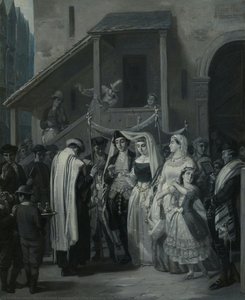
- Die Hochzeit (Die Trauung): Eine atemberaubend detaillierte Darstellung einer jüdischen Hochzeit im Jahr 1866 innerhalb des Frankfurter Ghettos, in der Oppenheim den Glanz traditioneller Kleidung und die Feierlichkeit des Hochzeitshimmels einfängt und so einen seltenen, bewahrten Einblick in eine schwindende Lebensweise bietet.
- Die Rückkehr des Freiwilligen: In diesem beeindruckenden Ölgemälde aus dem Jahr 1834 untersucht er die Schnittstelle zwischen jüdischem Erbe und der breiteren europäischen Geschichte, indem er einen Soldaten darstellt, der aus den Befreiungskriegen zu einer Familie zurückkehrt, die noch immer nach alten Bräuchen lebt. Damit illustriert er effektiv das Spannungsfeld zwischen den politischen Umbrüchen der napoleonischen Ära und einer beständigen religiösen Identität.
Vermächtnis und historische Bedeutung
Über seine technische Brillanz hinaus ist Oppenheims Werk untrennbar mit der Bewegung der Wissenschaft des Judentums verbunden – einem wissenschaftlichen Bestreben, die jüdische Geschichte und Kultur als respektiertes akademisches Feld zu etablieren. Seine Gemälde fungierten als visuelle Wissenschaft, indem sie eine würdevolle und authentische Darstellung einer Gemeinschaft lieferten, die im breiteren europäischen Kunstkanon oft marginalisiert wurde. Indem er jüdische Sujets mit demselben Maß an Detailreichtum, Würde und romantischer Grandiosität darstellte, das normalerweise aristokratischen oder mythologischen Themen vorbehalten war, forderte er bestehende Vorurteile heraus und unterstrich die Bedeutung der jüdischen Identität innerhalb des deutschen Kulturgefüges.
Letztendlich ist das Vermächtnis von Moritz Daniel Oppenheim eines der Resilienz und der Sichtbarkeit. Er malte nicht bloß Szenen; er konstruierte eine visuelle Sprache für eine Ära des Übergangs. Seine Fähigkeit, das empfindliche Gleichgewicht zwischen der alten und der neuen Welt einzufangen, stellt sicher, dass sein Werk ein wesentlicher Bezugspunkt für das Verständnis der jüdischen Erfahrung des neunzehnten Jahrhunderts bleibt und ihn zu einer unverzichtbaren Figur in der Geschichte sowohl der deutschen Romantik als auch der globalen Erzählung jüdischer Kunst macht.
Quick facts about Moritz Daniel Oppenheim
- Artistic Movement Or Style: Romantik
- Artists Who Influenced This Artist:
- Jean-Baptiste Regnault
- Bertel Thorwaldsen
- Johann Baptist Eberhard Krauss
- Date Of Birth: 8. Januar 1800
- Date Of Death: 25. Februar 1882
- Full Name: Moritz Daniel Oppenheim
- Nationality: Deutsch
- Notable Artworks:
- Return of the Volunteer
- Mignon und der Kräuterbinder
- Italienische Genreszene
- Place Of Birth: Hanau, Deutschland
Entdecken Sie Kunstwerke, die nach Themen, Stilen und Merkmalen sortiert sind.


Moritz Daniel Oppenheim
Self-Portrait
() ·
With its frame: · Hand-painted in oil on linen
Total