Sammlerstück-Beschreibung
An Exploration of Form and Perspective: Pablo Picasso's "Three Women"
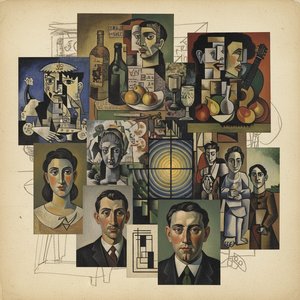
Pablo Picasso’s “Three Women” stands as a pivotal work within his groundbreaking Cubist period. Created around 1908, this painting exemplifies the revolutionary approach to representation that defined Cubism, moving away from traditional perspective and embracing fragmented forms and multiple viewpoints. The artwork is now available as a meticulously crafted, handmade oil painting reproduction on TopImpressionists.com, offering art enthusiasts an opportunity to own a piece of modern art history.
Deconstructing Reality: Style and Technique
"Three Women" is a quintessential example of early Cubism, also known as Analytical Cubism. Picasso, alongside Georges Braque, pioneered this style which sought to depict subjects from multiple angles simultaneously, challenging the conventional single-point perspective that had dominated Western art for centuries. The painting features three female figures arranged in a composition characterized by geometric shapes – cubes, spheres, and planes – rather than realistic curves and contours. This fragmentation isn't intended to be chaotic; instead, it aims to present a more complete understanding of the subject by showing different facets at once. The color palette is deliberately restrained, primarily utilizing earthy tones like browns, ochres, and grays, which further emphasizes the focus on form and structure over vibrant hues. The brushstrokes are deliberate and controlled, contributing to the overall sense of intellectual rigor that defines Cubism.
Historical Context: The Birth of a Revolution
The early 1900s were a period of immense artistic experimentation. Picasso’s “Three Women” emerged during a time when artists were actively questioning traditional modes of representation. Inspired by Paul Cézanne's emphasis on geometric forms and influenced by African masks and sculpture, Picasso began to deconstruct the human figure in radical new ways. Cubism was not merely an aesthetic choice; it reflected a broader shift in intellectual thought, mirroring advancements in science and philosophy that challenged established notions of space, time, and perception. The painting’s creation coincided with a period of rapid industrialization and urbanization, which may have contributed to the sense of fragmentation and dynamism evident in Cubist works.
Symbolism and Emotional Impact
While Cubism is often associated with intellectual analysis rather than overt emotional expression, "Three Women" evokes a subtle yet powerful mood. The fragmented forms can be interpreted as representing the complexities of human relationships and the multifaceted nature of identity. The figures are not portrayed in a sentimental or idealized manner; instead, they appear detached and enigmatic, inviting viewers to engage with the artwork on an intellectual level. The lack of traditional perspective creates a sense of spatial ambiguity, drawing the viewer into the painting's world and prompting contemplation about the nature of reality itself. Despite its seemingly abstract qualities, "Three Women" possesses a quiet intensity that resonates deeply with those who appreciate modern art’s exploration of form, space, and perception.
Picasso's Legacy: A Lasting Influence
Pablo Picasso’s contribution to the art world is immeasurable. “Three Women,” along with other Cubist masterpieces, paved the way for countless artistic movements that followed, including Fauvism, Suprematism, and Surrealism. His innovative approach to representation continues to inspire artists today, demonstrating the enduring power of his vision. Owning a reproduction of "Three Women" is not just acquiring a beautiful piece of art; it's embracing a pivotal moment in art history and celebrating the legacy of one of the most influential figures of the 20th century.



 Vorschau anzeigen
 Handgemalte Reproduktion bestellen
 Versenden
 Teilen
 Details anzeigen

 Herunterladen
 Ähnliche Objekte
 Röntgenaufnahme
 Diashow

 Weiterlesen






































 Die Glasoption ist nur für Größen unter 110 cm verfügbar.