


 Vorschau anzeigen
 Versenden
 Teilen
 Details anzeigen
 Leitfaden

 Herunterladen
 Ähnliche Objekte
 Röntgenaufnahme
 Diashow
 Statistiken
Solva
 Acryl auf Leinwand
- Wandkunst
- Romantic Landscape Painting
 28.0 x 39.0 cm
 Royal West of England Academy
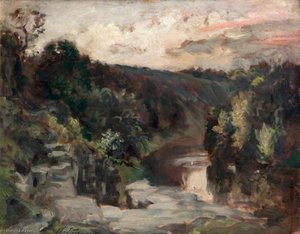
Ein beeindruckendes Landschaftsbild von Paul Ayshford Methuen zeigt einen Fluss und Gebirge im Hintergrund mit einem Boot und zwei Personen – eine Mischung aus Wissenschaft und Kunst zum Entdecken! Größe: 28 x 39 cm.
 Weiterlesen
Entdecken Sie den Künstler Paul Ayshford Methuen (1886-1974): Maler, Zoologe & Baron. Landschafts-, Stadtansichten & sein Erbe der Restaurierung von Corsham Court.
Die auf dieser Seite dargestellten Kunstwerke sind urheberrechtlich geschützt, was bedeutet, dass wir keine identische Reproduktion rechtmäßig erstellen oder verkaufen dürfen. Dieser Schutz wird durch internationale Abkommen wie die Berner Übereinkunft und durch nationale Gesetze, einschließlich derer, die von den US-Urheberrecht – Titel 17.
Diese Methode entspricht vollumfänglich den Urheberrechtsbestimmungen, da sie keine Kopie oder Vervielfältigung des geschützten Kunstwerks darstellt. Stattdessen handelt es sich um eine kreative Neuinterpretation – ein neues Gemälde, das vom Original inspiriert, aber nicht identisch mit ihm ist.
Giclée / Kunstdruck
Giclée- oder Leinwanddruck in Museumsqualität mit schneller Produktion und flexiblen Veredelungsoptionen. ( Handgemalte Reproduktion bestellen Zum digitalen Bild wechseln)




P118B €10

P118H €10

P118W €10

P438Z €10

P508JH €12

P508YH €12

P805H €10

P805Z €10

P919BZ €10

P919G €10

P919XJ €10

P959ZH €10

P968JZ €12

W106C €8

W218G €10

W218JH €8

W218Y €10

W307PJ €10

W316G €10

W316PJ €8

W316Y €10

W398PJ €8

W4111J €10

W500HY €15

W500JH €15

W692G €12

W849H €8

W940BG €15

W953PJ €8




Standardformat
individuell anpassbar
CM
INCH
Wählen Sie aus unseren vordefinierten Formaten, die den ursprünglichen Proportionen des Kunstwerks entsprechen.
Loading sizes...

Breite
Höhe
Geben Sie die benötigte Breite und Höhe an, damit der Druck perfekt in Ihren Rahmen oder an Ihre Wand passt. Ein Druck kann nur beschnitten, aber niemals größer als das Originalbild angefertigt werden; daher verliert ein Format mit anderen Proportionen einen Teil des Bildes. Wir senden Ihnen ein digitales Mockup zur Freigabe, bevor wir den Druck ausführen. Das auf dieser Seite gezeigte Bild zeigt nicht den tatsächlichen Beschnitt – dies ist nur im Mockup ersichtlich.
Weltweiter Versand () innerhalb von 2 Wochen statt der üblichen 4/5 Wochen. (25 Oktober)

Kostenloser weltweiter Expressversand

Hochwertige Leinenleinwand

Umfassender Versicherungsschutz beim Versand

Zollgebühren-Rückerstattungsgarantie

Garantie für exakte Farbtreue

100 Tage Rückgaberecht (nur bei Mängeln)

100% Geld-zurück-Garantie

Mengenrabatt verfügbar
 Die Glasoption ist nur für Größen unter 110 cm verfügbar.

Solva
Giclée / Kunstdruck
Format der Reproduktion
-


Endpreis
€ 61
Solva Saal: A Landscape Reverie by Paul Methuen
Paul Ayshford Methuen’s “Solva Saal,” painted in 1958, isn't merely a depiction of the Worcestershire countryside; it’s an embodiment of contemplative beauty—a snapshot frozen in time that captures the essence of British Impressionism. Situated within the Royal West of England Academy’s collection, this artwork speaks volumes about Methuen’s artistic vision and his profound connection to the natural world.
Subject Matter & Composition
The painting portrays a serene riverside scene dominated by rolling hills bathed in soft afternoon light. A meandering river snakes through the valley floor, reflecting the azure sky above—a classic compositional device employed by Impressionists to convey atmosphere and emotion. At the heart of the canvas is a small boat gliding along the water’s surface, adding a touch of human presence against the grandeur of nature. Two figures stand near the left side of the riverbank, subtly anchoring the viewer's gaze.
Style & Technique
Methuen’s brushstrokes are loose and expressive, characteristic of Impressionism’s rejection of meticulous detail in favor of capturing fleeting moments. He utilizes broken color—applying pigment in small patches rather than blending it smoothly—to create shimmering surfaces that vibrate with light. The artist skillfully employs glazing techniques to build up layers of translucent paint, enhancing the luminosity and depth of the landscape. Careful observation of tonal variations contributes to the painting’s overall sense of realism while simultaneously prioritizing artistic impression.
Historical Context & Influences
"Solva Saal" reflects the broader artistic trends of its time—the resurgence of plein air painting following World War II and the enduring fascination with landscapes as sources of inspiration. Methuen's work draws heavily from the Impressionist legacy of Claude Monet and Pierre-Auguste Renoir, artists who pioneered the exploration of light and color in outdoor settings. The painting’s tranquil mood aligns perfectly with the prevailing cultural desire for solace and beauty amidst postwar anxieties.
Symbolism & Emotional Impact
Beyond its visual splendor, “Solva Saal” carries a subtle symbolic resonance. The river represents fluidity and continuity—a journey through time—while the hills symbolize stability and permanence. The boat symbolizes exploration and aspiration, mirroring Methuen’s own intellectual curiosity and artistic ambition. Ultimately, the painting evokes feelings of peace, serenity, and wonder—inviting viewers to contemplate the sublime beauty of nature and the transformative power of art.
Provenance & Significance
Currently housed at the Royal West of England Academy in Bristol, “Solva Saal” exemplifies Methuen’s dedication to capturing the essence of his surroundings. Its inclusion within a prestigious institution underscores its artistic merit and contributes to its enduring legacy as a masterpiece of British Impressionism.
Fragen & Antworten
Welchem Künstler wird "Solva" zugeschrieben?
"Solva" wird Paul Ayshford Methuen zugeschrieben.
Wie lässt sich die Stimmung von "Solva" von Paul Ayshford Methuen beschreiben?
"Solva" verströmt eine Serenität Atmosphäre.
Inwiefern spiegelt der Stil von "Solva" die Epoche seines Schöpfers wider?
"Solva" von Paul Ayshford Methuen lässt sich der Strömung des Romantic Landscape Painting innerhalb der Moderne-Ära seines Schöpfers zuordnen.
Ähnliche Kunstwerke


Künstlerbiografie
Frühes Leben und Ausbildung
- Geboren: 29. September 1886, Corsham, Vereinigtes Königreich
- Eltern: Field Marshal Paul Sanford Methuen, 3. Baron Methuen, und Mary Ethel née Sanford
- Ausbildung: Eton College, New College, Oxford (studierte Zoologie und Ingenieurwesen)
- Frühe Interessen umfassten Naturwissenschaften und Ingenieurwesen.
- Studierte Zeichnen am Eton, Ruskin in Oxford und bei Charles Holmes.
Wissenschaftliche Tätigkeiten und frühe Karriere
- 1910-1914: Arbeitete im Transvaal Museum in Pretoria, Südafrika.
- Veröffentlichte mehrere wissenschaftliche Arbeiten über Zoologie, insbesondere Herpetologie, mit John Hewitt.
- Sammelte und beschrieb zahlreiche südafrikanische und madagassische Gattungen und Arten.
- Lehnte einen Lehrstuhl für Zoologie an einer südafrikanischen Universität ab, um seiner familiären Heimat treu zu bleiben.
- Diente im Royal Wiltshire Yeomanry und den Scots Guards während des Ersten Weltkriegs.
Künstlerische Entwicklung und Stil
- 1927: Besuchte Kunstkurse bei Walter Sickert, was seinen Malstil maßgeblich beeinflusste.
- Etablierte sich als ernstzunehmender Künstler.
- Bevorzugte Sujets waren Stadtansichten, Freilandschaften mit Gebäuden, Tiere und Pflanzen (Magnolien, Orchideen in Corsham Court).
- Seine Werke zeigten oft Landschaften und Stadtlandschaften mit Fokus auf Licht und Atmosphäre.
- Sickerts Einfluss ist in Methuens Farbwahl und seinem Interesse an der Darstellung des Alltagslebens erkennbar.
Wichtige Errungenschaften und Anerkennung
- 1928: Erste Einzelausstellung in der Warren Gallery.
- Stellte regelmäßig in den Leicester Galleries, Colnaghi's und der Royal Academy aus.
- War von 1939 bis 1971 Präsident der Royal West of England Academy in Bristol.
- Wurde 1951 zum Associate der Royal Academy und 1959 zum Royal Academician gewählt.
- Vertrauensmann der National Gallery (1938-1945) und der Tate Gallery (1940-1945).
- Verfasste *Normandy Diary*, das seine Erfahrungen beim Schutz von Kunstwerken während des Zweiten Weltkriegs im Rahmen der Procurement and Fine Art Branch dokumentiert.
Späteres Leben, Vermächtnis und Ehrungen
- Widmete sich der Restaurierung von Corsham Court und seiner Kunstsammlung.
- Veröffentlichte 1958 eine Geschichte der Kunstsammlung von Corsham Court und 1970 einen Katalog der Miniaturen.
- Stellte Corsham Court der Bath Academy of Art zur Verfügung, die es bis 1972 beherbergte.
- Eine südafrikanische Echsenart, *Lygodactylus methueni*, ist ihm zu Ehren benannt.
- Gestorben: 7. Januar 1974 in Bath.
- Sein Vermächtnis umfasst ein Werk, das sowohl seine wissenschaftliche Neugier als auch sein künstlerisches Talent widerspiegelt und die Essenz der britischen Landschaften und des städtischen Lebens einfängt.

Paul Ayshford Methuen
1886 - 1974 , Vereinigtes Königreich
Kurzinfos
- Beeinflusste Künstler: ['Walter Sickert']
- Geburtsdatum: 29. September 1886
- Geburtsort: Corsham, Vereinigtes Königreich
- Künstlerische Richtung: Urbanes & Tierstudium
- Nationalität: Britisch
- Sterbedatum: 7. Januar 1974
- Vollständiger Name: Paul Ayshford Methuen
Ähnliche Artikel

Drama in Nature: The Captivating Grandeur of Baroque Landscapes and the Art of Emotional Spectacle
Explore the breathtaking drama of Baroque landscapes. From Rubens's grand vistas to the mastery of chiaroscuro, discover how 17th-century artists transformed nature into a theatrical stage of emotion and light. A deep dive for true art enthusiasts.
Entdecken Sie Kunstwerke, die nach Themen, Stilen und Merkmalen sortiert sind.


