

 Vorschau anzeigen
 Versenden
 Teilen
 Details anzeigen
 Leitfaden

 Herunterladen
 Ähnliche Objekte
 Röntgenaufnahme
 Diashow
 Q&A
Q&A Statistiken
The bay


Experience the vibrant tranquility of Paul Signac's 1906 Pointillist masterpiece The Bay featuring colorful sailboats on a serene seascape and inviting you to bring this Neo-Impressionist gem into your collection.
 Weiterlesen
Entdecken Sie Paul Signac (1863-1935), den Neo-Impressionisten! Erleben Sie seine Pointillismus-Technik, Küstenlandschaften & Einfluss auf Fauvismus. Kunstwerke bei TopImpressionists!
Giclée / Kunstdruck
Giclée- oder Leinwanddruck in Museumsqualität mit schneller Produktion und flexiblen Veredelungsoptionen. ( Handgemalte Reproduktion bestellen Zum digitalen Bild wechseln)




P118B €10

P118H €10

P118W €10

P438Z €10

P508JH €12

P508YH €12

P805H €10

P805Z €10

P919BZ €10

P919G €10

P919XJ €10

P959ZH €10

P968JZ €12

W106C €8

W218G €10

W218JH €8

W218Y €10

W307PJ €10

W316G €10

W316PJ €8

W316Y €10

W398PJ €8

W4111J €10

W500HY €15

W500JH €15

W692G €12

W849H €8

W940BG €15

W953PJ €8




Standardformat
individuell anpassbar
CM
INCH
Wählen Sie aus unseren vordefinierten Formaten, die den ursprünglichen Proportionen des Kunstwerks entsprechen.
Loading sizes...

Breite
Höhe
Geben Sie die benötigte Breite und Höhe an, damit der Druck perfekt in Ihren Rahmen oder an Ihre Wand passt. Ein Druck kann nur beschnitten, aber niemals größer als das Originalbild angefertigt werden; daher verliert ein Format mit anderen Proportionen einen Teil des Bildes. Wir senden Ihnen ein digitales Mockup zur Freigabe, bevor wir den Druck ausführen. Das auf dieser Seite gezeigte Bild zeigt nicht den tatsächlichen Beschnitt – dies ist nur im Mockup ersichtlich.
Weltweiter Versand () innerhalb von 2 Wochen statt der üblichen 4/5 Wochen. (1 November)

Kostenloser weltweiter Expressversand

Hochwertige Leinenleinwand

Umfassender Versicherungsschutz beim Versand

Zollgebühren-Rückerstattungsgarantie

Garantie für exakte Farbtreue

100 Tage Rückgaberecht (nur bei Mängeln)

100% Geld-zurück-Garantie

Mengenrabatt verfügbar
 Die Glasoption ist nur für Größen unter 110 cm verfügbar.

The bay
Giclée / Kunstdruck
Format der Reproduktion
-


Endpreis
€ 61
A Symphony of Light and Color
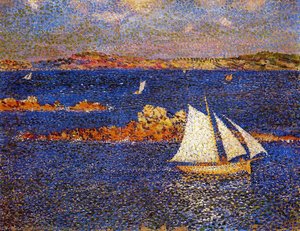
In the tranquil embrace of Paul Signac’s 1906 masterpiece, "The Bay," the viewer is invited into a world where light does not merely illuminate a scene but becomes the very fabric of its existence. This breathtaking work captures a serene coastal moment, where two sailboats with vibrant red and white sails drift lazily upon a shimmering expanse of water. The composition is anchored by a rugged, rocky shoreline in the foreground, where textured trees reach toward a sky filled with soft, drifting clouds. Beyond the gentle movement of the boats, a distant cliff rises with a sense of quiet grandeur, providing a structural weight that balances the ethereal lightness of the sea and sky. It is a scene that transcends mere landscape painting, offering instead a meditative window into the harmony of the natural world.
The true soul of this painting lies in its meticulous execution through the Pointillist technique, a method perfected by Signac to achieve a scientific yet deeply emotional resonance. Rather than blending pigments on a palette, Signac applied tiny, distinct dots of pure, unadulterated color directly onto the canvas. From a distance, these rhythmic pulsations of pigment dance and merge within the viewer's eye, creating an optical fusion that mimics the flickering quality of sunlight on water. This technique lends "The Bay" a unique, vibrating texture; the colors do not sit static upon the surface but seem to breathe and shimmer, capturing the fleeting essence of a summer afternoon with unparalleled vitality.
The Legacy of Neo-Impressionism
To understand the profound impact of "The Bay," one must look to the historical currents that shaped Paul Signac’s vision. As a pioneer of Neo-Impressionism, Signac sought to move beyond the spontaneous, often fleeting impressions of his predecessors toward a more structured and systematic approach to art. Influenced heavily by the scientific theories of color and light prevalent in late 19th-century France, he transformed the canvas into a laboratory of perception. In this work, we see the culmination of years of experimentation—a transition from the soft edges of Impressionism to a disciplined, mosaic-like precision that celebrates the mathematical beauty of light.
For the discerning collector or interior designer, "The Bay" offers much more than aesthetic beauty; it provides a focal point of sophisticated tranquility. The striking contrast between the deep, saturated tones of the rocky coast and the brilliant pops of crimson in the sails creates a dynamic visual energy that can anchor a room with elegance. Whether placed in a contemporary gallery setting or a classic study, this reproduction serves as a testament to the enduring power of Pointillism. It is an invitation to slow down, to observe the minute details, and to rediscover the profound peace found in the rhythmic dance of color and light.
Fragen & Antworten
Kann ich Augmented Reality nutzen, um "The bay" von Paul Signac in meinem Raum zu sehen?
„The bay“ verfügt über eine Augmented-Reality-Vorschau: Die AR-Vorschau-Seite des Kunstwerks zeigt es auf einem kompatiblen Gerät in Ihrem eigenen Raum.
Ist "The bay" von Paul Signac im Hoch-, Quer- oder Quadratformat angeordnet?
"The bay" von Paul Signac ist eine Komposition im Landscape-Format. Die Proportionen sollten vor der Wahl der Druckgröße überprüft werden.
Welcher Phase der Karriere von Paul Signac ist „The bay“ (1906) zuzuordnen?
Die Datierung auf 1906 ordnet „The bay“ der Mature Period von Paul Signacs künstlerischer Entwicklung zu.
Ähnliche Kunstwerke





Künstlerbiografie
Frühe Jahre und Ausbildung
Paul Victor Jules Signac, ein französischer Neo-Impressionistischer Maler, wurde am 11. November 1863 in Paris geboren. Ursprünglich absolvierte er eine Ausbildung zum Architekten, entschied sich aber im Alter von 18 Jahren für die Malerei. Dieser Entschluss wurde durch eine Ausstellung der Werke von Claude Monet beeinflusst.Künstlerischer Stil und Einflüsse
Signacs Stil zeichnete sich durch die Verwendung kleiner Punkte reiner Farbe aus, die er nebeneinander stellte, um ein Gefühl für Tiefe und Licht zu erzeugen. Diese Technik, bekannt als Pointillismus, wurde in Zusammenarbeit mit Georges Seurat entwickelt. Signacs Arbeit wurde auch von seinen Reisen entlang der europäischen Küste beeinflusst, wo er die Schönheit von Hafenstädten in Aquarellen festhielt.Wichtige Werke und Verbindungen
* Boulevard de Clichy (1886): Ein postimpressionistisches Werk, das Signacs akribischen Stil zeigt. * Der rote Bojen, Saint-Tropez (1895): Ein lebhaftes marines Gemälde mit einer rot-orangenen Boje vor blauem Hintergrund. * Gründungsmitglied der Société des Artistes Indépendants, die jährliche Ausstellungen organisierte, die Trends in der frühen 20. Jahrhundert Kunst prägten.Vermächtnis und Einfluss
Signacs Arbeit hatte einen tiefgreifenden Einfluss auf die Entwicklung des Fauvismus und beeinflusste Künstler wie Henri Matisse und André Derain. Als Präsident der Société des Artistes Indépendants unterstützte Signac jüngere Künstler und stellte kontroverse Werke von den Fauves und Kubisten aus.- Erleben Sie Paul Signacs „Boulevard de Clichy 1886“ – eine ruhige Pointillist-Winterszene in Paris. Bewundern Sie seine kühle Farbpalette und zeitlose Schönheit. Hochwertige Reproduktionen erhältlich.
- Entdecken Sie Paul Signacs „Der Kiefernbaum in Saint-Tropez“, ein lebendiger Neo-Impressionistischer Meisterwerk! Erkunden Sie Pointillismus, mediterrane Schönheit und zeitlose Anziehungskraft. Perfekt für Kunstliebhaber und Sammler.
- Entdecken Sie Paul Signacs 'Frühstück (Die Speisekammer)' – ein lebendiger Neo-Impressionistischer Meisterwerk! Erkunden Sie Pointillismus, Belle Époque Charme und zeitlose Schönheit. Perfekt für Kunstsammler.
- Erleben Sie Signacs 'Der Leuchtturm, Saint-Tropez'! Dieses lebendige Postimpressionistenwerk fängt die Schönheit der französischen Küste mit dem schimmernden Licht und den Farben des Pointillismus ein.
- Entdecken Sie Gustav Klimts 'Schloss Kammer am Attersee'! Eine friedliche Symbolistische Landschaft mit leuchtenden Farben und geometrischen Mustern. Besorgen Sie sich heute eine handgemalte Ölmalerei Reproduktion!
Wichtige Daten
* 11. November 1863: Geburt in Paris * 1884: Mitbegründung der Société des Artistes Indépendants * 15. August 1935: Verstarb im Alter von 71 Jahren. Erleben Sie das künstlerische Genie von Paul Signac durch seine fesselnden Werke, die auf TopImpressionists.com erkundet werden können.
Paul Signac
1863 - 1935 , Frankreich
Kurzinfos
- Beeinflusste Künstler:
- Henri Matisse
- André Derain
- Bemerkenswerte Werke:
- Boulevard de Clichy (1886)
- Der rote Boje, Saint-Tropez
- Frühstück (Die Speisekammer)
- Einflussreiche Kunstrichtung: Fauvismus
- Geburtsdatum: 11. November 1863
- Geburtsort: Paris, Frankreich
- Künstlerische Bewegung: Neo-Impressionismus
- Nationalität: Französisch
- Sterbedatum: 15. August 1935
- Vollständiger Name: Paul Signac
Ähnliche Artikel

Die 25 besten Gemälde von Paul Cézanne: Meisterwerke der Form
Entdecken Sie die 25 Meisterwerke von Paul Cézanne und den Postimpressionismus. Alle Klassiker auf TopImpressionists.com online erleben.

Meister der Abstraktion: Die 25 wichtigsten Kunstwerke von Paul Klee
Entdecken Sie die 25 Meisterwerke von Paul Klee und die Magie des Bauhaus. Erleben Sie Klee-Reproduktionen auf TopImpressionists.com.

The Science of Light: Decoding the Optical Precision of Neo-Impressionism
Explore the scientific brilliance of Neo-Impressionism. Discover how masters like Georges Seurat revolutionized art through optical mixing, color theory, and the precision of Pointillism to capture the true essence of light.

Paul Signac: Pointillismus, Politik und die Suche nach Harmonie in der modernen Kunst
Entdecken Sie Paul Signacs revolutionären Pointillismus! Erfahren Sie mehr über die wissenschaftlichen Grundlagen, politischen Engagements und das künstlerische Vermächtnis dieses Meisters des Neo-Impressionismus. Jetzt lesen!

Die Präzision des Lichts: Seurats und Signacs wissenschaftliche Revolution der Farbwahrnehmung
Erfahren Sie alles über die wissenschaftliche Revolution von Seurat und Signac. Entdecken Sie die Magie des Pointillismus jetzt!
Entdecken Sie Kunstwerke, die nach Themen, Stilen und Merkmalen sortiert sind.


