

Shown: · With its frame:
 Vorschau anzeigen
 Versenden
 Teilen
 Details anzeigen
 Leitfaden

 Herunterladen
 Ähnliche Objekte
 Röntgenaufnahme
 Diashow
 Q&A
Q&A Statistiken


€ 239
Handgefertigte Ölreproduktion
Handgemaltes Ölgemälde auf Leinwand in Ihrer Wunschgröße und mit Rahmen, auf Bestellung von unseren Künstlern angefertigt. ( Zum Druck wechseln Zum digitalen Bild wechseln)
Size
·Standardformat
individuell anpassbar
CM
INCH
Wählen Sie aus unseren vordefinierten Formaten, die den ursprünglichen Proportionen des Kunstwerks entsprechen.
Loading sizes...

Breite
Höhe
Geben Sie die Breite und die Höhe an, die Sie für Ihren Rahmen oder Ihre Wand benötigen. Da dieses Werk handgemalt ist, kann der Künstler bei einer anderen Form etwas mehr um das Bild herum malen oder etwas abschneiden – Sie entscheiden. Wir senden Ihnen ein digitales Mockup zur Freigabe, bevor mit dem Malen begonnen wird. Das auf dieser Seite gezeigte Bild stellt nicht das tatsächliche Ergebnis dar – dies tut nur das Mockup.
 Mehr erfahren
Finish
·
White €1

Blurside €1

Extended €1

P118B €10

P118H €10

P118W €10

P438Z €10

P508JH €12

P508YH €12

P805H €10

P805Z €10

P919BZ €10

P919G €10

P919XJ €10

P959ZH €10

P968JZ €12

W106C €8

W218G €10

W218JH €8

W218Y €10

W307PJ €10

W316G €10

W316PJ €8

W316Y €10

W398PJ €8

W4111J €10

W500HY €15

W500JH €15

W692G €12

W849H €8

W940BG €15

W953PJ €8

H24-GOLD €30

H24-SILVER €30

H36-GOLD €45

H36-SILVER €45
Shipped in a protective tube, ready for your own framer.
Above 105 cm the frame is shipped as a kit for a professional framer — read the details.
Extras
optionalWhat do the extras include?
Examples of what can be changed: Replace face with customer photo; Add pet (e.g., replace cat with dog); Include hidden message in background; Change background landscape or elements.
After order, TopImpressionists.com team will email client for instructions and provide a mockup preview
After order, TopImpressionists.com team will email client for instructions and provide a mockup preview
Weltweiter Versand () in nur 3 bis 4 Wochen statt der üblichen 5 Wochen. (31 Oktober). Keine Kompromisse bei der Qualität.
Schutzlackierung
Beschriftung
Details der gravierten Bronzetafel
This elegant plaque features the artist's name and the title of the artwork, finely engraved for a timeless presentation.
It is made from bronze with a refined, elegant finish. The text is precisely laser-engraved for a sharp and permanent result. Measuring 9x2 cm, the plaque is compact yet easy to read. It's built to be durable and scratch-resistant, offering a professional, museum-quality look. Mounting is simple thanks to the included adhesive backing.
Details zur Acrylglas-Plakette (transparent)
The plaque includes essential engraved details such as the artist's name, the title of the artwork, the date it was created, the type of media used-like oil on canvas or watercolor-a brief description of the piece, and a QR code that links to the complete artwork information.
It is crafted from clear acrylic, offering a sleek, modern appearance. The text is UV-engraved in black to ensure strong visual contrast. With a size of 10x15 cm, it ensures optimal readability. It comes equipped with two metal hooks for secure wall mounting. The plaque is designed to be weather-resistant, making it suitable for various environments, and it includes interactive features that work seamlessly with smartphone scanning.
Details zur schwarzen Acryltafel
This elegant plaque includes engraved information such as the artist's name, the title of the artwork, the date it was created, the type of media used (like oil on canvas or watercolor), a short description of the artwork, and a QR code for quick access to more information.
The plaque itself is made from refined black acrylic with a premium finish. The text is laser-engraved in white for high contrast and readability. Its size is 10x15 cm, designed to be easy to read. It comes with two metal hooks for professional mounting. The design is sleek and fits any interior style. It is also weather-resistant and durable, with built-in digital integration for mobile compatibility.
Die Glasoption ist nur für Größen unter 110 cm verfügbar.
 Die Glasoption ist nur für Größen unter 110 cm verfügbar.
- Kostenloser weltweiter Expressversand
- Hochwertige Leinenleinwand
- Umfassender Versicherungsschutz beim Versand
- Zollgebühren-Rückerstattungsgarantie
- Garantie für exakte Farbtreue
- 100 Tage Rückgaberecht (nur bei Mängeln)
- 100% Geld-zurück-Garantie
- Mengenrabatt verfügbar


Beschreibung des Sammlerstücks
Philip Wilson Steer's "Chepstow Castle" captures the majestic British landscape with atmospheric watercolors. Explore this iconic work of Impressionist art, showcasing the castle and River Wye.
Künstlerbiografie
Entdecken Sie Philip Wilson Steer (1860-1942), Schlüsselfigur des britischen Impressionismus! Erleben Sie seine lichtdurchfluteten Landschafts- & Seestück-Werke, inspiriert von Manet & Whistler. Jetzt in Tate & Uffizien!
About the painting
The Canvas as a Window: Philip Wilson Steer’s Chepstow Castle
Philip Wilson Steer's "Chepstow Castle" isn’t merely a depiction of a medieval fortress; it’s an immersion into the very essence of the Welsh landscape and the evocative power of memory. Painted in 1905, this watercolour captures more than just the physical structure of Chepstow Castle perched dramatically upon its limestone cliffs overlooking the River Wye. Instead, Steer offers us a shimmering, almost dreamlike vision—a testament to his profound understanding of light, atmosphere, and the enduring connection between man and nature. The castle itself, rendered with delicate washes of grey and ochre, seems to dissolve into the misty backdrop, becoming less a solid monument and more a spectral presence within the scene.
Steer’s artistic journey was one of constant evolution. Initially influenced by French Impressionism – particularly Manet and Whistler – he later sought inspiration in the works of John Constable and J.M.W. Turner, embracing a style that prioritized capturing fleeting moments and atmospheric effects over precise detail. This shift is powerfully evident here; the painting isn’t concerned with photographic accuracy but rather with conveying a specific mood—a sense of quiet contemplation and timelessness. The artist's deliberate blurring of edges and his masterful use of color create an ethereal quality, inviting the viewer to step into the scene and experience it as if they were standing beside the river themselves.
The Influence of Turner and Constable: A Return to English Roots
Steer’s decision to revisit the styles of Constable and Turner was a deliberate one, representing a conscious move away from the Parisian art world and back towards his British heritage. Constable's focus on the rural landscape—particularly the interplay of light and shadow in fields and waterways—provided Steer with a model for capturing the subtle nuances of the Welsh countryside. Similarly, Turner’s exploration of atmospheric perspective and his ability to evoke mood through color informed Steer’s approach to depicting the misty Wye Valley. The painting's silvery palette, reminiscent of Turner’s seascapes, suggests a sense of mystery and melancholy, while the composition echoes Constable’s emphasis on capturing the beauty of ordinary subjects.
Notably, Steer’s work during this period was heavily influenced by his travels in search of the picturesque. He sought out sites that were popular with eighteenth-century travelers—locations where the natural world could be experienced as a sublime and awe-inspiring spectacle. This pursuit is vividly reflected in "Chepstow Castle," which captures not just the castle itself but also the surrounding landscape, creating a harmonious whole. The inclusion of the River Wye, rendered with delicate washes of blue and grey, adds to the painting’s sense of tranquility and timelessness.
Symbolism and Emotional Resonance
Beyond its purely visual qualities, "Chepstow Castle" is rich in symbolic meaning. The castle itself represents not only a physical structure but also a symbol of power, history, and resilience—a reminder of the enduring legacy of Norman England in Wales. The misty atmosphere surrounding the castle evokes a sense of nostalgia and longing, suggesting that the past is never truly gone but continues to resonate within the present. The figures on the boats add a human element to the scene, hinting at the ongoing connection between people and place.
Steer’s masterful use of light—particularly its ability to transform the landscape—creates an emotional resonance that transcends mere representation. The painting evokes a sense of quiet contemplation and invites the viewer to reflect on their own relationship with history, memory, and the natural world. It's a piece that speaks not just to the eye but also to the heart, offering a glimpse into the artist’s profound understanding of beauty and its power to inspire.
Fragen & Antworten
Welche allgemeine Stimmung vermittelt "Chepstow Castle" von Philip Wilson Steer?
"Chepstow Castle" verströmt eine Calm Atmosphäre.
Welche Stimmung würde "Chepstow Castle" in einen Raum bringen?
"Chepstow Castle" von Philip Wilson Steer strahlt eine Calm Atmosphäre aus und wird für ein Living Room empfohlen. Die Stimmung beschreibt das Gefühl, das das Werk in den umgebenden Raum bringt.
Welches Motiv und welche Atmosphäre vereint "Chepstow Castle" von Philip Wilson Steer?
"Chepstow Castle" zeigt castle, river, landscape, wales, boats, 1905, steer, und die eingefangene Stimmung ist Calm.
Quick facts and art quiz
About Philip Wilson Steer

Philip Wilson Steer
1860 - 1942, Vereinigtes Königreich
Künstlerbiografie
Frühes Leben und künstlerische Prägung
Philip Wilson Steer, geboren am 28. Dezember 1860 in Birkenhead, England, entsprang einer Familie, die tief in der Kunst verwurzelt war – sein Vater übte das Porträtmalen aus und unterrichtete zudem diese Disziplin. Diese frühe familiäre Umgebung prägte Steers künstlerische Sensibilität entscheidend. Ein Umzug nach Whitchurch bei Monmouth im Alter von drei Jahren führte ihn in die Nähe der britischen Landschaft, eine Verbindung, die sein gesamtes Schaffen durchziehen sollte. Seine formale Ausbildung begann an der Hereford Cathedral School, wo er eine solide Grundlage erhielt, bevor er sich voll und ganz seinen künstlerischen Ambitionen widmete. Er vertiefte seine Fähigkeiten an der Gloucester School of Art und den South Kensington Drawing Schools, doch erst seine Zeit in Paris zwischen 1880 und 1884 erwies sich als wahrer Wendepunkt. An der Académie Julian und später unter Alexandre Cabanel an der École des Beaux-Arts begegnete er einer Welt voller neuer Ideen und maltechnischer Ansätze.Der Einfluss des Impressionismus und die Entwicklung eines individuellen Stils
Paris wurde zum Schmelztiegel für Steers künstlerische Entwicklung. Er war tief beeindruckt von den Werken von Édouard Manet und James McNeill Whistler, deren innovative Techniken zur Darstellung von Licht, Farbe und Atmosphäre er aufnahm. Diese Begegnungen entfachten seine Leidenschaft für den Impressionismus, doch Steer begnügte sich nie mit bloßer Nachahmung. Er verband diese französischen Einflüsse gekonnt mit seiner eigenen englischen Sensibilität und schuf so einen Stil, der einzigartig war. Seine Gemälde zeichnen sich durch eine bemerkenswerte Fähigkeit aus, flüchtige Momente einzufangen – das Spiel des Sonnenlichts auf dem Wasser, die vergängliche Qualität der Küstenluft. Er verwendete lockere Pinselstriche und lebendige Farben nicht nur zur Darstellung von Szenen, sondern um Emotionen hervorzurufen und ein intensives Gefühl der Unmittelbarkeit zu erzeugen. Wiederkehrende Motive in seinem Werk sind Strand- und Meeransichten, oft in silbernem, durchscheinendem Licht getaucht, die seine Meisterschaft in der Darstellung der Frische und Leuchtkraft dieser Umgebungen demonstrieren. Werke wie The Music Room, aus seiner frühen Schaffensperiode, zeigen bereits sein aufkeimendes Talent für Komposition und Lichtgestaltung, während Gemälde wie Girls Running: Walberswick Pier die Energie und Lebendigkeit einer Küstenstadt in Suffolk einfangen.Engagement für moderne Kunst und der Einfluss von Etaples
Steer war nicht nur ein Maler, sondern auch ein aktiver Gestalter des künstlerischen Lebens Großbritanniens. Er spielte eine Schlüsselrolle bei der Gründung des New English Art Club, einer Organisation, die sich der Förderung moderner künstlerischer Ausdrucksformen widmete – ein mutiger Schritt zu einer Zeit, in der traditionelle Geschmäcker noch vorherrschten. Durch diese Plattform und regelmäßige Ausstellungen in der Royal Academy, darunter seine Teilnahme an der bahnbrechenden London Impressionist Exhibition von 1889, trug er dazu bei, neue Ideen einzuführen und konventionelle Normen herauszufordern. Seine Zeit in der Künstlerkolonie Etaples im Jahr 1887 beeinflusste seine Arbeit nachhaltig. Diese lebendige Gemeinschaft bot ein anregendes Umfeld für Experimente und Zusammenarbeit und verfeinerte seine Fähigkeit, Licht und Atmosphäre mit zunehmender Nuance und Präzision einzufangen. Steer ließ sich von einer Vielzahl von Meistern inspirieren – John Constable, J.M.W. Turner und sogar François Boucher –, doch er filterte diese Einflüsse stets durch seine eigene unverwechselbare Perspektive.Vermächtnis, Anerkennung und bleibender Einfluss
Philip Wilson Steer malte unermüdlich weiter, bis gesundheitliche Probleme ihn 1940 zum Aufhören zwangen. Er verstarb zwei Jahre später im Alter von 81 Jahren. Seine Leistungen wurden zu seinen Lebzeiten vielfach gewürdigt, was in der Verleihung des Order of Merit gipfelte. Heute befinden sich seine Werke in renommierten Sammlungen auf der ganzen Welt, darunter die Tate Gallery und sogar die Uffizien – ein Beweis für sein internationales Ansehen. Über seine Gemälde hinaus erstreckt sich Steers Vermächtnis durch seine lange Tätigkeit als Dozent an der Slade School of Art. Er beeinflusste über viele Jahre hinweg Generationen junger Künstler tiefgreifend, indem er ihnen nicht nur technische Fähigkeiten vermittelte, sondern auch eine tiefe Wertschätzung für Beobachtungsgabe und künstlerische Integrität einflößte. Sein Beitrag zur Entwicklung und Akzeptanz des Impressionismus in Großbritannien ist unbestreitbar und festigt seine Position als bedeutende Figur der britischen Kunstgeschichte – ein Maler, der erfolgreich die Kluft zwischen Tradition und Moderne überbrückte und einen bleibenden Eindruck auf die Landschaft der britischen Kunst hinterließ. Bemerkenswerte Werke wie Convalescent, mit seinen reichen Texturen und dem eindringlichen Blick, und The Teme at Ludlow, das eine friedliche Schönheit und meisterhafte Pinseltechnik hervorhebt, fesseln auch heute noch die Betrachter und zeugen von der zeitlosen Qualität seiner künstlerischen Vision.Quick facts about Philip Wilson Steer
- Beeinflusste Künstler: ['Britischer Impressionismus']
- Bemerkenswerte Werke:
- The Music Room
- Girls Running
- Convalescent
- The Teme at Ludlow
- Mother and Daughter
- Einflüsse:
- Manet
- Whistler
- Constable
- Turner
- Boucher
- Geburtsdatum: 28. Dezember 1860
- Geburtsort: Birkenhead, Vereinigtes Königreich
- Künstlerische Bewegung: Impressionismus
- Nationalität: Britisch
- Sterbedatum: 18. März 1942
- Vollständiger Name: Philip Wilson Steer
Ähnliche Kunstwerke




Entdecken Sie Kunstwerke, die nach Themen, Stilen und Merkmalen sortiert sind.


Philip Wilson Steer
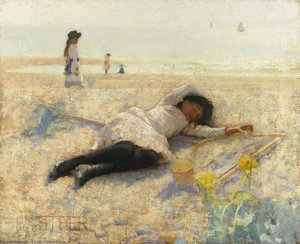
Chepstow Castle
() ·
With its frame: · Hand-painted in oil on linen
Total