


 In echtem Maßstab anzeigen
 Versenden als Grußkarte
 Teilen
 Details anzeigen
 Leitfaden öffnen

 Herunterladen
 Ähnliche Objekte
 Röntgenaufnahme
 Diashow
 Besucherstatistiken
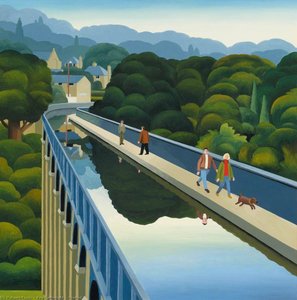
Viaduct
 British Pastoral
 1992
1992 50.0 x 50.0 cm
 Das British Postal Museum - Archiv
Discover 'Viaduct' by reg cartwright (1992). This serene landscape painting showcases British pastoral art with bold lines & muted colors. A captivating 50x50cm oil on canvas.
Discover the serene landscapes & still lifes of reg cartwright, a British artist known for capturing rural England's beauty with detailed realism.
 Mehr anzeigen
Die auf dieser Seite dargestellten Kunstwerke sind urheberrechtlich geschützt, was bedeutet, dass wir keine identische Reproduktion rechtmäßig erstellen oder verkaufen dürfen. Dieser Schutz wird durch internationale Abkommen wie die Berner Übereinkunft und durch nationale Gesetze, einschließlich derer, die von den ... festgelegt wurden US-Urheberrecht – Titel 17.
Als respektvolle und rechtlich einwandfreie Alternative bieten wir individuelle, handgemalte Kunstwerke an, die vom Original inspiriert sind. Unsere geschickten und professionellen Künstler studieren sorgfältig den Stil, die Stimmung und das künstlerische Wesen des Originals, um ein neues, einzigartiges Werk zu schaffen, das dasselbe Gefühl hervorruft – während es zugleich eine eigenständige Originalschöpfung bleibt.
Diese Methode entspricht vollumfänglich den Urheberrechtsbestimmungen, da sie keine Kopie oder Vervielfältigung des geschützten Kunstwerks darstellt. Stattdessen handelt es sich um eine kreative Neuinterpretation – ein neues Gemälde, das vom Original inspiriert, aber nicht identisch mit ihm ist.
Handgefertigte Ölreproduktion
Handgemaltes Ölgemälde auf Leinwand in Ihrer Wunschgröße und mit Rahmen, auf Bestellung von unseren Künstlern angefertigt. ( Zum Druck wechseln Zum digitalen Bild wechseln)




































Standardformat
individuell anpassbar
CM
INCH
Wählen Sie aus unseren vordefinierten Formaten, die den ursprünglichen Proportionen des Kunstwerks entsprechen.
Loading sizes...

Breite
Höhe
Geben Sie die Breite und die Höhe an, die Sie für Ihren Rahmen oder Ihre Wand benötigen. Da dieses Werk handgemalt ist, kann der Künstler bei einer anderen Form etwas mehr um das Bild herum malen oder etwas abschneiden – Sie entscheiden. Wir senden Ihnen ein digitales Mockup zur Freigabe, bevor mit dem Malen begonnen wird. Das auf dieser Seite gezeigte Bild stellt nicht das tatsächliche Ergebnis dar – dies tut nur das Mockup.
Beispiele für Anpassungsmöglichkeiten: Gesicht durch Kundenfoto ersetzen; Haustier hinzufügen (z. B. Katze durch Hund ersetzen); eine versteckte Nachricht im Hintergrund einfügen; Hintergrundlandschaft oder -elemente ändern.
Nach der Bestellung wird das TopImpressionists.com-Team dem Kunden Anweisungen per E-Mail zusenden und eine Mockup-Vorschau bereitstellen.
Nach der Bestellung wird das TopImpressionists.com-Team dem Kunden Anweisungen per E-Mail zusenden und eine Mockup-Vorschau bereitstellen.
Weltweiter Versand () in nur 3 bis 4 Wochen statt der üblichen 5 Wochen. (21 Oktober). Keine Kompromisse bei der Qualität.

Kostenloser weltweiter Expressversand

Hochwertige Leinenleinwand

Vollständiger Versicherungsschutz beim Versand

Zollgebühren-Rückerstattungsgarantie

Garantie für exakte Farbtreue

100-tägiges Rückgaberecht (nur bei Mängeln)

100% Geld-zurück-Garantie

Angebot für Mengenrabatt
 Die Glasoption ist nur für Größen unter 110 cm verfügbar.

Viaduct
Reproduktionsmedium
Format der Reproduktion
-


Gesamtpreis
€ 322


Biografie des Künstlers
Reg Cartwright: A Quiet Master of British Pastoral
Reg Cartwright, born in Leicester in 1938, is a quietly compelling figure within the landscape of British contemporary art. His career, spanning over seven decades, has been marked by a dedication to capturing the subtle beauty and enduring character of rural England – not through grand vistas or dramatic storms, but with an intimate focus on everyday objects and the quiet rhythms of the countryside. Cartwright’s work isn't about shouting; it whispers, inviting contemplation and a deep appreciation for the understated elegance of the natural world.
Cartwright’s early life offered little indication of his future artistic path. After attending Gateway grammar school, he initially pursued a pattern-making role in a shoe factory, a seemingly conventional route that ultimately proved unsatisfying. National service followed, and then a period working in advertising, experiences which, paradoxically, provided him with the foundational skills – particularly in design and composition – that would later inform his painting. It was within the bustling environment of Frank Gayton Advertising that he truly began to hone his artistic eye, absorbing techniques and developing a keen understanding of visual hierarchy and balance.
The Evolution of Still Life
Cartwright’s artistic trajectory shifted decisively in 1976 when he embraced full-time painting. Initially exploring various mediums, he quickly found his voice within the realm of still life. This choice wasn't a rejection of landscape, but rather a deliberate narrowing of focus that allowed him to delve into the intricacies of form, texture, and light with unparalleled precision. He’s often described as a “cubist” in his approach, not in the revolutionary sense of Picasso or Braque, but in his ability to deconstruct familiar objects – plates, jugs, flowers, fish – and rearrange them within a carefully constructed composition. This process isn't about creating abstract representations; it’s about revealing the inherent beauty and complexity of these commonplace subjects.
Influences on Cartwright’s work are subtle yet discernible. The traditions of British landscape painting, particularly the quiet realism of artists like Constable and Turner, undoubtedly played a role. However, he also draws inspiration from the precision of Dutch still life painters – masters of light, shadow, and meticulous detail – as well as the understated elegance of 20th-century European modernists. His work possesses a unique blend of these influences, resulting in a style that is both deeply rooted in tradition and refreshingly contemporary.
Technique and Style
Cartwright’s technique is characterized by its remarkable control and restraint. He works primarily in oil on canvas, employing a muted palette dominated by earthy tones – browns, greys, ochres, and subtle greens – that evoke the textures and colors of the English countryside. His brushwork is often delicate and precise, meticulously building up layers of paint to create a sense of depth and luminosity. A key element of his style is his masterful use of light; he captures the fleeting effects of sunlight on surfaces with remarkable accuracy, creating an illusion of three-dimensionality that draws the viewer into the scene.
He frequently incorporates elements of landscape – often estuaries or coastal scenes – as a backdrop to his still lifes. These landscapes aren’t rendered in grand detail but rather serve as subtle anchors, grounding the compositions and reinforcing the connection between the objects within and the natural world outside. The effect is one of quiet harmony and understated beauty.
Recognition and Legacy
Cartwright's work has been exhibited widely throughout the United Kingdom and internationally, including shows in London, Cambridge, New York, and Japan. He’s received numerous awards and commissions, including the ‘Mother Goose Award’ for illustration and recognition from the MSIA (Museum of Society Illustrators). His paintings are held in private and public collections across the globe, testament to their enduring appeal.
Today, Reg Cartwright remains a vital voice within British contemporary art. His work speaks to a deep appreciation for the beauty of the everyday, inviting viewers to slow down, observe closely, and find solace in the quiet rhythms of rural England. He is an artist who has quietly, yet powerfully, captured the essence of a disappearing world – a testament to his skill, dedication, and profound understanding of the art of observation.
Reg Cartwright
1938 -
Eckdaten zum Künstler
- Artistic Movement Or Style: British Modernism
- Artists Or Movements Influenced By This Artist: ['Cambridge Contemporary Art']
- Artists Who Influenced This Artist:
- Cubism
- Still life painters
- Date Of Birth: 1938
- Full Name: Reg Cartwright
- Nationality: British
- Notable Artworks:
- Viaduct
- Blue Still Life
- Estuary Still Life
- Place Of Birth: Leicester, UK
Verwandte Artikel

Romantische Landschaften: Die 10 Meisterwerke, die eine Epoche prägten | TopImpressionists
Entdecken Sie die 10 Meisterwerke der Romantischen Landschaftsmalerei! Von Caspar David Friedrich bis Turner – erleben Sie die Kunst, Emotion & Natur. Hochwertige Reproduktionen auf TopImpressionists.com

Cultivating Visions: A Historical Journey Through Rural Landscapes in Art
Explore the rich history of rural landscape painting with TopImpressionists. Discover Impressionist masterpieces, key artists & movements. Find your perfect serene artwork and bring nature's beauty home.

John Constable: Die 25 Meisterwerke des englischen Landschaftsgenies – TopImpressionists
Entdecken Sie die 25 Meisterwerke von John Constable! Erleben Sie englische Landschaftsmalerei vom Hay Wain bis zur Stour Valley. Hochwertige Reproduktionen & Kunst für Ihr Zuhause auf TopImpressionists.com.

Evocations of Place: A Historical Journey Through Landscape Art
Explore the rich history of landscape art with TopImpressionists. Discover renowned artists, movements like Impressionism & Romanticism, and expert guidance for collecting timeless pieces. Find your perfect serene escape today!

Evoking Arcadia: A Historical & Aesthetic Exploration of Rural Landscape Art
Explore the rich history of pastoral landscape art, from classical Arcadia to Impressionism & beyond. Discover key artists, movements, and how to collect serene rural scenes for your home. Expert insights at TopImpressionists.