


 Vorschau anzeigen
 Versenden
 Teilen
 Details anzeigen
 Leitfaden

 Herunterladen
 Ähnliche Objekte
 Röntgenaufnahme
 Diashow
 Q&A
Q&A Statistiken
Quadrature


Experience Victor Vasarely’s groundbreaking Quadrature, a vibrant Op-Art masterpiece featuring dynamic geometric shapes and bold colors. This iconic 1960s artwork showcases the artist's innovative approach to visual perception – discover or own this captivating piece.
 Weiterlesen
Entdecken Sie Victor Vasarely (1906-1997), Pionier der Op Art! Seine geometrischen Abstraktionen & optischen Illusionen revolutionierten das Design. Jetzt auf TopImpressionists!
Die auf dieser Seite dargestellten Kunstwerke sind urheberrechtlich geschützt, was bedeutet, dass wir keine identische Reproduktion rechtmäßig erstellen oder verkaufen dürfen. Dieser Schutz wird durch internationale Abkommen wie die Berner Übereinkunft und durch nationale Gesetze, einschließlich derer, die von den US-Urheberrecht – Titel 17.
Diese Methode entspricht vollumfänglich den Urheberrechtsbestimmungen, da sie keine Kopie oder Vervielfältigung des geschützten Kunstwerks darstellt. Stattdessen handelt es sich um eine kreative Neuinterpretation – ein neues Gemälde, das vom Original inspiriert, aber nicht identisch mit ihm ist.
Giclée / Kunstdruck
Giclée- oder Leinwanddruck in Museumsqualität mit schneller Produktion und flexiblen Veredelungsoptionen. ( Handgemalte Reproduktion bestellen Zum digitalen Bild wechseln)




P118B €10

P118H €10

P118W €10

P438Z €10

P508JH €12

P508YH €12

P805H €10

P805Z €10

P919BZ €10

P919G €10

P919XJ €10

P959ZH €10

P968JZ €12

W106C €8

W218G €10

W218JH €8

W218Y €10

W307PJ €10

W316G €10

W316PJ €8

W316Y €10

W398PJ €8

W4111J €10

W500HY €15

W500JH €15

W692G €12

W849H €8

W940BG €15

W953PJ €8




Standardformat
individuell anpassbar
CM
INCH
Wählen Sie aus unseren vordefinierten Formaten, die den ursprünglichen Proportionen des Kunstwerks entsprechen.
Loading sizes...

Breite
Höhe
Geben Sie die benötigte Breite und Höhe an, damit der Druck perfekt in Ihren Rahmen oder an Ihre Wand passt. Ein Druck kann nur beschnitten, aber niemals größer als das Originalbild angefertigt werden; daher verliert ein Format mit anderen Proportionen einen Teil des Bildes. Wir senden Ihnen ein digitales Mockup zur Freigabe, bevor wir den Druck ausführen. Das auf dieser Seite gezeigte Bild zeigt nicht den tatsächlichen Beschnitt – dies ist nur im Mockup ersichtlich.
Weltweiter Versand () innerhalb von 2 Wochen statt der üblichen 4/5 Wochen. (30 Oktober)

Kostenloser weltweiter Expressversand

Hochwertige Leinenleinwand

Umfassender Versicherungsschutz beim Versand

Zollgebühren-Rückerstattungsgarantie

Garantie für exakte Farbtreue

100 Tage Rückgaberecht (nur bei Mängeln)

100% Geld-zurück-Garantie

Mengenrabatt verfügbar
 Die Glasoption ist nur für Größen unter 110 cm verfügbar.

Quadrature
Giclée / Kunstdruck
Format der Reproduktion
-


Endpreis
€ 61
Victor Vasarely’s *Quadrature*: A Dance of Perception
Victor Vasarely's *Quadrature* isn't merely a painting; it’s an invitation – an invitation to question the very nature of visual reality. Created by a visionary who anticipated the digital age, this work embodies the core tenets of Op Art, a movement that sought to manipulate perception through carefully constructed geometric forms and vibrant color fields. Painted in 1960s, *Quadrature* showcases Vasarely’s mastery of optical illusion, transforming two dynamic spheres into an experience that seems to vibrate with energy before your eyes. The bold use of yellow and orange, punctuated by strategic blue accents, isn't simply decorative; it’s a calculated orchestration designed to disrupt our ingrained assumptions about depth and space.
Geometric Abstraction and the Bauhaus Legacy
Vasarely’s artistic journey began far from the canvas. Initially trained as a medical student, his fascination with visual form led him to abandon conventional pursuits in favor of exploring abstraction. This path was profoundly shaped by his time at Sándor Bortnyik’s Műhely workshop, directly influenced by the revolutionary principles of the Bauhaus school. The Bauhaus emphasized functional design and geometric reduction – stripping away extraneous detail to reveal the essential structure of objects. Vasarely absorbed these ideas, translating them into a uniquely personal style characterized by precisely rendered circles, squares, and spheres arranged in dynamic compositions. *Quadrature* stands as a testament to this rigorous training, demonstrating a deep understanding of how our eyes perceive and interpret visual information.
The Illusion of Movement: Op Art’s Core Principles
At the heart of *Quadrature* lies the captivating technique that defines Op Art – the creation of an illusion of movement or depth through static imagery. Vasarely meticulously controlled color, scale, and repetition to achieve this effect. The overlapping spheres create a sense of infinite space, drawing the viewer’s eye across the canvas in a perpetual dance. This isn't about depicting a realistic scene; it’s about manipulating our visual system, triggering a neurological response that generates an impression of motion. The painting is a powerful demonstration of how art can actively engage with the viewer’s perception, challenging the boundaries between what is seen and what is felt.
Symbolism and Emotional Impact
While seemingly abstract, *Quadrature* resonates with profound symbolic weight. The geometric forms themselves represent fundamental building blocks of reality – circles symbolizing wholeness and unity, squares representing stability and order. The dynamic arrangement suggests a constant state of flux, mirroring the ever-changing nature of perception itself. More than just an aesthetic experience, *Quadrature* evokes a sense of wonder and intrigue, prompting contemplation about our relationship with space, time, and visual information. It’s a piece that rewards repeated viewing, revealing new layers of complexity with each encounter.
A Legacy of Innovation
*Quadrature* represents a pivotal moment in the history of art, solidifying Vasarely's place as a pioneer of Op Art and kinetic art. His influence extends far beyond the 1960s, inspiring generations of artists and designers. Today, reproductions like this one offer an accessible way to experience the brilliance of Vasarely’s vision – a timeless exploration of perception that continues to captivate and challenge viewers worldwide.
Fragen & Antworten
Welche Technik wurde für "Quadrature" von Victor Vasarely verwendet?
Das Medium von "Quadrature" von Victor Vasarely ist Acryl auf Leinwand. Die Reproduktionen zielen darauf ab, die Optik dieser Technik wiederzugeben.
Wie bekannt ist "Quadrature" von Victor Vasarely?
"Quadrature" von Victor Vasarely weist ein Ikonisch Popularitätsniveau auf. Diese Klassifizierung spiegelt die weite Verbreitung und Bekanntheit des Werkes wider.
Wie kann ich eine Vorschau einer Reproduktion von "Quadrature" von Victor Vasarely aufrufen?
Auf der Vorschau im Raum-Seite von „Quadrature“ können Sie das Kunstwerk vor der Bestellung in einer Vorschau betrachten.
Künstlerbiografie
Victor Vasarely: Pionier der Op Art und kinetischer Erkundung
- Geboren: 9. April 1906, Pécs, Kroatien
- Gestorben: 15. März 1997, Paris, Frankreich
- Nationalität: Ungarisch-Französisch
Victor Vasarely (geboren Károly Vaszary) war eine zentrale Figur in der Entwicklung der Op Art und kinetischen Kunst. Seine Arbeit versuchte, die traditionelle Malerei zu überwinden, indem er optische Illusionen erforschte und dynamische visuelle Erfahrungen schuf. Geboren in Pécs, damals Teil Österreich-Ungarns (heute Kroatien), umfassten seine frühen Jahre ein Medizinstudium an der Eötvös Loránd Universität in Budapest, bevor er sich ganz der Kunst widmete.
Früher Einfluss und künstlerische Entwicklung
- Frühzeitiges Training: Vasarely studierte zunächst traditionelle akademische Malerei an der Podolini-Volkmann Akademie.
- Bauhaus-Einfluss: Ein entscheidender Wendepunkt war seine Einschreibung in den Workshop (Műhely) von Sándor Bortnyik in Budapest, einer Schule, die stark von den Bauhaus-Prinzipien beeinflusst war und die funktionale Gestaltung und geometrische Abstraktion betonte. Diese Exposition prägte seine zukünftige künstlerische Richtung.
- Geometrische Abstraktion: In den späten 1920er und frühen 1930er Jahren experimentierte Vasarely mit geometrischen Formen und Farbharmonien, um sich von der gegenständlichen Kunst hin zur reinen Abstraktion zu bewegen. Schlüsselwerke wie "Blue Study" (1929) und "Green Study" (1929) demonstrieren diesen Übergang.
- Einfluss von Mondrian & Malevich: Obwohl er seinen eigenen einzigartigen Stil entwickelte, wurde Vasarely von den geometrischen Abstraktionen von Piet Mondrian und Kasimir Malewitsch beeinflusst, strebte jedoch letztendlich danach, über ihre statischen Kompositionen hinauszugehen.
Der Aufstieg der Op Art und kinetische Erkundung
- Definition der Op Art: Vasarely gilt weithin als Gründervater der Op Art (Optical Art), einer Bewegung, die in den 1960er Jahren entstand und durch Werke gekennzeichnet ist, die optische Illusionen durch präzise Anordnungen von Formen, Farben und Linien erzeugen.
- Systematischer Ansatz: Im Gegensatz zu einigen Künstlern, die sich auf Intuition verließen, entwickelte Vasarely einen systematischen Ansatz für seine Kunst, der Gitter und mathematische Prinzipien nutzte, um Muster zu erzeugen und dynamische visuelle Effekte zu erzielen. Er strebte nach Reproduzierbarkeit und Massenappeal an.
- Kinetische Kunst & Großinstallationen: Später in seiner Karriere erforschte Vasarely die kinetische Kunst – Werke, die Bewegung beinhalten oder den Eindruck von Bewegung erwecken. "Georges Pompidou" (1976), ein großes kinematische Objekt, das im Centre Pompidou in Paris installiert wurde, veranschaulicht diesen Anspruch und demonstriert sein Interesse an der Integration von Kunst mit Architektur und Stadtgestaltung.
- Kommerzielle Unternehmungen: Vasarely war auch ein Innovator bei der Anwendung seiner Designs auf kommerzielle Produkte. Seine Zusammenarbeit mit Rosenthal-Porzellan führte zur "Suomi"-Geschirrserie, die seine Fähigkeit demonstriert, abstrakte Konzepte in funktionale Objekte zu übersetzen.
Wichtige Errungenschaften und Vermächtnis
- Foundation Vasarely: Die Gründung der Foundation Vasarely in Aix-en-Provence, Frankreich, sorgte für die Erhaltung und Förderung seines umfangreichen Werkes.
- Raumfahrt: Ein bedeutender Moment war, als Serigraphien von Vasarely an Bord der französischen sowjetischen Raumfähre Salyut 7 (1982) in den Weltraum geschickt wurden, später zum Wohle von UNESCO verkauft – ein Beweis für die globale Anerkennung seiner Kunst.
- Einfluss auf das Design: Vasarelys systematischer Ansatz und sein geometrischer Stil beeinflussten tiefgreifend Grafikdesign, Mode und Inneneinrichtung. Seine Arbeit demonstrierte, wie abstrakte Prinzipien eingesetzt werden können, um visuell ansprechende und funktionale Umgebungen zu schaffen.
- Bleibender Einfluss: Victor Vasarelys Vermächtnis liegt in seiner bahnbrechenden Erforschung optischer Illusionen, kinetischer Kunst und der Schnittstelle zwischen Kunst und Technologie. Er bleibt eine bedeutende Figur in der modernen Kunstgeschichte und inspiriert Generationen von Künstlern und Designern mit seiner innovativen Vision.
Historische Bedeutung
Vasarelys Beitrag zur Kunstgeschichte ist vielschichtig. Er ging über traditionelle Maltechniken hinaus, um Werke zu schaffen, die die Wahrnehmung des Betrachters aktiv einbeziehen. Sein systematischer Ansatz forderte konventionelle Vorstellungen künstlerischer Kreativität heraus und ebnete den Weg für computergenerierte Kunst und digitales Design. Indem er Reproduzierbarkeit und kommerzielle Anwendungen annahm, verschwamm Vasarely die Grenzen zwischen bildender Kunst und Populärkultur und hinterließ einen bleibenden Eindruck in beiden Bereichen.

Victor Vasarely
1906 - 1997 , Kroatien
Kurzinfos
- Artistic Movement Or Style: Op Art, Geometrische Abstraktion
- Artists Who Influenced This Artist:
- Piet Mondrian
- Kasimir Malevich
- Date Of Birth: 9. April 1906
- Date Of Death: 15. März 1997
- Full Name: Victor Vasarely
- Nationality: Ungarisch-Französisch
- Notable Artworks:
- Blue Study (1929)
- Green Study (1929)
- Georges Pompidou (1976)
- Place Of Birth (City And Country): Pécs, Kroatien
Ähnliche Artikel
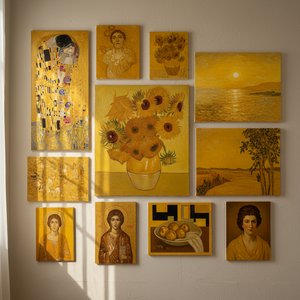
Die Top 10 berühmter Gemälde im Gelbocherton – Kunst für Ihr Zuhause |
Entdecken Sie die Top 10 berühmter Gemälde, dominiert von warmen Gelbochtönen! Von Van Gogh bis Monet – erfahren Sie die Geschichten hinter den Meisterwerken und lassen Sie sich für Ihre Wohnraumgestaltung inspirieren. Hochwertige Kunstdrucke auf

Op Art Unveiled: The Science of Optical Illusion and Kinetic Movement in Geometric Abstraction
Explore the science of Op Art through the lens of masters like Victor Vasarely. Discover how geometric abstraction uses optical illusions to create movement and delve into the neuroaesthetics of perception with our expert art history guide.

Mastering Illusion: The Vibrant World of Victor Vasarely's Op Art and the Geometry of Perception
Explore the mesmerizing world of Victor Vasarely. Discover how his Bauhaus-inspired Op Art masters the science of perception through geometric abstraction and vibrant color. A sophisticated guide for discerning art collectors seeking to understand the legacy of optical illusion.

Geometrische Abstraktion: Die 10 Meisterwerke, die Kunstgeschichte prägten | TopImpressionists.com
Entdecken Sie die 10 Meisterwerke der geometrischen Abstraktion! Von Kandinsky bis Mondrian – erleben Sie die Geschichte, Farben & Formen dieser revolutionären Kunstrichtung. Hochwertige Kunstreproduktionen auf TopImpressionists.com

Victor Vasarely: Pionier der Op Art und die Demokratisierung visueller Erfahrung
Entdecken Sie das faszinierende Werk von Victor Vasarely, dem Pionier der Op Art! Erfahren Sie mehr über seine künstlerischen Grundlagen, Prinzipien und seinen Einfluss auf die moderne Kunst. Jetzt bei TopImpressionists!
Entdecken Sie Kunstwerke, die nach Themen, Stilen und Merkmalen sortiert sind.


