

Gezeigt: · Inklusive Rahmen:
 Vorschau anzeigen
 Versenden
 Teilen
 Details anzeigen
 Leitfaden

 Herunterladen
 Ähnliche Objekte
 Röntgenaufnahme
 Diashow
 Fragen & Antworten
 Statistiken
- 40.0 x 34.0 cm


€ 239
Handgefertigte Ölreproduktion
Handgemaltes Ölgemälde auf Leinwand in Ihrer Wunschgröße und mit Rahmen, auf Bestellung von unseren Künstlern angefertigt. ( Zum Druck wechseln Zum digitalen Bild wechseln)
Größe
·Standardformat
individuell anpassbar
CM
INCH
Wählen Sie aus unseren vordefinierten Formaten, die den ursprünglichen Proportionen des Kunstwerks entsprechen.
Größen werden geladen...

Breite
Höhe
Geben Sie die Breite und die Höhe an, die Sie für Ihren Rahmen oder Ihre Wand benötigen. Da dieses Werk handgemalt ist, kann der Künstler bei einer anderen Form etwas mehr um das Bild herum malen oder etwas abschneiden – Sie entscheiden. Wir senden Ihnen ein digitales Mockup zur Freigabe, bevor mit dem Malen begonnen wird. Das auf dieser Seite gezeigte Bild stellt nicht das tatsächliche Ergebnis dar – dies tut nur das Mockup.
 Mehr erfahren
Abschließen
·
Weißer Rand €1

verlaufende Kanten €1

Umrandung €1

P118B €10

P118H €10

P118W €10

P438Z €10

P508JH €12

P508YH €12

P805H €10

P805Z €10

P919BZ €10

P919G €10

P919XJ €10

P959ZH €10

P968JZ €12

W106C €8

W218G €10

W218JH €8

W218Y €10

W307PJ €10

W316G €10

W316PJ €8

W316Y €10

W398PJ €8

W4111J €10

W500HY €15

W500JH €15

W692G €12

W849H €8

W940BG €15

W953PJ €8

H24-GOLD €30

H24-SILVER €30

H36-GOLD €45

H36-SILVER €45
Versand in einer Schutzröhre, bereit für die Rahmung durch Ihren Rahmenmacher.
Extras
optionalWas sind die Extras enthalten?
Beispiele für Anpassungsmöglichkeiten: Gesicht durch Kundenfoto ersetzen; Haustier hinzufügen (z. B. Katze durch Hund ersetzen); Versteckte Botschaft im Hintergrund einfügen; Hintergrundlandschaft oder Elemente ändern.
Nach der Bestellung wird das Team von TopImpressionists.com den Kunden per E-Mail kontaktieren, um Anweisungen einzuholen und eine Vorschau des Entwurfs bereitzustellen
Nach der Bestellung wird das Team von TopImpressionists.com den Kunden per E-Mail kontaktieren, um Anweisungen einzuholen und eine Vorschau des Entwurfs bereitzustellen
Weltweiter Versand () in nur 3 bis 4 Wochen statt der üblichen 5 Wochen. (15 November). Keine Kompromisse bei der Qualität.
Schutzlackierung
Beschriftung
Details der gravierten Bronzetafel
This elegant plaque features the artist's name and the title of the artwork, finely engraved for a timeless presentation.
It is made from bronze with a refined, elegant finish. The text is precisely laser-engraved for a sharp and permanent result. Measuring 9x2 cm, the plaque is compact yet easy to read. It's built to be durable and scratch-resistant, offering a professional, museum-quality look. Mounting is simple thanks to the included adhesive backing.
Details zur Acrylglas-Plakette (transparent)
The plaque includes essential engraved details such as the artist's name, the title of the artwork, the date it was created, the type of media used-like oil on canvas or watercolor-a brief description of the piece, and a QR code that links to the complete artwork information.
It is crafted from clear acrylic, offering a sleek, modern appearance. The text is UV-engraved in black to ensure strong visual contrast. With a size of 10x15 cm, it ensures optimal readability. It comes equipped with two metal hooks for secure wall mounting. The plaque is designed to be weather-resistant, making it suitable for various environments, and it includes interactive features that work seamlessly with smartphone scanning.
Details zur schwarzen Acryltafel
This elegant plaque includes engraved information such as the artist's name, the title of the artwork, the date it was created, the type of media used (like oil on canvas or watercolor), a short description of the artwork, and a QR code for quick access to more information.
The plaque itself is made from refined black acrylic with a premium finish. The text is laser-engraved in white for high contrast and readability. Its size is 10x15 cm, designed to be easy to read. It comes with two metal hooks for professional mounting. The design is sleek and fits any interior style. It is also weather-resistant and durable, with built-in digital integration for mobile compatibility.
Die Glasoption ist nur für Größen unter 110 cm verfügbar.
 Die Glasoption ist nur für Größen unter 110 cm verfügbar.
- Kostenloser weltweiter Expressversand
- Hochwertige Leinenleinwand
- Umfassender Versicherungsschutz beim Versand
- Zollgebühren-Rückerstattungsgarantie
- Garantie für exakte Farbtreue
- 100 Tage Rückgaberecht (nur bei Mängeln)
- 100% Geld-zurück-Garantie
- Mengenrabatt verfügbar


Beschreibung des Sammlerstücks
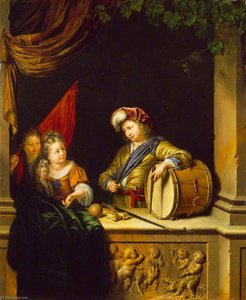
Erleben Sie ‚Der Gemüsehändler‘ von Willem van Mieris – ein fesselndes Ölgemälde aus dem Jahr 1731, das eine belebte Marktszene mit detailreicher Präzision und eleganter Komposition zeigt. Ein Meisterwerk des niederländischen Barock.
Künstlerbiografie
Willem van Mieris (1662-1747) war ein niederländischer Fijnschilder, bekannt für elegante Genreszenen und Porträts der Oberschicht. Als Meister des Details führte er die Leipziger Tradition mit seinem Vater fort.
Über das Gemälde
Ein Einblick in das tägliche Leben: Der Charme der niederländischen Genremalerei
Vor Willem van Mieris' Der Gemüsehändler zu stehen bedeutet, direkt in die lebendige und doch akribisch geordnete Welt des Leiden des 18. Jahrhunderts einzutauchen. Dieses Gemälde ist weit mehr als eine bloße Darstellung von Marktgeschäften; es ist ein sorgfältig komponiertes Tableau vivant, eine Feier des alltäglichen Daseins, die mit atemberaubender Präzision wiedergegeben wurde. Die Szene fängt zwei Figuren ein – einen Verkäufer, umgeben von üppigem Grün, und eine Frau, die ihren geflochtenen Korb hält – an einem, wie es scheint, belebten Obststand. Beachten Sie den Reichtum ihrer traditionellen Kleidung und das spürbare Gefühl von geschäftiger Betriebsamkeit, das die Luft erfüllt. Van Mieris, ein Meister der Fijnschilder-Tradition, lädt uns nicht nur zum Betrachten ein, sondern lässt uns am stillen Rhythmus dieses historischen Augenblicks teilhaben.
Meisterhaftigkeit im Kleinen: Technik und Detail
Was dieses Werk über eine einfache Genredokumentation hinaushebt, ist die schiere technische Virtuosität, die hier zur Schau gestellt wird. Van Mieris war berühmt für seine elegante Detailtreue, ein Markenzeichen, das er von der großen Leipziger Schule geerbt hatte. Beobachten Sie, wie das Licht die Rundung eines Apfels einfängt, der nahe am Stand liegt, oder wie die Falten in der Kleidung der Frau mit fast mikroskopischer Genauigkeit dargestellt sind. Die Einbeziehung scheinbar nebensächlicher Objekte – die sichtbaren Uhren, die sowohl oben als auch auf Bodenhöhe die Zeit markieren, der zarte Vorhang, der das Hintergrundfenster einrahmt – sind keine bloßen Füllsel. Sie sind kompositorische Anker, die den Blick tiefer in den erzählerischen Raum ziehen. Diese Hingabe zur kleinsten Beobachtung spricht Bände über die Widmung des Künstlers zum Realismus und verwandelt gewöhnliche Waren in Sujets, die der hohen Kunst würdig sind.
Die in die Szene eingewobene Symbolik
In der niederländischen Genremalerei ist nichts dem Zufall überlassen. Die am Stand präsentierte Fülle – das Gemüse und die Früchte – trug oft ein symbolisches Gewicht und repräsentierte Wohlstand, Nahrung oder die zyklische Natur des Lebens selbst. Das Vorhandensein mehrerer Uhren unterstreicht subtil das Vergehen der Zeit vor dem Hintergrund beständiger menschlicher Routine. Es deutet darauf an, dass Momente zwar schnell vergehen, aber der Handel, die Gemeinschaft und die Kunstfertigkeit des täglichen Lebens fortbestehen. Für den modernen Sammler oder Designer bietet dieses Gemälde eine tiefgründige Meditation über Vergänglichkeit versus Beständigkeit, alles eingefangen im warmen Glanz einer Öl Leinwand.
Den niederländischen Barock nach Hause bringen
Für all jene, die einen Raum mit der stillen Würde und der reichen erzählerischen Tiefe des Goldenen Zeitalters der Niederlande bereichern möchten, ist Der Gemüsehändler eine unvergleichliche Wahl. Seine Komposition balanciert Intimität mit Grandiosität und eignet sich daher hervorragend für Wohnzimmer oder anspruchsvolle Essbereiche. Der Besitz einer Reproduktion ermöglicht es, ein Stück Geschichte zu besitzen – eine greifbare Verbindung zur akribischen Handwerkskunst und zum Humanismus, die diese Epoche prägten. Es flüstert Geschichten von Marktschreien und häuslichem Leben und bietet nicht nur Dekoration, sondern einen Anlass zum Gespräch.
Fragen & Antworten
Aus welcher Schaffensperiode von Willem Van Mieris stammt "Der Gemüsehändler"?
Innerhalb der Schaffensperiode von Willem Van Mieris lässt sich „Der Gemüsehändler“ der Spätwerk zuordnen. Diese Phase ermöglicht einen Vergleich mit anderen Werken des Künstlers.
Wie verbinden sich Medium und Bewegung in "Der Gemüsehändler"?
"Der Gemüsehändler" ist in Öl auf Leinwand im Stil der Niederländisches Goldenes Zeitalter-Epoche gefertigt.
Welchem Künstler wird "Der Gemüsehändler" zugeschrieben?
Der Künstler hinter „Der Gemüsehändler“ ist Willem Van Mieris. Das Werk ist unter dem Namen von Willem Van Mieris katalogisiert.
Kurzinfos und Kunst-Quiz
Über Willem Van Mieris

Willem Van Mieris
1662 - 1747, Niederlande
Künstlerbiografie
Willem van Mieris (1662 - 1747): The Master of Elegant Detail
Willem van Mieris (1662-1747) stands as a pivotal figure in the Leiden fijnschilders’ movement, embodying the culmination of Dutch Baroque artistic ideals. Born in Leiden on June 3rd, 1662, he descended from a lineage steeped in artistic tradition—his father, Frans van Mieris the Elder (1635-1681), was himself a celebrated genre painter who had established a formidable reputation for capturing the nuances of upper-class society. This familial legacy profoundly shaped Willem’s formative years and instilled within him an unwavering dedication to upholding his father's esteemed position as Leiden’s foremost fijnschilder—a commitment that would define his entire artistic career.- Early Training & Influences:
- Frans van Mieris the Elder’s profound impact on Willem’s technique and aesthetic sensibilities cannot be overstated. Guided by the tutelage of his father, Willem honed his skills under the watchful eye of Gerrit Dou (1613-1675), a master of chiaroscuro and meticulous observation—a stylistic approach that would become synonymous with Leiden fijnschilders.
The Leiden Tradition & Pieter Post’s Vision
Willem van Mieris's artistic trajectory was inextricably linked to the broader intellectual currents of his time. The influence of Pieter Post (1659-1734), a Dutch art theoretician and humanist, proved particularly transformative. Post championed the notion that genre painters should transcend mere representation—rather, they ought to elevate their subjects through classical ideals of beauty and proportion. This conviction spurred Willem to meticulously analyze sculptural masterpieces from antiquity, incorporating their compositional principles into his paintings.A Career Defined by Patronage & Artistic Innovation
Willem’s professional life unfolded amidst a landscape of considerable artistic patronage—he secured commissions from prominent figures such as Madam Oortmans and Pieter de la Court van der Voort, cementing his reputation as one of Leiden's most sought-after artists. Notably, he served as Dean of the Guild of Saint Luke in 1693, demonstrating not only his artistic prowess but also his engagement with the intellectual and social fabric of Leiden.Style & Technique: The Pursuit of Perfection
Willem van Mieris’s distinctive style—characterized by an unparalleled attention to detail and a masterful command of chiaroscuro—represented the apex of Leiden fijnschilders' artistic ambition. Like his father, Willem meticulously studied the works of Gerrit Dou, adopting his technique and stylistic approach. He skillfully rendered textures and surfaces with remarkable accuracy, capturing subtle nuances that breathed life into his subjects. Furthermore, he frequently employed classical poses borrowed from sculptures by Francis van Bossuit—a deliberate gesture aimed at elevating genre painting to the level of monumental art.Legacy & Historical Significance
Willem van Mieris’s oeuvre comprises a vast collection of genre scenes and portraits, reflecting the tastes and sensibilities of his era. His paintings offer invaluable insights into Dutch society during the Baroque period—depicting opulent interiors, refined costumes, and psychologically astute portrayals of human character. Willem's enduring influence extends beyond his artistic achievements; he established Leiden’s Drawing Academy alongside Jacob Toorenvliet and Carel de Moor, fostering a new generation of artists committed to upholding the Leiden tradition—a legacy that continues to resonate within Dutch art history today.Kurzinfos zu Willem Van Mieris
- Artistic Movement Or Style: Fijnschilders
- Artists Or Movements Influenced By This Artist: ['Antike Skulptur']
- Artists Who Influenced This Artist:
- Gerard Dou
- Frans van Mieris der Ältere
- Date Of Birth: Leiden, Niederlande (1662)
- Date Of Death: 1747
- Full Name: Willem van Mieris
- Nationality: Niederländisch
- Notable Artworks:
- Die Kartoffelesser
- Allegorie der Vergänglichkeit
- Place Of Birth: Leiden




Entdecken Sie Kunstwerke, die nach Themen, Stilen und Merkmalen sortiert sind.




Willem Van Mieris
Der Gemüsehändler
() ·
Inklusive Rahmen: · Handgemalt mit Öl auf Leinen
Gesamtbetrag