


 Vorschau anzeigen
 Versenden
 Teilen
 Details anzeigen
 Leitfaden

 Herunterladen
 Ähnliche Objekte
 Röntgenaufnahme
 Diashow
 Statistiken
Children Roller Skating


William Glackens' "Children Roller Skating" (1918) captures a lively street scene of kids enjoying their pastime, showcasing the artist’s signature realism and vibrant style.
 Weiterlesen
Entdecken Sie William James Glackens (1870-1938), Pionier der Ashcan School! Realistische Gemälde des frühen 20. Jh., die New York & Paris mit Detail zeigen.
Handgefertigte Ölreproduktion
Handgemaltes Ölgemälde auf Leinwand in Ihrer Wunschgröße und mit Rahmen, auf Bestellung von unseren Künstlern angefertigt. ( Zum Druck wechseln Zum digitalen Bild wechseln)




P118B €10

P118H €10

P118W €10

P438Z €10

P508JH €12

P508YH €12

P805H €10

P805Z €10

P919BZ €10

P919G €10

P919XJ €10

P959ZH €10

P968JZ €12

W106C €8

W218G €10

W218JH €8

W218Y €10

W307PJ €10

W316G €10

W316PJ €8

W316Y €10

W398PJ €8

W4111J €10

W500HY €15

W500JH €15

W692G €12

W849H €8

W940BG €15

W953PJ €8




Standardformat
individuell anpassbar
CM
INCH
Wählen Sie aus unseren vordefinierten Formaten, die den ursprünglichen Proportionen des Kunstwerks entsprechen.
Loading sizes...

Breite
Höhe
Geben Sie die Breite und die Höhe an, die Sie für Ihren Rahmen oder Ihre Wand benötigen. Da dieses Werk handgemalt ist, kann der Künstler bei einer anderen Form etwas mehr um das Bild herum malen oder etwas abschneiden – Sie entscheiden. Wir senden Ihnen ein digitales Mockup zur Freigabe, bevor mit dem Malen begonnen wird. Das auf dieser Seite gezeigte Bild stellt nicht das tatsächliche Ergebnis dar – dies tut nur das Mockup.
Beispiele für Anpassungsmöglichkeiten: Gesicht durch Kundenfoto ersetzen; Haustier hinzufügen (z. B. Katze durch Hund ersetzen); eine versteckte Nachricht im Hintergrund einfügen; Hintergrundlandschaft oder -elemente ändern.
Nach der Bestellung wird das TopImpressionists.com-Team dem Kunden Anweisungen per E-Mail zusenden und eine Mockup-Vorschau bereitstellen.
Nach der Bestellung wird das TopImpressionists.com-Team dem Kunden Anweisungen per E-Mail zusenden und eine Mockup-Vorschau bereitstellen.
Weltweiter Versand () in nur 3 bis 4 Wochen statt der üblichen 5 Wochen. (26 Oktober). Keine Kompromisse bei der Qualität.

Kostenloser weltweiter Expressversand

Hochwertige Leinenleinwand

Umfassender Versicherungsschutz beim Versand

Zollgebühren-Rückerstattungsgarantie

Garantie für exakte Farbtreue

100 Tage Rückgaberecht (nur bei Mängeln)

100% Geld-zurück-Garantie

Mengenrabatt verfügbar
 Die Glasoption ist nur für Größen unter 110 cm verfügbar.

Children Roller Skating
Art der Reproduktion
Format der Reproduktion
-


Endpreis
€ 236
William James Glackens’ “Children Roller Skating” – A Snapshot of Urban Joy
“Children Roller Skating,” painted in 1918 by William James Glackens, isn't merely a depiction of children enjoying an afternoon pastime; it’s a vibrant distillation of early 20th-century American life—a fleeting moment of unadulterated joy captured amidst the grit and bustle of New York City. Glackens, a key figure in the Ashcan School movement, rejected the idealized portrayals favored by the National Academy of Design, instead choosing to focus on the realities of everyday existence, often portraying it with a distinctive, almost frenetic energy. This painting exemplifies his talent for imbuing ordinary scenes with an extraordinary sense of life and movement.
The scene unfolds on a busy city street, likely in Greenwich Village, a neighborhood known for its bohemian spirit during this period. A group of children, rendered in Glackens’ characteristic bold brushstrokes and rich, dark palette, are engaged in spirited roller skating. Their faces are alight with laughter and excitement, their limbs moving with an infectious energy that spills out onto the canvas. The composition is dynamic—a swirling mass of movement and color—reflecting the lively atmosphere of the street. Glackens masterfully uses loose brushwork to convey a sense of spontaneity and immediacy, as if he’s capturing the scene in real-time.
A Window into the Ashcan School
Glackens' work is deeply rooted in the principles of the Ashcan School, an artistic movement that emerged in New York City around 1908. Rejecting the polished surfaces and mythological subjects favored by academic art, the Ashcan artists sought to portray the realities of urban life—the crowded streets, the working-class neighborhoods, and the everyday struggles of ordinary people. Glackens’ “Children Roller Skating” perfectly embodies this ethos. It's a far cry from the carefully staged portraits that dominated the art world at the time; instead, it offers an unfiltered glimpse into the lives of New Yorkers.
The painting’s style is distinctly American—a blend of realism and impressionism. Glackens employs a vibrant color palette, using dark blues, greens, and browns to create a sense of depth and atmosphere. He also utilizes broken brushstrokes and contrasting colors to capture the movement and energy of the scene. The figures are not rendered with meticulous detail but rather suggested through loose brushwork and expressive gestures. This technique contributes to the painting’s overall dynamism and immediacy.
Symbolism and Context
Beyond its immediate depiction of children roller skating, the painting carries a subtle layer of symbolism. Roller skating was a popular pastime in early 20th-century America, particularly among young people. It represented freedom, recreation, and a break from the constraints of Victorian society. The scene captures a moment of carefree joy—a reminder that even amidst the challenges of urban life, there is always room for laughter and play.
Furthermore, the painting reflects the changing social landscape of New York City at the turn of the century. The city was undergoing rapid industrialization and urbanization, leading to overcrowding, poverty, and social unrest. However, despite these challenges, there was also a sense of optimism and progress—a belief in the potential for a brighter future. “Children Roller Skating” captures this duality—the juxtaposition of hardship and hope, chaos and joy.
A Timeless Image of American Life
“Children Roller Skating” is more than just a painting; it’s a snapshot of a bygone era—a vibrant testament to the spirit of New York City in 1918. Glackens' masterful use of color, brushwork, and composition creates an image that is both captivating and emotionally resonant. It invites us to step back in time and experience the joy and energy of a group of children roller skating on a busy city street. Reproductions of this work offer a beautiful way to bring a piece of American history into your home or office, reminding us of the simple pleasures of life and the enduring power of art.
Fragen & Antworten
Sind die Farben von "Children Roller Skating" von William James Glackens leuchtend oder eher dezent?
Die Farben von "Children Roller Skating" von William James Glackens bestechen durch eine Clear Color Presence Sättigung und eine Vivid Intensität.
Welche Farbe sticht in "Children Roller Skating" am meisten hervor?
Walnut (#705535) ist die dominierende Farbe von "Children Roller Skating" von William James Glackens.
Welches Gefühl wird mit "Children Roller Skating" assoziiert?
"Children Roller Skating" von William James Glackens vermittelt eine Nostalgic emotionale Stimmung.
Ähnliche Kunstwerke


Künstlerbiografie
Ein Pionier der Ashcan School
William James Glackens, eine bedeutende Figur in der amerikanischen Kunst, hinterließ mit seinen fesselnden realistischen Gemälden einen bleibenden Eindruck auf die Leinwand der Geschichte. Geboren 1870 in Philadelphia, Pennsylvania, war Williams künstlerische Reise ein Beweis für seine unerschütterliche Leidenschaft, das Wesen des täglichen Lebens einzufangen.Frühes Leben und Einflüsse
Glackens' frühe Jahre waren von einer angeborenen Neigung zur Kunst geprägt, was ihn dazu veranlasste, sich an der Pennsylvania Academy of the Fine Arts einzuschreiben. Unter der Anleitung von Thomas Anshutz, einem renommierten Realisten, verfeinerte Glackens seine Fähigkeiten und wurde schließlich einer der Gründer der Ashcan School. Diese Bewegung lehnte die konventionellen Grenzen künstlerischer Schönheit ab und konzentrierte sich stattdessen auf die rauen Realitäten des städtischen Lebens.Künstlerische Laufbahn
Glackens' Werk zeichnet sich durch seine dunkel getönten, lebhaft gemalten Straßenszenen und Darstellungen des täglichen Lebens im vorwendezeitlichen New York und Paris aus. Seine späteren Werke, die von Renoir beeinflusst waren, zeigten einen helleren Ton, der sein Wachstum als Künstler widerspiegelte. Bemerkenswert ist, dass Glackens auch als Illustrator für Zeitungen und Zeitschriften in Philadelphia und New York City arbeitete.- View of Haarlem with Bleaching Grounds, ein Gemälde von Jacob Isaakszoon van Ruisdael (Ruisdael), veranschaulicht das Maß an Detailgenauigkeit und Handwerkskunst, das Glackens' Werk definiert. Dieses Stück befindet sich jetzt in der Sammlung des Chrysler Museum of Art.
- Glackens' eigenes Meisterwerk, The Shoppers, ist ein Beweis für seine Fähigkeit, das Wesen des Stadtlebens einzufangen. Dieses Gemälde befindet sich in der New Realism-Kollektion auf TopImpressionists.com.
Vermächtnis und Bedeutung
Glackens' Beiträge zur amerikanischen Kunst sind vielschichtig und gehen über seine eigenen Werke hinaus. Er spielte eine entscheidende Rolle bei der Unterstützung von Albert C. Barnes beim Ankauf europäischer Gemälde für die Barnes Foundation in Philadelphia. Diese Sammlung ist zu einem Eckpfeiler der amerikanischen Kunstgeschichte geworden. Wichtige Werke und Sammlungen: * The Shoppers (New Realism, Öl auf Leinwand, Chrysler Museum of Art) * View of Haarlem with Bleaching Grounds (Ruisdael, Sforza Castle, Mailand, Italien) Empfohlene Lektüre: * [https://TopImpressionists.com/@/william-james-glackens](https://TopImpressionists.com/@/william-james-glackens) - Entdecken Sie die umfangreiche Sammlung von Glackens' Werken auf TopImpressionists.com. * [https://en.wikipedia.org/wiki/william_glackens](https://en.wikipedia.org/wiki/william_glackens) - Tauchen Sie ein in die detaillierte Biografie von William James Glackens auf Wikipedia.
William James Glackens
1870 - 1938 , Vereinigte Staaten von Amerika
Kurzinfos
- Bemerkenswerte Kunstwerke:
- The Shoppers
- View of Haarlem with Bleaching Grounds
- Geburtsdatum: 1870
- Geburtsort (Stadt Und Land): Philadelphia, USA
- Künstler Oder Bewegungen, Von Denen Dieser Künstler Beeinflusst Wurde: ['Ashcan School']
- Künstler, Die Diesen Künstler Beeinflussten:
- Thomas Anshutz
- Renoir
- Künstlerische Bewegung Oder Stil: Ashcan School, Realismus
- Nationalität: Amerikanisch
- Sterbedatum: 1938
- Vollständiger Name: William James Glackens
Ähnliche Artikel

Capturing the Light: A Journey Through the Soul of American Impressionism and the Hudson River School
Explore the luminous beauty of American Impressionism and the Hudson River School. Discover a curated journey through light, landscape, and history, celebrating the enduring legacy of masters through exquisite, hand-painted oil reproductions for the discerning art lover.
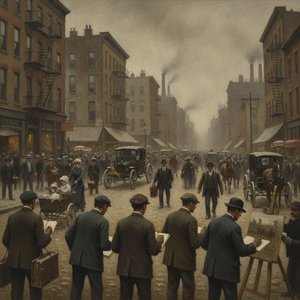
The Ashcan School: Capturing the Raw, Unfiltered Soul of Urban Life through American Realism
Discover the raw beauty of the Ashcan School. Explore how masters like Bellows and Henri captured the gritty, vibrant soul of early 20th-century New York through profound American Realism and evocative urban landscapes.

The Unvarnished Truth: A Cultural Journey Through the Soul of American Realism
Explore the profound beauty of American Realism. From the Ashcan School's urban grit to intimate portraits, discover how artists captured the authentic soul of a nation through unvarnished truth and masterful observation.
Entdecken Sie Kunstwerke, die nach Themen, Stilen und Merkmalen sortiert sind.


